mirror of
https://github.com/mrdbourke/pytorch-deep-learning.git
synced 2026-11-27 06:07:09 +00:00
some more typos
This commit is contained in:

1 file changed
+5
-5
@@ -793,7 +793,7 @@
|
||||
"\n",
|
||||
"| Function | What does it do? | Where does it live in PyTorch? | Common values |\n",
|
||||
"| ----- | ----- | ----- | ----- |\n",
|
||||
"| **Loss function** | Measures how wrong your models predictions (e.g. `y_preds`) are compared to the truth labels (e.g. `y_test`). Lower the better. | PyTorch has plenty of built-in loss functions in [`torch.nn`](https://pytorch.org/docs/stable/nn.html#loss-functions). | Mean absolute error (MAE) for regression problems ([`torch.nn.L1Loss()`](https://pytorch.org/docs/stable/generated/torch.nn.L1Loss.html)). Binary cross entropy for binary classification problems ([`torch.nn.BCELoss()`](https://pytorch.org/docs/stable/generated/torch.nn.BCELoss.html)). |\n",
|
||||
"| **Loss function** | Measures how wrong your model's predictions (e.g. `y_preds`) are compared to the truth labels (e.g. `y_test`). Lower the better. | PyTorch has plenty of built-in loss functions in [`torch.nn`](https://pytorch.org/docs/stable/nn.html#loss-functions). | Mean absolute error (MAE) for regression problems ([`torch.nn.L1Loss()`](https://pytorch.org/docs/stable/generated/torch.nn.L1Loss.html)). Binary cross entropy for binary classification problems ([`torch.nn.BCELoss()`](https://pytorch.org/docs/stable/generated/torch.nn.BCELoss.html)). |\n",
|
||||
"| **Optimizer** | Tells your model how to update its internal parameters to best lower the loss. | You can find various optimization function implementations in [`torch.optim`](https://pytorch.org/docs/stable/optim.html). | Stochastic gradient descent ([`torch.optim.SGD()`](https://pytorch.org/docs/stable/generated/torch.optim.SGD.html#torch.optim.SGD)). Adam optimizer ([`torch.optim.Adam()`](https://pytorch.org/docs/stable/generated/torch.optim.Adam.html#torch.optim.Adam)). | \n",
|
||||
"\n",
|
||||
"Let's create a loss function and an optimizer we can use to help improve our model.\n",
|
||||
@@ -843,14 +843,14 @@
|
||||
"\n",
|
||||
"The training loop involves the model going through the training data and learning the relationships between the `features` and `labels`.\n",
|
||||
"\n",
|
||||
"The testing loop involves going through the testing data and evaluating how good the patterns are that the model learned on the training data (the model never see's the testing data during training).\n",
|
||||
"The testing loop involves going through the testing data and evaluating how good the patterns are that the model learned on the training data (the model never sees the testing data during training).\n",
|
||||
"\n",
|
||||
"Each of these is called a \"loop\" because we want our model to look (loop through) at each sample in each dataset.\n",
|
||||
"\n",
|
||||
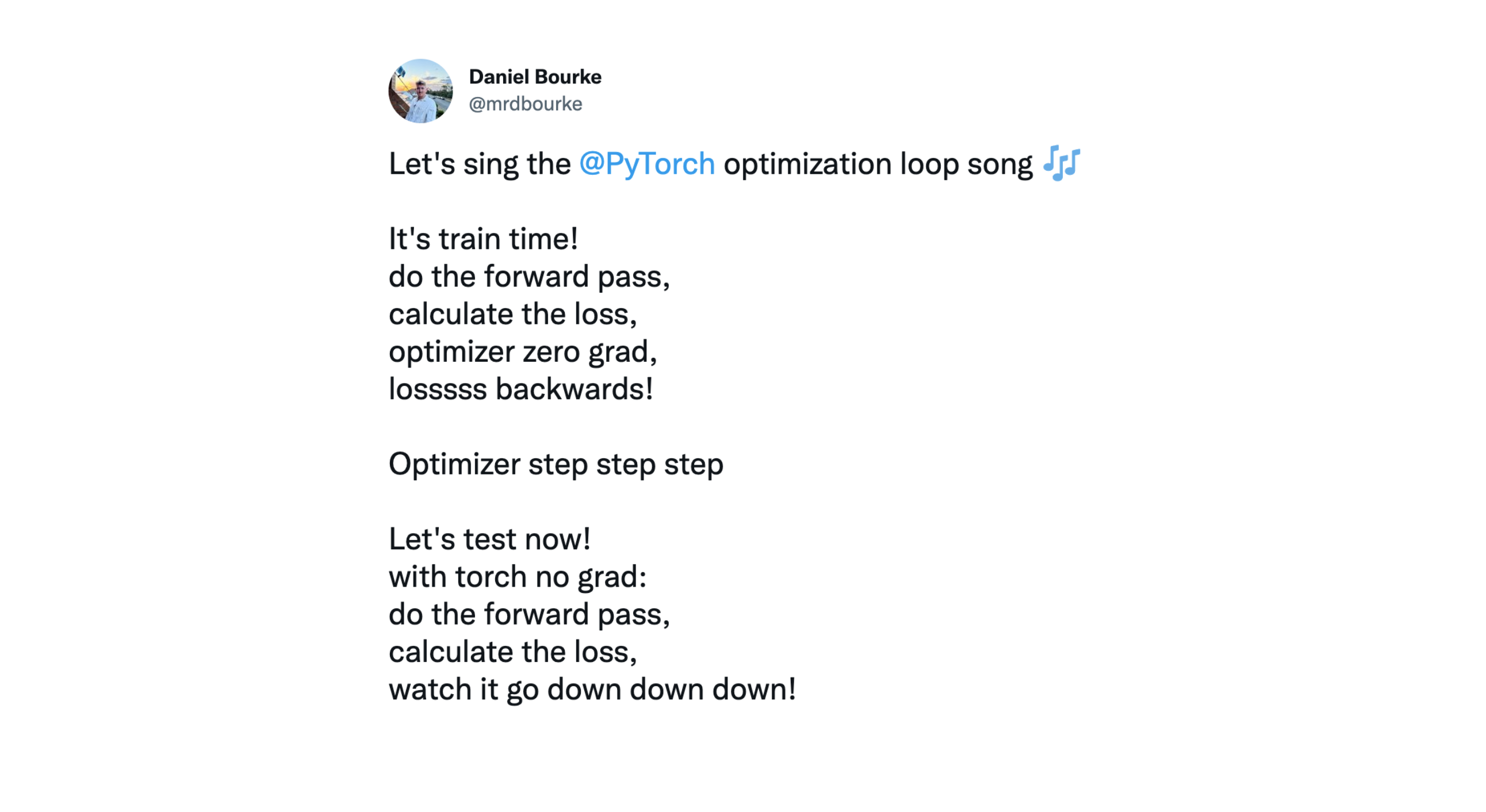
"To create these we're going to write a Python `for` loop in the theme of the [unofficial PyTorch optimization loop song](https://twitter.com/mrdbourke/status/1450977868406673410?s=20) (there's a [video version too](https://youtu.be/Nutpusq_AFw)).\n",
|
||||
"\n",
|
||||
"\n",
|
||||
"*The unoffical PyTorch optimization loops song, a fun way to remember the steps in a PyTorch training (and testing) loop.*\n",
|
||||
"*The unofficial PyTorch optimization loops song, a fun way to remember the steps in a PyTorch training (and testing) loop.*\n",
|
||||
"\n",
|
||||
"There will be a fair bit of code but nothing we can't handle.\n"
|
||||
]
|
||||
@@ -901,7 +901,7 @@
|
||||
"| ----- | ----- | ----- | ----- |\n",
|
||||
"| 1 | Forward pass | The model goes through all of the testing data once, performing its `forward()` function calculations. | `model(x_test)` |\n",
|
||||
"| 2 | Calculate the loss | The model's outputs (predictions) are compared to the ground truth and evaluated to see how wrong they are. | `loss = loss_fn(y_pred, y_test)` | \n",
|
||||
"| 3 | Calulate evaluation metrics (optional) | Alongisde the loss value you may want to calculate other evaluation metrics such as accuracy on the test set. | Custom functions |\n",
|
||||
"| 3 | Calulate evaluation metrics (optional) | Alongside the loss value you may want to calculate other evaluation metrics such as accuracy on the test set. | Custom functions |\n",
|
||||
"\n",
|
||||
"Notice the testing loop doesn't contain performing backpropagation (`loss.backward()`) or stepping the optimizer (`optimizer.step()`), this is because no parameters in the model are being changed during testing, they've already been calculated. For testing, we're only interested in the output of the forward pass through the model.\n",
|
||||
"\n",
|
||||
@@ -1047,7 +1047,7 @@
|
||||
"\n",
|
||||
"Well, thanks to our loss function and optimizer, the model's internal parameters (`weights` and `bias`) were updated to better reflect the underlying patterns in the data.\n",
|
||||
"\n",
|
||||
"Let's inspect our model's [`.state_dict()`](https://pytorch.org/tutorials/recipes/recipes/what_is_state_dict.html) to see see how close our model gets to the original values we set for weights and bias.\n",
|
||||
"Let's inspect our model's [`.state_dict()`](https://pytorch.org/tutorials/recipes/recipes/what_is_state_dict.html) to see how close our model gets to the original values we set for weights and bias.\n",
|
||||
"\n"
|
||||
]
|
||||
},
|
||||
|
||||
Reference in new issue
Block a user