mirror of
https://github.com/mrdbourke/pytorch-deep-learning.git
synced 2026-11-27 06:07:09 +00:00
update docs
This commit is contained in:
 Daniel Bourke committed
1 parent
ec2bdba930
commit
136f405f27
12 files changed
+20045
-4356
No files matched your search
File renamed without changes.
+1876
-736
File diff suppressed because it is too large.
Load diff
File diff suppressed because it is too large.
Load diff
+2426
-1185
File diff suppressed because it is too large.
Load diff
+3870
-1568
File diff suppressed because it is too large.
Load diff
File diff suppressed because it is too large.
Load diff
+3372
-838
File diff suppressed because it is too large.
Load diff
@@ -0,0 +1,804 @@
|
||||
# TODO: Going modular
|
||||
|
||||
In this section we're going to turn notebook 04 into a series of Python scripts saved to a directory called [`going_modular`](https://github.com/mrdbourke/pytorch-deep-learning/tree/main/going_modular).
|
||||
|
||||
This document will describe those steps.
|
||||
|
||||
Afterwards we can reuse the same code in the scripts in the next notebook (06. Transfer Learning).
|
||||
|
||||
## TK - What is going modular?
|
||||
|
||||
Going modular involves turning notebook code (from a Jupyter Notebook or Google Colab notebook) into a series of different Python scripts that offer similar functionality.
|
||||
|
||||
For example, we'd turn our notebook code from a series of cells into the following files:
|
||||
* `data_setup.py` - a file to prepare and download data if needed.
|
||||
* `engine.py` - a file containing various training functions.
|
||||
* `model_builder.py` or `model.py` - a file to create a PyTorch model.
|
||||
* `train.py` - a file to leverage all other files and train a target PyTorch model.
|
||||
* `utils.py` - a file dedicated to helpful utility functions.
|
||||
|
||||
> **Note:** The naming and layout of the above files will depend on your use case and code requirements. Python scripts are as general as individual notebook cells, meaning, you could create one for almost any kind of functionality.
|
||||
|
||||
## TK - Why would you want to go modular?
|
||||
|
||||
Notebooks are fantastic for iteratively exploring and running experiments quickly.
|
||||
|
||||
However, for larger scale projects you may find Python scripting more reproducible and easier to run.
|
||||
|
||||
Though this is a debated topic, as companies like [Netflix have shown they can use notebooks for production code](https://netflixtechblog.com/notebook-innovation-591ee3221233).
|
||||
|
||||
**Production code** is code that runs to offer a service to someone or something.
|
||||
|
||||
For example, if you have an app running online that other people can access and use, the code running that app is considered **production code**.
|
||||
|
||||
And libraries like fast.ai's [`nb-dev`](https://github.com/fastai/nbdev) (short for notebook development) enable you to write whole Python libraries (including documentation) with Jupyter Notebooks.
|
||||
|
||||
### Pros and cons of notebooks vs Python scripts
|
||||
|
||||
There's arguments for both sides.
|
||||
|
||||
But this list sums up a few of the main topics.
|
||||
|
||||
| | **Pros** | **Cons** |
|
||||
| ----- | ----- | ----- |
|
||||
| **Notebooks** | Easy to experiment/get started | Versioning can be hard |
|
||||
| | Easy to share (e.g. a link to a Google Colab notebook) | Hard to use only specific parts |
|
||||
| | Very visual | Text and graphics can get in the way of code |
|
||||
| | | |
|
||||
| **Python scripts** | Can package code together (saves rewriting similar code across different notebooks) | Experimenting isn't as visual/have to run the whole script (rather than one cell) |
|
||||
| | Can use git for versioning | |
|
||||
| | Many open source projects use scripts | |
|
||||
| | Larger projects can be run on cloud vendors (not as much support for notebooks) | |
|
||||
|
||||
### My workflow
|
||||
|
||||
I start ML projects in Jupyter/Google Colab notebooks for quick experimentation and visualization.
|
||||
|
||||
Then when I've got something working, I move to Python scripts.
|
||||
|
||||
* TK image - workflow: notebooks/Google Colab -> Python Scripts
|
||||
|
||||
### PyTorch in the wild
|
||||
|
||||
In your travels, you'll see many code repositories for PyTorch-based ML projects have instructions on how to run the PyTorch code in the form of Python scripts.
|
||||
|
||||
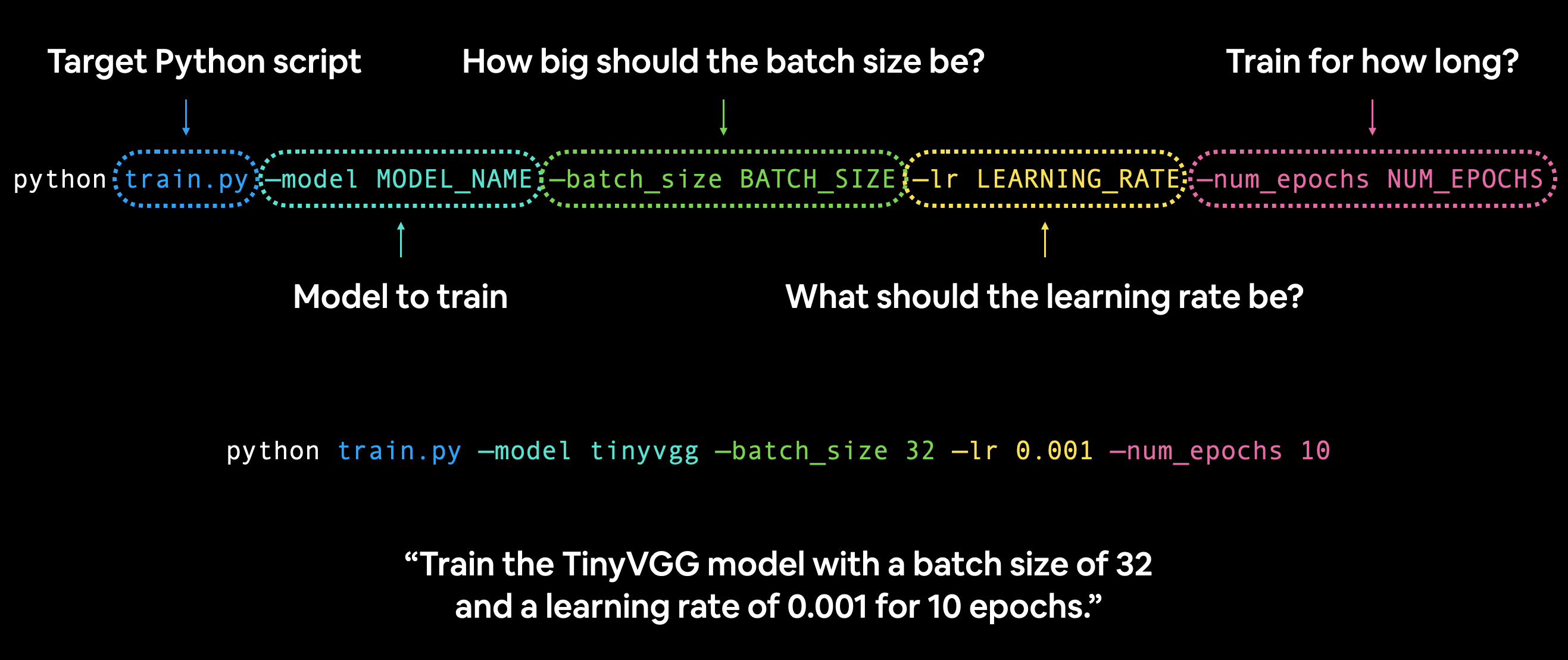
For example, you might be instructred to run code like the following in a terminal/command line to train a model:
|
||||
|
||||
```
|
||||
python train.py --model MODEL_NAME --batch_size BATCH_SIZE --lr LEARNING_RATE --num_epochs NUM_EPOCHS
|
||||
```
|
||||
|
||||
|
||||
* TK - caption above/make smaller with <img> tag
|
||||
|
||||
In this case, `train.py` is the target Python script, it'll likely contain functions to train a PyTorch model.
|
||||
|
||||
And `--model`, `--batch_size`, `--lr` and `--num_epochs` are known as argument flags.
|
||||
|
||||
You can set these to whatever values you like and if they're compatible with `train.py`, they'll work, if not, they'll error.
|
||||
|
||||
For example, let's say we wanted to train our TinyVGG model for 10 epochs with a batch size of 32 and a learning rate of 0.001:
|
||||
|
||||
```
|
||||
python train.py --model tinyvgg --batch_size 32 --lr 0.001 --num_epochs 10
|
||||
```
|
||||
|
||||
You could setup any number of these argument flags in your `train.py` script to suit your needs.
|
||||
|
||||
The PyTorch blog post for training state-of-the-art computer vision models uses this style.
|
||||
|
||||
TK image for PyTorch blog post training code - https://pytorch.org/blog/how-to-train-state-of-the-art-models-using-torchvision-latest-primitives/#break-down-of-key-accuracy-improvements
|
||||
|
||||
## TK - What we'ere going to cover
|
||||
|
||||
The main concept of this section is: **Turn useful notebook code cells into reusable Python files.**
|
||||
|
||||
Doing this will save us in the future writing the save code over and over again.
|
||||
|
||||
There are two notebooks for this section:
|
||||
|
||||
More specifically, the two parts are:
|
||||
1. [**05. Going Modular: Part 1 (cell mode)**](https://github.com/mrdbourke/pytorch-deep-learning/blob/main/going_modular/05_pytorch_going_modular_cell_mode.ipynb) - this notebook is run as a traditional Jupyter Notebook/Google Colab notebook and is a condensed version of [notebook 04](https://www.learnpytorch.io/04_pytorch_custom_datasets/).
|
||||
2. [**05. Going Modular: Part 2 (script mode)**](https://github.com/mrdbourke/pytorch-deep-learning/blob/main/going_modular/05_pytorch_going_modular_script_mode.ipynb) - this notebook is the same as number 1 but with added functionality to turn each of the major sections into Python scripts, such as, `data_setup.py` and `train.py`.
|
||||
|
||||
### Why two parts?
|
||||
|
||||
Because sometimes the best way to learn something is to see how it *differs* from something else.
|
||||
|
||||
If you run each notebook side-by-side you'll see how they differ and that's where the key learnings are.
|
||||
|
||||
The text in this document focuses on 05. Going Modular: Part 2 (script mode).
|
||||
|
||||
* TK image - run 05 part 1 and 05 part 2 side-by-side and show a point of difference
|
||||
|
||||
### What we're working towards
|
||||
|
||||
By the end of this section we want to have two things:
|
||||
|
||||
1. The ability to train the model we built in notebook 04 (Food Vision Mini) with one line of code:
|
||||
|
||||
```
|
||||
python train.py
|
||||
```
|
||||
|
||||
2. A directory structure of reusable Python scripts, such as:
|
||||
|
||||
```
|
||||
going_modular/
|
||||
├── going_modular/
|
||||
│ ├── data_setup.py
|
||||
│ ├── engine.py
|
||||
│ ├── model_builder.py
|
||||
│ ├── train.py
|
||||
│ └── utils.py
|
||||
├── models/
|
||||
│ ├── 05_going_modular_cell_mode_tinyvgg_model.pth
|
||||
│ └── 05_going_modular_script_mode_tinyvgg_model.pth
|
||||
└── data/
|
||||
└── pizza_steak_sushi/
|
||||
├── train/
|
||||
│ ├── pizza/
|
||||
│ │ ├── image01.jpeg
|
||||
│ │ └── ...
|
||||
│ ├── steak/
|
||||
│ └── sushi/
|
||||
└── test/
|
||||
├── pizza/
|
||||
├── steak/
|
||||
└── sushi/
|
||||
```
|
||||
|
||||
### Things to note
|
||||
|
||||
* **Docstrings** - Writing reproducible and understandable code is important. And with this in mind, each of the functions/classes we'll be putting into scripts has been created with Google's [Python docstring style in mind](https://google.github.io/styleguide/pyguide.html#383-functions-and-methods).
|
||||
* **Imports at the top of scripts** - Since all of the Python scripts we're going to create could be considered a small program on their own, all of the scripts require their input modules be imported at the start of the script for example:
|
||||
|
||||
```python
|
||||
# Import modules required for train.py
|
||||
import os
|
||||
import torch
|
||||
import data_setup, engine, model_builder, utils
|
||||
|
||||
from torchvision import transforms
|
||||
```
|
||||
|
||||
## TK - Where can you get help?
|
||||
|
||||
All of the materials for this course [are available on GitHub](https://github.com/mrdbourke/pytorch-deep-learning).
|
||||
|
||||
If you run into trouble, you can ask a question on the course [GitHub Discussions page](https://github.com/mrdbourke/pytorch-deep-learning/discussions).
|
||||
|
||||
And of course, there's the [PyTorch documentation](https://pytorch.org/docs/stable/index.html) and [PyTorch developer forums](https://discuss.pytorch.org/), a very helpful place for all things PyTorch.
|
||||
|
||||
## TK - 0. Cell mode vs. script mode
|
||||
|
||||
A cell mode notebook such as [05. Going Modular Part 1 (cell mode)](https://github.com/mrdbourke/pytorch-deep-learning/blob/main/going_modular/05_pytorch_going_modular_cell_mode.ipynb) is a notebook run normally, each cell in the notebook is either code or markdown.
|
||||
|
||||
A script mode notebook such as [05. Going Modular Part 2 (script mode)](https://github.com/mrdbourke/pytorch-deep-learning/blob/main/going_modular/05_pytorch_going_modular_script_mode.ipynb) is very similar to a cell mode notebook, however, many of the code cells may be turned into Python scripts.
|
||||
|
||||
> **Note:** You don't need to create Python scripts via a notebook, you can create them directly through an IDE (integrated developer environment) such as [VS Code](https://code.visualstudio.com/). Having the script mode notebook as part of this section is just to demonstrate one way of going from notebooks to Python scripts.
|
||||
|
||||
## TK - 1. Get data
|
||||
|
||||
Getting the data in each of the 05 notebooks happens the same as in [notebook 04](https://www.learnpytorch.io/04_pytorch_custom_datasets/#1-get-data).
|
||||
|
||||
A call is made to GitHub via Python's `requests` module to download a `.zip` file and unzip it.
|
||||
|
||||
```python
|
||||
import os
|
||||
import requests
|
||||
import zipfile
|
||||
from pathlib import Path
|
||||
|
||||
# Setup path to data folder
|
||||
data_path = Path("data/")
|
||||
image_path = data_path / "pizza_steak_sushi"
|
||||
|
||||
# If the image folder doesn't exist, download it and prepare it...
|
||||
if image_path.is_dir():
|
||||
print(f"{image_path} directory exists.")
|
||||
else:
|
||||
print(f"Did not find {image_path} directory, creating one...")
|
||||
image_path.mkdir(parents=True, exist_ok=True)
|
||||
|
||||
# Download pizza, steak, sushi data
|
||||
with open(data_path / "pizza_steak_sushi.zip", "wb") as f:
|
||||
request = requests.get("https://github.com/mrdbourke/pytorch-deep-learning/raw/main/data/pizza_steak_sushi.zip")
|
||||
print("Downloading pizza, steak, sushi data...")
|
||||
f.write(request.content)
|
||||
|
||||
# Unzip pizza, steak, sushi data
|
||||
with zipfile.ZipFile(data_path / "pizza_steak_sushi.zip", "r") as zip_ref:
|
||||
print("Unzipping pizza, steak, sushi data...")
|
||||
zip_ref.extractall(image_path)
|
||||
|
||||
# Remove zip file
|
||||
os.remove(data_path / "pizza_steak_sushi.zip")
|
||||
```
|
||||
|
||||
This results in having a file called `data` that contains another directory called `pizza_steak_sushi` with images of pizza, steak and sushi in standard image classification format.
|
||||
|
||||
```
|
||||
data/
|
||||
└── pizza_steak_sushi/
|
||||
├── train/
|
||||
│ ├── pizza/
|
||||
│ │ ├── train_image01.jpeg
|
||||
│ │ ├── test_image02.jpeg
|
||||
│ │ └── ...
|
||||
│ ├── steak/
|
||||
│ │ └── ...
|
||||
│ └── sushi/
|
||||
│ └── ...
|
||||
└── test/
|
||||
├── pizza/
|
||||
│ ├── test_image01.jpeg
|
||||
│ └── test_image02.jpeg
|
||||
├── steak/
|
||||
└── sushi/
|
||||
```
|
||||
|
||||
## TK - 2. Create Datasets and DataLoaders (`data_setup.py`)
|
||||
|
||||
Once we've got data, we can then turn it into PyTorch `Dataset`'s and `DataLoader`'s (one for training data and one for testing data).
|
||||
|
||||
We convert the useful `Dataset` and `DataLoader` creation code into a function called `create_dataloaders()`.
|
||||
|
||||
And we write it to file using the line `%%writefile going_modular/data_setup.py`.
|
||||
|
||||
```python
|
||||
%%writefile going_modular/data_setup.py
|
||||
"""
|
||||
Contains functionality for creating PyTorch DataLoaders for
|
||||
image classification data.
|
||||
"""
|
||||
import os
|
||||
|
||||
from torchvision import datasets, transforms
|
||||
from torch.utils.data import DataLoader
|
||||
|
||||
NUM_WORKERS = os.cpu_count()
|
||||
|
||||
def create_dataloaders(
|
||||
train_dir: str,
|
||||
test_dir: str,
|
||||
transform: transforms.Compose,
|
||||
batch_size: int,
|
||||
num_workers: int=NUM_WORKERS
|
||||
):
|
||||
"""Creates training and testing DataLoaders.
|
||||
|
||||
Takes in a training directory and testing directory path and turns
|
||||
them into PyTorch Datasets and then into PyTorch DataLoaders.
|
||||
|
||||
Args:
|
||||
train_dir: Path to training directory.
|
||||
test_dir: Path to testing directory.
|
||||
transform: torchvision transforms to perform on training and testing data.
|
||||
batch_size: Number of samples per batch in each of the DataLoaders.
|
||||
num_workers: An integer for number of workers per DataLoader.
|
||||
|
||||
Returns:
|
||||
A tuple of (train_dataloader, test_dataloader, class_names).
|
||||
Where class_names is a list of the target classes.
|
||||
Example usage:
|
||||
train_dataloader, test_dataloader, class_names = \
|
||||
= create_dataloaders(train_dir=path/to/train_dir,
|
||||
test_dir=path/to/test_dir,
|
||||
transform=some_transform,
|
||||
batch_size=32,
|
||||
num_workers=4)
|
||||
"""
|
||||
# Use ImageFolder to create dataset(s)
|
||||
train_data = datasets.ImageFolder(train_dir, transform=transform)
|
||||
test_data = datasets.ImageFolder(test_dir, transform=transform)
|
||||
|
||||
# Get class names
|
||||
class_names = train_data.classes
|
||||
|
||||
# Turn images into data loaders
|
||||
train_dataloader = DataLoader(
|
||||
train_data,
|
||||
batch_size=batch_size,
|
||||
shuffle=True,
|
||||
num_workers=num_workers,
|
||||
pin_memory=True,
|
||||
)
|
||||
test_dataloader = DataLoader(
|
||||
test_data,
|
||||
batch_size=batch_size,
|
||||
shuffle=True,
|
||||
num_workers=num_workers,
|
||||
pin_memory=True,
|
||||
)
|
||||
|
||||
return train_dataloader, test_dataloader, class_names
|
||||
```
|
||||
|
||||
If we'd like to make `DataLoader`'s we can now use the function within `data_setup.py` like so:
|
||||
|
||||
```python
|
||||
from going_modular import data_setup
|
||||
|
||||
# Create train/test dataloader and get class names as a list
|
||||
train_dataloader, test_dataloader, class_names = data_setup.create_dataloaders(...)
|
||||
```
|
||||
|
||||
## TK - 3. Making a model (`model_builder.py`)
|
||||
|
||||
Over the past few notebooks, we've built the TinyVGG model a few times.
|
||||
|
||||
So it makes sense to put the model into its file so we can reuse it again and again.
|
||||
|
||||
Let's put our `TinyVGG()` model class into a script with the line `%%writefile going_modular/model_builder.py`:
|
||||
|
||||
```python
|
||||
%%writefile going_modular/model_builder.py
|
||||
"""
|
||||
Contains PyTorch model code to instantiate a TinyVGG model.
|
||||
"""
|
||||
import torch
|
||||
from torch import nn
|
||||
|
||||
class TinyVGG(nn.Module):
|
||||
"""Creates the TinyVGG architecture.
|
||||
|
||||
Replicates the TinyVGG architecture from the CNN explainer website in PyTorch.
|
||||
See the original architecture here: https://poloclub.github.io/cnn-explainer/
|
||||
|
||||
Args:
|
||||
input_shape: An integer indicating number of input channels.
|
||||
hidden_units: An integer indicating number of hidden units between layers.
|
||||
output_shape: An integer indicating number of output units.
|
||||
"""
|
||||
def __init__(self, input_shape: int, hidden_units: int, output_shape: int) -> None:
|
||||
super().__init__()
|
||||
self.conv_block_1 = nn.Sequential(
|
||||
nn.Conv2d(in_channels=input_shape,
|
||||
out_channels=hidden_units,
|
||||
kernel_size=3,
|
||||
stride=1,
|
||||
padding=0),
|
||||
nn.ReLU(),
|
||||
nn.Conv2d(in_channels=hidden_units,
|
||||
out_channels=hidden_units,
|
||||
kernel_size=3,
|
||||
stride=1,
|
||||
padding=0),
|
||||
nn.ReLU(),
|
||||
nn.MaxPool2d(kernel_size=2,
|
||||
stride=2)
|
||||
)
|
||||
self.conv_block_2 = nn.Sequential(
|
||||
nn.Conv2d(hidden_units, hidden_units, kernel_size=3, padding=0),
|
||||
nn.ReLU(),
|
||||
nn.Conv2d(hidden_units, hidden_units, kernel_size=3, padding=0),
|
||||
nn.ReLU(),
|
||||
nn.MaxPool2d(2)
|
||||
)
|
||||
self.classifier = nn.Sequential(
|
||||
nn.Flatten(),
|
||||
# Where did this in_features shape come from?
|
||||
# It's because each layer of our network compresses and changes the shape of our inputs data.
|
||||
nn.Linear(in_features=hidden_units*13*13,
|
||||
out_features=output_shape)
|
||||
)
|
||||
|
||||
def forward(self, x: torch.Tensor):
|
||||
x = self.conv_block_1(x)
|
||||
x = self.conv_block_2(x)
|
||||
x = self.classifier(x)
|
||||
return x
|
||||
# return self.classifier(self.block_2(self.block_1(x))) # <- leverage the benefits of operator fusion
|
||||
```
|
||||
|
||||
Now instead of coding the TinyVGG model from scratch every time, we can import it using:
|
||||
|
||||
```python
|
||||
import torch
|
||||
from going_modular import model_builder
|
||||
device = "cuda" if torch.cuda.is_available() else "cpu"
|
||||
|
||||
# Instantiate an instance of the model from the "model_builder.py" script
|
||||
torch.manual_seed(42)
|
||||
model = model_builder.TinyVGG(input_shape=3,
|
||||
hidden_units=10,
|
||||
output_shape=len(class_names)).to(device)
|
||||
```
|
||||
|
||||
## TK - 4. Creating `train_step()` and `test_step()` functions and `train()` to combine them
|
||||
|
||||
We wrote several training functions in [notebook 04](https://www.learnpytorch.io/04_pytorch_custom_datasets/#75-create-train-test-loop-functions):
|
||||
1. `train_step()` - takes in a model, a `DataLoader`, a loss function and an optimizer and trains the model on the `DataLoader`.
|
||||
2. `test_step()` - takes in a model, a `DataLoader` and a loss function and evaluates the model on the `DataLoader`.
|
||||
3. `train()` - performs 1. and 2. together for a given number of epochs and returns a results dictionary.
|
||||
|
||||
Since these will be the "engine" of our model training, we can put them all into a Python script called `engine.py` with the line `%%writefile going_modular/engine.py`:
|
||||
|
||||
```python
|
||||
%%writefile going_modular/engine.py
|
||||
"""
|
||||
Contains functions for training and testing a PyTorch model.
|
||||
"""
|
||||
import torch
|
||||
|
||||
from tqdm.auto import tqdm
|
||||
from typing import Dict, List, Tuple
|
||||
|
||||
def train_step(model: torch.nn.Module,
|
||||
dataloader: torch.utils.data.DataLoader,
|
||||
loss_fn: torch.nn.Module,
|
||||
optimizer: torch.optim.Optimizer,
|
||||
device: torch.device) -> Tuple[float, float]:
|
||||
"""Trains a PyTorch model for a single epoch.
|
||||
|
||||
Turns a target PyTorch model to training mode and then
|
||||
runs through all of the required training steps (forward
|
||||
pass, loss calculation, optimizer step).
|
||||
|
||||
Args:
|
||||
model: A PyTorch model to be trained.
|
||||
dataloader: A DataLoader instance for the model to be trained on.
|
||||
loss_fn: A PyTorch loss function to minimize.
|
||||
optimizer: A PyTorch optimizer to help minimize the loss function.
|
||||
device: A target device to compute on (e.g. "cuda" or "cpu").
|
||||
|
||||
Returns:
|
||||
A tuple of training loss and training accuracy metrics.
|
||||
In the form (train_loss, train_accuracy). For example:
|
||||
|
||||
(0.1112, 0.8743)
|
||||
"""
|
||||
# Put model in train mode
|
||||
model.train()
|
||||
|
||||
# Setup train loss and train accuracy values
|
||||
train_loss, train_acc = 0, 0
|
||||
|
||||
# Loop through data loader data batches
|
||||
for batch, (X, y) in enumerate(dataloader):
|
||||
# Send data to target device
|
||||
X, y = X.to(device), y.to(device)
|
||||
|
||||
# 1. Forward pass
|
||||
y_pred = model(X)
|
||||
|
||||
# 2. Calculate and accumulate loss
|
||||
loss = loss_fn(y_pred, y)
|
||||
train_loss += loss.item()
|
||||
|
||||
# 3. Optimizer zero grad
|
||||
optimizer.zero_grad()
|
||||
|
||||
# 4. Loss backward
|
||||
loss.backward()
|
||||
|
||||
# 5. Optimizer step
|
||||
optimizer.step()
|
||||
|
||||
# Calculate and accumulate accuracy metric across all batches
|
||||
y_pred_class = torch.argmax(torch.softmax(y_pred, dim=1), dim=1)
|
||||
train_acc += (y_pred_class == y).sum().item()/len(y_pred)
|
||||
|
||||
# Adjust metrics to get average loss and accuracy per batch
|
||||
train_loss = train_loss / len(dataloader)
|
||||
train_acc = train_acc / len(dataloader)
|
||||
return train_loss, train_acc
|
||||
|
||||
def test_step(model: torch.nn.Module,
|
||||
dataloader: torch.utils.data.DataLoader,
|
||||
loss_fn: torch.nn.Module,
|
||||
device: torch.device) -> Tuple[float, float]:
|
||||
"""Tests a PyTorch model for a single epoch.
|
||||
|
||||
Turns a target PyTorch model to "eval" mode and then performs
|
||||
a forward pass on a testing dataset.
|
||||
|
||||
Args:
|
||||
model: A PyTorch model to be tested.
|
||||
dataloader: A DataLoader instance for the model to be tested on.
|
||||
loss_fn: A PyTorch loss function to calculate loss on the test data.
|
||||
device: A target device to compute on (e.g. "cuda" or "cpu").
|
||||
|
||||
Returns:
|
||||
A tuple of testing loss and testing accuracy metrics.
|
||||
In the form (test_loss, test_accuracy). For example:
|
||||
|
||||
(0.0223, 0.8985)
|
||||
"""
|
||||
# Put model in eval mode
|
||||
model.eval()
|
||||
|
||||
# Setup test loss and test accuracy values
|
||||
test_loss, test_acc = 0, 0
|
||||
|
||||
# Turn on inference context manager
|
||||
with torch.inference_mode():
|
||||
# Loop through DataLoader batches
|
||||
for batch, (X, y) in enumerate(dataloader):
|
||||
# Send data to target device
|
||||
X, y = X.to(device), y.to(device)
|
||||
|
||||
# 1. Forward pass
|
||||
test_pred_logits = model(X)
|
||||
|
||||
# 2. Calculate and accumulate loss
|
||||
loss = loss_fn(test_pred_logits, y)
|
||||
test_loss += loss.item()
|
||||
|
||||
# Calculate and accumulate accuracy
|
||||
test_pred_labels = test_pred_logits.argmax(dim=1)
|
||||
test_acc += ((test_pred_labels == y).sum().item()/len(test_pred_labels))
|
||||
|
||||
# Adjust metrics to get average loss and accuracy per batch
|
||||
test_loss = test_loss / len(dataloader)
|
||||
test_acc = test_acc / len(dataloader)
|
||||
return test_loss, test_acc
|
||||
|
||||
def train(model: torch.nn.Module,
|
||||
train_dataloader: torch.utils.data.DataLoader,
|
||||
test_dataloader: torch.utils.data.DataLoader,
|
||||
optimizer: torch.optim.Optimizer,
|
||||
loss_fn: torch.nn.Module,
|
||||
epochs: int,
|
||||
device: torch.device) -> Dict[str, List]:
|
||||
"""Trains and tests a PyTorch model.
|
||||
|
||||
Passes a target PyTorch models through train_step() and test_step()
|
||||
functions for a number of epochs, training and testing the model
|
||||
in the same epoch loop.
|
||||
|
||||
Calculates, prints and stores evaluation metrics throughout.
|
||||
|
||||
Args:
|
||||
model: A PyTorch model to be trained and tested.
|
||||
train_dataloader: A DataLoader instance for the model to be trained on.
|
||||
test_dataloader: A DataLoader instance for the model to be tested on.
|
||||
optimizer: A PyTorch optimizer to help minimize the loss function.
|
||||
loss_fn: A PyTorch loss function to calculate loss on both datasets.
|
||||
epochs: An integer indicating how many epochs to train for.
|
||||
device: A target device to compute on (e.g. "cuda" or "cpu").
|
||||
|
||||
Returns:
|
||||
A dictionary of training and testing loss as well as training and
|
||||
testing accuracy metrics. Each metric has a value in a list for
|
||||
each epoch.
|
||||
In the form: {train_loss: [...],
|
||||
train_acc: [...],
|
||||
test_loss: [...],
|
||||
test_acc: [...]}
|
||||
For example if training for epochs=2:
|
||||
{train_loss: [2.0616, 1.0537],
|
||||
train_acc: [0.3945, 0.3945],
|
||||
test_loss: [1.2641, 1.5706],
|
||||
test_acc: [0.3400, 0.2973]}
|
||||
"""
|
||||
# Create empty results dictionary
|
||||
results = {"train_loss": [],
|
||||
"train_acc": [],
|
||||
"test_loss": [],
|
||||
"test_acc": []
|
||||
}
|
||||
|
||||
# Loop through training and testing steps for a number of epochs
|
||||
for epoch in tqdm(range(epochs)):
|
||||
train_loss, train_acc = train_step(model=model,
|
||||
dataloader=train_dataloader,
|
||||
loss_fn=loss_fn,
|
||||
optimizer=optimizer,
|
||||
device=device)
|
||||
test_loss, test_acc = test_step(model=model,
|
||||
dataloader=test_dataloader,
|
||||
loss_fn=loss_fn,
|
||||
device=device)
|
||||
|
||||
# Print out what's happening
|
||||
print(
|
||||
f"Epoch: {epoch+1} | "
|
||||
f"train_loss: {train_loss:.4f} | "
|
||||
f"train_acc: {train_acc:.4f} | "
|
||||
f"test_loss: {test_loss:.4f} | "
|
||||
f"test_acc: {test_acc:.4f}"
|
||||
)
|
||||
|
||||
# Update results dictionary
|
||||
results["train_loss"].append(train_loss)
|
||||
results["train_acc"].append(train_acc)
|
||||
results["test_loss"].append(test_loss)
|
||||
results["test_acc"].append(test_acc)
|
||||
|
||||
# Return the filled results at the end of the epochs
|
||||
return results
|
||||
```
|
||||
|
||||
Now we've got the `engine.py` script, we can import functions from it via:
|
||||
|
||||
```python
|
||||
from going_modular import engine
|
||||
|
||||
# Use train() by calling it from engine.py
|
||||
engine.train(...)
|
||||
```
|
||||
|
||||
## TK - 5. Creating a function to save the model (`utils.py`)
|
||||
|
||||
Often you'll want to save a model whilst it's training or after training.
|
||||
|
||||
Since we've written the code to save a model a few times now in previous notebooks, it makes sense to turn it into a function and save it to file.
|
||||
|
||||
It's common practice to store helper functions in a file called `utils.py` (short for utilities).
|
||||
|
||||
Let's save our `save_model()` function to a file called `utils.py` with the line `%%writefile going_modular/utils.py`:
|
||||
|
||||
```python
|
||||
%%writefile going_modular/utils.py
|
||||
"""
|
||||
Contains various utility functions for PyTorch model training and saving.
|
||||
"""
|
||||
import torch
|
||||
from pathlib import Path
|
||||
|
||||
def save_model(model: torch.nn.Module,
|
||||
target_dir: str,
|
||||
model_name: str):
|
||||
"""Saves a PyTorch model to a target directory.
|
||||
|
||||
Args:
|
||||
model: A target PyTorch model to save.
|
||||
target_dir: A directory for saving the model to.
|
||||
model_name: A filename for the saved model. Should include
|
||||
either ".pth" or ".pt" as the file extension.
|
||||
|
||||
Example usage:
|
||||
save_model(model=model_0,
|
||||
target_dir="models",
|
||||
model_name="05_going_modular_tingvgg_model.pth")
|
||||
"""
|
||||
# Create target directory
|
||||
target_dir_path = Path(target_dir)
|
||||
target_dir_path.mkdir(parents=True,
|
||||
exist_ok=True)
|
||||
|
||||
# Create model save path
|
||||
assert model_name.endswith(".pth") or model_name.endswith(".pt"), "model_name should end with '.pt' or '.pth'"
|
||||
model_save_path = target_dir_path / model_name
|
||||
|
||||
# Save the model state_dict()
|
||||
print(f"[INFO] Saving model to: {model_save_path}")
|
||||
torch.save(obj=model.state_dict(),
|
||||
f=model_save_path)
|
||||
```
|
||||
|
||||
Now if we wanted to use our `save_model()` function, instead of writing it all over again, we can import it and use it via:
|
||||
|
||||
```python
|
||||
from going_modular import utils
|
||||
|
||||
# Save a model to file
|
||||
save_model(model=...
|
||||
target_dir=...,
|
||||
model_name=...)
|
||||
```
|
||||
|
||||
## TK - 6. Train, evaluate and save the model (`train.py`)
|
||||
|
||||
As previously disccused you'll often come across PyTorch repositories that combine all of their functionality together in a `train.py` file.
|
||||
|
||||
This file is essentially saying "train the model using whatever data is available".
|
||||
|
||||
In this file, we combine all of the functionality of the other Python scripts we've created and use it to train a model.
|
||||
|
||||
This way we can train a PyTorch model using a single line of code on the command line:
|
||||
|
||||
```
|
||||
python train.py
|
||||
```
|
||||
|
||||
To create `train.py` we'll go through the following steps:
|
||||
1. Import the various dependencies, namely `torch`, `os`, `torchvision.transforms` and all of the scripts from the `going_modular` directory, `data_setup`, `engine`, `model_builder`, `utils`.
|
||||
* **Note:** Since `train.py` will be *inside* the `going_modular` directory, we can import the other modules via `import ...` rather than `from going_modular import ...`.
|
||||
2. Setup various hyperparameters such as batch size, number of epochs, learning rate and number of hidden units (these could be set in the future via [Python's `argparse`](https://docs.python.org/3/library/argparse.html)).
|
||||
3. Setup the training and test directories.
|
||||
4. Setup device-agnostic code.
|
||||
5. Create the necessary data transforms.
|
||||
6. Create the DataLoaders using `data_setup.py`.
|
||||
7. Create the model using `model_builder.py`.
|
||||
8. Setup the loss function and optimizer.
|
||||
9. Train the model using `engine.py`.
|
||||
10. Save the model using `utils.py`.
|
||||
|
||||
And we can create the file from a notebook cell using the line `%%writefile going_modular/train.py`:
|
||||
|
||||
```python
|
||||
%%writefile going_modular/train.py
|
||||
"""
|
||||
Trains a PyTorch image classification model using device-agnostic code.
|
||||
"""
|
||||
|
||||
import os
|
||||
import torch
|
||||
import data_setup, engine, model_builder, utils
|
||||
|
||||
from torchvision import transforms
|
||||
|
||||
# Setup hyperparameters
|
||||
NUM_EPOCHS = 5
|
||||
BATCH_SIZE = 32
|
||||
HIDDEN_UNITS = 10
|
||||
LEARNING_RATE = 0.001
|
||||
|
||||
# Setup directories
|
||||
train_dir = "data/pizza_steak_sushi/train"
|
||||
test_dir = "data/pizza_steak_sushi/test"
|
||||
|
||||
# Setup target device
|
||||
device = "cuda" if torch.cuda.is_available() else "cpu"
|
||||
|
||||
# Create transforms
|
||||
data_transform = transforms.Compose([
|
||||
transforms.Resize((64, 64)),
|
||||
transforms.ToTensor()
|
||||
])
|
||||
|
||||
# Create DataLoaders with help from data_setup.py
|
||||
train_dataloader, test_dataloader, class_names = data_setup.create_dataloaders(
|
||||
train_dir=train_dir,
|
||||
test_dir=test_dir,
|
||||
transform=data_transform,
|
||||
batch_size=BATCH_SIZE
|
||||
)
|
||||
|
||||
# Create model with help from model_builder.py
|
||||
model = model_builder.TinyVGG(
|
||||
input_shape=3,
|
||||
hidden_units=HIDDEN_UNITS,
|
||||
output_shape=len(class_names)
|
||||
).to(device)
|
||||
|
||||
# Set loss and optimizer
|
||||
loss_fn = torch.nn.CrossEntropyLoss()
|
||||
optimizer = torch.optim.Adam(model.parameters(),
|
||||
lr=LEARNING_RATE)
|
||||
|
||||
# Start training with help from engine.py
|
||||
engine.train(model=model,
|
||||
train_dataloader=train_dataloader,
|
||||
test_dataloader=test_dataloader,
|
||||
loss_fn=loss_fn,
|
||||
optimizer=optimizer,
|
||||
epochs=NUM_EPOCHS,
|
||||
device=device)
|
||||
|
||||
# Save the model with help from utils.py
|
||||
utils.save_model(model=model,
|
||||
target_dir="models",
|
||||
model_name="05_going_modular_script_mode_tinyvgg_model.pth")
|
||||
```
|
||||
|
||||
Woohoo!
|
||||
|
||||
Now we can train a PyTorch model by running the following line on the command line:
|
||||
|
||||
```
|
||||
python train.py
|
||||
```
|
||||
|
||||
Doing this will leverage all of the other code scripts we've created.
|
||||
|
||||
And if we wanted to we could adjust our `train.py` file to use argument flag inputs with Python's `argparse` module, this would allow us to provide different hyperparameter settings like previously discussed:
|
||||
|
||||
```
|
||||
python train.py --model MODEL_NAME --batch_size BATCH_SIZE --lr LEARNING_RATE --num_epochs NUM_EPOCHS
|
||||
```
|
||||
|
||||
## TK - Exercises
|
||||
* TK Add an argument for using a different:
|
||||
* train/test dir
|
||||
* optimizer
|
||||
* etc...
|
||||
* Use `argparse` to be able to send `train.py` custom settings for training procedures
|
||||
* Create a script to predict on a target image given a file path with a saved model
|
||||
|
||||
## TK - Extra-curriculum
|
||||
* Read up on structuring a Python project on RealPython - https://realpython.com/python-application-layouts/
|
||||
* Recommended code structure for training your PyTorch model - https://github.com/IgorSusmelj/pytorch-styleguide#recommended-code-structure-for-training-your-model
|
||||
@@ -64,14 +64,14 @@
|
||||
},
|
||||
{
|
||||
"cell_type": "code",
|
||||
"execution_count": 7,
|
||||
"execution_count": 4,
|
||||
"metadata": {},
|
||||
"outputs": [
|
||||
{
|
||||
"data": {
|
||||
"text/plain": [
|
||||
"(<torch.utils.data.dataloader.DataLoader at 0x7fee094e6dc0>,\n",
|
||||
" <torch.utils.data.dataloader.DataLoader at 0x7fee094e67c0>,\n",
|
||||
"(<torch.utils.data.dataloader.DataLoader at 0x7f5d201ee820>,\n",
|
||||
" <torch.utils.data.dataloader.DataLoader at 0x7f5d20237fa0>,\n",
|
||||
" ['apple',\n",
|
||||
" 'banana',\n",
|
||||
" 'beef',\n",
|
||||
@@ -84,7 +84,7 @@
|
||||
" 'strawberries'])"
|
||||
]
|
||||
},
|
||||
"execution_count": 7,
|
||||
"execution_count": 4,
|
||||
"metadata": {},
|
||||
"output_type": "execute_result"
|
||||
}
|
||||
@@ -116,7 +116,7 @@
|
||||
},
|
||||
{
|
||||
"cell_type": "code",
|
||||
"execution_count": 8,
|
||||
"execution_count": 5,
|
||||
"metadata": {},
|
||||
"outputs": [],
|
||||
"source": [
|
||||
@@ -128,7 +128,7 @@
|
||||
},
|
||||
{
|
||||
"cell_type": "code",
|
||||
"execution_count": 9,
|
||||
"execution_count": 6,
|
||||
"metadata": {},
|
||||
"outputs": [
|
||||
{
|
||||
@@ -580,7 +580,7 @@
|
||||
")"
|
||||
]
|
||||
},
|
||||
"execution_count": 9,
|
||||
"execution_count": 6,
|
||||
"metadata": {},
|
||||
"output_type": "execute_result"
|
||||
}
|
||||
@@ -591,7 +591,7 @@
|
||||
},
|
||||
{
|
||||
"cell_type": "code",
|
||||
"execution_count": 10,
|
||||
"execution_count": 7,
|
||||
"metadata": {},
|
||||
"outputs": [],
|
||||
"source": [
|
||||
@@ -615,7 +615,7 @@
|
||||
},
|
||||
{
|
||||
"cell_type": "code",
|
||||
"execution_count": 11,
|
||||
"execution_count": 8,
|
||||
"metadata": {},
|
||||
"outputs": [],
|
||||
"source": [
|
||||
@@ -626,77 +626,77 @@
|
||||
},
|
||||
{
|
||||
"cell_type": "code",
|
||||
"execution_count": 12,
|
||||
"execution_count": 9,
|
||||
"metadata": {},
|
||||
"outputs": [
|
||||
{
|
||||
"name": "stderr",
|
||||
"output_type": "stream",
|
||||
"text": [
|
||||
" 20%|██ | 1/5 [00:02<00:09, 2.48s/it]"
|
||||
" 20%|██████████▊ | 1/5 [00:02<00:09, 2.46s/it]"
|
||||
]
|
||||
},
|
||||
{
|
||||
"name": "stdout",
|
||||
"output_type": "stream",
|
||||
"text": [
|
||||
"Epoch: 1 | train_loss: 1.9464 | train_acc: 0.4379 | test_loss: 1.3973 | test_acc: 0.7552\n"
|
||||
"Epoch: 1 | train_loss: 1.8854 | train_acc: 0.5072 | test_loss: 1.3689 | test_acc: 0.8125\n"
|
||||
]
|
||||
},
|
||||
{
|
||||
"name": "stderr",
|
||||
"output_type": "stream",
|
||||
"text": [
|
||||
" 40%|████ | 2/5 [00:04<00:06, 2.27s/it]"
|
||||
" 40%|█████████████████████▌ | 2/5 [00:04<00:05, 1.98s/it]"
|
||||
]
|
||||
},
|
||||
{
|
||||
"name": "stdout",
|
||||
"output_type": "stream",
|
||||
"text": [
|
||||
"Epoch: 2 | train_loss: 1.2162 | train_acc: 0.7912 | test_loss: 0.9931 | test_acc: 0.8125\n"
|
||||
"Epoch: 2 | train_loss: 1.1764 | train_acc: 0.8276 | test_loss: 1.0145 | test_acc: 0.8229\n"
|
||||
]
|
||||
},
|
||||
{
|
||||
"name": "stderr",
|
||||
"output_type": "stream",
|
||||
"text": [
|
||||
" 60%|██████ | 3/5 [00:06<00:04, 2.21s/it]"
|
||||
" 60%|████████████████████████████████▍ | 3/5 [00:05<00:03, 1.84s/it]"
|
||||
]
|
||||
},
|
||||
{
|
||||
"name": "stdout",
|
||||
"output_type": "stream",
|
||||
"text": [
|
||||
"Epoch: 3 | train_loss: 0.8517 | train_acc: 0.8540 | test_loss: 0.7805 | test_acc: 0.8906\n"
|
||||
"Epoch: 3 | train_loss: 0.8214 | train_acc: 0.8659 | test_loss: 0.7632 | test_acc: 0.8698\n"
|
||||
]
|
||||
},
|
||||
{
|
||||
"name": "stderr",
|
||||
"output_type": "stream",
|
||||
"text": [
|
||||
" 80%|████████ | 4/5 [00:08<00:02, 2.22s/it]"
|
||||
" 80%|███████████████████████████████████████████▏ | 4/5 [00:07<00:01, 1.77s/it]"
|
||||
]
|
||||
},
|
||||
{
|
||||
"name": "stdout",
|
||||
"output_type": "stream",
|
||||
"text": [
|
||||
"Epoch: 4 | train_loss: 0.6407 | train_acc: 0.8846 | test_loss: 0.6374 | test_acc: 0.8542\n"
|
||||
"Epoch: 4 | train_loss: 0.6256 | train_acc: 0.9062 | test_loss: 0.6190 | test_acc: 0.8646\n"
|
||||
]
|
||||
},
|
||||
{
|
||||
"name": "stderr",
|
||||
"output_type": "stream",
|
||||
"text": [
|
||||
"100%|██████████| 5/5 [00:11<00:00, 2.22s/it]"
|
||||
"100%|██████████████████████████████████████████████████████| 5/5 [00:09<00:00, 1.82s/it]"
|
||||
]
|
||||
},
|
||||
{
|
||||
"name": "stdout",
|
||||
"output_type": "stream",
|
||||
"text": [
|
||||
"Epoch: 5 | train_loss: 0.5433 | train_acc: 0.8984 | test_loss: 0.6578 | test_acc: 0.8333\n"
|
||||
"Epoch: 5 | train_loss: 0.5076 | train_acc: 0.9196 | test_loss: 0.6438 | test_acc: 0.8333\n"
|
||||
]
|
||||
},
|
||||
{
|
||||
@@ -745,10 +745,13 @@
|
||||
"cell_type": "markdown",
|
||||
"metadata": {},
|
||||
"source": [
|
||||
"## TODO Extensions + Exercises\n",
|
||||
"## TK - Extensions + Exercises\n",
|
||||
"* Try a different model from PyTorch pretrained models\n",
|
||||
"* Train for longer, what happens?\n",
|
||||
"* Could you add in some data augmentation? What happens then?"
|
||||
"* Could you add in some data augmentation? What happens then?\n",
|
||||
"\n",
|
||||
"## TK - Extra-curriculum\n",
|
||||
"* Check out the PyTorch multi-weights API (still in beta at time of writing, March 2022) - https://pytorch.org/blog/introducing-torchvision-new-multi-weight-support-api/"
|
||||
]
|
||||
},
|
||||
{
|
||||
@@ -762,7 +765,7 @@
|
||||
"hash": "3fbe1355223f7b2ffc113ba3ade6a2b520cadace5d5ec3e828c83ce02eb221bf"
|
||||
},
|
||||
"kernelspec": {
|
||||
"display_name": "Python 3.9.7 64-bit (conda)",
|
||||
"display_name": "Python 3 (ipykernel)",
|
||||
"language": "python",
|
||||
"name": "python3"
|
||||
},
|
||||
@@ -777,9 +780,8 @@
|
||||
"nbconvert_exporter": "python",
|
||||
"pygments_lexer": "ipython3",
|
||||
"version": "3.9.7"
|
||||
},
|
||||
"orig_nbformat": 4
|
||||
}
|
||||
},
|
||||
"nbformat": 4,
|
||||
"nbformat_minor": 2
|
||||
"nbformat_minor": 4
|
||||
}
|
||||
File renamed without changes.
+1
-1
@@ -12,7 +12,7 @@ For full code and resources see the [course GitHub](https://github.com/mrdbourke
|
||||
|
||||
Videos are done for 00, 01, 02, 03, 04.
|
||||
|
||||
Currently working on chapter 05: going modular.
|
||||
Currently working on [chapter 05: going modular].
|
||||
|
||||
Chapters 06, 07, 08 will come after.
|
||||
|
||||
|
||||
+4
-2
@@ -31,9 +31,11 @@ nav:
|
||||
- 00. Getting started with PyTorch: '00_pytorch_fundamentals.ipynb'
|
||||
- 01. PyTorch workflow: '01_pytorch_workflow.ipynb'
|
||||
- 02. PyTorch classification: '02_pytorch_classification.ipynb'
|
||||
- (WIP) 03. PyTorch computer vision: '03_pytorch_computer_vision.ipynb'
|
||||
- (WIP) 04. PyTorch custom datasets: '04_pytorch_custom_datasets.ipynb'
|
||||
- 03. PyTorch computer vision: '03_pytorch_computer_vision.ipynb'
|
||||
- 04. PyTorch custom datasets: '04_pytorch_custom_datasets.ipynb'
|
||||
- (WIP) 05. PyTorch going modular: '05_pytorch_going_modular.md'
|
||||
- (WIP) 06. PyTorch transfer learning: '06_pytorch_transfer_learning.ipynb'
|
||||
- (WIP) 07. PyTorch experiment tracking: '07_pytorch_experiment_tracking.ipynb'
|
||||
|
||||
extra:
|
||||
social:
|
||||
|
||||
Reference in new issue
Block a user