
334 KiB
(WIP) 03. PyTorch Computer Vision
Computer vision is the art of teaching a computer to see.
For example, it could involve building a model to classify whether a photo is of a cat or a dog (binary classification).
Or whether a photo is of a cat, dog or chicken (multi-class classification).
Or identifying where a car appears in a video frame (object detection).
Or figuring out where different objects in an image can be separated (panoptic segmentation).
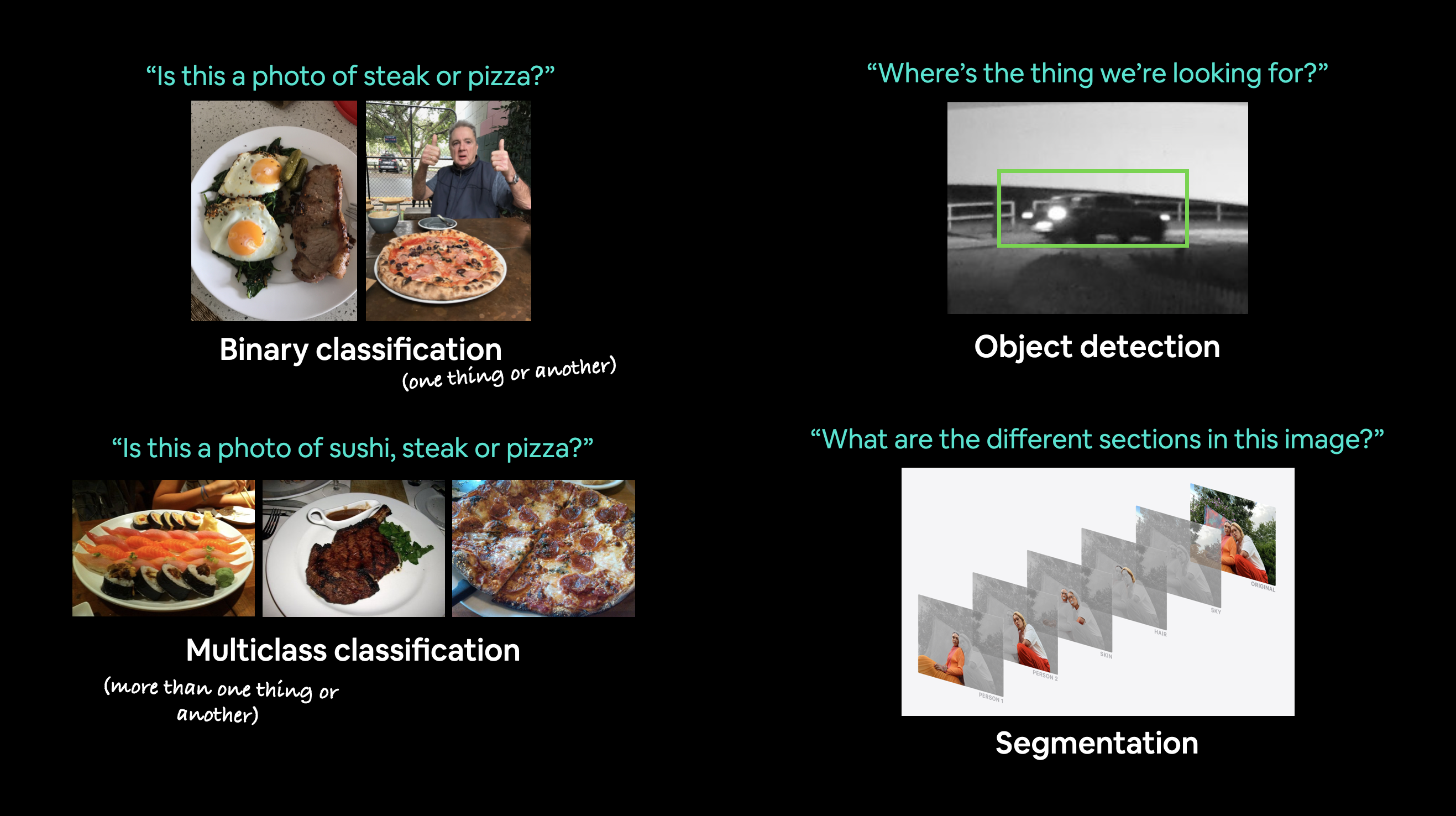 Example computer vision problems for binary classification, multiclass classification, object detection and segmentation.
Where does computer vision get used?
If you use a smartphone, you've already used computer vision.
Camera and photo apps use computer vision to enhance and sort images.
Modern cars use computer vision to avoid other cars and stay within lane lines.
Manufacturers use computer vision to identify defects in various products.
Security cameras use computer vision to detect potential intruders.
In essence, anything that can described in a visual sense can be a potential computer vision problem.
What we're going to cover
We're going to apply the PyTorch Workflow we've been learning in the past couple of sections to computer vision.
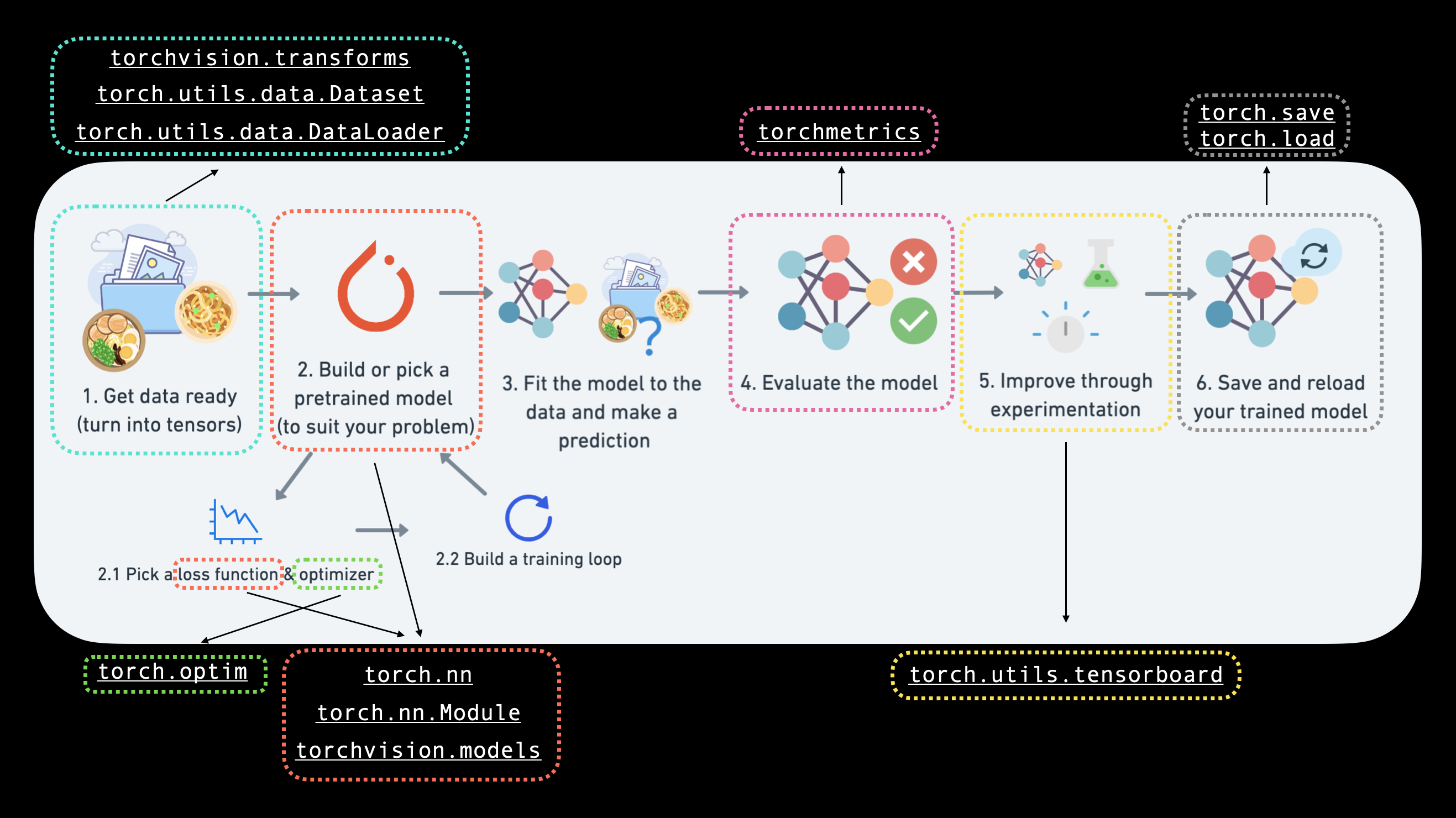
Specifically, we're going to cover:
| Topic | Contents |
|---|---|
| 0. Computer vision libraries in PyTorch | PyTorch has a bunch of built-in helpful computer vision libraries, let's check them out. |
| 1. Load data | To practice computer vision, we'll start with some images of different pieces of clothing from FashionMNIST. |
| 2. Prepare data | We've got some images, let's load them in with a PyTorch DataLoader so we can use them with our training loop. |
| 3. Model 0: Building a baseline model | Here we'll create a multi-class classification model to learn patterns in the data, we'll also choose a loss function, optimizer and build a training loop. |
| 4. Making predictions and evaluting model 0 | Let's make some predictions with our baseline model and evaluate them. |
| 5. Setup device agnostic code for future models | It's best practice to write device-agnostic code, so let's set it up. |
| 6. Model 1: Adding non-linearity | Experimenting is a large part of machine learning, let's try and improve upon our baseline model by adding non-linear layers. |
| 7. Model 2: Convolutional Neural Network (CNN) | Time to get computer vision specific and introduce the powerful convolutional neural network architecture. |
| 8. Comparing our models | We've built three different models, let's compare them. |
| 9. Evaluating our best model | Let's make some predictons on random images and evaluate our best model. |
| 10. Making a confusion matrix | A confusion matrix is a great way to evaluate a classification model, let's see how we can make one. |
| 11. Saving and loading the best performing model | Since we might want to use our model for later, let's save it and make sure it loads back in correctly. |
# Import PyTorch
import torch
from torch import nn

# Import torchvision
import torchvision
from torchvision import datasets
from torchvision.transforms import ToTensor

# Import matplotlib for visualization
import matplotlib.pyplot as plt

# Check versions
# Note: your PyTorch version shouldn't be lower than 1.10.0 and torchvision version shouldn't be lower than 0.11
print(f"PyTorch version: {torch.__version__}\ntorchvision version: {torchvision.__version__}")
PyTorch version: 1.10.0 torchvision version: 0.11.1
1. Getting a dataset
To begin working on a computer vision problem, let's get a computer vision dataset.
We're going to start with FashionMNIST.
MNIST stands for Modified National Institute of Standards and Technology.
The original MNIST dataset contains thousands of examples of handwritten digits (from 0 to 9) and was used to build computer vision models to identify numbers for postal services.
FashionMNIST, made by Zalando Research, is a similar setup.
Except it contains grayscale images of 10 different kinds of clothing.
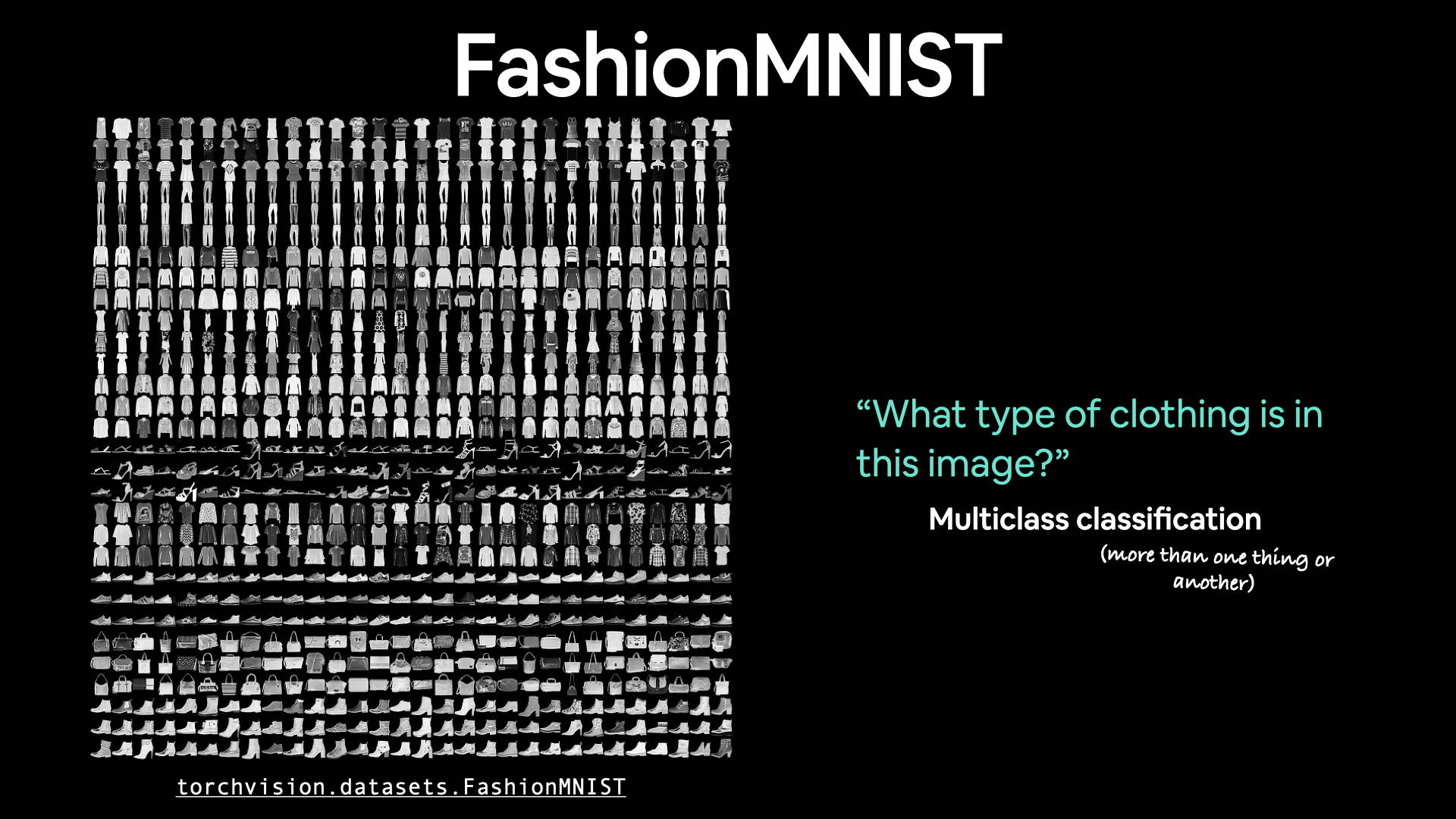
torchvision.datasets contains a lot of example datasets you can use to practice writing computer vision code on. FashionMNIST is one of those datasets. And since it has 10 different image classes (different types of clothing), it's a multi-class classification problem.
Later, we'll be building a computer vision neural network to identify the different styles of clothing in these images.
PyTorch has a bunch of common computer vision datasets stored in torchvision.datasets.
Including FashionMNIST in torchvision.datasets.FashionMNIST().
To download it, we provide the following parameters:
root: str- which folder do you want to download the data to?train: Bool- do you want the training or test split?download: Bool- should the data be downloaded?transform: torchvision.transforms- what transformations would you like to do on the data?target_transform- you can transform the targets (labels) if you like too.
Many other datasets in torchvision have these parameter options.
# Setup training data
train_data = datasets.FashionMNIST(
    root="data", # where to download data to?
    train=True, # get training data
    download=True, # download data if it doesn't exist on disk
    transform=ToTensor(), # images come as PIL format, we want to turn into Torch tensors
    target_transform=None # you can transform labels as well
)

# Setup testing data
test_data = datasets.FashionMNIST(
    root="data",
    train=False, # get test data
    download=True,
    transform=ToTensor()
)# See first training sample
image, label = train_data[0]
image, label(tensor([[[0.0000, 0.0000, 0.0000, 0.0000, 0.0000, 0.0000, 0.0000, 0.0000,
0.0000, 0.0000, 0.0000, 0.0000, 0.0000, 0.0000, 0.0000, 0.0000,
0.0000, 0.0000, 0.0000, 0.0000, 0.0000, 0.0000, 0.0000, 0.0000,
0.0000, 0.0000, 0.0000, 0.0000],
[0.0000, 0.0000, 0.0000, 0.0000, 0.0000, 0.0000, 0.0000, 0.0000,
0.0000, 0.0000, 0.0000, 0.0000, 0.0000, 0.0000, 0.0000, 0.0000,
0.0000, 0.0000, 0.0000, 0.0000, 0.0000, 0.0000, 0.0000, 0.0000,
0.0000, 0.0000, 0.0000, 0.0000],
[0.0000, 0.0000, 0.0000, 0.0000, 0.0000, 0.0000, 0.0000, 0.0000,
0.0000, 0.0000, 0.0000, 0.0000, 0.0000, 0.0000, 0.0000, 0.0000,
0.0000, 0.0000, 0.0000, 0.0000, 0.0000, 0.0000, 0.0000, 0.0000,
0.0000, 0.0000, 0.0000, 0.0000],
[0.0000, 0.0000, 0.0000, 0.0000, 0.0000, 0.0000, 0.0000, 0.0000,
0.0000, 0.0000, 0.0000, 0.0000, 0.0039, 0.0000, 0.0000, 0.0510,
0.2863, 0.0000, 0.0000, 0.0039, 0.0157, 0.0000, 0.0000, 0.0000,
0.0000, 0.0039, 0.0039, 0.0000],
[0.0000, 0.0000, 0.0000, 0.0000, 0.0000, 0.0000, 0.0000, 0.0000,
0.0000, 0.0000, 0.0000, 0.0000, 0.0118, 0.0000, 0.1412, 0.5333,
0.4980, 0.2431, 0.2118, 0.0000, 0.0000, 0.0000, 0.0039, 0.0118,
0.0157, 0.0000, 0.0000, 0.0118],
[0.0000, 0.0000, 0.0000, 0.0000, 0.0000, 0.0000, 0.0000, 0.0000,
0.0000, 0.0000, 0.0000, 0.0000, 0.0235, 0.0000, 0.4000, 0.8000,
0.6902, 0.5255, 0.5647, 0.4824, 0.0902, 0.0000, 0.0000, 0.0000,
0.0000, 0.0471, 0.0392, 0.0000],
[0.0000, 0.0000, 0.0000, 0.0000, 0.0000, 0.0000, 0.0000, 0.0000,
0.0000, 0.0000, 0.0000, 0.0000, 0.0000, 0.0000, 0.6078, 0.9255,
0.8118, 0.6980, 0.4196, 0.6118, 0.6314, 0.4275, 0.2510, 0.0902,
0.3020, 0.5098, 0.2824, 0.0588],
[0.0000, 0.0000, 0.0000, 0.0000, 0.0000, 0.0000, 0.0000, 0.0000,
0.0000, 0.0000, 0.0000, 0.0039, 0.0000, 0.2706, 0.8118, 0.8745,
0.8549, 0.8471, 0.8471, 0.6392, 0.4980, 0.4745, 0.4784, 0.5725,
0.5529, 0.3451, 0.6745, 0.2588],
[0.0000, 0.0000, 0.0000, 0.0000, 0.0000, 0.0000, 0.0000, 0.0000,
0.0000, 0.0039, 0.0039, 0.0039, 0.0000, 0.7843, 0.9098, 0.9098,
0.9137, 0.8980, 0.8745, 0.8745, 0.8431, 0.8353, 0.6431, 0.4980,
0.4824, 0.7686, 0.8980, 0.0000],
[0.0000, 0.0000, 0.0000, 0.0000, 0.0000, 0.0000, 0.0000, 0.0000,
0.0000, 0.0000, 0.0000, 0.0000, 0.0000, 0.7176, 0.8824, 0.8471,
0.8745, 0.8941, 0.9216, 0.8902, 0.8784, 0.8706, 0.8784, 0.8667,
0.8745, 0.9608, 0.6784, 0.0000],
[0.0000, 0.0000, 0.0000, 0.0000, 0.0000, 0.0000, 0.0000, 0.0000,
0.0000, 0.0000, 0.0000, 0.0000, 0.0000, 0.7569, 0.8941, 0.8549,
0.8353, 0.7765, 0.7059, 0.8314, 0.8235, 0.8275, 0.8353, 0.8745,
0.8627, 0.9529, 0.7922, 0.0000],
[0.0000, 0.0000, 0.0000, 0.0000, 0.0000, 0.0000, 0.0000, 0.0000,
0.0000, 0.0039, 0.0118, 0.0000, 0.0471, 0.8588, 0.8627, 0.8314,
0.8549, 0.7529, 0.6627, 0.8902, 0.8157, 0.8549, 0.8784, 0.8314,
0.8863, 0.7725, 0.8196, 0.2039],
[0.0000, 0.0000, 0.0000, 0.0000, 0.0000, 0.0000, 0.0000, 0.0000,
0.0000, 0.0000, 0.0235, 0.0000, 0.3882, 0.9569, 0.8706, 0.8627,
0.8549, 0.7961, 0.7765, 0.8667, 0.8431, 0.8353, 0.8706, 0.8627,
0.9608, 0.4667, 0.6549, 0.2196],
[0.0000, 0.0000, 0.0000, 0.0000, 0.0000, 0.0000, 0.0000, 0.0000,
0.0000, 0.0157, 0.0000, 0.0000, 0.2157, 0.9255, 0.8941, 0.9020,
0.8941, 0.9412, 0.9098, 0.8353, 0.8549, 0.8745, 0.9176, 0.8510,
0.8510, 0.8196, 0.3608, 0.0000],
[0.0000, 0.0000, 0.0039, 0.0157, 0.0235, 0.0275, 0.0078, 0.0000,
0.0000, 0.0000, 0.0000, 0.0000, 0.9294, 0.8863, 0.8510, 0.8745,
0.8706, 0.8588, 0.8706, 0.8667, 0.8471, 0.8745, 0.8980, 0.8431,
0.8549, 1.0000, 0.3020, 0.0000],
[0.0000, 0.0118, 0.0000, 0.0000, 0.0000, 0.0000, 0.0000, 0.0000,
0.0000, 0.2431, 0.5686, 0.8000, 0.8941, 0.8118, 0.8353, 0.8667,
0.8549, 0.8157, 0.8275, 0.8549, 0.8784, 0.8745, 0.8588, 0.8431,
0.8784, 0.9569, 0.6235, 0.0000],
[0.0000, 0.0000, 0.0000, 0.0000, 0.0706, 0.1725, 0.3216, 0.4196,
0.7412, 0.8941, 0.8627, 0.8706, 0.8510, 0.8863, 0.7843, 0.8039,
0.8275, 0.9020, 0.8784, 0.9176, 0.6902, 0.7373, 0.9804, 0.9725,
0.9137, 0.9333, 0.8431, 0.0000],
[0.0000, 0.2235, 0.7333, 0.8157, 0.8784, 0.8667, 0.8784, 0.8157,
0.8000, 0.8392, 0.8157, 0.8196, 0.7843, 0.6235, 0.9608, 0.7569,
0.8078, 0.8745, 1.0000, 1.0000, 0.8667, 0.9176, 0.8667, 0.8275,
0.8627, 0.9098, 0.9647, 0.0000],
[0.0118, 0.7922, 0.8941, 0.8784, 0.8667, 0.8275, 0.8275, 0.8392,
0.8039, 0.8039, 0.8039, 0.8627, 0.9412, 0.3137, 0.5882, 1.0000,
0.8980, 0.8667, 0.7373, 0.6039, 0.7490, 0.8235, 0.8000, 0.8196,
0.8706, 0.8941, 0.8824, 0.0000],
[0.3843, 0.9137, 0.7765, 0.8235, 0.8706, 0.8980, 0.8980, 0.9176,
0.9765, 0.8627, 0.7608, 0.8431, 0.8510, 0.9451, 0.2549, 0.2863,
0.4157, 0.4588, 0.6588, 0.8588, 0.8667, 0.8431, 0.8510, 0.8745,
0.8745, 0.8784, 0.8980, 0.1137],
[0.2941, 0.8000, 0.8314, 0.8000, 0.7569, 0.8039, 0.8275, 0.8824,
0.8471, 0.7255, 0.7725, 0.8078, 0.7765, 0.8353, 0.9412, 0.7647,
0.8902, 0.9608, 0.9373, 0.8745, 0.8549, 0.8314, 0.8196, 0.8706,
0.8627, 0.8667, 0.9020, 0.2627],
[0.1882, 0.7961, 0.7176, 0.7608, 0.8353, 0.7725, 0.7255, 0.7451,
0.7608, 0.7529, 0.7922, 0.8392, 0.8588, 0.8667, 0.8627, 0.9255,
0.8824, 0.8471, 0.7804, 0.8078, 0.7294, 0.7098, 0.6941, 0.6745,
0.7098, 0.8039, 0.8078, 0.4510],
[0.0000, 0.4784, 0.8588, 0.7569, 0.7020, 0.6706, 0.7176, 0.7686,
0.8000, 0.8235, 0.8353, 0.8118, 0.8275, 0.8235, 0.7843, 0.7686,
0.7608, 0.7490, 0.7647, 0.7490, 0.7765, 0.7529, 0.6902, 0.6118,
0.6549, 0.6941, 0.8235, 0.3608],
[0.0000, 0.0000, 0.2902, 0.7412, 0.8314, 0.7490, 0.6863, 0.6745,
0.6863, 0.7098, 0.7255, 0.7373, 0.7412, 0.7373, 0.7569, 0.7765,
0.8000, 0.8196, 0.8235, 0.8235, 0.8275, 0.7373, 0.7373, 0.7608,
0.7529, 0.8471, 0.6667, 0.0000],
[0.0078, 0.0000, 0.0000, 0.0000, 0.2588, 0.7843, 0.8706, 0.9294,
0.9373, 0.9490, 0.9647, 0.9529, 0.9569, 0.8667, 0.8627, 0.7569,
0.7490, 0.7020, 0.7137, 0.7137, 0.7098, 0.6902, 0.6510, 0.6588,
0.3882, 0.2275, 0.0000, 0.0000],
[0.0000, 0.0000, 0.0000, 0.0000, 0.0000, 0.0000, 0.0000, 0.1569,
0.2392, 0.1725, 0.2824, 0.1608, 0.1373, 0.0000, 0.0000, 0.0000,
0.0000, 0.0000, 0.0000, 0.0000, 0.0000, 0.0000, 0.0000, 0.0000,
0.0000, 0.0000, 0.0000, 0.0000],
[0.0000, 0.0000, 0.0000, 0.0000, 0.0000, 0.0000, 0.0000, 0.0000,
0.0000, 0.0000, 0.0000, 0.0000, 0.0000, 0.0000, 0.0000, 0.0000,
0.0000, 0.0000, 0.0000, 0.0000, 0.0000, 0.0000, 0.0000, 0.0000,
0.0000, 0.0000, 0.0000, 0.0000],
[0.0000, 0.0000, 0.0000, 0.0000, 0.0000, 0.0000, 0.0000, 0.0000,
0.0000, 0.0000, 0.0000, 0.0000, 0.0000, 0.0000, 0.0000, 0.0000,
0.0000, 0.0000, 0.0000, 0.0000, 0.0000, 0.0000, 0.0000, 0.0000,
0.0000, 0.0000, 0.0000, 0.0000]]]),
9)# What's the shape of the image?
image.shapetorch.Size([1, 28, 28])
The shape of the image tensor is [1, 28, 28] or more specifically:
[color_channels=1, height=28, width=28]
Having color_channels=1 means the image is grayscale.
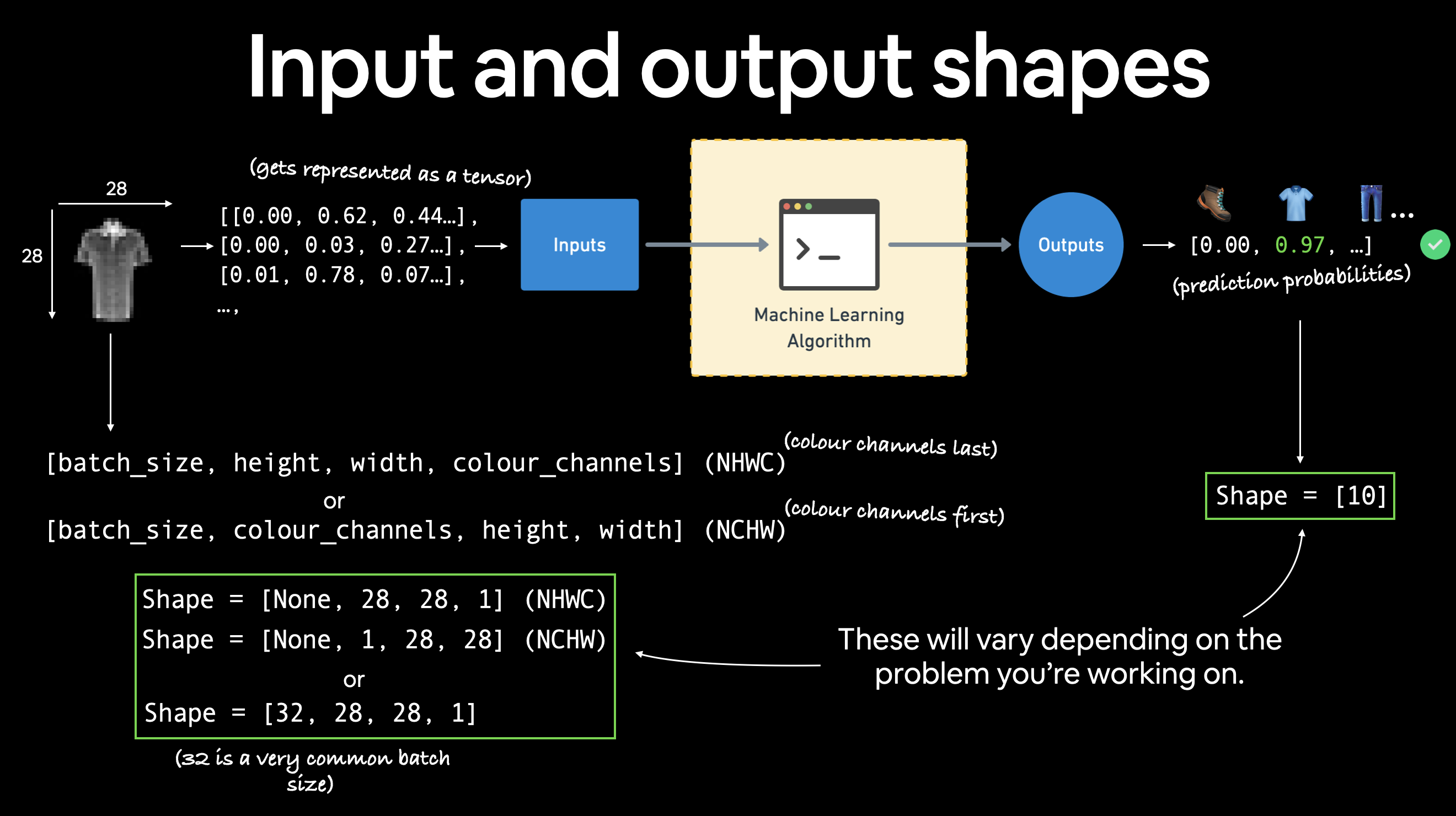 Various problems will have various input and output shapes. But the premise reamins: encode data into numbers, build a model to find patterns in those numbers, convert those patterns into something meaningful.
If color_channels=3, the image comes in pixel values for red, green and blue (this is also known a the RGB color model).
The order of our current tensor is often referred to as CHW (Color Channels, Height, Width).
There's debate on whether images should be represented as CHW (color channels first) or HWC (color channels last).
Note: You'll also see
NCHWandNHWCformats whereNstands for number of images. For example if you have abatch_size=32, your tensor shape may be[32, 1, 28, 28]. We'll cover batch sizes later.
PyTorch generally accepts NCHW (channels first) as the default for many operators.
However, PyTorch also explains that NHWC (channels last) performs better and is considered best practice.
For now, since our dataset and models are relatively small, this won't make too much of a difference.
But keep it in mind for when you're working on larger image datasets and using convolutional neural networks (we'll see these later).
Let's check out more shapes of our data.
# How many samples are there?
len(train_data.data), len(train_data.targets), len(test_data.data), len(test_data.targets)(60000, 60000, 10000, 10000)
# See classes
class_names = train_data.classes
class_names['T-shirt/top', 'Trouser', 'Pullover', 'Dress', 'Coat', 'Sandal', 'Shirt', 'Sneaker', 'Bag', 'Ankle boot']
import matplotlib.pyplot as plt
image, label = train_data[0]
print(f"Image shape: {image.shape}")
plt.imshow(image.squeeze()) # image shape is [1, 28, 28] (colour channels, height, width)
plt.title(label);
Image shape: torch.Size([1, 28, 28])

plt.imshow(image.squeeze(), cmap="gray")
plt.title(class_names[label]);
# Plot more images
torch.manual_seed(42)
fig = plt.figure(figsize=(9, 9))
rows, cols = 4, 4
for i in range(1, rows * cols + 1):
    random_idx = torch.randint(0, len(train_data), size=[1]).item()
    img, label = train_data[random_idx]
    fig.add_subplot(rows, cols, i)
    plt.imshow(img.squeeze(), cmap="gray")
    plt.title(class_names[label])
    plt.axis(False);
TK - 2. Prepare DataLoader
Now we've got a dataset ready to go.
The next step is to prepare it with a torch.utils.data.DataLoader or DataLoader for short.
The DataLoader does what you think it might do.
It helps load data into a model.
For training and for inference.
It turns a large Dataset into a Python iterable of smaller chunks.
These smaller chunks are called batches or mini-batches and can be set by the batch_size parameter.
Why do this?
Because it's more computationally efficient.
In an ideal world you could do the forward pass and backward pass across all of your data at once.
But once you start using really large datasets, unless you've got infinite computing power, it's easier to break them up into batches.
What's a good batch size?
32 is a good place to start for a fair amount of problems.
But since this is a value you can set (a hyperparameter) you can try all different kinds of values, though generally powers of 2 are used most often (e.g. 32, 64, 128, 256, 512).
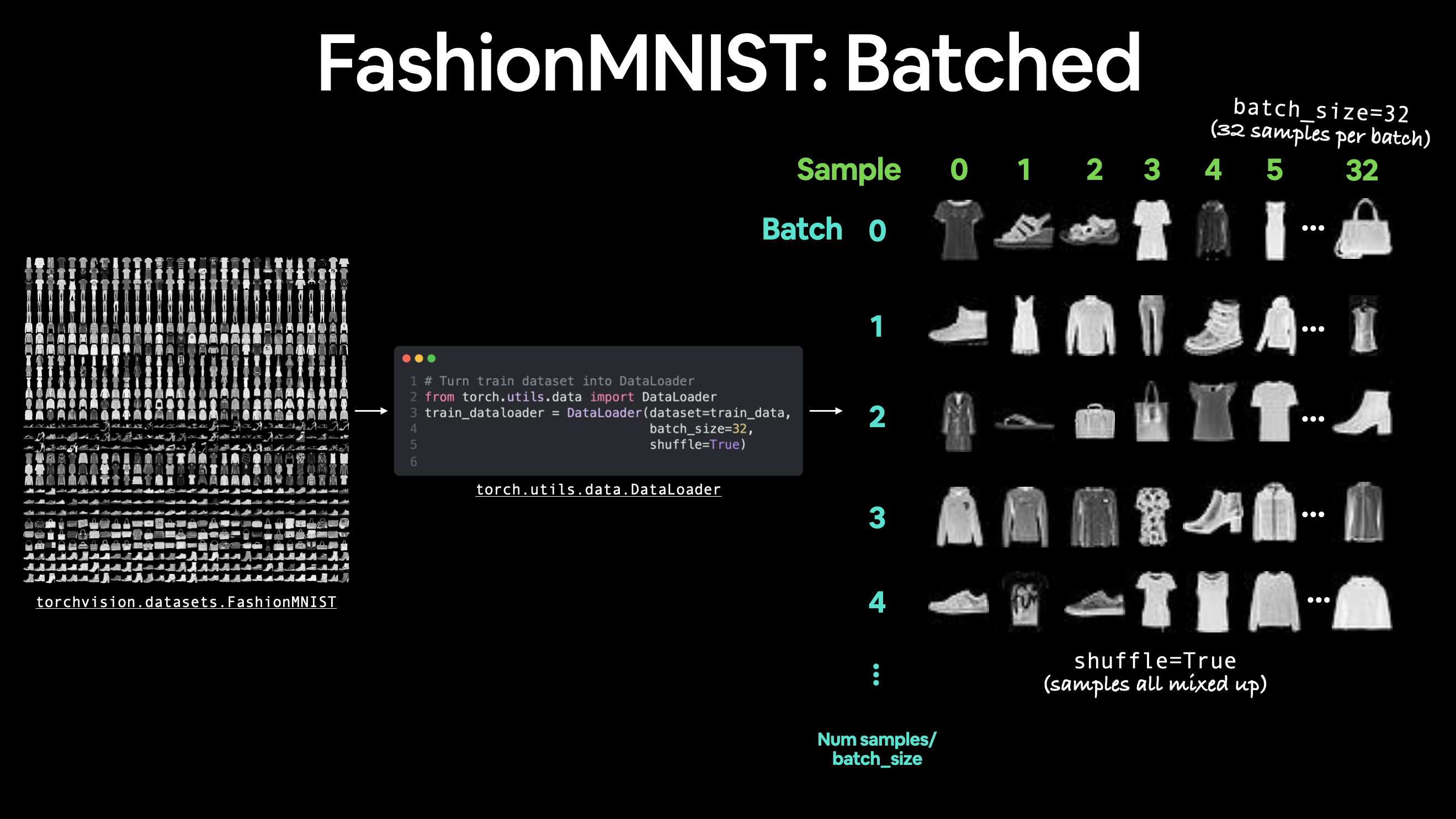 Batching FashionMNIST with a batch size of 32 and shuffle turned on. A similar batching process will occur for other datasets but will differ depending on the batch size.
Let's create DataLoader's for our training and test sets.
from torch.utils.data import DataLoader

# Setup the batch size hyperparameter
BATCH_SIZE = 32

# Turn datasets into iterables (batches)
train_dataloader = DataLoader(train_data, # dataset to turn into iterable
    batch_size=BATCH_SIZE, # how many samples per batch?
    shuffle=True # shuffle data every epoch?
)

test_dataloader = DataLoader(test_data,
    batch_size=BATCH_SIZE,
    shuffle=False # don't necessarily have to shuffle the testing data
)

# Let's check out what we've created
print(f"Dataloaders: {train_dataloader, test_dataloader}")
print(f"Length of train dataloader: {len(train_dataloader)} batches of {BATCH_SIZE}")
print(f"Length of test dataloader: {len(test_dataloader)} batches of {BATCH_SIZE}")
Dataloaders: (<torch.utils.data.dataloader.DataLoader object at 0x7f34aa3920a0>, <torch.utils.data.dataloader.DataLoader object at 0x7f34ae5060d0>) Length of train dataloader: 1875 batches of 32 Length of test dataloader: 313 batches of 32
# Check out what's inside the training dataloader
train_features_batch, train_labels_batch = next(iter(train_dataloader))
train_features_batch.shape, train_labels_batch.shape(torch.Size([32, 1, 28, 28]), torch.Size([32]))
# Show a sample
torch.manual_seed(42)
random_idx = torch.randint(0, len(train_features_batch), size=[1]).item()
img, label = train_features_batch[random_idx], train_labels_batch[random_idx]
plt.imshow(img.squeeze(), cmap="gray")
plt.title(class_names[label])
plt.axis("Off");
print(f"Image size: {img.shape}")
print(f"Label: {label}, label size: {label.shape}")
Image size: torch.Size([1, 28, 28]) Label: 6, label size: torch.Size([])

# Create a flatten layer
flatten_model = nn.Flatten() # all nn modules function as a model (can do a forward pass)

# Get a single sample
x = train_features_batch[0]

# Flatten the sample
output = flatten_model(x) # perform forward pass

# Print out what happened
print(f"Shape before flattening: {x.shape} -> [color_channels, height, width]")
print(f"Shape after flattening: {output.shape} -> [color_channels, height*width]")

# Try uncommenting below and see what happened
#print(x)
#print(output)
Shape before flattening: torch.Size([1, 28, 28]) -> [color_channels, height, width] Shape after flattening: torch.Size([1, 784]) -> [color_channels, height*width]
from torch import nn
class FashionMNISTModelV0(nn.Module):
    def __init__(self, input_shape, hidden_units, output_shape):
        super().__init__()
        self.layer_stack = nn.Sequential(
            nn.Flatten(), # neural networks like their inputs in vector form
            nn.Linear(in_features=input_shape, out_features=hidden_units), # in_features = number of features in a data sample (784 pixels)
            nn.Linear(in_features=hidden_units, out_features=output_shape)
        )

    def forward(self, x):
return self.layer_stack(x)torch.manual_seed(42)
# Need to setup model with input parameters
model_0 = FashionMNISTModelV0(input_shape=784, # one for every pixel (28x28)
hidden_units=10, # how many units in the hiden layer
output_shape=len(class_names) # one for every class
)
model_0.to("cpu") # keep model on CPU to begin wtih FashionMNISTModelV0(
(layer_stack): Sequential(
(0): Flatten(start_dim=1, end_dim=-1)
(1): Linear(in_features=784, out_features=10, bias=True)
(2): Linear(in_features=10, out_features=10, bias=True)
)
)import requests
from pathlib import Path
# Download helper functions from Learn PyTorch repo (if not already downloaded)
if Path("helper_functions.py").is_file():
print("helper_functions.py already exists, skipping download")
else:
print("Downloading helper_functions.py")
# Note: you need the "raw" GitHub URL for this to work
request = requests.get("https://raw.githubusercontent.com/mrdbourke/pytorch-deep-learning/main/helper_functions.py")
with open("helper_functions.py", "wb") as f:
f.write(request.content)helper_functions.py already exists, skipping download
# Import accuracy metric
from helper_functions import accuracy_fn # Note: could also use torchmetrics.Accuracy()

# Setup loss function and optimizer
loss_fn = nn.CrossEntropyLoss() # this is also called "criterion"/"cost function" in some places
optimizer = torch.optim.SGD(params=model_0.parameters(), lr=0.1)from timeit import default_timer as timer
def print_train_time(start, end, device=None):
"""Prints difference between start and end time.
Args:
start (float): Start time of computation (preferred in timeit format).
end (float): End time of computation.
device ([type], optional): Device that compute is running on. Defaults to None.
Returns:
float: time between start and end in seconds (higher is longer).
"""
total_time = end - start
print(f"Train time on {device}: {total_time:.3f} seconds")
return total_time# Set the seed and start the timer
torch.manual_seed(42)
train_time_start_on_cpu = timer()
# Set the number of epochs (we'll keep this small for faster training times)
epochs = 3
# Create training and testing loop
for epoch in range(epochs):
print(f"Epoch: {epoch}\n-------")
### Training
train_loss = 0
# Add a loop to loop through training batches
for batch, (X, y) in enumerate(train_dataloader):
model_0.train()
# 1. Forward pass
y_pred = model_0(X)
# 2. Calculate loss (per batch)
loss = loss_fn(y_pred, y)
train_loss += loss # accumulatively add up the loss per epoch
# 3. Optimizer zero grad
optimizer.zero_grad()
# 4. Loss backward
loss.backward()
# 5. Optimizer step
optimizer.step()
# Print out how many samples have been seen
if batch % 400 == 0:
print(f"Looked at {batch * len(X)}/{len(train_dataloader.dataset)} samples")
# Divide total train loss by length of train dataloader (average loss per batch per epoch)
train_loss /= len(train_dataloader)
### Testing
# Setup variables for accumulatively adding up loss and accuracy
test_loss, test_acc = 0, 0
model_0.eval()
with torch.inference_mode():
for X, y in test_dataloader:
# 1. Forward pass
test_pred = model_0(X)
# 2. Calculate loss (accumatively)
test_loss += loss_fn(test_pred, y) # accumulatively add up the loss per epoch
# 3. Calculate accuracy (preds need to be same as y_true)
test_acc += accuracy_fn(y_true=y, y_pred=test_pred.argmax(dim=1))
# Calculations on test metrics need to happen inside torch.inference_mode()
# Divide total test loss by length of test dataloader (per batch)
test_loss /= len(test_dataloader)
# Divide total accuracy by length of test dataloader (per batch)
test_acc /= len(test_dataloader)
## Print out what's happening
print(f"\nTrain loss: {train_loss:.5f} | Test loss: {test_loss:.5f}, Test acc: {test_acc:.2f}%\n")
# Calculate training time
train_time_end_on_cpu = timer()
total_train_time_model_0 = print_train_time(start=train_time_start_on_cpu,
end=train_time_end_on_cpu,
device=str(next(model_0.parameters()).device))Epoch: 0 ------- Looked at 0/60000 samples Looked at 12800/60000 samples Looked at 25600/60000 samples Looked at 38400/60000 samples Looked at 51200/60000 samples Train loss: 0.59039 | Test loss: 0.50954, Test acc: 82.04% Epoch: 1 ------- Looked at 0/60000 samples Looked at 12800/60000 samples Looked at 25600/60000 samples Looked at 38400/60000 samples Looked at 51200/60000 samples Train loss: 0.47633 | Test loss: 0.47989, Test acc: 83.20% Epoch: 2 ------- Looked at 0/60000 samples Looked at 12800/60000 samples Looked at 25600/60000 samples Looked at 38400/60000 samples Looked at 51200/60000 samples Train loss: 0.45503 | Test loss: 0.47664, Test acc: 83.43% Train time on cpu: 15.526 seconds
torch.manual_seed(42)
def eval_model(model: torch.nn.Module,
               data_loader: torch.utils.data.DataLoader,
               loss_fn: torch.nn.Module,
               accuracy_fn):
    """Returns a dictionary containing the results of model predicting on data_loader.

    Args:
        model (torch.nn.Module): A PyTorch model capable of making predictions on data_loader.
        data_loader (torch.utils.data.DataLoader): The target dataset to predict on.
        loss_fn (torch.nn.Module): The loss function of model.
        accuracy_fn: An accuracy function to compare the models predictions to the truth labels.

    Returns:
        (dict): Results of model making predictions on data_loader.
    """
    loss, acc = 0, 0
    model.eval()
    with torch.inference_mode():
        for X, y in data_loader:
            # Make predictions with the model
            y_pred = model(X)

            # Accumulate the loss and accuracy values per batch
            loss += loss_fn(y_pred, y)
            acc += accuracy_fn(y_true=y,
                                y_pred=y_pred.argmax(dim=1)) # For accuracy, need the prediction labels (logits -> pred_prob -> pred_labels)

        # Scale loss and acc to find the average loss/acc per batch
        loss /= len(data_loader)
        acc /= len(data_loader)

    return {"model_name": model.__class__.__name__, # only works when model was created with a class
            "model_loss": loss.item(),
            "model_acc": acc}

# Calculate model 0 results on test dataset
model_0_results = eval_model(model=model_0, data_loader=test_dataloader,
    loss_fn=loss_fn, accuracy_fn=accuracy_fn
)
model_0_results{'model_name': 'FashionMNISTModelV0',
'model_loss': 0.47663894295692444,
'model_acc': 83.42651757188499}# Setup device agnostic code
import torch
device = "cuda" if torch.cuda.is_available() else "cpu"
device'cuda'
# Create a model with non-linear and linear layers
class FashionMNISTModelV1(nn.Module):
    def __init__(self, input_shape, hidden_units, output_shape):
        super().__init__()
        self.layer_stack = nn.Sequential(
            nn.Flatten(), # flatten inputs into single vector
            nn.Linear(in_features=input_shape, out_features=hidden_units),
            nn.ReLU(),
            nn.Linear(in_features=hidden_units, out_features=output_shape),
            nn.ReLU()
        )

    def forward(self, x):
return self.layer_stack(x)torch.manual_seed(42)
model_1 = FashionMNISTModelV1(input_shape=784, # number of input features
hidden_units=10,
output_shape=len(class_names) # number of output classes desired
).to(device) # send model to GPU if it's available
next(model_1.parameters()).device # check model devicedevice(type='cuda', index=0)
from helper_functions import accuracy_fn
loss_fn = nn.CrossEntropyLoss()
optimizer = torch.optim.SGD(params=model_1.parameters(),
lr=0.1)def train_step(model, data_loader, loss_fn, optimizer, accuracy_fn, device=device):
train_loss, train_acc = 0, 0
for batch, (X, y) in enumerate(data_loader):
# Send data to GPU
X, y = X.to(device), y.to(device)
# 1. Forward pass
y_pred = model(X)
# 2. Calculate loss
loss = loss_fn(y_pred, y)
train_loss += loss
train_acc += accuracy_fn(y_true=y,
y_pred=y_pred.argmax(dim=1)) # Go from logits -> pred labels
# 3. Optimizer zero grad
optimizer.zero_grad()
# 4. Loss backward
loss.backward()
# 5. Optimizer step
optimizer.step()
# Calculate loss and accuracy per epoch and print out what's happening
train_loss /= len(data_loader)
train_acc /= len(data_loader)
print(f"Train loss: {test_loss:.5f} | Train accuracy: {test_acc:.2f}%")
def test_step(data_loader, model, loss_fn, accuracy_fn, device=device):
test_loss, test_acc = 0, 0
model.eval() # put model in eval mode
# Turn on inference context manager
with torch.inference_mode():
for X, y in data_loader:
# Send data to GPU
X, y = X.to(device), y.to(device)
# 1. Forward pass
test_pred = model(X)
# 2. Calculate loss and accuracy
test_loss += loss_fn(test_pred, y)
test_acc += accuracy_fn(y_true=y,
y_pred=test_pred.argmax(dim=1) # Go from logits -> pred labels
)
# Adjust metrics and print out
test_loss /= len(data_loader)
test_acc /= len(data_loader)
print(f"Test loss: {test_loss:.5f} | Test accuracy: {test_acc:.2f}%\n")torch.manual_seed(42)
# Measure time
from timeit import default_timer as timer
train_time_start_on_gpu = timer()
epochs = 3
for epoch in range(epochs):
print(f"Epoch: {epoch}\n---------")
train_step(data_loader=train_dataloader,
model=model_1,
loss_fn=loss_fn,
optimizer=optimizer,
accuracy_fn=accuracy_fn
)
test_step(data_loader=test_dataloader,
model=model_1,
loss_fn=loss_fn,
accuracy_fn=accuracy_fn
)
train_time_end_on_gpu = timer()
total_train_time_model_1 = print_train_time(start=train_time_start_on_gpu,
end=train_time_end_on_gpu,
device=device)Epoch: 0 --------- Train loss: 0.47664 | Train accuracy: 83.43% Test loss: 0.95636 | Test accuracy: 65.00% Epoch: 1 --------- Train loss: 0.47664 | Train accuracy: 83.43% Test loss: 0.72227 | Test accuracy: 73.91% Epoch: 2 --------- Train loss: 0.47664 | Train accuracy: 83.43% Test loss: 0.68500 | Test accuracy: 75.02% Train time on cuda: 17.823 seconds
# torch.manual_seed(42)

# Note: This will error due to `eval_model()` not using device agnostic code
# model_1_results = eval_model(model=model_1,
#     data_loader=test_dataloader,
#     loss_fn=loss_fn,
#     accuracy_fn=accuracy_fn)
# model_1_results # Move values to device
torch.manual_seed(42)
def eval_model(model: torch.nn.Module,
data_loader: torch.utils.data.DataLoader,
loss_fn: torch.nn.Module,
accuracy_fn,
device: str = device):
"""Evaluates a given model on a given dataset.
Args:
model (torch.nn.Module): A PyTorch model capable of making predictions on data_loader.
data_loader (torch.utils.data.DataLoader): The target dataset to predict on.
loss_fn (torch.nn.Module): The loss function of model.
accuracy_fn: An accuracy function to compare the models predictions to the truth labels.
device (str, optional): Target device to compute on. Defaults to device.
Returns:
(dict): Results of model making predictions on data_loader.
"""
loss, acc = 0, 0
model.eval()
with torch.inference_mode():
for X, y in data_loader:
# Send data to the target device
X, y = X.to(device), y.to(device)
y_pred = model(X)
loss += loss_fn(y_pred, y)
acc += accuracy_fn(y_true=y, y_pred=y_pred.argmax(dim=1))
# Scale loss and acc
loss /= len(data_loader)
acc /= len(data_loader)
return {"model_name": model.__class__.__name__, # only works when model was created with a class
"model_loss": loss.item(),
"model_acc": acc}
# Calculate model 1 results with device-agnostic code
model_1_results = eval_model(model=model_1, data_loader=test_dataloader,
loss_fn=loss_fn, accuracy_fn=accuracy_fn,
device=device
)
model_1_results{'model_name': 'FashionMNISTModelV1',
'model_loss': 0.6850008964538574,
'model_acc': 75.01996805111821}# Check baseline results
model_0_results{'model_name': 'FashionMNISTModelV0',
'model_loss': 0.47663894295692444,
'model_acc': 83.42651757188499}What model should I use?
Question: Wait, you say CNN's are good for images, are there any other model types I should be aware of?
Good question.
This table is a good general guide for which model to use (though there are exceptions).
| Problem type | Model to use (generally) | Code example |
|---|---|---|
| Structured data (Excel spreadsheets, row and column data) | Gradient boosted models, Random Forests, XGBoost | sklearn.ensemble, XGBoost library |
| Unstructured data (images, audio, language) | Convolutional Neural Networks, Transformers | torchvision.models, HuggingFace Transformers |
Note: The table above is only for reference, the model you end up using will be highly dependant on the problem you're working on and the constraints you have (amount of data, latency requirements).
Enough talking about models, let's now build a CNN that replicates the model on the CNN Explainer website.
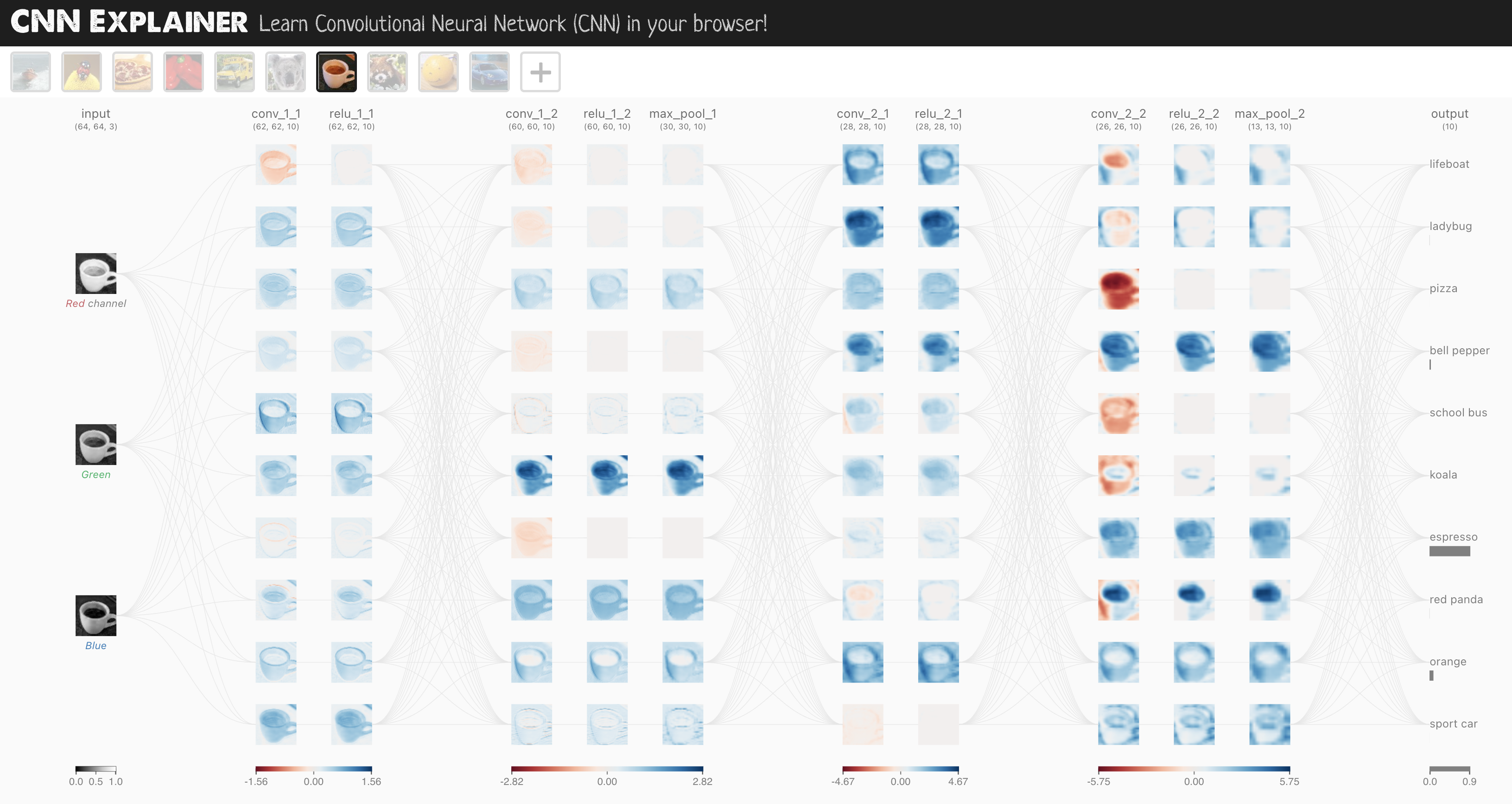
To do so, we'll leverage the nn.Conv2d() and nn.MaxPool2d() layers from torch.nn.
# Create a convolutional neural network
class FashionMNISTModelV2(nn.Module):
    """
    Model architecture copying TinyVGG from:
    https://poloclub.github.io/cnn-explainer/
    """
    def __init__(self, input_shape, hidden_units, output_shape):
        super().__init__()
        self.block_1 = nn.Sequential(
            nn.Conv2d(in_channels=input_shape,
                      out_channels=hidden_units,
                      kernel_size=3, # how big is the square that's going over the image?
                      stride=1, # default
                      padding=1),# options = "valid" (no padding) or "same" (output has same shape as input) or int for specific number
            nn.ReLU(),
            nn.Conv2d(in_channels=hidden_units,
                      out_channels=hidden_units,
                      kernel_size=3,
                      stride=1,
                      padding=1),
            nn.ReLU(),
            nn.MaxPool2d(kernel_size=2,
                         stride=2) # default stride value is same as kernel_size
        )
        self.block_2 = nn.Sequential(
            nn.Conv2d(hidden_units, hidden_units, 3, padding=1),
            nn.ReLU(),
            nn.Conv2d(hidden_units, hidden_units, 3, padding=1),
            nn.ReLU(),
            nn.MaxPool2d(2)
        )
        self.classifier = nn.Sequential(
            nn.Flatten(),
            # Where did this in_features shape come from?
            # It's because each layer of our network compresses and changes the shape of our inputs data.
            nn.Linear(in_features=hidden_units*7*7,
                      out_features=output_shape)
        )

    def forward(self, x):
        x = self.block_1(x)
        # print(x.shape)
        x = self.block_2(x)
        # print(x.shape)
        x = self.classifier(x)
        # print(x.shape)
        return x

torch.manual_seed(42)
model_2 = FashionMNISTModelV2(input_shape=1,
    hidden_units=10,
    output_shape=len(class_names)).to(device)
model_2FashionMNISTModelV2(
(block_1): Sequential(
(0): Conv2d(1, 10, kernel_size=(3, 3), stride=(1, 1), padding=(1, 1))
(1): ReLU()
(2): Conv2d(10, 10, kernel_size=(3, 3), stride=(1, 1), padding=(1, 1))
(3): ReLU()
(4): MaxPool2d(kernel_size=2, stride=2, padding=0, dilation=1, ceil_mode=False)
)
(block_2): Sequential(
(0): Conv2d(10, 10, kernel_size=(3, 3), stride=(1, 1), padding=(1, 1))
(1): ReLU()
(2): Conv2d(10, 10, kernel_size=(3, 3), stride=(1, 1), padding=(1, 1))
(3): ReLU()
(4): MaxPool2d(kernel_size=2, stride=2, padding=0, dilation=1, ceil_mode=False)
)
(classifier): Sequential(
(0): Flatten(start_dim=1, end_dim=-1)
(1): Linear(in_features=490, out_features=10, bias=True)
)
)torch.manual_seed(42)
# Create sample batch of random numbers with same size as image batch
images = torch.randn(size=(32, 3, 64, 64)) # [batch_size, color_channels, height, width]
test_image = images[0] # get a single image for testing
print(f"Image batch shape: {images.shape} -> [batch_size, color_channels, height, width]")
print(f"Single image shape: {test_image.shape} -> [color_channels, height, width]")
print(f"Single image pixel values:\n{test_image}")Image batch shape: torch.Size([32, 3, 64, 64]) -> [batch_size, color_channels, height, width]
Single image shape: torch.Size([3, 64, 64]) -> [color_channels, height, width]
Single image pixel values:
tensor([[[ 1.9269, 1.4873, 0.9007, ..., 1.8446, -1.1845, 1.3835],
[ 1.4451, 0.8564, 2.2181, ..., 0.3399, 0.7200, 0.4114],
[ 1.9312, 1.0119, -1.4364, ..., -0.5558, 0.7043, 0.7099],
...,
[-0.5610, -0.4830, 0.4770, ..., -0.2713, -0.9537, -0.6737],
[ 0.3076, -0.1277, 0.0366, ..., -2.0060, 0.2824, -0.8111],
[-1.5486, 0.0485, -0.7712, ..., -0.1403, 0.9416, -0.0118]],
[[-0.5197, 1.8524, 1.8365, ..., 0.8935, -1.5114, -0.8515],
[ 2.0818, 1.0677, -1.4277, ..., 1.6612, -2.6223, -0.4319],
[-0.1010, -0.4388, -1.9775, ..., 0.2106, 0.2536, -0.7318],
...,
[ 0.2779, 0.7342, -0.3736, ..., -0.4601, 0.1815, 0.1850],
[ 0.7205, -0.2833, 0.0937, ..., -0.1002, -2.3609, 2.2465],
[-1.3242, -0.1973, 0.2920, ..., 0.5409, 0.6940, 1.8563]],
[[-0.7978, 1.0261, 1.1465, ..., 1.2134, 0.9354, -0.0780],
[-1.4647, -1.9571, 0.1017, ..., -1.9986, -0.7409, 0.7011],
[-1.3938, 0.8466, -1.7191, ..., -1.1867, 0.1320, 0.3407],
...,
[ 0.8206, -0.3745, 1.2499, ..., -0.0676, 0.0385, 0.6335],
[-0.5589, -0.3393, 0.2347, ..., 2.1181, 2.4569, 1.3083],
[-0.4092, 1.5199, 0.2401, ..., -0.2558, 0.7870, 0.9924]]])
Let's create an example nn.Conv2d() with various parameters:
in_channels(int) - Number of channels in the input image.out_channels(int) - Number of channels produced by the convolution.kernel_size(int or tuple) - Size of the convolving kernel/filter.stride(int or tuple, optional) - How big of a step the convolving kernel takes at a time. Default: 1.padding(int, tuple, str) - Padding added to all four sides of input. Default: 0.
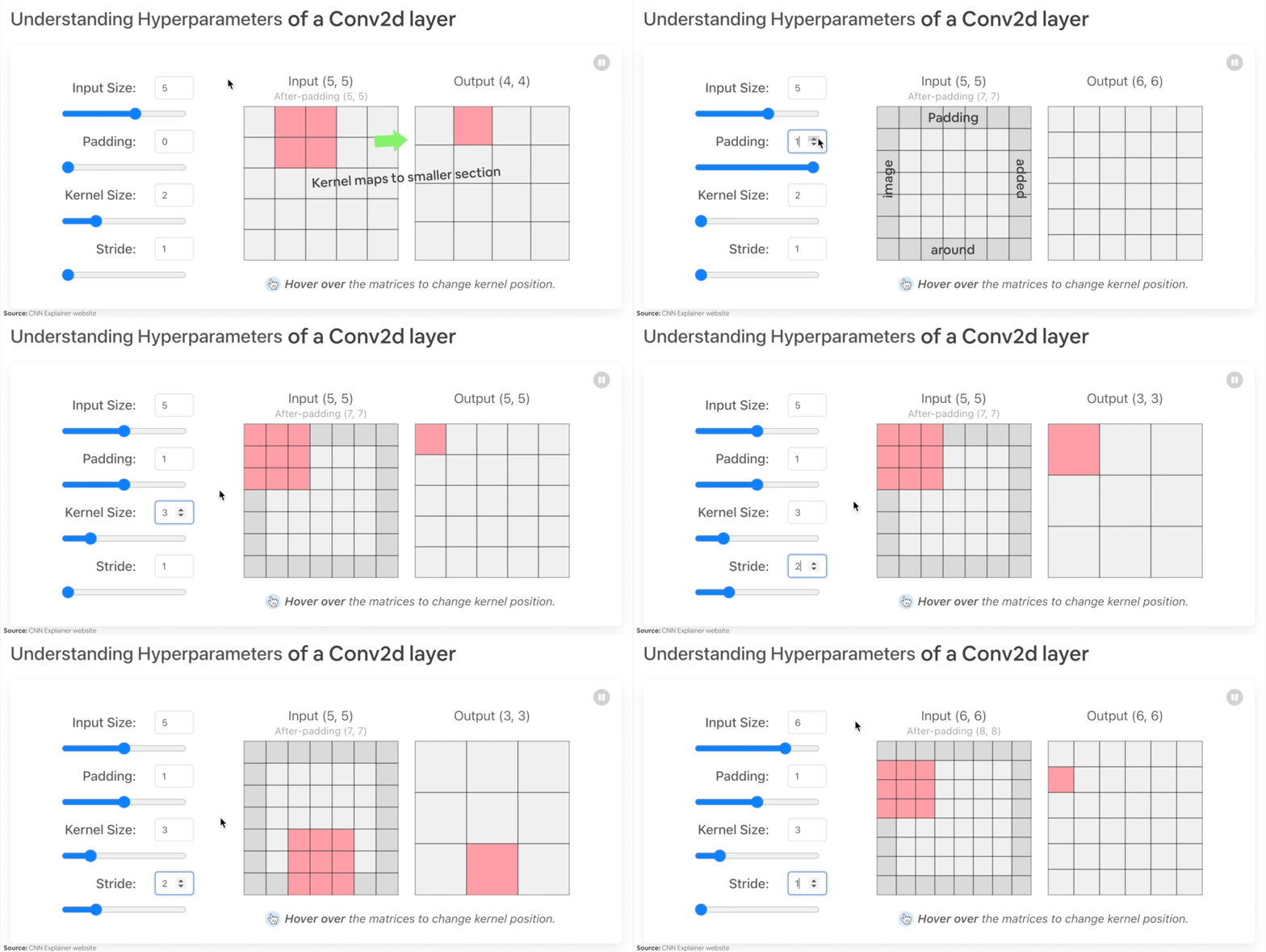 Example of what happens when you change the hyperparameters of a
nn.Conv2d() layer.
torch.manual_seed(42)

# Create a convolutional layer with same dimensions as TinyVGG
# (try changing any of the parameters and see what happens)
conv_layer = nn.Conv2d(in_channels=3,
                       out_channels=10,
                       kernel_size=3,
                       stride=1,
                       padding=0) # also try using "valid" or "same" here

# Pass the data through the convolutional layer
# conv_layer(test_image) # Note: this will error because of shape issues (nn.Conv.2d() expects a 4d tensor as input)# Add extra dimension to test image
test_image.unsqueeze(dim=0).shapetorch.Size([1, 3, 64, 64])
# Pass test image with extra dimension through conv_layer
conv_layer(test_image.unsqueeze(dim=0)).shapetorch.Size([1, 10, 62, 62])
torch.manual_seed(42)
# Create a new conv_layer with different values (try setting these to whatever you like)
conv_layer_2 = nn.Conv2d(in_channels=3, # same number of color channels as our input image
                         out_channels=10,
                         kernel_size=(5, 5), # kernel is usually a square so a tuple also works
                         stride=2,
                         padding=0)

# Pass single image through new conv_layer_2 (this calls nn.Conv2d()'s forward() method on the input)
conv_layer_2(test_image.unsqueeze(dim=0)).shapetorch.Size([1, 10, 30, 30])
# Check out the conv_layer_2 internal parameters
print(conv_layer_2.state_dict())
OrderedDict([('weight', tensor([[[[ 0.0883, 0.0958, -0.0271, 0.1061, -0.0253],
[ 0.0233, -0.0562, 0.0678, 0.1018, -0.0847],
[ 0.1004, 0.0216, 0.0853, 0.0156, 0.0557],
[-0.0163, 0.0890, 0.0171, -0.0539, 0.0294],
[-0.0532, -0.0135, -0.0469, 0.0766, -0.0911]],
[[-0.0532, -0.0326, -0.0694, 0.0109, -0.1140],
[ 0.1043, -0.0981, 0.0891, 0.0192, -0.0375],
[ 0.0714, 0.0180, 0.0933, 0.0126, -0.0364],
[ 0.0310, -0.0313, 0.0486, 0.1031, 0.0667],
[-0.0505, 0.0667, 0.0207, 0.0586, -0.0704]],
[[-0.1143, -0.0446, -0.0886, 0.0947, 0.0333],
[ 0.0478, 0.0365, -0.0020, 0.0904, -0.0820],
[ 0.0073, -0.0788, 0.0356, -0.0398, 0.0354],
[-0.0241, 0.0958, -0.0684, -0.0689, -0.0689],
[ 0.1039, 0.0385, 0.1111, -0.0953, -0.1145]]],
[[[-0.0903, -0.0777, 0.0468, 0.0413, 0.0959],
[-0.0596, -0.0787, 0.0613, -0.0467, 0.0701],
[-0.0274, 0.0661, -0.0897, -0.0583, 0.0352],
[ 0.0244, -0.0294, 0.0688, 0.0785, -0.0837],
[-0.0616, 0.1057, -0.0390, -0.0409, -0.1117]],
[[-0.0661, 0.0288, -0.0152, -0.0838, 0.0027],
[-0.0789, -0.0980, -0.0636, -0.1011, -0.0735],
[ 0.1154, 0.0218, 0.0356, -0.1077, -0.0758],
[-0.0384, 0.0181, -0.1016, -0.0498, -0.0691],
[ 0.0003, -0.0430, -0.0080, -0.0782, -0.0793]],
[[-0.0674, -0.0395, -0.0911, 0.0968, -0.0229],
[ 0.0994, 0.0360, -0.0978, 0.0799, -0.0318],
[-0.0443, -0.0958, -0.1148, 0.0330, -0.0252],
[ 0.0450, -0.0948, 0.0857, -0.0848, -0.0199],
[ 0.0241, 0.0596, 0.0932, 0.1052, -0.0916]]],
[[[ 0.0291, -0.0497, -0.0127, -0.0864, 0.1052],
[-0.0847, 0.0617, 0.0406, 0.0375, -0.0624],
[ 0.1050, 0.0254, 0.0149, -0.1018, 0.0485],
[-0.0173, -0.0529, 0.0992, 0.0257, -0.0639],
[-0.0584, -0.0055, 0.0645, -0.0295, -0.0659]],
[[-0.0395, -0.0863, 0.0412, 0.0894, -0.1087],
[ 0.0268, 0.0597, 0.0209, -0.0411, 0.0603],
[ 0.0607, 0.0432, -0.0203, -0.0306, 0.0124],
[-0.0204, -0.0344, 0.0738, 0.0992, -0.0114],
[-0.0259, 0.0017, -0.0069, 0.0278, 0.0324]],
[[-0.1049, -0.0426, 0.0972, 0.0450, -0.0057],
[-0.0696, -0.0706, -0.1034, -0.0376, 0.0390],
[ 0.0736, 0.0533, -0.1021, -0.0694, -0.0182],
[ 0.1117, 0.0167, -0.0299, 0.0478, -0.0440],
[-0.0747, 0.0843, -0.0525, -0.0231, -0.1149]]],
[[[ 0.0773, 0.0875, 0.0421, -0.0805, -0.1140],
[-0.0938, 0.0861, 0.0554, 0.0972, 0.0605],
[ 0.0292, -0.0011, -0.0878, -0.0989, -0.1080],
[ 0.0473, -0.0567, -0.0232, -0.0665, -0.0210],
[-0.0813, -0.0754, 0.0383, -0.0343, 0.0713]],
[[-0.0370, -0.0847, -0.0204, -0.0560, -0.0353],
[-0.1099, 0.0646, -0.0804, 0.0580, 0.0524],
[ 0.0825, -0.0886, 0.0830, -0.0546, 0.0428],
[ 0.1084, -0.0163, -0.0009, -0.0266, -0.0964],
[ 0.0554, -0.1146, 0.0717, 0.0864, 0.1092]],
[[-0.0272, -0.0949, 0.0260, 0.0638, -0.1149],
[-0.0262, -0.0692, -0.0101, -0.0568, -0.0472],
[-0.0367, -0.1097, 0.0947, 0.0968, -0.0181],
[-0.0131, -0.0471, -0.1043, -0.1124, 0.0429],
[-0.0634, -0.0742, -0.0090, -0.0385, -0.0374]]],
[[[ 0.0037, -0.0245, -0.0398, -0.0553, -0.0940],
[ 0.0968, -0.0462, 0.0306, -0.0401, 0.0094],
[ 0.1077, 0.0532, -0.1001, 0.0458, 0.1096],
[ 0.0304, 0.0774, 0.1138, -0.0177, 0.0240],
[-0.0803, -0.0238, 0.0855, 0.0592, -0.0731]],
[[-0.0926, -0.0789, -0.1140, -0.0891, -0.0286],
[ 0.0779, 0.0193, -0.0878, -0.0926, 0.0574],
[-0.0859, -0.0142, 0.0554, -0.0534, -0.0126],
[-0.0101, -0.0273, -0.0585, -0.1029, -0.0933],
[-0.0618, 0.1115, -0.0558, -0.0775, 0.0280]],
[[ 0.0318, 0.0633, 0.0878, 0.0643, -0.1145],
[ 0.0102, 0.0699, -0.0107, -0.0680, 0.1101],
[-0.0432, -0.0657, -0.1041, 0.0052, 0.0512],
[ 0.0256, 0.0228, -0.0876, -0.1078, 0.0020],
[ 0.1053, 0.0666, -0.0672, -0.0150, -0.0851]]],
[[[-0.0557, 0.0209, 0.0629, 0.0957, -0.1060],
[ 0.0772, -0.0814, 0.0432, 0.0977, 0.0016],
[ 0.1051, -0.0984, -0.0441, 0.0673, -0.0252],
[-0.0236, -0.0481, 0.0796, 0.0566, 0.0370],
[-0.0649, -0.0937, 0.0125, 0.0342, -0.0533]],
[[-0.0323, 0.0780, 0.0092, 0.0052, -0.0284],
[-0.1046, -0.1086, -0.0552, -0.0587, 0.0360],
[-0.0336, -0.0452, 0.1101, 0.0402, 0.0823],
[-0.0559, -0.0472, 0.0424, -0.0769, -0.0755],
[-0.0056, -0.0422, -0.0866, 0.0685, 0.0929]],
[[ 0.0187, -0.0201, -0.1070, -0.0421, 0.0294],
[ 0.0544, -0.0146, -0.0457, 0.0643, -0.0920],
[ 0.0730, -0.0448, 0.0018, -0.0228, 0.0140],
[-0.0349, 0.0840, -0.0030, 0.0901, 0.1110],
[-0.0563, -0.0842, 0.0926, 0.0905, -0.0882]]],
[[[-0.0089, -0.1139, -0.0945, 0.0223, 0.0307],
[ 0.0245, -0.0314, 0.1065, 0.0165, -0.0681],
[-0.0065, 0.0277, 0.0404, -0.0816, 0.0433],
[-0.0590, -0.0959, -0.0631, 0.1114, 0.0987],
[ 0.1034, 0.0678, 0.0872, -0.0155, -0.0635]],
[[ 0.0577, -0.0598, -0.0779, -0.0369, 0.0242],
[ 0.0594, -0.0448, -0.0680, 0.0156, -0.0681],
[-0.0752, 0.0602, -0.0194, 0.1055, 0.1123],
[ 0.0345, 0.0397, 0.0266, 0.0018, -0.0084],
[ 0.0016, 0.0431, 0.1074, -0.0299, -0.0488]],
[[-0.0280, -0.0558, 0.0196, 0.0862, 0.0903],
[ 0.0530, -0.0850, -0.0620, -0.0254, -0.0213],
[ 0.0095, -0.1060, 0.0359, -0.0881, -0.0731],
[-0.0960, 0.1006, -0.1093, 0.0871, -0.0039],
[-0.0134, 0.0722, -0.0107, 0.0724, 0.0835]]],
[[[-0.1003, 0.0444, 0.0218, 0.0248, 0.0169],
[ 0.0316, -0.0555, -0.0148, 0.1097, 0.0776],
[-0.0043, -0.1086, 0.0051, -0.0786, 0.0939],
[-0.0701, -0.0083, -0.0256, 0.0205, 0.1087],
[ 0.0110, 0.0669, 0.0896, 0.0932, -0.0399]],
[[-0.0258, 0.0556, -0.0315, 0.0541, -0.0252],
[-0.0783, 0.0470, 0.0177, 0.0515, 0.1147],
[ 0.0788, 0.1095, 0.0062, -0.0993, -0.0810],
[-0.0717, -0.1018, -0.0579, -0.1063, -0.1065],
[-0.0690, -0.1138, -0.0709, 0.0440, 0.0963]],
[[-0.0343, -0.0336, 0.0617, -0.0570, -0.0546],
[ 0.0711, -0.1006, 0.0141, 0.1020, 0.0198],
[ 0.0314, -0.0672, -0.0016, 0.0063, 0.0283],
[ 0.0449, 0.1003, -0.0881, 0.0035, -0.0577],
[-0.0913, -0.0092, -0.1016, 0.0806, 0.0134]]],
[[[-0.0622, 0.0603, -0.1093, -0.0447, -0.0225],
[-0.0981, -0.0734, -0.0188, 0.0876, 0.1115],
[ 0.0735, -0.0689, -0.0755, 0.1008, 0.0408],
[ 0.0031, 0.0156, -0.0928, -0.0386, 0.1112],
[-0.0285, -0.0058, -0.0959, -0.0646, -0.0024]],
[[-0.0717, -0.0143, 0.0470, -0.1130, 0.0343],
[-0.0763, -0.0564, 0.0443, 0.0918, -0.0316],
[-0.0474, -0.1044, -0.0595, -0.1011, -0.0264],
[ 0.0236, -0.1082, 0.1008, 0.0724, -0.1130],
[-0.0552, 0.0377, -0.0237, -0.0126, -0.0521]],
[[ 0.0927, -0.0645, 0.0958, 0.0075, 0.0232],
[ 0.0901, -0.0190, -0.0657, -0.0187, 0.0937],
[-0.0857, 0.0262, -0.1135, 0.0605, 0.0427],
[ 0.0049, 0.0496, 0.0001, 0.0639, -0.0914],
[-0.0170, 0.0512, 0.1150, 0.0588, -0.0840]]],
[[[ 0.0888, -0.0257, -0.0247, -0.1050, -0.0182],
[ 0.0817, 0.0161, -0.0673, 0.0355, -0.0370],
[ 0.1054, -0.1002, -0.0365, -0.1115, -0.0455],
[ 0.0364, 0.1112, 0.0194, 0.1132, 0.0226],
[ 0.0667, 0.0926, 0.0965, -0.0646, 0.1062]],
[[ 0.0699, -0.0540, -0.0551, -0.0969, 0.0290],
[-0.0936, 0.0488, 0.0365, -0.1003, 0.0315],
[-0.0094, 0.0527, 0.0663, -0.1148, 0.1059],
[ 0.0968, 0.0459, -0.1055, -0.0412, -0.0335],
[-0.0297, 0.0651, 0.0420, 0.0915, -0.0432]],
[[ 0.0389, 0.0411, -0.0961, -0.1120, -0.0599],
[ 0.0790, -0.1087, -0.1005, 0.0647, 0.0623],
[ 0.0950, -0.0872, -0.0845, 0.0592, 0.1004],
[ 0.0691, 0.0181, 0.0381, 0.1096, -0.0745],
[-0.0524, 0.0808, -0.0790, -0.0637, 0.0843]]]])), ('bias', tensor([ 0.0364, 0.0373, -0.0489, -0.0016, 0.1057, -0.0693, 0.0009, 0.0549,
-0.0797, 0.1121]))])
# Get shapes of weight and bias tensors within conv_layer_2
print(f"conv_layer_2 weight shape: \n{conv_layer_2.weight.shape} -> [out_channels=10, in_channels=3, kernel_size=5, kernel_size=5]")
print(f"\nconv_layer_2 bias shape: \n{conv_layer_2.bias.shape} -> [out_channels=10]")
conv_layer_2 weight shape: torch.Size([10, 3, 5, 5]) -> [out_channels=10, in_channels=3, kernel_size=5, kernel_size=5] conv_layer_2 bias shape: torch.Size([10]) -> [out_channels=10]
# Print out original image shape without and with unsqueezed dimension
print(f"Test image original shape: {test_image.shape}")
print(f"Test image with unsqueezed dimension: {test_image.unsqueeze(dim=0).shape}")

# Create a sample nn.MaxPoo2d() layer
max_pool_layer = nn.MaxPool2d(kernel_size=2)

# Pass data through just the conv_layer
test_image_through_conv = conv_layer(test_image.unsqueeze(dim=0))
print(f"Shape after going through conv_layer(): {test_image_through_conv.shape}")

# Pass data through the max pool layer
test_image_through_conv_and_max_pool = max_pool_layer(test_image_through_conv)
print(f"Shape after going through conv_layer() and max_pool_layer(): {test_image_through_conv_and_max_pool.shape}")
Test image original shape: torch.Size([3, 64, 64]) Test image with unsqueezed dimension: torch.Size([1, 3, 64, 64]) Shape after going through conv_layer(): torch.Size([1, 10, 62, 62]) Shape after going through conv_layer() and max_pool_layer(): torch.Size([1, 10, 31, 31])
torch.manual_seed(42)
# Create a random tensor with a similiar number of dimensions to our images
random_tensor = torch.randn(size=(1, 1, 2, 2))
print(f"Random tensor:\n{random_tensor}")
print(f"Random tensor shape: {random_tensor.shape}")

# Create a max pool layer
max_pool_layer = nn.MaxPool2d(kernel_size=2) # see what happens when you change the kernel_size value

# Pass the random tensor through the max pool layer
max_pool_tensor = max_pool_layer(random_tensor)
print(f"\nMax pool tensor:\n{max_pool_tensor} <- this is the maximum value from random_tensor")
print(f"Max pool tensor shape: {max_pool_tensor.shape}")
Random tensor:
tensor([[[[0.3367, 0.1288],
[0.2345, 0.2303]]]])
Random tensor shape: torch.Size([1, 1, 2, 2])
Max pool tensor:
tensor([[[[0.3367]]]]) <- this is the maximum value from random_tensor
Max pool tensor shape: torch.Size([1, 1, 1, 1])
Notice the final two dimensions between random_tensor and max_pool_tensor, they go from [2, 2] to [1, 1].
In essence, they get halved.
And the change would be different for different values of kernel_size for nn.MaxPool2d().
Also notice the value leftover in max_pool_tensor is the maximum value from random_tensor.
What's happening here?
This is another important piece of the puzzle of neural networks.
Essentially, every layer in a neural network is trying to compress data from higher dimensional space to lower dimensional space.
In other words, take a lot of numbers (raw data) and learn patterns in those numbers, patterns that are predictive whilst also being smaller in size than the original values.
From an artificial intelligence perspective, you could consider the whole goal of a neural network to compress information.
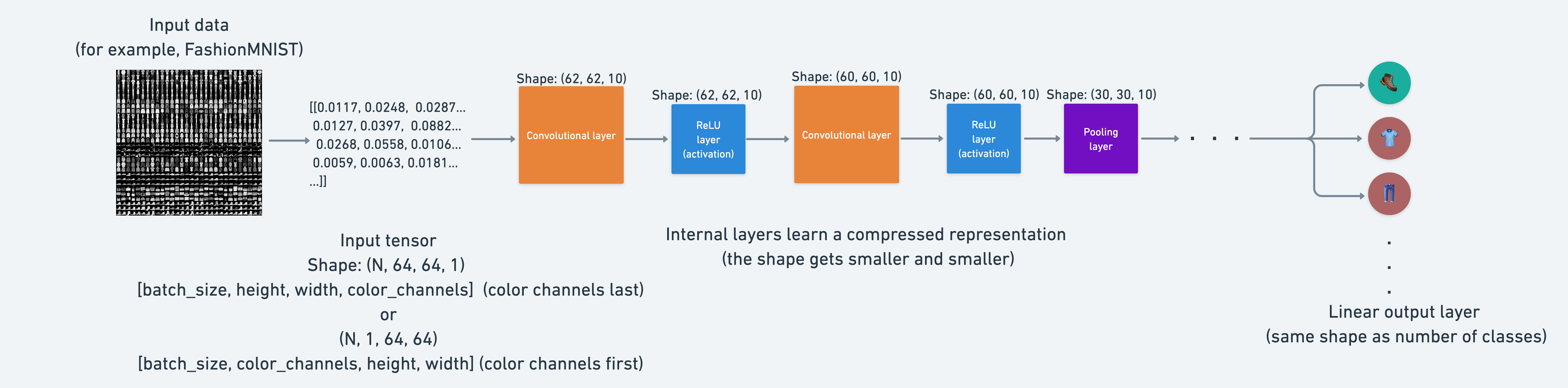
This means, that from the point of view of a neural network, intelligence is compression.
This is the idea of the use of a nn.MaxPool2d() layer: take the maximum value from a portion of a tensor and disregard the rest.
In essence, lowering the dimensionality of a tensor whilst still retaining a (hopefully) significant portion of the information.
It is the same story for a nn.Conv2d() layer.
Except instead of just taking the maximum, the nn.Conv2d() performs a conovlutional operation on the data (see this in action on the CNN Explainer webpage).
Exercise: What do you think the
nn.AvgPool2d()layer does? Try making a random tensor like we did above and passing it through. Check the input and output shapes as well as the input and output values.
Extra-curriculum: Lookup "most common convolutional neural networks", what architectures do you find? Are any of them contained within the
torchvision.modelslibrary? What do you think you could do with these?
# Setup loss and optimizer
loss_fn = nn.CrossEntropyLoss()
optimizer = torch.optim.SGD(params=model_2.parameters(),
lr=0.1)torch.manual_seed(42)
# Measure time
from timeit import default_timer as timer
train_time_start_model_2 = timer()
# Train and test model
epochs = 3
for epoch in range(epochs):
print(f"Epoch: {epoch}\n---------")
train_step(data_loader=train_dataloader,
model=model_2,
loss_fn=loss_fn,
optimizer=optimizer,
accuracy_fn=accuracy_fn,
device=device
)
test_step(data_loader=test_dataloader,
model=model_2,
loss_fn=loss_fn,
accuracy_fn=accuracy_fn,
device=device
)
train_time_end_model_2 = timer()
total_train_time_model_2 = print_train_time(start=train_time_start_model_2,
end=train_time_end_model_2,
device=device)Epoch: 0 --------- Train loss: 0.47664 | Train accuracy: 83.43% Test loss: 0.39195 | Test accuracy: 85.87% Epoch: 1 --------- Train loss: 0.47664 | Train accuracy: 83.43% Test loss: 0.34597 | Test accuracy: 87.10% Epoch: 2 --------- Train loss: 0.47664 | Train accuracy: 83.43% Test loss: 0.33714 | Test accuracy: 88.16% Train time on cuda: 21.591 seconds
# Get model_2 results
model_2_results = eval_model(
    model=model_2,
    data_loader=test_dataloader,
    loss_fn=loss_fn,
    accuracy_fn=accuracy_fn
)
model_2_results{'model_name': 'FashionMNISTModelV2',
'model_loss': 0.33714359998703003,
'model_acc': 88.15894568690096}import pandas as pd
compare_results = pd.DataFrame([model_0_results, model_1_results, model_2_results])
compare_results| model_name | model_loss | model_acc | |
|---|---|---|---|
| 0 | FashionMNISTModelV0 | 0.476639 | 83.426518 |
| 1 | FashionMNISTModelV1 | 0.685001 | 75.019968 |
| 2 | FashionMNISTModelV2 | 0.337144 | 88.158946 |
compare_results["training_time"] = [total_train_time_model_0,
                                    total_train_time_model_1,
                                    total_train_time_model_2]
compare_results| model_name | model_loss | model_acc | training_time | |
|---|---|---|---|---|
| 0 | FashionMNISTModelV0 | 0.476639 | 83.426518 | 15.525963 |
| 1 | FashionMNISTModelV1 | 0.685001 | 75.019968 | 17.822646 |
| 2 | FashionMNISTModelV2 | 0.337144 | 88.158946 | 21.590805 |
# Visualize our model results
compare_results.set_index("model_name")["model_acc"].plot(kind="bar", xlabel="model", ylabel="accuracy (%)");
def make_predictions(model, data, device=device):
    pred_probs = []
    model.eval()
    with torch.inference_mode():
        for sample in data:
            # Prepare sample
            sample = torch.unsqueeze(sample, dim=0).to(device) # Add an extra dimension and send sample to device

            # Forward pass (model outputs raw logit)
            pred_logit = model(sample)

            # Get prediction probability (logit -> prediction probability)
            pred_prob = torch.softmax(pred_logit.squeeze(), dim=0)

            # Get pred_prob off GPU for further calculations
            pred_probs.append(pred_prob.cpu())

    # Stack the pred_probs to turn list into a tensor
    return torch.stack(pred_probs)