mirror of
https://github.com/mrdbourke/pytorch-deep-learning.git
synced 2026-11-27 06:07:09 +00:00

39 KiB
39 KiB

In [1]:
import torch

# Check the version
print(f"PyTorch version: {torch.__version__}")
PyTorch version: 1.13.1
In [2]:
# Can also import the common abbreviation "nn" for "Neural Networks"
from torch import nn

# Almost everything in PyTorch is called a "Module" (you build neural networks by stacking together Modules)
this_is_a_module = nn.Linear(in_features=1,
                             out_features=1)
print(type(this_is_a_module))
<class 'torch.nn.modules.linear.Linear'>
In [3]:
# Import PyTorch Dataset (you can store your data here) and DataLoader (you can load your data here)
from torch.utils.data import Dataset, DataLoaderIn [4]:
# Create a single number tensor (scalar)
scalar = torch.tensor(7)
In [5]:
# Create a random tensor
random_tensor = torch.rand(size=(3, 4)) # this will create a tensor of size 3x4 but you can manipulate the shape how you want
In [6]:
# Multiply two random tensors
random_tensor_1 = torch.rand(size=(3, 4))
random_tensor_2 = torch.rand(size=(3, 4))
random_tensor_3 = random_tensor_1 * random_tensor_2 # PyTorch has support for most math operators in Python (+, *, -, /)In [7]:
# Base computer vision library
import torchvision

# Other components of TorchVision (premade datasets, pretrained models and image transforms)
from torchvision import datasets, models, transforms In [8]:
# Base text and natural language processing library
import torchtext

# Other components of TorchText (premade datasets, pretrained models and text transforms)
from torchtext import datasets, models, transformsIn [9]:
# Base audio and speech processing library
import torchaudio

# Other components of TorchAudio (premade datasets, pretrained models and text transforms)
from torchaudio import datasets, models, transformsIn [10]:
# # Base recommendation system library
# import torchrec

# # Other components of TorchRec
# from torchrec import datasets, modelsIn [11]:
# Setup device-agnostic code
if torch.cuda.is_available():
    device = "cuda" # NVIDIA GPU
elif torch.backends.mps.is_available():
    device = "mps" # Apple GPU
else:
    device = "cpu" # Defaults to CPU if NVIDIA GPU/Apple GPU aren't available

print(f"Using device: {device}")
Using device: mps
In [12]:
# Create a tensor
x = torch.tensor([1, 2, 3])
print(x.device) # defaults to CPU

# Send tensor to target device
x = x.to(device)
print(x.device)
cpu mps:0
In [13]:
import torch

# Set the random seed (you can set this to any number you like, it will "flavour"
# the randomness with that number.
torch.manual_seed(42)

# Create two random tensors
random_tensor_A = torch.rand(3, 4)

torch.manual_seed(42) # set the seed again (try commenting this out and see what happens)
random_tensor_B = torch.rand(3, 4)

print(f"Tensor A:\n{random_tensor_A}\n")
print(f"Tensor B:\n{random_tensor_B}\n")
print(f"Does Tensor A equal Tensor B? (anywhere)")
random_tensor_A == random_tensor_B
Out [13]:
Tensor A:
tensor([[0.8823, 0.9150, 0.3829, 0.9593],
        [0.3904, 0.6009, 0.2566, 0.7936],
        [0.9408, 0.1332, 0.9346, 0.5936]])

Tensor B:
tensor([[0.8823, 0.9150, 0.3829, 0.9593],
        [0.3904, 0.6009, 0.2566, 0.7936],
        [0.9408, 0.1332, 0.9346, 0.5936]])

Does Tensor A equal Tensor B? (anywhere)
tensor([[True, True, True, True],
        [True, True, True, True],
[True, True, True, True]])In [14]:
# Set random seed on GPU
torch.cuda.manual_seed(42)In [15]:
from torch import nnIn [16]:
# Create a linear layer with 10 in features and out features
linear_layer = nn.Linear(in_features=10,
                         out_features=10)
In [17]:
# Create an Identity layer
identity_layer = nn.Identity()In [18]:
# Create a Conv1d layer (often used for text with a singular dimension)
conv1d = nn.Conv1d(in_channels=1,
                   out_channels=10,
                   kernel_size=3)
In [19]:
# Create a Conv2d layer (often used for images with Height x Width dimensions)
conv2d = nn.Conv2d(in_channels=3, # 3 channels for color images (red, green, blue)
                   out_channels=10,
                   kernel_size=3)
In [20]:
# Create a Conv3d layer (often used for video with Height x Width x Time dimensions)
conv3d = nn.Conv3d(in_channels=3,
                   out_channels=10,
kernel_size=3)In [21]:
# Create a Transformer model (model based on the paper "Attention Is All You Need" - https://arxiv.org/abs/1706.03762)
transformer_model = nn.Transformer()
In [22]:
# Create a single Transformer encoder cell
transformer_encoder = nn.TransformerEncoderLayer(d_model=768, # embedding dimension
                                                 nhead=12) # number of attention heads
In [23]:
# Stack together Transformer encoder cells
transformer_encoder_stack = nn.TransformerEncoder(encoder_layer=transformer_encoder, # from above
                                                  num_layers=6) # 6 Transformer encoders stacked on top of each other
In [24]:
# Create a single Transformer decoder cell
transformer_decoder = nn.TransformerDecoderLayer(d_model=768,
                                                 nhead=12)
In [25]:
# Stack together Transformer decoder cells
transformer_decoder_stack = nn.TransformerDecoder(decoder_layer=transformer_decoder, # from above
num_layers=6) # 6 Transformer decoders stacked on top of each otherIn [26]:
# Create a single LSTM cell
lstm_cell = nn.LSTMCell(input_size=10, # can adjust as necessary
                        hidden_size=10) # can adjust as necessary
In [27]:
# Stack together LSTM cells
lstm_stack = nn.LSTM(input_size=10,
                     hidden_size=10,
                     num_layers=3) # 3 single LSTM cells stacked on top of each other
In [28]:
# Create a single GRU cell
gru_cell = nn.GRUCell(input_size=10, # can adjust as necessary
                      hidden_size=10) # can adjust as necessary
In [29]:
# Stack together GRU cells
gru_stack = nn.GRU(input_size=10,
                   hidden_size=10,
num_layers=3) # 3 single GRU cells stacked on top of each other In [30]:
# ReLU
relu = nn.ReLU()

# Sigmoid
sigmoid = nn.Sigmoid()

# Softmax
softmax = nn.Softmax()In [31]:
# L1Loss
loss_fn = nn.L1Loss() # also known as MAE or mean absolute error

# MSELoss
loss_fn = nn.MSELoss() # also known as MSE or mean squared error

# Binary cross entropy (for binary classification problems)
loss_fn = nn.BCEWithLogitsLoss()

# Cross entropy (for multi-class classification problems)
loss_fn = nn.CrossEntropyLoss()In [32]:
# Create a baseline model
model = nn.Transformer()

# SGD (stochastic gradient descent)
optimizer = torch.optim.SGD(lr=0.1, # set the learning rate (required)
                            params=model.parameters()) # tell the optimizer what parameters to optimize
In [33]:
# Create a baseline model
model = nn.Transformer()

# Adam optimizer
optimizer = torch.optim.Adam(lr=0.001, # set the learning rate (required)
                             params=model.parameters()) # tell the optimizer what parameters to optimize
End-to-end example workflow
Let's put everything together in a quick end-to-end workflow.
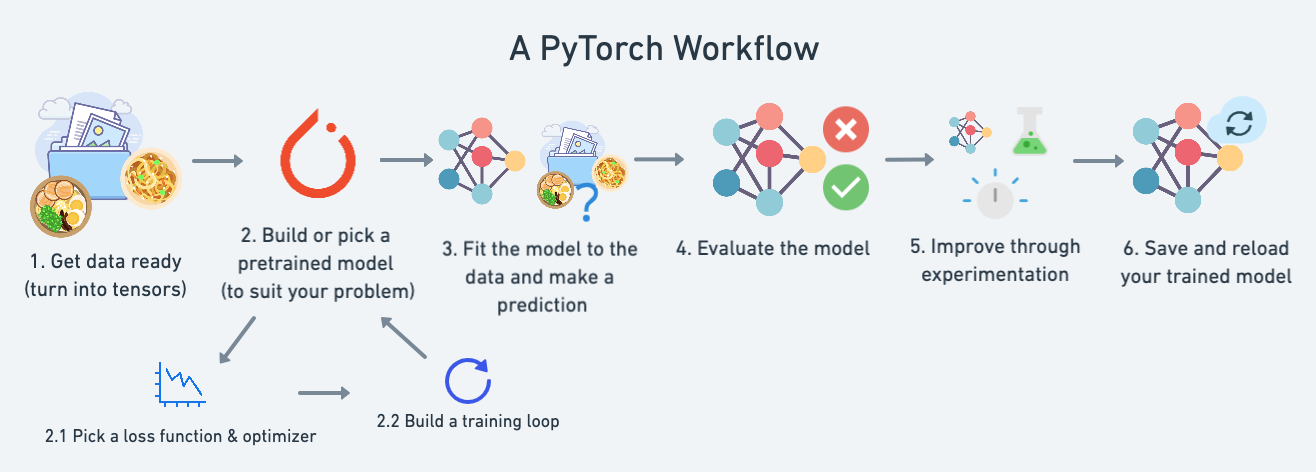
This workflow has been taken from 01. PyTorch Workflow Fundamentals.
In [34]:
# Create *known* parameters
weight = 0.7
bias = 0.3

# Create data
start = 0
end = 1
step = 0.02
X = torch.arange(start, end, step).unsqueeze(dim=1) # data
y = weight * X + bias # labels (want model to learn from data to predict these)

X[:10], y[:10]
Out [34]:
(tensor([[0.0000],
         [0.0200],
         [0.0400],
         [0.0600],
         [0.0800],
         [0.1000],
         [0.1200],
         [0.1400],
         [0.1600],
         [0.1800]]),
 tensor([[0.3000],
         [0.3140],
         [0.3280],
         [0.3420],
         [0.3560],
         [0.3700],
         [0.3840],
         [0.3980],
         [0.4120],
         [0.4260]]))
In [35]:
# Create train/test split
train_split = int(0.8 * len(X)) # 80% of data used for training set, 20% for testing
X_train, y_train = X[:train_split], y[:train_split]
X_test, y_test = X[train_split:], y[train_split:]

len(X_train), len(y_train), len(X_test), len(y_test)
Out [35]:
(40, 40, 10, 10)
In [36]:
from torch import nn

# Option 1 - subclass torch.nn.Module
class LinearRegressionModel(nn.Module):
    def __init__(self):
        super().__init__()
        # Use nn.Linear() for creating the model parameters
        self.linear_layer = nn.Linear(in_features=1,
                                      out_features=1)

    # Define the forward computation (input data x flows through nn.Linear())
    def forward(self, x: torch.Tensor) -> torch.Tensor:
        return self.linear_layer(x)

model_0 = LinearRegressionModel()
model_0, model_0.state_dict()
Out [36]:
(LinearRegressionModel(
   (linear_layer): Linear(in_features=1, out_features=1, bias=True)
 ),
 OrderedDict([('linear_layer.weight', tensor([[0.5025]])),
('linear_layer.bias', tensor([-0.0722]))]))In [37]:
from torch import nn

# Option 2 - use torch.nn.Sequential
model_1 = torch.nn.Sequential(
    nn.Linear(in_features=1,
              out_features=1))

model_1, model_1.state_dict()
Out [37]:
(Sequential(
   (0): Linear(in_features=1, out_features=1, bias=True)
 ),
OrderedDict([('0.weight', tensor([[0.9905]])), ('0.bias', tensor([0.9053]))]))In [38]:
# Create loss function
loss_fn = nn.L1Loss()

# Create optimizer
optimizer = torch.optim.SGD(params=model_1.parameters(), # optimize newly created model's parameters
lr=0.01)In [40]:
torch.manual_seed(42)

# Set the number of epochs
epochs = 1000

# Put data on the available device
# Without this, an error will happen (not all data on target device)
X_train = X_train.to(device)
X_test = X_test.to(device)
y_train = y_train.to(device)
y_test = y_test.to(device)

# Put model on the available device
# With this, an error will happen (the model is not on target device)
model_1 = model_1.to(device)

for epoch in range(epochs):
    ### Training
    model_1.train() # train mode is on by default after construction

    # 1. Forward pass
    y_pred = model_1(X_train)

    # 2. Calculate loss
    loss = loss_fn(y_pred, y_train)

    # 3. Zero grad optimizer
    optimizer.zero_grad()

    # 4. Loss backward
    loss.backward()

    # 5. Step the optimizer
    optimizer.step()

    ### Testing
    model_1.eval() # put the model in evaluation mode for testing (inference)
    # 1. Forward pass
    with torch.inference_mode():
        test_pred = model_1(X_test)

        # 2. Calculate the loss
        test_loss = loss_fn(test_pred, y_test)

    if epoch % 100 == 0:
        print(f"Epoch: {epoch} | Train loss: {loss} | Test loss: {test_loss}")
Epoch: 0 | Train loss: 0.008362661115825176 | Test loss: 0.005596190690994263 Epoch: 100 | Train loss: 0.008362661115825176 | Test loss: 0.005596190690994263 Epoch: 200 | Train loss: 0.008362661115825176 | Test loss: 0.005596190690994263 Epoch: 300 | Train loss: 0.008362661115825176 | Test loss: 0.005596190690994263 Epoch: 400 | Train loss: 0.008362661115825176 | Test loss: 0.005596190690994263 Epoch: 500 | Train loss: 0.008362661115825176 | Test loss: 0.005596190690994263 Epoch: 600 | Train loss: 0.008362661115825176 | Test loss: 0.005596190690994263 Epoch: 700 | Train loss: 0.008362661115825176 | Test loss: 0.005596190690994263 Epoch: 800 | Train loss: 0.008362661115825176 | Test loss: 0.005596190690994263 Epoch: 900 | Train loss: 0.008362661115825176 | Test loss: 0.005596190690994263