
168 KiB

import datetime
print(f"Notebook last updated: {datetime.datetime.now()}")
Notebook last updated: 2023-04-14 15:24:37.007274
import torch
import torchvision

model = torchvision.models.resnet50() # note: this could be any model

### Train model ###

### Test model ###import torch
import torchvision
model = torchvision.models.resnet50() # note: this could be any model
compiled_model = torch.compile(model) # <- magic happens!
### Train model ### <- faster!
### Test model ### <- faster!Speedups
Ok so the focus of PyTorch 2.0 is speed, how much faster is it actually?
The PyTorch team ran tests across 163 open-source models from Hugging Face Transformers, timm (PyTorch Image Models) and TorchBench (a curated set of popular code bases from across GitHub).
This is important because unless PyTorch 2.0 is faster on models people actually use, it’s not faster.
Using a mixture of AMP (automatic mixed precision or float16) training and float32 precision (higher precision requires more compute) the PyTorch team found that torch.compile() provides an average speedup of 43% in training on a NVIDIA A100 GPU.
Or 38% on timm, 76% on TorchBench and 52% on Hugging Face Transformers.
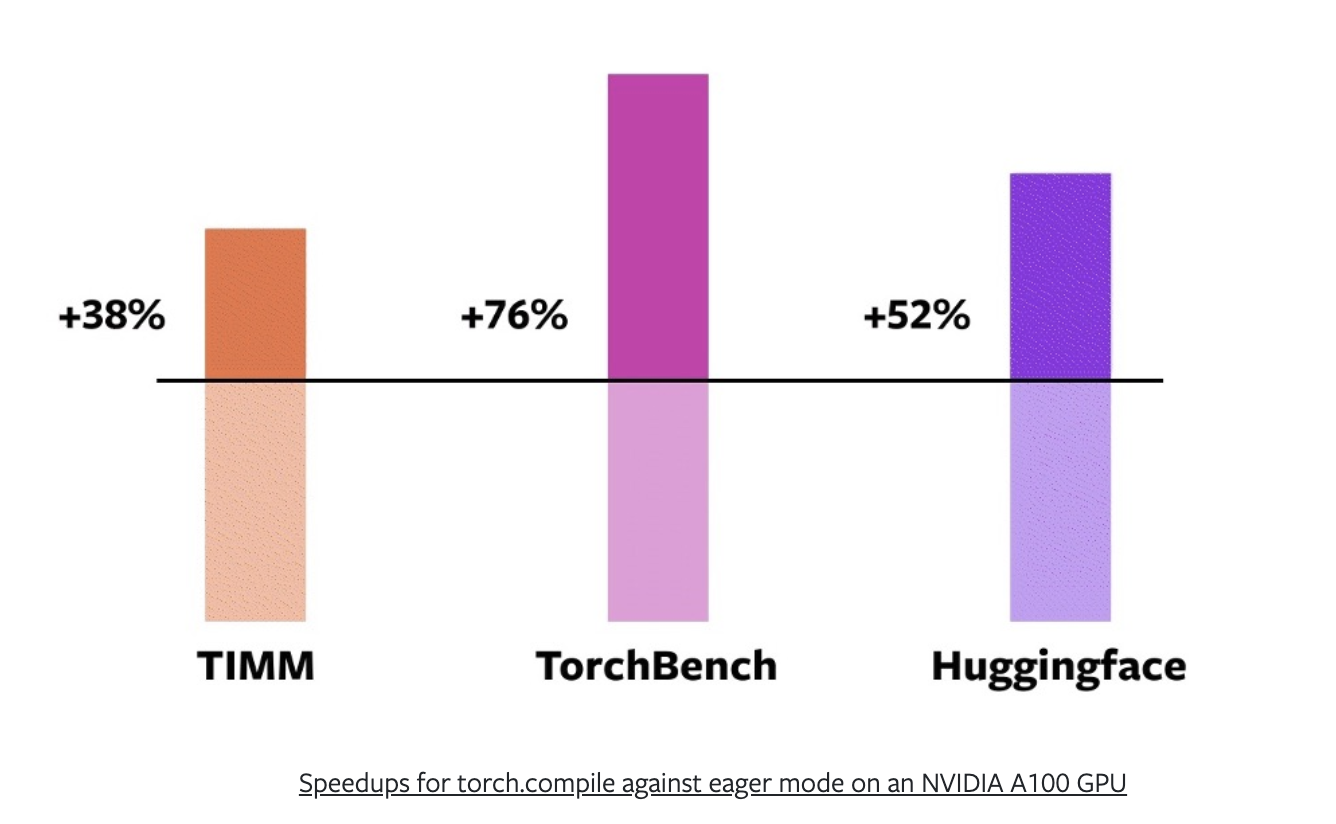
PyTorch 2.0 speedups across various models from different locations. Source: PyTorch 2.0 announcement post.
Fusion
Fusion, also known as operator fusion is one of the best ways to make deep learning models go brrrrrr (brrrrrr is the sound your GPUs fan make when your models are training).
Operator fusion condenses (like Dragon Ball Z) many operations into one (or many to less).
Why?
Modern GPUs have so much compute power they are often not compute limited, as in, the main bottleneck to training models is how fast can you get data from your CPU to your GPU. This is known as bandwidth or memory bandwidth.
You want to reduce your bandwidth costs as much as possible.
And feed the data hungry GPUs with as much data as possible.
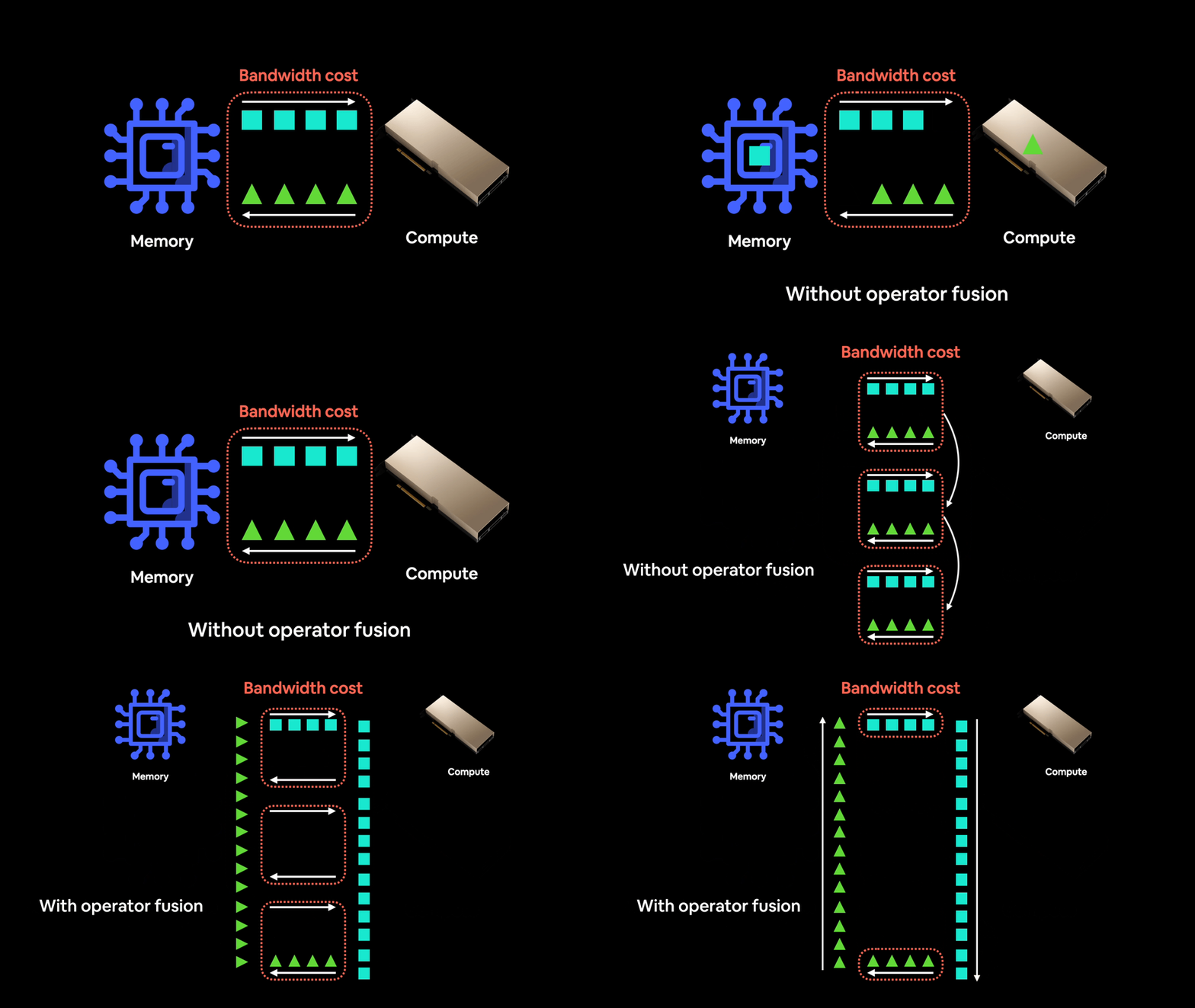
So instead of performing an operation on a piece of data and then saving the result to memory (increased bandwidth costs), you chain together as many operations as possible via fusion.
A rough analogy would be using a blender to make a smoothie.
Most blenders are good at blending things (like GPUs are good at performing matrix multiplications).
Using a blender without operator fusion would be like adding each ingredient one by one and blending each time a new ingredient is added. Not only is this insane, it increases your bandwidth cost.
The actual blending is fast each time (like GPU computations generally are) but you lose a bunch of time adding each ingredient one by one.
Using a blender with operator fusion is akin to using a blender by adding all the ingredients at the start (operator fusion) and then performing the blend once.
You lose a little time adding at the start but you gain all of the lost memory bandwidth time back.
Graph capture
Graph capture I’m less confident explaining.
But the way I think about is that graph capture or graph tracing is:
- Going through a series of operations that need to happen, such as the operations in a neural network.
- And capturing or tracing what needs to happen ahead of time.
Computing without graph capture is like going to a new area and following GPS directions turn by turn.
As a good human driver, you can follow the turns quite easily but you still have to think about each turn you take.
This is the equivalent to PyTorch having to look up what each operation does as it does it.
As in, to perform an addition, it has to look up what an addition does before it can perform it.
It does this quickly but there’s still non-zero overhead.

Example of graph capture, mapping out the steps in a neural network and then capturing every operation that needs to happen ahead of time.
Computing with graph capture is like driving through your own neighbourhood.
You barely think about what turns to make.
Sometimes you get out of the car and realise you can’t remember the last 5 minutes of the drive.
Your brain was functioning on autopilot, minimal overhead.
However, it took you some time upfront to remember how to drive to your house.
This is a caveat of graph capture, it takes a little time upfront to memorize the operations that need to happen but subsequent computations should be faster.
Of course, this is a quick high-level overview of what’s happening behind the scenes of torch.compile()but it's how I understand it.
For more on fusion and graph tracing, I’d recommend Horace He’s Making Deep Learning Go Brrrr From First Principles blog post.
Things to note
Since PyTorch 2.0 was just released, there are a few limitations with some of the features.
One of the main ones being with exporting models.
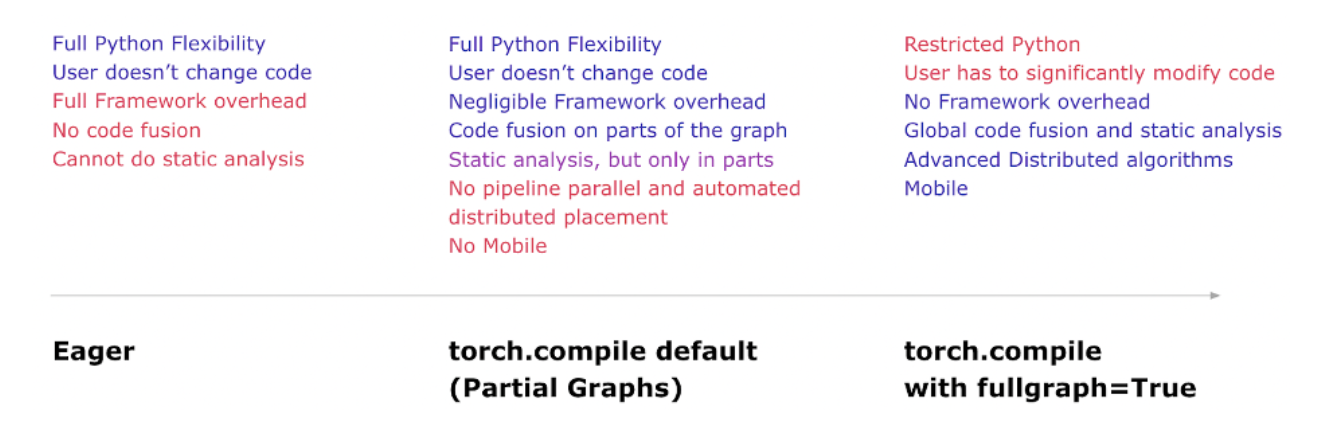
There are a few caveats when using the PyTorch 2.0 features, such as not being about to export to mobile devices when using the torch.compile() default options. However, there are work arounds to this and improved exporting is on the PyTorch 2.x roadmap. Source: PyTorch 2.0 announcement post.
However, these will likely be fixed in future releases.
Another main limitation is that because the features of PyTorch 2.0 are designed for newer hardware, old GPUs and desktop-class GPUs (e.g. NVIDIA RTX 30 series) will likely see less speedups than newer hardware.
import torch

# Check PyTorch version
pt_version = torch.__version__
print(f"[INFO] Current PyTorch version: {pt_version} (should be 2.x+)")

# Install PyTorch 2.0 if necessary
if pt_version.split(".")[0] == "1": # Check if PyTorch version begins with 1
    !pip3 install -U torch torchvision torchaudio --index-url https://download.pytorch.org/whl/cu118
    print("[INFO] PyTorch 2.x installed, if you're on Google Colab, you may need to restart your runtime.\
          Though as of April 2023, Google Colab comes with PyTorch 2.0 pre-installed.")
    import torch
    pt_version = torch.__version__
    print(f"[INFO] Current PyTorch version: {pt_version} (should be 2.x+)")
else:
    print("[INFO] PyTorch 2.x installed, you'll be able to use the new features.")
[INFO] Current PyTorch version: 2.0.0+cu118 (should be 2.x+) [INFO] PyTorch 2.x installed, you'll be able to use the new features.
# Make sure we're using a NVIDIA GPU
if torch.cuda.is_available():
  gpu_info = !nvidia-smi
  gpu_info = '\n'.join(gpu_info)
  if gpu_info.find("failed") >= 0:
    print("Not connected to a GPU, to leverage the best of PyTorch 2.0, you should connect to a GPU.")

  # Get GPU name
  gpu_name = !nvidia-smi --query-gpu=gpu_name --format=csv
  gpu_name = gpu_name[1]
  GPU_NAME = gpu_name.replace(" ", "_") # remove underscores for easier saving
  print(f'GPU name: {GPU_NAME}')

  # Get GPU capability score
  GPU_SCORE = torch.cuda.get_device_capability()
  print(f"GPU capability score: {GPU_SCORE}")
  if GPU_SCORE >= (8, 0):
    print(f"GPU score higher than or equal to (8, 0), PyTorch 2.x speedup features available.")
  else:
    print(f"GPU score lower than (8, 0), PyTorch 2.x speedup features will be limited (PyTorch 2.x speedups happen most on newer GPUs).")

  # Print GPU info
  print(f"GPU information:\n{gpu_info}")

else:
  print("PyTorch couldn't find a GPU, to leverage the best of PyTorch 2.0, you should connect to a GPU.")
GPU name: NVIDIA_TITAN_RTX
GPU capability score: (7, 5)
GPU score lower than (8, 0), PyTorch 2.x speedup features will be limited (PyTorch 2.x speedups happen most on newer GPUs).
GPU information:
Fri Apr 14 15:24:38 2023
+-----------------------------------------------------------------------------+
| NVIDIA-SMI 525.89.02 Driver Version: 525.89.02 CUDA Version: 12.0 |
|-------------------------------+----------------------+----------------------+
| GPU Name Persistence-M| Bus-Id Disp.A | Volatile Uncorr. ECC |
| Fan Temp Perf Pwr:Usage/Cap| Memory-Usage | GPU-Util Compute M. |
| | | MIG M. |
|===============================+======================+======================|
| 0 NVIDIA TITAN RTX Off | 00000000:01:00.0 Off | N/A |
| 40% 50C P8 9W / 280W | 260MiB / 24576MiB | 0% Default |
| | | N/A |
+-------------------------------+----------------------+----------------------+
+-----------------------------------------------------------------------------+
| Processes: |
| GPU GI CI PID Type Process name GPU Memory |
| ID ID Usage |
|=============================================================================|
| 0 N/A N/A 1020 G /usr/lib/xorg/Xorg 53MiB |
| 0 N/A N/A 1415245 G /usr/lib/xorg/Xorg 162MiB |
| 0 N/A N/A 1415374 G /usr/bin/gnome-shell 8MiB |
+-----------------------------------------------------------------------------+
import torch

# Set the device
device = "cuda" if torch.cuda.is_available() else "cpu"

# Set the device with context manager (requires PyTorch 2.x+)
with torch.device(device):
    # All tensors created in this block will be on device
    layer = torch.nn.Linear(20, 30)
    print(f"Layer weights are on device: {layer.weight.device}")
    print(f"Layer creating data on device: {layer(torch.randn(128, 20)).device}")
Layer weights are on device: cuda:0 Layer creating data on device: cuda:0
import torch

# Set the device
device = "cuda" if torch.cuda.is_available() else "cpu"

# Set the device globally
torch.set_default_device(device)

# All tensors created will be on the global device by default
layer = torch.nn.Linear(20, 30)
print(f"Layer weights are on device: {layer.weight.device}")
print(f"Layer creating data on device: {layer(torch.randn(128, 20)).device}")
Layer weights are on device: cuda:0 Layer creating data on device: cuda:0
import torch

# Set the device globally
torch.set_default_device("cpu")

# All tensors created will be on "cpu"
layer = torch.nn.Linear(20, 30)
print(f"Layer weights are on device: {layer.weight.device}")
print(f"Layer creating data on device: {layer(torch.randn(128, 20)).device}")
Layer weights are on device: cpu Layer creating data on device: cpu
import torch
import torchvision

print(f"PyTorch version: {torch.__version__}")
print(f"TorchVision version: {torchvision.__version__}")

# Set the target device
device = "cuda" if torch.cuda.is_available() else "cpu"

print(f"Using device: {device}")
PyTorch version: 2.0.0+cu118 TorchVision version: 0.15.1+cu118 Using device: cuda
# Create model weights and transforms
model_weights = torchvision.models.ResNet50_Weights.IMAGENET1K_V2 # <- use the latest weights (could also use .DEFAULT)
transforms = model_weights.transforms()

# Setup model
model = torchvision.models.resnet50(weights=model_weights)

# Count the number of parameters in the model
total_params = sum(
    param.numel() for param in model.parameters() # <- all params
	# param.numel() for param in model.parameters() if param.requires_grad # <- only trainable params
)

print(f"Total parameters of model: {total_params} (the more parameters, the more GPU memory the model will use, the more *relative* of a speedup you'll get)")
print(f"Model transforms:\n{transforms}")
Total parameters of model: 25557032 (the more parameters, the more GPU memory the model will use, the more *relative* of a speedup you'll get)
Model transforms:
ImageClassification(
crop_size=[224]
resize_size=[232]
mean=[0.485, 0.456, 0.406]
std=[0.229, 0.224, 0.225]
interpolation=InterpolationMode.BILINEAR
)
def create_model(num_classes=10):
  """
  Creates a ResNet50 model with the latest weights and transforms via torchvision.
  """
  model_weights = torchvision.models.ResNet50_Weights.IMAGENET1K_V2
  transforms = model_weights.transforms()
  model = torchvision.models.resnet50(weights=model_weights)

  # Adjust the number of output features in model to match the number of classes in the dataset
  model.fc = torch.nn.Linear(in_features=2048,
                             out_features=num_classes)
  return model, transforms

model, transforms = create_model()
2.2 Speedups are most noticeable when a large portion of the GPU is being used
Since modern GPUs are so fast at performing operations, you will often notice the majority of relative speedups when as much data as possible is on the GPU.
This can be achieved by:
- Increasing the batch size - More samples per batch means more samples on the GPU, for example, using a batch size of 256 instead of 32.
- Increasing data size - For example, using larger image size, 224x224 instead of 32x32. A larger data size means that more tensor operations will be happening on the GPU.
- Increasing model size - For example, using a larger model such as ResNet101 instead of ResNet50. A larger model means that more tensor operations will be happening on the GPU.
- Decreasing data transfer - For example, setting up all your tensors to be on GPU memory, this minizes the amount of data transfer between the CPU and GPU.
All of these result in more data being on the GPU.
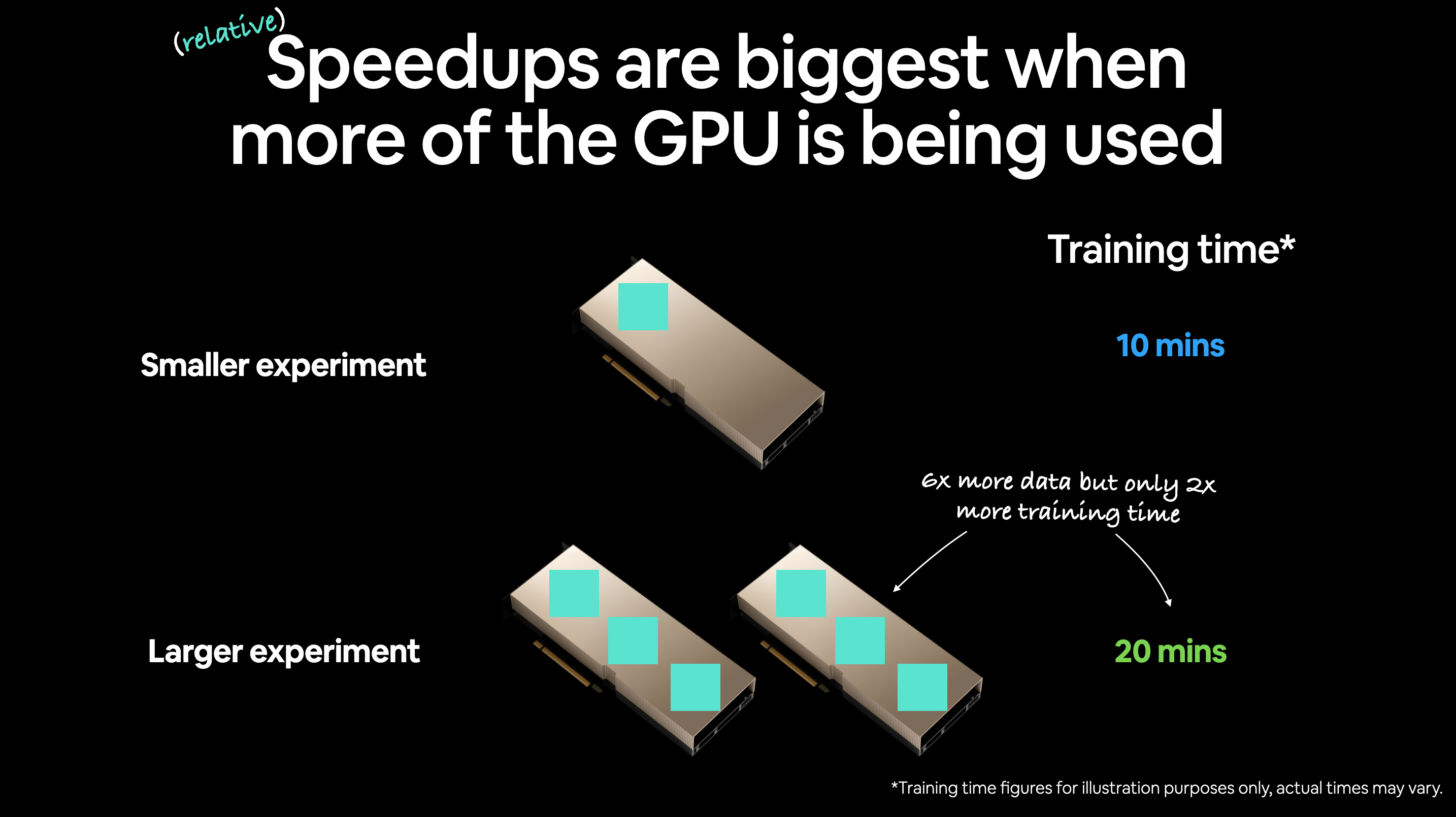
You may be thinking, "but doesn't this mean that the GPU will be slower because it has to do more work?"
This is correct, operations may take longer when using more data on the GPU, however, they benefit from parallelism (many operations happening at once).
This means that although more operations are happening, the GPU is performing as many of them as possible simultaneously.
So while you may see speedups with smaller datasets, models, batch sizes and data sizes, however, you will tend to see the biggest relative speedups with increasing scale.
# Check available GPU memory and total GPU memory
total_free_gpu_memory, total_gpu_memory = torch.cuda.mem_get_info()
print(f"Total free GPU memory: {round(total_free_gpu_memory * 1e-9, 3)} GB")
print(f"Total GPU memory: {round(total_gpu_memory * 1e-9, 3)} GB")
Total free GPU memory: 24.187 GB Total GPU memory: 25.386 GB
# Set batch size depending on amount of GPU memory
total_free_gpu_memory_gb = round(total_free_gpu_memory * 1e-9, 3)
if total_free_gpu_memory_gb >= 16:
  BATCH_SIZE = 128 # Note: you could experiment with higher values here if you like.
  IMAGE_SIZE = 224
  print(f"GPU memory available is {total_free_gpu_memory_gb} GB, using batch size of {BATCH_SIZE} and image size {IMAGE_SIZE}")
else:
  BATCH_SIZE = 32
  IMAGE_SIZE = 128
  print(f"GPU memory available is {total_free_gpu_memory_gb} GB, using batch size of {BATCH_SIZE} and image size {IMAGE_SIZE}")
GPU memory available is 24.187 GB, using batch size of 128 and image size 224
transforms.crop_size = IMAGE_SIZE
transforms.resize_size = IMAGE_SIZE
print(f"Updated data transforms:\n{transforms}")
Updated data transforms:
ImageClassification(
crop_size=224
resize_size=224
mean=[0.485, 0.456, 0.406]
std=[0.229, 0.224, 0.225]
interpolation=InterpolationMode.BILINEAR
)
if GPU_SCORE >= (8, 0):
  print(f"[INFO] Using GPU with score: {GPU_SCORE}, enabling TensorFloat32 (TF32) computing (faster on new GPUs)")
  torch.backends.cuda.matmul.allow_tf32 = True
else:
  print(f"[INFO] Using GPU with score: {GPU_SCORE}, TensorFloat32 (TF32) not available, to use it you need a GPU with score >= (8, 0)")
  torch.backends.cuda.matmul.allow_tf32 = False
[INFO] Using GPU with score: (7, 5), TensorFloat32 (TF32) not available, to use it you need a GPU with score >= (8, 0)
# Create train and test datasets
train_dataset = torchvision.datasets.CIFAR10(root='.',
                                             train=True,
                                             download=True,
                                             transform=transforms)

test_dataset = torchvision.datasets.CIFAR10(root='.',
                                            train=False, # want the test split
                                            download=True,
                                            transform=transforms)

# Get the lengths of the datasets
train_len = len(train_dataset)
test_len = len(test_dataset)

print(f"[INFO] Train dataset length: {train_len}")
print(f"[INFO] Test dataset length: {test_len}")
Files already downloaded and verified Files already downloaded and verified [INFO] Train dataset length: 50000 [INFO] Test dataset length: 10000
from torch.utils.data import DataLoader

# Create DataLoaders
import os
NUM_WORKERS = os.cpu_count() # <- use all available CPU cores (this number can be tweaked through experimentation but generally more workers means faster dataloading from CPU to GPU)

train_dataloader = DataLoader(dataset=train_dataset,
                              batch_size=BATCH_SIZE,
                              shuffle=True,
                              num_workers=NUM_WORKERS)

test_dataloader = DataLoader(dataset=test_dataset,
                              batch_size=BATCH_SIZE,
                              shuffle=False,
                              num_workers=NUM_WORKERS)

# Print details
print(f"Train dataloader length: {len(train_dataloader)} batches of size {BATCH_SIZE}")
print(f"Test dataloader length: {len(test_dataloader)} batches of size {BATCH_SIZE}")
print(f"Using number of workers: {NUM_WORKERS} (generally more workers means faster dataloading from CPU to GPU)")
Train dataloader length: 391 batches of size 128 Test dataloader length: 79 batches of size 128 Using number of workers: 16 (generally more workers means faster dataloading from CPU to GPU)
import time
from tqdm.auto import tqdm
from typing import Dict, List, Tuple

def train_step(epoch: int,
               model: torch.nn.Module,
               dataloader: torch.utils.data.DataLoader,
               loss_fn: torch.nn.Module,
               optimizer: torch.optim.Optimizer,
               device: torch.device,
               disable_progress_bar: bool = False) -> Tuple[float, float]:
  """Trains a PyTorch model for a single epoch.

  Turns a target PyTorch model to training mode and then
  runs through all of the required training steps (forward
  pass, loss calculation, optimizer step).

  Args:
    model: A PyTorch model to be trained.
    dataloader: A DataLoader instance for the model to be trained on.
    loss_fn: A PyTorch loss function to minimize.
    optimizer: A PyTorch optimizer to help minimize the loss function.
    device: A target device to compute on (e.g. "cuda" or "cpu").

  Returns:
    A tuple of training loss and training accuracy metrics.
    In the form (train_loss, train_accuracy). For example:

    (0.1112, 0.8743)
  """
  # Put model in train mode
  model.train()

  # Setup train loss and train accuracy values
  train_loss, train_acc = 0, 0

  # Loop through data loader data batches
  progress_bar = tqdm(
        enumerate(dataloader),
        desc=f"Training Epoch {epoch}",
        total=len(dataloader),
        disable=disable_progress_bar
    )

  for batch, (X, y) in progress_bar:
      # Send data to target device
      X, y = X.to(device), y.to(device)

      # 1. Forward pass
      y_pred = model(X)

      # 2. Calculate  and accumulate loss
      loss = loss_fn(y_pred, y)
      train_loss += loss.item()

      # 3. Optimizer zero grad
      optimizer.zero_grad()

      # 4. Loss backward
      loss.backward()

      # 5. Optimizer step
      optimizer.step()

      # Calculate and accumulate accuracy metric across all batches
      y_pred_class = torch.argmax(torch.softmax(y_pred, dim=1), dim=1)
      train_acc += (y_pred_class == y).sum().item()/len(y_pred)

      # Update progress bar
      progress_bar.set_postfix(
            {
                "train_loss": train_loss / (batch + 1),
                "train_acc": train_acc / (batch + 1),
            }
        )


  # Adjust metrics to get average loss and accuracy per batch
  train_loss = train_loss / len(dataloader)
  train_acc = train_acc / len(dataloader)
  return train_loss, train_acc

def test_step(epoch: int,
              model: torch.nn.Module,
              dataloader: torch.utils.data.DataLoader,
              loss_fn: torch.nn.Module,
              device: torch.device,
              disable_progress_bar: bool = False) -> Tuple[float, float]:
  """Tests a PyTorch model for a single epoch.

  Turns a target PyTorch model to "eval" mode and then performs
  a forward pass on a testing dataset.

  Args:
    model: A PyTorch model to be tested.
    dataloader: A DataLoader instance for the model to be tested on.
    loss_fn: A PyTorch loss function to calculate loss on the test data.
    device: A target device to compute on (e.g. "cuda" or "cpu").

  Returns:
    A tuple of testing loss and testing accuracy metrics.
    In the form (test_loss, test_accuracy). For example:

    (0.0223, 0.8985)
  """
  # Put model in eval mode
  model.eval()

  # Setup test loss and test accuracy values
  test_loss, test_acc = 0, 0

  # Loop through data loader data batches
  progress_bar = tqdm(
      enumerate(dataloader),
      desc=f"Testing Epoch {epoch}",
      total=len(dataloader),
      disable=disable_progress_bar
  )

  # Turn on inference context manager
  with torch.no_grad(): # no_grad() required for PyTorch 2.0, I found some errors with `torch.inference_mode()`, please let me know if this is not the case
      # Loop through DataLoader batches
      for batch, (X, y) in progress_bar:
          # Send data to target device
          X, y = X.to(device), y.to(device)

          # 1. Forward pass
          test_pred_logits = model(X)

          # 2. Calculate and accumulate loss
          loss = loss_fn(test_pred_logits, y)
          test_loss += loss.item()

          # Calculate and accumulate accuracy
          test_pred_labels = test_pred_logits.argmax(dim=1)
          test_acc += ((test_pred_labels == y).sum().item()/len(test_pred_labels))

          # Update progress bar
          progress_bar.set_postfix(
              {
                  "test_loss": test_loss / (batch + 1),
                  "test_acc": test_acc / (batch + 1),
              }
          )

  # Adjust metrics to get average loss and accuracy per batch
  test_loss = test_loss / len(dataloader)
  test_acc = test_acc / len(dataloader)
  return test_loss, test_acc

def train(model: torch.nn.Module,
          train_dataloader: torch.utils.data.DataLoader,
          test_dataloader: torch.utils.data.DataLoader,
          optimizer: torch.optim.Optimizer,
          loss_fn: torch.nn.Module,
          epochs: int,
          device: torch.device,
          disable_progress_bar: bool = False) -> Dict[str, List]:
  """Trains and tests a PyTorch model.

  Passes a target PyTorch models through train_step() and test_step()
  functions for a number of epochs, training and testing the model
  in the same epoch loop.

  Calculates, prints and stores evaluation metrics throughout.

  Args:
    model: A PyTorch model to be trained and tested.
    train_dataloader: A DataLoader instance for the model to be trained on.
    test_dataloader: A DataLoader instance for the model to be tested on.
    optimizer: A PyTorch optimizer to help minimize the loss function.
    loss_fn: A PyTorch loss function to calculate loss on both datasets.
    epochs: An integer indicating how many epochs to train for.
    device: A target device to compute on (e.g. "cuda" or "cpu").

  Returns:
    A dictionary of training and testing loss as well as training and
    testing accuracy metrics. Each metric has a value in a list for
    each epoch.
    In the form: {train_loss: [...],
                  train_acc: [...],
                  test_loss: [...],
                  test_acc: [...]}
    For example if training for epochs=2:
                 {train_loss: [2.0616, 1.0537],
                  train_acc: [0.3945, 0.3945],
                  test_loss: [1.2641, 1.5706],
                  test_acc: [0.3400, 0.2973]}
  """
  # Create empty results dictionary
  results = {"train_loss": [],
      "train_acc": [],
      "test_loss": [],
      "test_acc": [],
      "train_epoch_time": [],
      "test_epoch_time": []
  }

  # Loop through training and testing steps for a number of epochs
  for epoch in tqdm(range(epochs), disable=disable_progress_bar):

      # Perform training step and time it
      train_epoch_start_time = time.time()
      train_loss, train_acc = train_step(epoch=epoch,
                                        model=model,
                                        dataloader=train_dataloader,
                                        loss_fn=loss_fn,
                                        optimizer=optimizer,
                                        device=device,
                                        disable_progress_bar=disable_progress_bar)
      train_epoch_end_time = time.time()
      train_epoch_time = train_epoch_end_time - train_epoch_start_time

      # Perform testing step and time it
      test_epoch_start_time = time.time()
      test_loss, test_acc = test_step(epoch=epoch,
                                      model=model,
                                      dataloader=test_dataloader,
                                      loss_fn=loss_fn,
                                      device=device,
                                      disable_progress_bar=disable_progress_bar)
      test_epoch_end_time = time.time()
      test_epoch_time = test_epoch_end_time - test_epoch_start_time

      # Print out what's happening
      print(
          f"Epoch: {epoch+1} | "
          f"train_loss: {train_loss:.4f} | "
          f"train_acc: {train_acc:.4f} | "
          f"test_loss: {test_loss:.4f} | "
          f"test_acc: {test_acc:.4f} | "
          f"train_epoch_time: {train_epoch_time:.4f} | "
          f"test_epoch_time: {test_epoch_time:.4f}"
      )

      # Update results dictionary
      results["train_loss"].append(train_loss)
      results["train_acc"].append(train_acc)
      results["test_loss"].append(test_loss)
      results["test_acc"].append(test_acc)
      results["train_epoch_time"].append(train_epoch_time)
      results["test_epoch_time"].append(test_epoch_time)

  # Return the filled results at the end of the epochs
return results# Set the number of epochs as a constant
NUM_EPOCHS = 5
# Set the learning rate as a constant (this can be changed to get better results but for now we're just focused on time)
LEARNING_RATE = 0.003# Create model
model, transforms = create_model()
model.to(device)
# Create loss function and optimizer
loss_fn = torch.nn.CrossEntropyLoss()
optimizer = torch.optim.Adam(model.parameters(),
lr=LEARNING_RATE)
# Train model and track results
single_run_no_compile_results = train(model=model,
train_dataloader=train_dataloader,
test_dataloader=test_dataloader,
loss_fn=loss_fn,
optimizer=optimizer,
epochs=NUM_EPOCHS,
device=device)0%| | 0/5 [00:00<?, ?it/s]
Training Epoch 0: 0%| | 0/391 [00:00<?, ?it/s]
Testing Epoch 0: 0%| | 0/79 [00:00<?, ?it/s]
Epoch: 1 | train_loss: 0.7734 | train_acc: 0.7333 | test_loss: 0.8021 | test_acc: 0.7477 | train_epoch_time: 184.9701 | test_epoch_time: 12.9893
Training Epoch 1: 0%| | 0/391 [00:00<?, ?it/s]
Testing Epoch 1: 0%| | 0/79 [00:00<?, ?it/s]
Epoch: 2 | train_loss: 0.4337 | train_acc: 0.8501 | test_loss: 0.4794 | test_acc: 0.8338 | train_epoch_time: 185.3404 | test_epoch_time: 12.9515
Training Epoch 2: 0%| | 0/391 [00:00<?, ?it/s]
Testing Epoch 2: 0%| | 0/79 [00:00<?, ?it/s]
Epoch: 3 | train_loss: 0.3055 | train_acc: 0.8944 | test_loss: 0.4282 | test_acc: 0.8533 | train_epoch_time: 185.3870 | test_epoch_time: 13.0559
Training Epoch 3: 0%| | 0/391 [00:00<?, ?it/s]
Testing Epoch 3: 0%| | 0/79 [00:00<?, ?it/s]
Epoch: 4 | train_loss: 0.2268 | train_acc: 0.9198 | test_loss: 0.4387 | test_acc: 0.8580 | train_epoch_time: 185.5914 | test_epoch_time: 13.0495
Training Epoch 4: 0%| | 0/391 [00:00<?, ?it/s]
Testing Epoch 4: 0%| | 0/79 [00:00<?, ?it/s]
Epoch: 5 | train_loss: 0.1723 | train_acc: 0.9395 | test_loss: 0.3901 | test_acc: 0.8754 | train_epoch_time: 185.5304 | test_epoch_time: 13.0517
# Create model and transforms
model, transforms = create_model()
model.to(device)

# Create loss function and optimizer
loss_fn = torch.nn.CrossEntropyLoss()
optimizer = torch.optim.Adam(model.parameters(),
                             lr=LEARNING_RATE)

# Compile the model and time how long it takes
compile_start_time = time.time()

### New in PyTorch 2.x ###
compiled_model = torch.compile(model)
##########################

compile_end_time = time.time()
compile_time = compile_end_time - compile_start_time
print(f"Time to compile: {compile_time} | Note: The first time you compile your model, the first few epochs will be slower than subsequent runs.")

# Train the compiled model
single_run_compile_results = train(model=compiled_model,
                                   train_dataloader=train_dataloader,
                                   test_dataloader=test_dataloader,
                                   loss_fn=loss_fn,
                                   optimizer=optimizer,
                                   epochs=NUM_EPOCHS,
                                   device=device)
Time to compile: 0.00491642951965332 | Note: The first time you compile your model, the first few epochs will be slower than subsequent runs.
0%| | 0/5 [00:00<?, ?it/s]
Training Epoch 0: 0%| | 0/391 [00:00<?, ?it/s]
Testing Epoch 0: 0%| | 0/79 [00:00<?, ?it/s]
Epoch: 1 | train_loss: 0.7585 | train_acc: 0.7364 | test_loss: 0.5852 | test_acc: 0.8004 | train_epoch_time: 196.4621 | test_epoch_time: 21.0730
Training Epoch 1: 0%| | 0/391 [00:00<?, ?it/s]
Testing Epoch 1: 0%| | 0/79 [00:00<?, ?it/s]
Epoch: 2 | train_loss: 0.4288 | train_acc: 0.8521 | test_loss: 0.5468 | test_acc: 0.8108 | train_epoch_time: 169.9891 | test_epoch_time: 11.0555
Training Epoch 2: 0%| | 0/391 [00:00<?, ?it/s]
Testing Epoch 2: 0%| | 0/79 [00:00<?, ?it/s]
Epoch: 3 | train_loss: 0.3080 | train_acc: 0.8928 | test_loss: 0.4791 | test_acc: 0.8377 | train_epoch_time: 170.4004 | test_epoch_time: 10.9841
Training Epoch 3: 0%| | 0/391 [00:00<?, ?it/s]
Testing Epoch 3: 0%| | 0/79 [00:00<?, ?it/s]
Epoch: 4 | train_loss: 0.2322 | train_acc: 0.9184 | test_loss: 0.5551 | test_acc: 0.8306 | train_epoch_time: 170.1974 | test_epoch_time: 11.0482
Training Epoch 4: 0%| | 0/391 [00:00<?, ?it/s]
Testing Epoch 4: 0%| | 0/79 [00:00<?, ?it/s]
Epoch: 5 | train_loss: 0.1766 | train_acc: 0.9376 | test_loss: 0.3410 | test_acc: 0.8874 | train_epoch_time: 170.0547 | test_epoch_time: 10.9239
# Turn experiment results into dataframes
import pandas as pd
single_run_no_compile_results_df = pd.DataFrame(single_run_no_compile_results)
single_run_compile_results_df = pd.DataFrame(single_run_compile_results)# Check out the head of one of the results dataframes
single_run_no_compile_results_df.head()| train_loss | train_acc | test_loss | test_acc | train_epoch_time | test_epoch_time | |
|---|---|---|---|---|---|---|
| 0 | 0.773435 | 0.733272 | 0.802100 | 0.747725 | 184.970135 | 12.989331 |
| 1 | 0.433699 | 0.850052 | 0.479412 | 0.833762 | 185.340373 | 12.951483 |
| 2 | 0.305494 | 0.894429 | 0.428212 | 0.853343 | 185.386973 | 13.055891 |
| 3 | 0.226751 | 0.919829 | 0.438668 | 0.857991 | 185.591368 | 13.049541 |
| 4 | 0.172269 | 0.939482 | 0.390148 | 0.875396 | 185.530370 | 13.051713 |
# Create filename to save the results
DATASET_NAME = "CIFAR10"
MODEL_NAME = "ResNet50"import matplotlib.pyplot as plt
import numpy as np
def plot_mean_epoch_times(non_compiled_results: pd.DataFrame,
compiled_results: pd.DataFrame,
multi_runs: bool=False,
num_runs: int=0,
save: bool=False,
save_path: str="",
dataset_name: str=DATASET_NAME,
model_name: str=MODEL_NAME,
num_epochs: int=NUM_EPOCHS,
image_size: int=IMAGE_SIZE,
batch_size: int=BATCH_SIZE) -> plt.figure:
# Get the mean epoch times from the non-compiled models
mean_train_epoch_time = non_compiled_results.train_epoch_time.mean()
mean_test_epoch_time = non_compiled_results.test_epoch_time.mean()
mean_results = [mean_train_epoch_time, mean_test_epoch_time]
# Get the mean epoch times from the compiled models
mean_compile_train_epoch_time = compiled_results.train_epoch_time.mean()
mean_compile_test_epoch_time = compiled_results.test_epoch_time.mean()
mean_compile_results = [mean_compile_train_epoch_time, mean_compile_test_epoch_time]
# Calculate the percentage difference between the mean compile and non-compile train epoch times
train_epoch_time_diff = mean_compile_train_epoch_time - mean_train_epoch_time
train_epoch_time_diff_percent = (train_epoch_time_diff / mean_train_epoch_time) * 100
# Calculate the percentage difference between the mean compile and non-compile test epoch times
test_epoch_time_diff = mean_compile_test_epoch_time - mean_test_epoch_time
test_epoch_time_diff_percent = (test_epoch_time_diff / mean_test_epoch_time) * 100
# Print the mean difference percentages
print(f"Mean train epoch time difference: {round(train_epoch_time_diff_percent, 3)}% (negative means faster)")
print(f"Mean test epoch time difference: {round(test_epoch_time_diff_percent, 3)}% (negative means faster)")
# Create a bar plot of the mean train and test epoch time for both compiled and non-compiled models
plt.figure(figsize=(10, 7))
width = 0.3
x_indicies = np.arange(len(mean_results))
plt.bar(x=x_indicies, height=mean_results, width=width, label="non_compiled_results")
plt.bar(x=x_indicies + width, height=mean_compile_results, width=width, label="compiled_results")
plt.xticks(x_indicies + width / 2, ("Train Epoch", "Test Epoch"))
plt.ylabel("Mean epoch time (seconds, lower is better)")
# Create the title based on the parameters passed to the function
if multi_runs:
plt.suptitle("Multiple run results")
plt.title(f"GPU: {gpu_name} | Epochs: {num_epochs} ({num_runs} runs) | Data: {dataset_name} | Model: {model_name} | Image size: {image_size} | Batch size: {batch_size}")
else:
plt.suptitle("Single run results")
plt.title(f"GPU: {gpu_name} | Epochs: {num_epochs} | Data: {dataset_name} | Model: {model_name} | Image size: {image_size} | Batch size: {batch_size}")
plt.legend();
# Save the figure
if save:
assert save_path != "", "Please specify a save path to save the model figure to via the save_path parameter."
plt.savefig(save_path)
print(f"[INFO] Plot saved to {save_path}")# Create directory for saving figures
import os
dir_to_save_figures_in = "pytorch_2_results/figures/"
os.makedirs(dir_to_save_figures_in, exist_ok=True)
# Create a save path for the single run results
save_path_multi_run = f"{dir_to_save_figures_in}single_run_{GPU_NAME}_{MODEL_NAME}_{DATASET_NAME}_{IMAGE_SIZE}_train_epoch_time.png"
print(f"[INFO] Save path for single run results: {save_path_multi_run}")
# Plot the results and save the figures
plot_mean_epoch_times(non_compiled_results=single_run_no_compile_results_df,
compiled_results=single_run_compile_results_df,
multi_runs=False,
save_path=save_path_multi_run,
save=True)[INFO] Save path for single run results: pytorch_2_results/figures/single_run_NVIDIA_TITAN_RTX_ResNet50_CIFAR10_224_train_epoch_time.png Mean train epoch time difference: -5.364% (negative means faster) Mean test epoch time difference: -0.02% (negative means faster) [INFO] Plot saved to pytorch_2_results/figures/single_run_NVIDIA_TITAN_RTX_ResNet50_CIFAR10_224_train_epoch_time.png

# Make a directory for single_run results
import os
pytorch_2_results_dir = "pytorch_2_results"
pytorch_2_single_run_results_dir = f"{pytorch_2_results_dir}/single_run_results"
os.makedirs(pytorch_2_single_run_results_dir, exist_ok=True)

# Create filenames for each of the dataframes
save_name_for_non_compiled_results = f"single_run_non_compiled_results_{DATASET_NAME}_{MODEL_NAME}_{GPU_NAME}.csv"
save_name_for_compiled_results = f"single_run_compiled_results_{DATASET_NAME}_{MODEL_NAME}_{GPU_NAME}.csv"

# Create filepaths to save the results to
single_run_no_compile_save_path = f"{pytorch_2_single_run_results_dir}/{save_name_for_non_compiled_results}"
single_run_compile_save_path = f"{pytorch_2_single_run_results_dir}/{save_name_for_compiled_results}"
print(f"[INFO] Saving non-compiled experiment 1 results to: {single_run_no_compile_save_path}")
print(f"[INFO] Saving compiled experiment 2 results to: {single_run_compile_save_path}")

# Save the results
single_run_no_compile_results_df.to_csv(single_run_no_compile_save_path)
single_run_compile_results_df.to_csv(single_run_compile_save_path)
[INFO] Saving non-compiled experiment 1 results to: pytorch_2_results/single_run_results/single_run_non_compiled_results_CIFAR10_ResNet50_NVIDIA_TITAN_RTX.csv [INFO] Saving compiled experiment 2 results to: pytorch_2_results/single_run_results/single_run_compiled_results_CIFAR10_ResNet50_NVIDIA_TITAN_RTX.csv
def create_and_train_non_compiled_model(epochs=NUM_EPOCHS,
                                        learning_rate=LEARNING_RATE,
                                        disable_progress_bar=False):
    """
    Create and train a non-compiled PyTorch model.
    """
    model, _ = create_model()
    model.to(device)

    loss_fn = torch.nn.CrossEntropyLoss()
    optimizer = torch.optim.Adam(model.parameters(),
                                 lr=learning_rate)

    results = train(model=model,
                    train_dataloader=train_dataloader,
                    test_dataloader=test_dataloader,
                    loss_fn=loss_fn,
                    optimizer=optimizer,
                    epochs=epochs,
                    device=device,
                    disable_progress_bar=disable_progress_bar)
    return results

def create_compiled_model():
    """
    Create a compiled PyTorch model and return it.
    """
    model, _ = create_model()
    model.to(device)

    compile_start_time = time.time()
    ### New in PyTorch 2.x ###
    compiled_model = torch.compile(model)
    ##########################
    compile_end_time = time.time()

    compile_time = compile_end_time - compile_start_time

    print(f"Time to compile: {compile_time} | Note: The first time you compile your model, the first few epochs will be slower than subsequent runs.")
    return compiled_model

def train_compiled_model(model=compiled_model,
                         epochs=NUM_EPOCHS,
                         learning_rate=LEARNING_RATE,
                         disable_progress_bar=False):
    """
    Train a compiled model and return the results.
    """
    loss_fn = torch.nn.CrossEntropyLoss()
    optimizer = torch.optim.Adam(compiled_model.parameters(),
                                 lr=learning_rate)

    compile_results = train(model=model,
                            train_dataloader=train_dataloader,
                            test_dataloader=test_dataloader,
                            loss_fn=loss_fn,
                            optimizer=optimizer,
                            epochs=epochs,
                            device=device,
                            disable_progress_bar=disable_progress_bar)

return compile_results# Run non-compiled model for multiple runs
NUM_RUNS = 3
NUM_EPOCHS = 5
# Create an empty list to store multiple run results
non_compile_results_multiple_runs = []
# Run non-compiled model for multiple runs
for i in tqdm(range(NUM_RUNS)):
print(f"[INFO] Run {i+1} of {NUM_RUNS} for non-compiled model")
results = create_and_train_non_compiled_model(epochs=NUM_EPOCHS, disable_progress_bar=True)
non_compile_results_multiple_runs.append(results)0%| | 0/3 [00:00<?, ?it/s]
[INFO] Run 1 of 3 for non-compiled model
Epoch: 1 | train_loss: 0.8242 | train_acc: 0.7136 | test_loss: 0.5486 | test_acc: 0.8124 | train_epoch_time: 185.1112 | test_epoch_time: 12.9925
Epoch: 2 | train_loss: 0.4415 | train_acc: 0.8479 | test_loss: 0.6415 | test_acc: 0.7829 | train_epoch_time: 185.0138 | test_epoch_time: 12.9690
Epoch: 3 | train_loss: 0.3229 | train_acc: 0.8882 | test_loss: 0.4486 | test_acc: 0.8488 | train_epoch_time: 185.0366 | test_epoch_time: 12.9433
Epoch: 4 | train_loss: 0.2433 | train_acc: 0.9151 | test_loss: 0.4376 | test_acc: 0.8596 | train_epoch_time: 185.0900 | test_epoch_time: 12.9465
Epoch: 5 | train_loss: 0.1785 | train_acc: 0.9379 | test_loss: 0.4305 | test_acc: 0.8641 | train_epoch_time: 185.0405 | test_epoch_time: 13.0102
[INFO] Run 2 of 3 for non-compiled model
Epoch: 1 | train_loss: 0.8304 | train_acc: 0.7101 | test_loss: 0.6132 | test_acc: 0.7884 | train_epoch_time: 185.0911 | test_epoch_time: 13.0429
Epoch: 2 | train_loss: 0.4602 | train_acc: 0.8411 | test_loss: 0.6183 | test_acc: 0.7907 | train_epoch_time: 185.0738 | test_epoch_time: 12.9596
Epoch: 3 | train_loss: 0.3283 | train_acc: 0.8869 | test_loss: 0.4309 | test_acc: 0.8534 | train_epoch_time: 185.0462 | test_epoch_time: 12.9877
Epoch: 4 | train_loss: 0.2474 | train_acc: 0.9140 | test_loss: 0.4525 | test_acc: 0.8565 | train_epoch_time: 184.9521 | test_epoch_time: 12.9942
Epoch: 5 | train_loss: 0.1860 | train_acc: 0.9360 | test_loss: 0.6284 | test_acc: 0.8195 | train_epoch_time: 184.9911 | test_epoch_time: 12.9369
[INFO] Run 3 of 3 for non-compiled model
Epoch: 1 | train_loss: 0.7915 | train_acc: 0.7246 | test_loss: 0.6102 | test_acc: 0.7894 | train_epoch_time: 184.9795 | test_epoch_time: 13.0175
Epoch: 2 | train_loss: 0.4394 | train_acc: 0.8477 | test_loss: 0.5958 | test_acc: 0.7968 | train_epoch_time: 184.9266 | test_epoch_time: 12.9909
Epoch: 3 | train_loss: 0.3156 | train_acc: 0.8893 | test_loss: 0.4299 | test_acc: 0.8547 | train_epoch_time: 185.1226 | test_epoch_time: 12.9396
Epoch: 4 | train_loss: 0.2371 | train_acc: 0.9163 | test_loss: 0.4185 | test_acc: 0.8608 | train_epoch_time: 184.9447 | test_epoch_time: 12.9673
Epoch: 5 | train_loss: 0.1739 | train_acc: 0.9389 | test_loss: 0.3797 | test_acc: 0.8805 | train_epoch_time: 184.9552 | test_epoch_time: 13.0328
# Go through non_compile_results_multiple_runs and create a dataframe for each run then concatenate them together
non_compile_results_dfs = []
for result in non_compile_results_multiple_runs:
    result_df = pd.DataFrame(result)
    non_compile_results_dfs.append(result_df)
non_compile_results_multiple_runs_df = pd.concat(non_compile_results_dfs)

# Get the averages across the multiple runs
non_compile_results_multiple_runs_df = non_compile_results_multiple_runs_df.groupby(non_compile_results_multiple_runs_df.index).mean()
non_compile_results_multiple_runs_df| train_loss | train_acc | test_loss | test_acc | train_epoch_time | test_epoch_time | |
|---|---|---|---|---|---|---|
| 0 | 0.815352 | 0.716103 | 0.590690 | 0.796710 | 185.060622 | 13.017663 |
| 1 | 0.447013 | 0.845567 | 0.618526 | 0.790150 | 185.004740 | 12.973144 |
| 2 | 0.322255 | 0.888117 | 0.436471 | 0.852321 | 185.068499 | 12.956863 |
| 3 | 0.242587 | 0.915120 | 0.436207 | 0.858946 | 184.995601 | 12.969341 |
| 4 | 0.179439 | 0.937612 | 0.479547 | 0.854727 | 184.995575 | 12.993280 |
# Create compiled model
compiled_model = create_compiled_model()

# Create an empty list to store compiled model results
compiled_results_multiple_runs = []

# Run compiled model for multiple runs
for i in tqdm(range(NUM_RUNS)):
    print(f"[INFO] Run {i+1} of {NUM_RUNS} for compiled model")
    # Train the compiled model (note: the model will only be compiled once and then re-used for subsequent runs)
    results = train_compiled_model(model=compiled_model, epochs=NUM_EPOCHS, disable_progress_bar=True)
    compiled_results_multiple_runs.append(results)
Time to compile: 0.001275777816772461 | Note: The first time you compile your model, the first few epochs will be slower than subsequent runs.
0%| | 0/3 [00:00<?, ?it/s]
[INFO] Run 1 of 3 for compiled model
Epoch: 1 | train_loss: 0.8026 | train_acc: 0.7192 | test_loss: 0.6995 | test_acc: 0.7650 | train_epoch_time: 194.3336 | test_epoch_time: 20.6106
Epoch: 2 | train_loss: 0.4440 | train_acc: 0.8483 | test_loss: 0.5565 | test_acc: 0.8089 | train_epoch_time: 169.3882 | test_epoch_time: 10.8076
Epoch: 3 | train_loss: 0.3208 | train_acc: 0.8896 | test_loss: 0.4164 | test_acc: 0.8620 | train_epoch_time: 169.9283 | test_epoch_time: 10.8361
Epoch: 4 | train_loss: 0.2329 | train_acc: 0.9197 | test_loss: 0.3635 | test_acc: 0.8792 | train_epoch_time: 169.8744 | test_epoch_time: 10.9050
Epoch: 5 | train_loss: 0.1803 | train_acc: 0.9369 | test_loss: 0.4387 | test_acc: 0.8587 | train_epoch_time: 169.6391 | test_epoch_time: 10.8240
[INFO] Run 2 of 3 for compiled model
Epoch: 1 | train_loss: 0.1875 | train_acc: 0.9347 | test_loss: 0.4187 | test_acc: 0.8714 | train_epoch_time: 169.4814 | test_epoch_time: 10.8180
Epoch: 2 | train_loss: 0.1288 | train_acc: 0.9550 | test_loss: 0.4333 | test_acc: 0.8698 | train_epoch_time: 169.4503 | test_epoch_time: 10.8263
Epoch: 3 | train_loss: 0.0950 | train_acc: 0.9672 | test_loss: 0.4867 | test_acc: 0.8650 | train_epoch_time: 169.6038 | test_epoch_time: 10.8199
Epoch: 4 | train_loss: 0.0943 | train_acc: 0.9675 | test_loss: 0.3714 | test_acc: 0.8966 | train_epoch_time: 169.5757 | test_epoch_time: 10.8221
Epoch: 5 | train_loss: 0.0537 | train_acc: 0.9821 | test_loss: 0.5002 | test_acc: 0.8701 | train_epoch_time: 169.5253 | test_epoch_time: 10.8426
[INFO] Run 3 of 3 for compiled model
Epoch: 1 | train_loss: 0.0705 | train_acc: 0.9751 | test_loss: 0.4333 | test_acc: 0.8839 | train_epoch_time: 169.4846 | test_epoch_time: 10.9057
Epoch: 2 | train_loss: 0.0595 | train_acc: 0.9802 | test_loss: 0.4341 | test_acc: 0.8904 | train_epoch_time: 169.6055 | test_epoch_time: 10.8804
Epoch: 3 | train_loss: 0.0405 | train_acc: 0.9859 | test_loss: 0.4478 | test_acc: 0.8901 | train_epoch_time: 169.5788 | test_epoch_time: 10.8449
Epoch: 4 | train_loss: 0.0365 | train_acc: 0.9873 | test_loss: 0.5382 | test_acc: 0.8765 | train_epoch_time: 169.6732 | test_epoch_time: 10.9873
Epoch: 5 | train_loss: 0.0422 | train_acc: 0.9854 | test_loss: 0.5057 | test_acc: 0.8832 | train_epoch_time: 169.6618 | test_epoch_time: 10.8969
# Go through compile_results_multiple_runs and create a dataframe for each run then concatenate them together
compile_results_dfs = []
for result in compiled_results_multiple_runs:
    result_df = pd.DataFrame(result)
    compile_results_dfs.append(result_df)
compile_results_multiple_runs_df = pd.concat(compile_results_dfs)

# Get the averages across the multiple runs
compile_results_multiple_runs_df = compile_results_multiple_runs_df.groupby(compile_results_multiple_runs_df.index).mean() # .index = groupby the epoch number
compile_results_multiple_runs_df| train_loss | train_acc | test_loss | test_acc | train_epoch_time | test_epoch_time | |
|---|---|---|---|---|---|---|
| 0 | 0.353548 | 0.876332 | 0.517181 | 0.840124 | 177.766548 | 14.111428 |
| 1 | 0.210781 | 0.927845 | 0.474630 | 0.856375 | 169.481367 | 10.838063 |
| 2 | 0.152098 | 0.947577 | 0.450293 | 0.872396 | 169.703638 | 10.833619 |
| 3 | 0.121230 | 0.958177 | 0.424376 | 0.884065 | 169.707751 | 10.904810 |
| 4 | 0.092080 | 0.968116 | 0.481520 | 0.870649 | 169.608708 | 10.854486 |
# Create a directory to save the multi-run figure to
os.makedirs("pytorch_2_results/figures", exist_ok=True)

# Create a path to save the figure for multiple runs
save_path_multi_run = f"pytorch_2_results/figures/multi_run_{GPU_NAME}_{MODEL_NAME}_{DATASET_NAME}_{IMAGE_SIZE}_train_epoch_time.png"

# Plot the mean epoch times for experiment 3 and 4
plot_mean_epoch_times(non_compiled_results=non_compile_results_multiple_runs_df,
                      compiled_results=compile_results_multiple_runs_df,
                      multi_runs=True,
                      num_runs=NUM_RUNS,
                      save_path=save_path_multi_run,
                      save=True)
Mean train epoch time difference: -7.443% (negative means faster) Mean test epoch time difference: -11.351% (negative means faster) [INFO] Plot saved to pytorch_2_results/figures/multi_run_NVIDIA_TITAN_RTX_ResNet50_CIFAR10_224_train_epoch_time.png

# Make a directory for multi_run results
import os
pytorch_2_results_dir = "pytorch_2_results"
pytorch_2_multi_run_results_dir = f"{pytorch_2_results_dir}/multi_run_results"
os.makedirs(pytorch_2_multi_run_results_dir, exist_ok=True)

# Create filenames for each of the dataframes
save_name_for_multi_run_non_compiled_results = f"multi_run_non_compiled_results_{NUM_RUNS}_runs_{DATASET_NAME}_{MODEL_NAME}_{GPU_NAME}.csv"
save_name_for_multi_run_compiled_results = f"multi_run_compiled_results_{NUM_RUNS}_runs_{DATASET_NAME}_{MODEL_NAME}_{GPU_NAME}.csv"

# Create filepaths to save the results to
multi_run_no_compile_save_path = f"{pytorch_2_multi_run_results_dir}/{save_name_for_non_compiled_results}"
multi_run_compile_save_path = f"{pytorch_2_multi_run_results_dir}/{save_name_for_compiled_results}"
print(f"[INFO] Saving experiment 3 non-compiled results to: {multi_run_no_compile_save_path}")
print(f"[INFO] Saving experiment 4 compiled results to: {multi_run_compile_save_path}")

# Save the results
non_compile_results_multiple_runs_df.to_csv(multi_run_no_compile_save_path)
compile_results_multiple_runs_df.to_csv(multi_run_compile_save_path)
[INFO] Saving experiment 3 non-compiled results to: pytorch_2_results/multi_run_results/single_run_non_compiled_results_CIFAR10_ResNet50_NVIDIA_TITAN_RTX.csv [INFO] Saving experiment 4 compiled results to: pytorch_2_results/multi_run_results/single_run_compiled_results_CIFAR10_ResNet50_NVIDIA_TITAN_RTX.csv