
120 KiB

01. PyTorch Workflow Fundamentals
The essence of machine learning and deep learning is to take some data from the past, build an algorithm (like a neural network) to discover patterns in it and use the discoverd patterns to predict the future.
There are many ways to do this and many new ways are being discovered all the time.
But let's start small.
How about we start with a straight line?
And we see if we can build a model with PyTorch to that straight line.
What we're going to cover
In this module we're going to cover a standard PyTorch workflow.
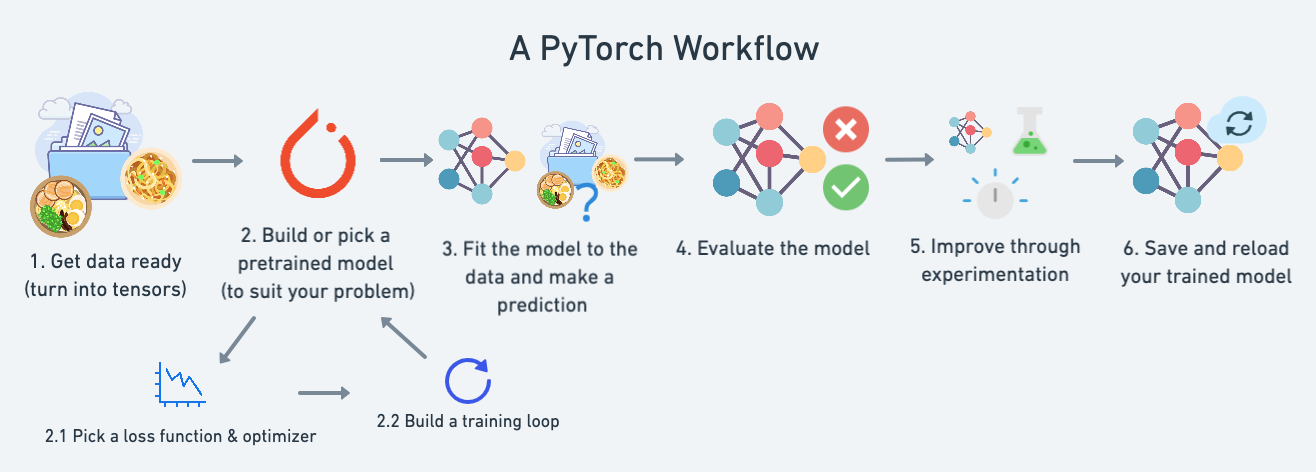
For now, we'll use this workflow to predict a simple straight line but the workflow steps can be repeated and changed depending on the problem you're working on.
Specifically, we're going to cover:
| Topic | Contents |
|---|---|
| 1. Getting data ready | Data can be almost anything but for to get started we're going to create a simple straight line |
| 2. Building a model | Here we'll create a model to learn patterns in the data, we'll also choose a loss function, optimizer and build a training loop. |
| 3. Fitting the model to data (training) | We've got data and a model, now let's let the model (try to) find patterns in the (training) data. |
| 4. Making predictions and evaluating a model (inference) | Our model's found patterns in the data, let's compare its findings to the actual (testing) data. |
| 5. Saving and loading a model | You may want to use your model elsewhere, or come back to it later, here we'll cover that. |
| 6. Putting it all together | Let's take all of the above and combine it. |
Where can can you get help?
All of the materials for this course live on GitHub.
And if you run into trouble, you can ask a question on the Discussions page there too.
There's also the PyTorch developer forums, a very helpful place for all things PyTorch.
Let's start by putting what we're covering into a dictionary to reference later.
what_were_covering = {1: "data (prepare and load)",
    2: "build model",
    3: "fitting the model to data (training)",
    4: "making predictions and evaluating a model (inference)",
    5: "saving and loading a model",
    6: "putting it all together"
}import torch
from torch import nn # nn contains all of PyTorch's building blocks for neural networks
import matplotlib.pyplot as plt
# Check PyTorch version
torch.__version__'1.10.0+cu111'
# Create *known* parameters
weight = 0.7
bias = 0.3

# Create data
start = 0
end = 1
step = 0.02
X = torch.arange(start, end, step).unsqueeze(dim=1)
y = weight * X + bias

X[:10], y[:10](tensor([[0.0000],
[0.0200],
[0.0400],
[0.0600],
[0.0800],
[0.1000],
[0.1200],
[0.1400],
[0.1600],
[0.1800]]), tensor([[0.3000],
[0.3140],
[0.3280],
[0.3420],
[0.3560],
[0.3700],
[0.3840],
[0.3980],
[0.4120],
[0.4260]]))# Create train/test split
train_split = int(0.8 * len(X)) # 80% of data used for training set, 20% for testing
X_train, y_train = X[:train_split], y[:train_split]
X_test, y_test = X[train_split:], y[train_split:]
len(X_train), len(y_train), len(X_test), len(y_test)(40, 40, 10, 10)
def plot_predictions(train_data=X_train,
                     train_labels=y_train,
                     test_data=X_test,
                     test_labels=y_test,
                     predictions=None):
  """
  Plots training data, test data and compares predictions.
  """
  plt.figure(figsize=(10, 7))

  # Plot training data in blue
  plt.scatter(train_data, train_labels, c="b", s=4, label="Training data")

  # Plot test data in green
  plt.scatter(test_data, test_labels, c="g", s=4, label="Testing data")

  if predictions is not None:
    # Plot the predictions in red (predictions were made on the test data)
    plt.scatter(test_data, predictions, c="r", s=4, label="Predictions")

  # Show the legend
plt.legend(prop={"size": 14});plot_predictions();
class LinearRegressionModel(nn.Module):
    def __init__(self):
        super().__init__()
        self.weights = nn.Parameter(torch.randn(1,
            requires_grad=True,
            dtype=torch.float
        ))

        self.bias = nn.Parameter(torch.randn(1,
            requires_grad=True,
            dtype=torch.float
        ))

    # Forward defines the computation in the model
    def forward(self, x):
return self.weights * x + self.biastorch.manual_seed(42)
model_0 = LinearRegressionModel()
list(model_0.parameters())[Parameter containing: tensor([0.3367], requires_grad=True), Parameter containing: tensor([0.1288], requires_grad=True)]
# List named parameters
model_0.state_dict()
OrderedDict([('weights', tensor([0.3367])), ('bias', tensor([0.1288]))])# Make predictions with model
with torch.inference_mode():
y_preds = model_0(X_test)y_predstensor([[0.3982],
[0.4049],
[0.4116],
[0.4184],
[0.4251],
[0.4318],
[0.4386],
[0.4453],
[0.4520],
[0.4588]])plot_predictions(predictions=y_preds)
loss_fn = nn.L1Loss() # MAE loss is same as L1Loss
optimizer = torch.optim.SGD(model_0.parameters(), lr=0.01)X_testtensor([[0.8000],
[0.8200],
[0.8400],
[0.8600],
[0.8800],
[0.9000],
[0.9200],
[0.9400],
[0.9600],
[0.9800]])torch.manual_seed(42)
epochs = 100
for epoch in range(epochs):
# Training
# 1. Forward pass on train data
y_pred = model_0(X_train)
# 2. Calculate the loss
loss = loss_fn(y_pred, y_train)
# 3. Zero grad of the optimizer
optimizer.zero_grad()
# 4. Loss backwards
loss.backward()
# 5. Progress the optimizer
optimizer.step()
# Testing
# 1. Forward pass on test data
with torch.inference_mode():
test_pred = model_0(X_test)
# 2. Caculate loss on test data
test_loss = loss_fn(test_pred, y_test.type(torch.float))
if epoch % 10 == 0:
print(f"Epoch: {epoch} | MAE Train Loss: {loss} | MAE Test Loss: {test_loss} ")Epoch: 0 | MAE Train Loss: 0.31288138031959534 | MAE Test Loss: 0.48106518387794495 Epoch: 10 | MAE Train Loss: 0.1976713240146637 | MAE Test Loss: 0.3463551998138428 Epoch: 20 | MAE Train Loss: 0.08908725529909134 | MAE Test Loss: 0.21729660034179688 Epoch: 30 | MAE Train Loss: 0.053148526698350906 | MAE Test Loss: 0.14464017748832703 Epoch: 40 | MAE Train Loss: 0.04543796554207802 | MAE Test Loss: 0.11360953003168106 Epoch: 50 | MAE Train Loss: 0.04167863354086876 | MAE Test Loss: 0.09919948130846024 Epoch: 60 | MAE Train Loss: 0.03818932920694351 | MAE Test Loss: 0.08886633068323135 Epoch: 70 | MAE Train Loss: 0.03476089984178543 | MAE Test Loss: 0.0805937647819519 Epoch: 80 | MAE Train Loss: 0.03132382780313492 | MAE Test Loss: 0.07232122868299484 Epoch: 90 | MAE Train Loss: 0.02788739837706089 | MAE Test Loss: 0.06473556160926819
model_0.state_dict()OrderedDict([('weights', tensor([0.5784])), ('bias', tensor([0.3513]))])weight, bias(0.7, 0.3)
model_0.eval()
with torch.inference_mode():
    y_preds = model_0(X_test)
y_preds
tensor([[0.8141],
[0.8256],
[0.8372],
[0.8488],
[0.8603],
[0.8719],
[0.8835],
[0.8950],
[0.9066],
[0.9182]])plot_predictions(predictions=y_preds)
# Save to file
import os
os.makedirs("models", exist_ok=True)
save_path = "models/01_pytorch_workflow_model_0.pth"
torch.save(model_0.state_dict(), save_path) # only saving the state_dict() only saves the models learned parameters!ls -l models/01_pytorch_workflow_model_0.pth-rw-rw-r-- 1 daniel daniel 1063 Oct 26 12:47 models/01_pytorch_workflow_model_0.pth
# Instantiate model
loaded_model_0 = LinearRegressionModel()
loaded_model_0.load_state_dict(torch.load(save_path))
<All keys matched successfully>
# Evaluate loaded model
loaded_model_0.eval()
with torch.inference_mode():
loaded_model_preds = loaded_model_0(X_test)y_preds == loaded_model_predstensor([[True],
[True],
[True],
[True],
[True],
[True],
[True],
[True],
[True],
[True]])# Setup device agnostic code
device = "cuda" if torch.cuda.is_available() else "cpu"
device'cuda'
# Check which device model is on
next(model_0.parameters()).device
device(type='cpu')
weight = 0.7
bias = 0.3
start = 0
end = 1
step = 0.02

X = torch.arange(start, end, step).unsqueeze(dim=1) # without unsqueeze, errors will happen later on (shapes within linear layers)
y = weight * X + bias
X[:10], y[:10]
(tensor([[0.0000],
[0.0200],
[0.0400],
[0.0600],
[0.0800],
[0.1000],
[0.1200],
[0.1400],
[0.1600],
[0.1800]]),
tensor([[0.3000],
[0.3140],
[0.3280],
[0.3420],
[0.3560],
[0.3700],
[0.3840],
[0.3980],
[0.4120],
[0.4260]]))# Split data
train_split = int(0.8 * len(X))
X_train, y_train = X[:train_split], y[:train_split]
X_test, y_test = X[train_split:], y[train_split:]
len(X_train), len(y_train), len(X_test), len(y_test)(40, 40, 10, 10)
plot_predictions(X_train, y_train, X_test, y_test)
class LinearRegressionModelV2(nn.Module):
    def __init__(self):
        super().__init__()
        self.linear_layer = nn.Linear(in_features=1,
                                      out_features=1)

    def forward(self, x):
        return self.linear_layer(x)

torch.manual_seed(42)
model_1 = LinearRegressionModelV2()
model_1, model_1.state_dict()
(LinearRegressionModelV2(
(linear_layer): Linear(in_features=1, out_features=1, bias=True)
),
OrderedDict([('linear_layer.weight', tensor([[0.7645]])),
('linear_layer.bias', tensor([0.8300]))]))# Check model device
next(model_1.parameters()).devicedevice(type='cpu')
device = "cuda" if torch.cuda.is_available() else "cpu"
model_1.to(device)
next(model_1.parameters()).device
device(type='cuda', index=0)
loss_fn = nn.L1Loss()
optimizer = torch.optim.SGD(params=model_1.parameters(), lr=0.01)torch.manual_seed(42)
epochs = 1000
for epoch in range(epochs):
# Without this, error will happen (not all model/data on device)
X_train = X_train.to(device)
X_test = X_test.to(device)
y_train = y_train.to(device)
y_test = y_test.to(device)
# Training
model_1.train() # train mode is on by default after construction
# 1. Forward pass
y_pred = model_1(X_train)
# 2. Calculate loss
loss = loss_fn(y_pred, y_train)
# 3. Zero grad optimizer
optimizer.zero_grad()
# 4. Loss backward
loss.backward()
# 5. Step the optimizer
optimizer.step()
# Testing
model_1.eval()
# 1. Forward pass
with torch.inference_mode():
test_pred = model_1(X_test)
# 2. Calculate the loss
test_loss = loss_fn(test_pred, y_test)
if epoch % 100 == 0:
print(f"Epoch: {epoch} | Train loss: {loss} | Test loss: {test_loss}")Epoch: 0 | Train loss: 0.5551779866218567 | Test loss: 0.5739762187004089 Epoch: 100 | Train loss: 0.006215683650225401 | Test loss: 0.014086711220443249 Epoch: 200 | Train loss: 0.0012645035749301314 | Test loss: 0.013801801018416882 Epoch: 300 | Train loss: 0.0012645035749301314 | Test loss: 0.013801801018416882 Epoch: 400 | Train loss: 0.0012645035749301314 | Test loss: 0.013801801018416882 Epoch: 500 | Train loss: 0.0012645035749301314 | Test loss: 0.013801801018416882 Epoch: 600 | Train loss: 0.0012645035749301314 | Test loss: 0.013801801018416882 Epoch: 700 | Train loss: 0.0012645035749301314 | Test loss: 0.013801801018416882 Epoch: 800 | Train loss: 0.0012645035749301314 | Test loss: 0.013801801018416882 Epoch: 900 | Train loss: 0.0012645035749301314 | Test loss: 0.013801801018416882
model_1.state_dict()OrderedDict([('linear_layer.weight', tensor([[0.6968]], device='cuda:0')),
('linear_layer.bias', tensor([0.3025], device='cuda:0'))])weight, bias(0.7, 0.3)
model_1.eval()
with torch.inference_mode():
    y_preds = model_1(X_test)
y_preds
tensor([[0.8600],
[0.8739],
[0.8878],
[0.9018],
[0.9157],
[0.9296],
[0.9436],
[0.9575],
[0.9714],
[0.9854]], device='cuda:0')# plot_predictions(predictions=y_preds) # -> won't work... data not on CPU
plot_predictions(predictions=y_preds.cpu())
# Save model
os.makedirs("models", exist_ok=True)
save_path = "models/01_pytorch_workflow_model_1.pth"
torch.save(model_1.state_dict(), save_path)# Load model (if your data is on GPU, model will have to be on GPU to make predictions)
loaded_model_1 = LinearRegressionModelV2()
loaded_model_1.load_state_dict(torch.load(save_path))
loaded_model_1.to(device)
loaded_model_1, next(loaded_model_1.parameters()).device(LinearRegressionModelV2( (linear_layer): Linear(in_features=1, out_features=1, bias=True) ), device(type='cuda', index=0))
# Evaluate loaded model
loaded_model_1.eval()
with torch.inference_mode():
    loaded_model_1_preds = loaded_model_1(X_test)
y_preds == loaded_model_1_preds
tensor([[True],
[True],
[True],
[True],
[True],
[True],
[True],
[True],
[True],
[True]], device='cuda:0')