
1.6 MiB

08. PyTorch Paper Replicating
Welcome to Milestone Project 2: PyTorch Paper Replicating!
In this project, we're going to be replicating a machine learning research paper and creating a Vision Transformer (ViT) from scratch using PyTorch.
We'll then see how ViT, a state-of-the-art computer vision architecture, performs on our FoodVision Mini problem.
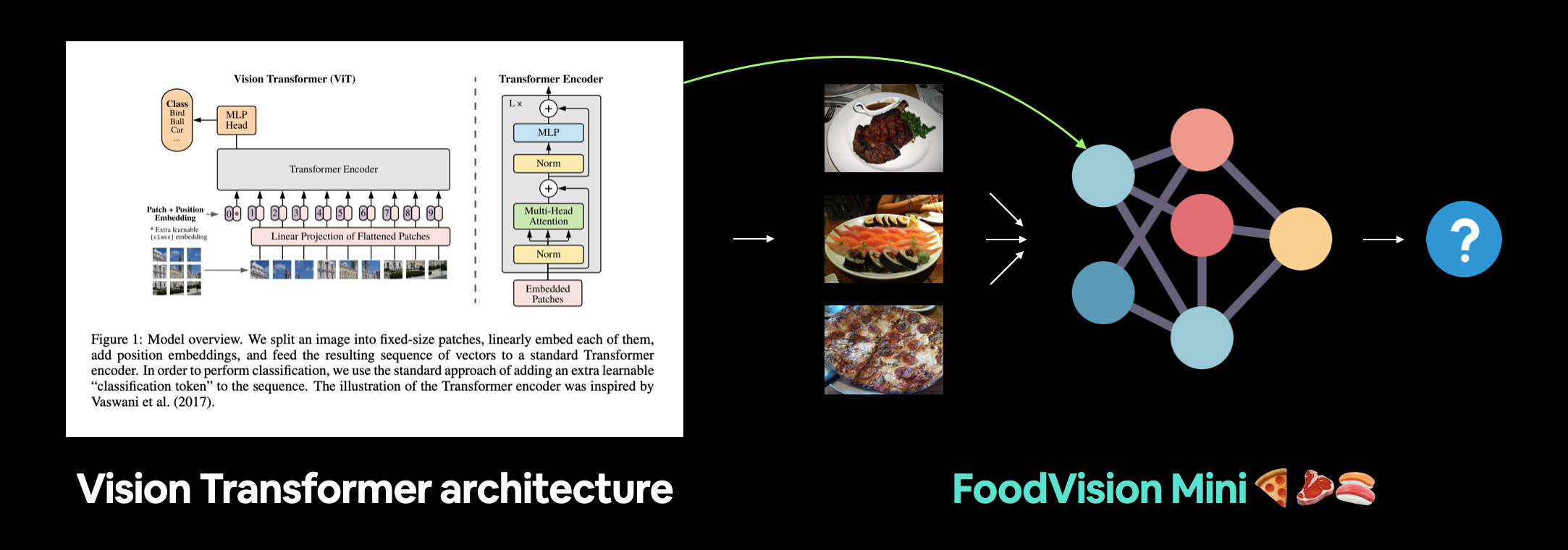
For Milestone Project 2 we're going to focus on recreating the Vision Transformer (ViT) computer vision architecture and applying it to our FoodVision Mini problem to classify different images of pizza, steak and sushi.
What is paper replicating?
It's no secret machine learning is advancing fast.
Many of these advances get published in machine learning research papers.
And the goal of paper replicating is to take replicate these advances with code so you can use the techniques for your own problem.
For example, let's say a new model architecture gets released that performs better than any other architecture before on various benchmarks, wouldn't it be nice to try that architecture on your own problems?
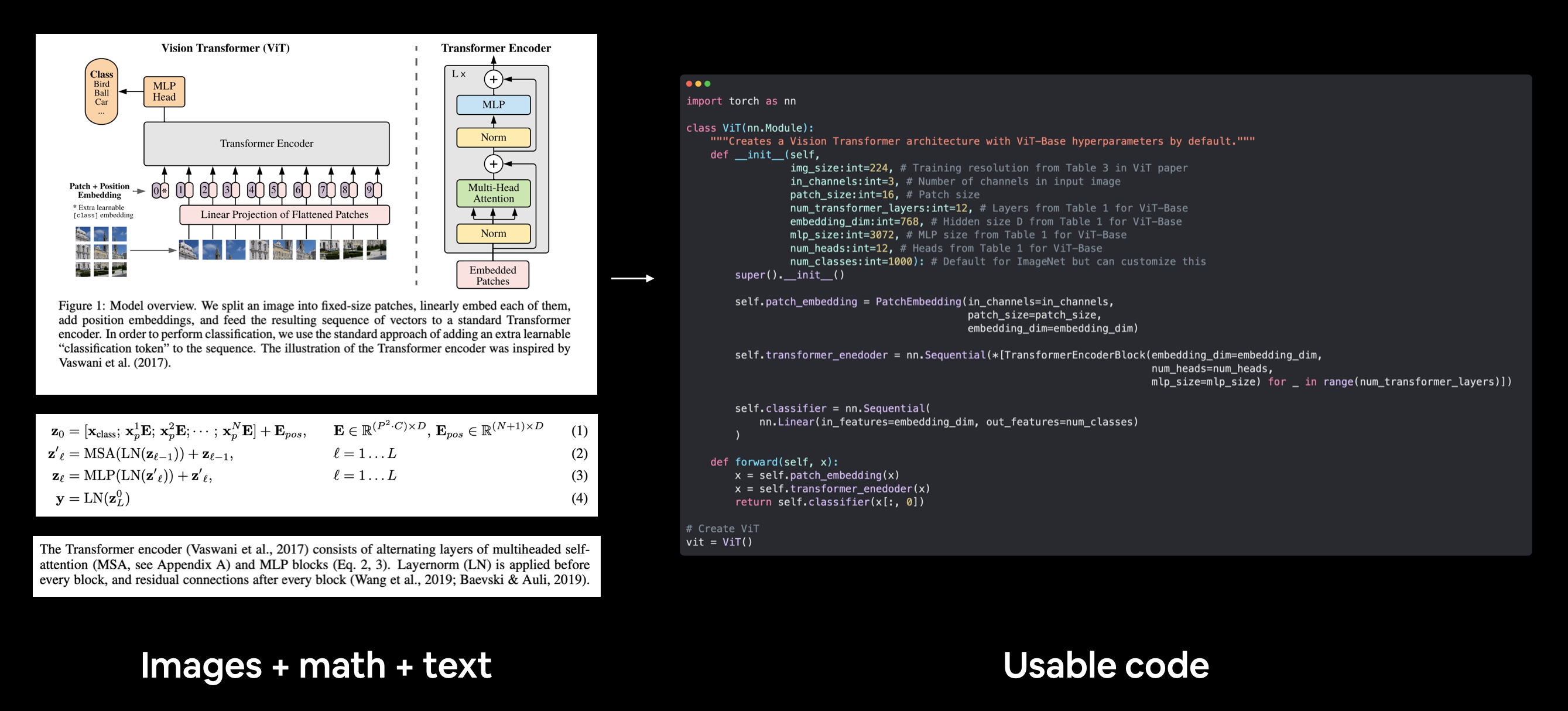
Machine learning paper replicating involves turning a machine learning paper comprised of images/diagrams, math and text into usable code and in our case, usable PyTorch code. Diagram, math equations and text from the ViT paper.
Why replicate a machine learning research paper?
A machine learning research paper is often a presentation of months of work and experiments done by some of the best machine learning teams in the world condensed into a few pages of text.
And if these experiments lead to better results in an area related to the problem you're working on, it'd be nice to them out.
Also, replicating the work of others is a fantastic way to practice your skills.
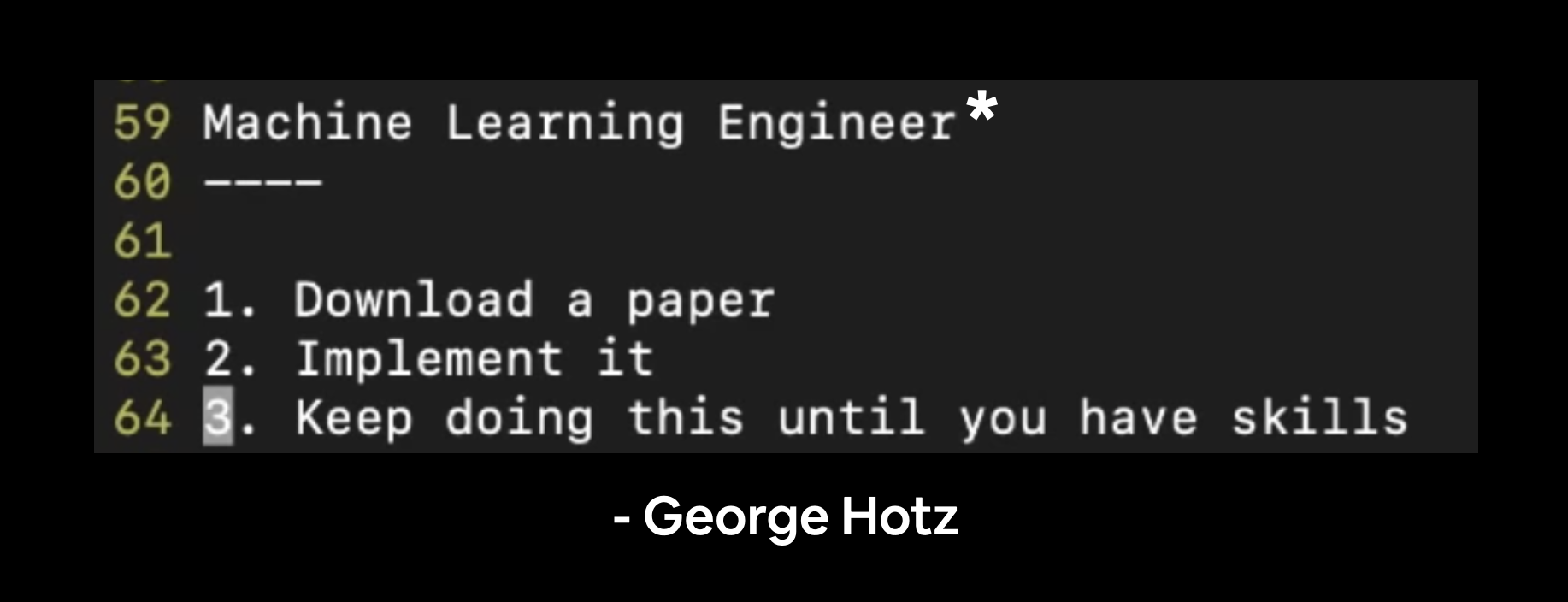
George Hotz is founder of comma.ai, a self-driving car company and livestreams machine learning coding on Twitch and those videos get posted in full to YouTube. I pulled this quote from one of his livestreams. The "٭" is to note that machine learning engineering often involves the extra step(s) of preprocessing data and making your models available for others to use (deployment).
When you first start trying to replicate research papers, you'll likely be overwhelmed.
That's normal.
Research teams spend weeks, months and sometimes years creating these works so it makes sense if it takes you sometime to even read let alone reproduce the works.
Replicating research is such a tough problem, phenomenal machine learning libraries and tools such as, HuggingFace, PyTorch Image Models (timm library) and fast.ai have been born out of making machine learning research more accessible.
# For this notebook to run with updated APIs, we need torch 1.12+ and torchvision 0.13+
try:
    import torch
    import torchvision
    assert int(torch.__version__.split(".")[1]) >= 12, "torch version should be 1.12+"
    assert int(torchvision.__version__.split(".")[1]) >= 13, "torchvision version should be 0.13+"
    print(f"torch version: {torch.__version__}")
    print(f"torchvision version: {torchvision.__version__}")
except:
    print(f"[INFO] torch/torchvision versions not as required, installing nightly versions.")
    !pip3 install -U --pre torch torchvision torchaudio --extra-index-url https://download.pytorch.org/whl/nightly/cu113
    import torch
    import torchvision
    print(f"torch version: {torch.__version__}")
    print(f"torchvision version: {torchvision.__version__}")
torch version: 1.12.0+cu102 torchvision version: 0.13.0+cu102
# Continue with regular imports
import matplotlib.pyplot as plt
import torch
import torchvision

from torch import nn
from torchvision import transforms

# Try to get torchinfo, install it if it doesn't work
try:
    from torchinfo import summary
except:
    print("[INFO] Couldn't find torchinfo... installing it.")
    !pip install -q torchinfo
    from torchinfo import summary

# Try to import the going_modular directory, download it from GitHub if it doesn't work
try:
    from going_modular.going_modular import data_setup, engine
    from helper_functions import download_data, set_seeds, plot_loss_curves
except:
    # Get the going_modular scripts
    print("[INFO] Couldn't find going_modular or helper_functions scripts... downloading them from GitHub.")
    !git clone https://github.com/mrdbourke/pytorch-deep-learning
    !mv pytorch-deep-learning/going_modular .
    !mv pytorch-deep-learning/helper_functions.py . # get the helper_functions.py script
    !rm -rf pytorch-deep-learning
    from going_modular.going_modular import data_setup, engine
from helper_functions import download_data, set_seeds, plot_loss_curvesdevice = "cuda" if torch.cuda.is_available() else "cpu"
device'cuda'
# Download pizza, steak, sushi images from GitHub
image_path = download_data(source="https://github.com/mrdbourke/pytorch-deep-learning/raw/main/data/pizza_steak_sushi.zip",
                           destination="pizza_steak_sushi")
image_path[INFO] data/pizza_steak_sushi directory exists, skipping download.
PosixPath('data/pizza_steak_sushi')# Setup directory paths to train and test images
train_dir = image_path / "train"
test_dir = image_path / "test"2. Create Datasets and DataLoaders
Now we've got some data, let's now turn it into DataLoader's.
To do so we can use the create_dataloaders() function in data_setup.py.
First, we'll create a transform to prepare our images.
This where one of the first references to the ViT paper will come in.
In Table 3, the training resolution is mentioned as being 224 (height=224, width=224).
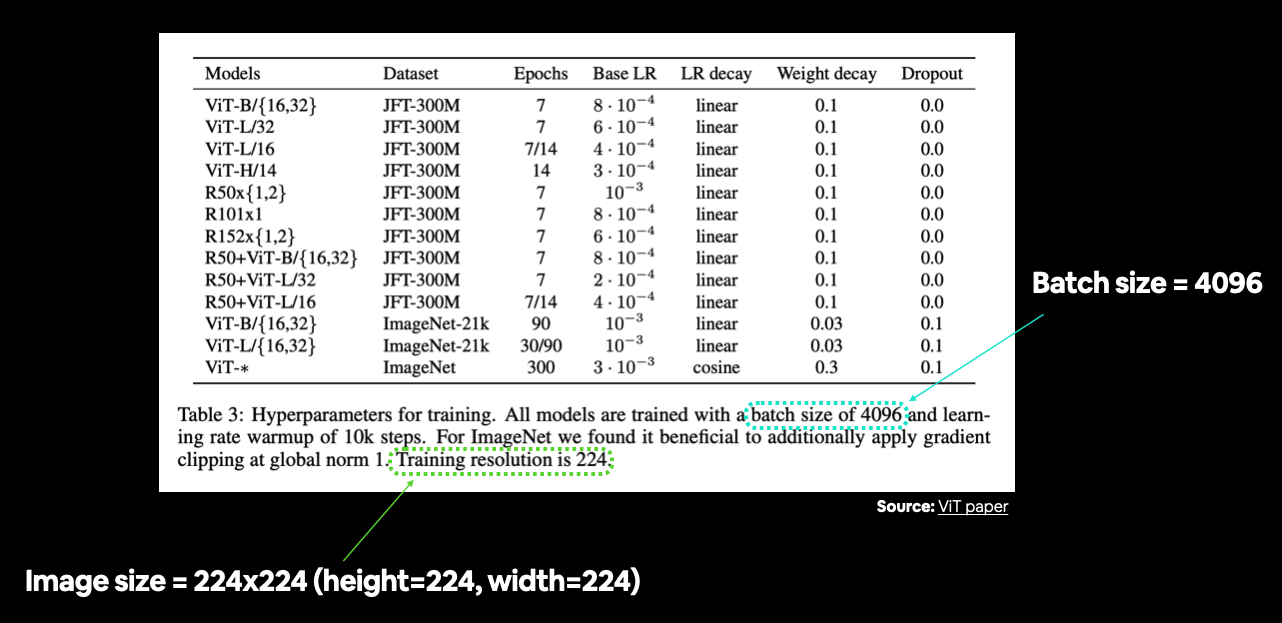
You can often find various hyperparameter settings listed in a table. In this case we're still preparing our data, so we're mainly concerned with things like image size and batch size. Source: Table 3 in ViT paper.
So we'll make sure our transform resizes our images appropriately.
And since we'll be training our model from scratch (no transfer learning to begin with), we won't provide a normalize transform like we did in 06. PyTorch Transfer Learning section 2.1.
2.1 Prepare transforms for images
# Create image size (from Table 3 in the ViT paper)
IMG_SIZE = 224

# Create transform pipeline manually
manual_transforms = transforms.Compose([
    transforms.Resize((IMG_SIZE, IMG_SIZE)),
    transforms.ToTensor(),
])
print(f"Manually created transforms: {manual_transforms}")
Manually created transforms: Compose(
Resize(size=(224, 224), interpolation=bilinear, max_size=None, antialias=None)
ToTensor()
)
# Set the batch size
BATCH_SIZE = 32 # this is lower than the ViT paper but it's because we're starting small

# Create data loaders
train_dataloader, test_dataloader, class_names = data_setup.create_dataloaders(
    train_dir=train_dir,
    test_dir=test_dir,
    transform=manual_transforms, # use manually created transforms
    batch_size=BATCH_SIZE
)

train_dataloader, test_dataloader, class_names(<torch.utils.data.dataloader.DataLoader at 0x7f6f4c06f820>, <torch.utils.data.dataloader.DataLoader at 0x7f6f4c06f520>, ['pizza', 'steak', 'sushi'])
# Get a batch of images
image_batch, label_batch = next(iter(train_dataloader))

# Get a single image from the batch
image, label = image_batch[0], label_batch[0]

# View the batch shapes
image.shape, label(torch.Size([3, 224, 224]), tensor(0))
# Plot image with matplotlib
plt.imshow(image.permute(1, 2, 0)) # rearrange image dimensions to suit matplotlib [color_channels, height, width] -> [height, width, color_channels]
plt.title(class_names[label])
plt.axis(False);
3.1 Inputs and outputs, layers and blocks
ViT is a deep learning neural network architecture.
And any neural network architecture is generally comprised of layers.
And a collection of layers is often referred to as a block.
And stacking many blocks together is what gives us the whole architecture.
A layer takes an input (say an image tensor), performs some kind of function on it (for example what's in the layer's forward() method) and then returns an output.
So if a single layer takes an input and gives an output, then a collection of layers or a block also takes an input and gives an output.
Let's make this concrete:
- Layer - takes an input, performs a function on it, returns an output.
- Block - a collection of layers, takes an input, performs a series of functions on it, returns an output.
- Architecture (or model) - a collection of blocks, takes an input, performs a series of functions on it, returns an output.
This ideology is what we're going to be using to replicate the ViT paper.
We're going to take it layer by layer, block by block, function by function putting the pieces of the puzzle together like Lego to get our desired overall architecture.
The reason we do this is because looking at a whole research paper can be intimidating.
So for a better understanding, we'll break it down, starting with the inputs and outputs of single layer and working up to the inputs and outputs of the whole model.
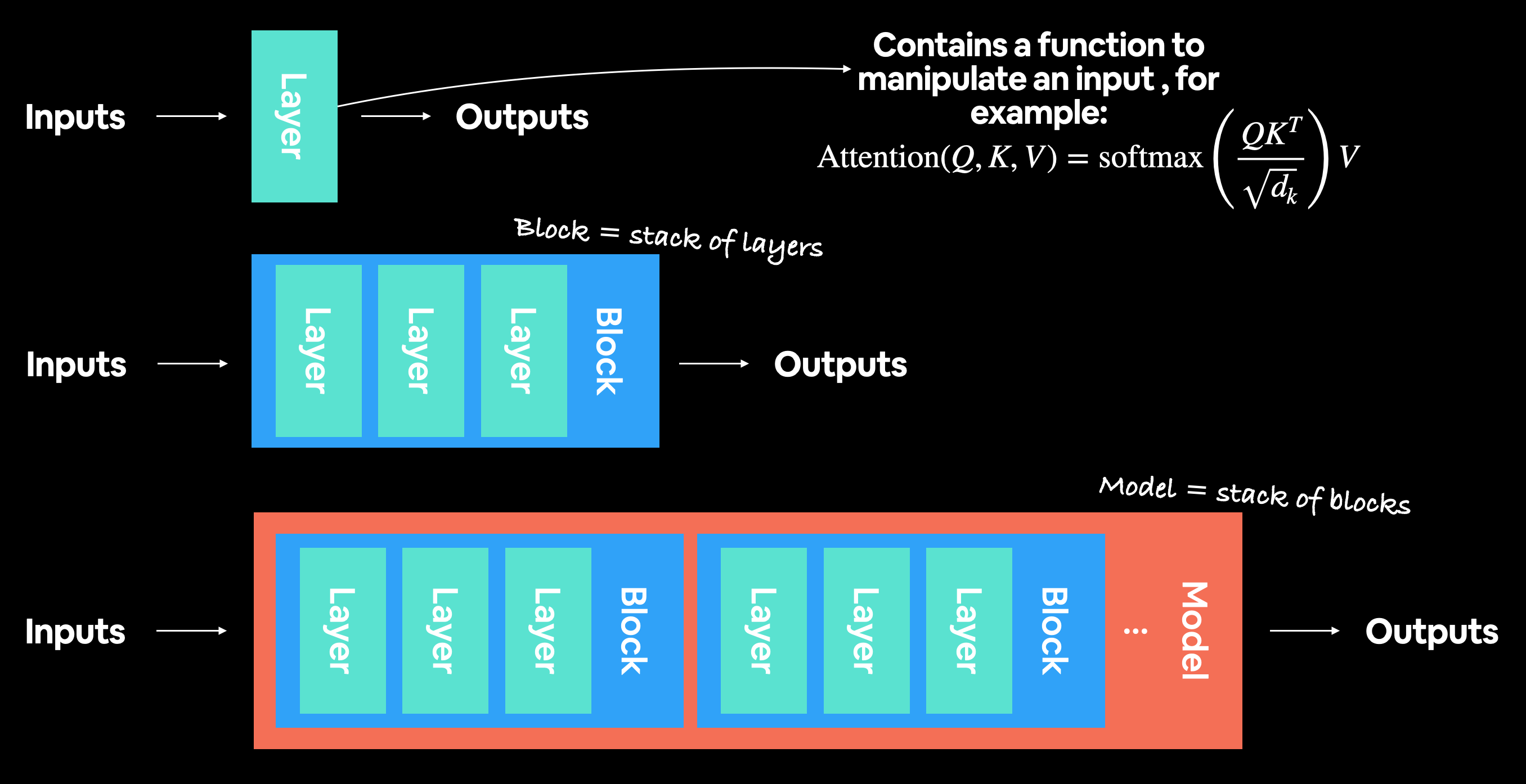
A modern deep learning architecture is usually collection of layers and blocks. Where layers take an input (data as a numerical representation) and manipulate it using some kind of function (for example, the self-attention formula pictured above, however, this function could be almost anything) and then output it. Blocks are generally stacks of layers on top of each other doing a similar thing to a single layer but multiple times.
3.2.1 Exploring Figure 1
Let's start by going through Figure 1 of the ViT Paper.
The main things we'll be paying attention to are:
- Layers - takes an input, performs an operation or function on the input, produces an output.
- Blocks - a collection of layers, which in turn also takes an input and produces an output.
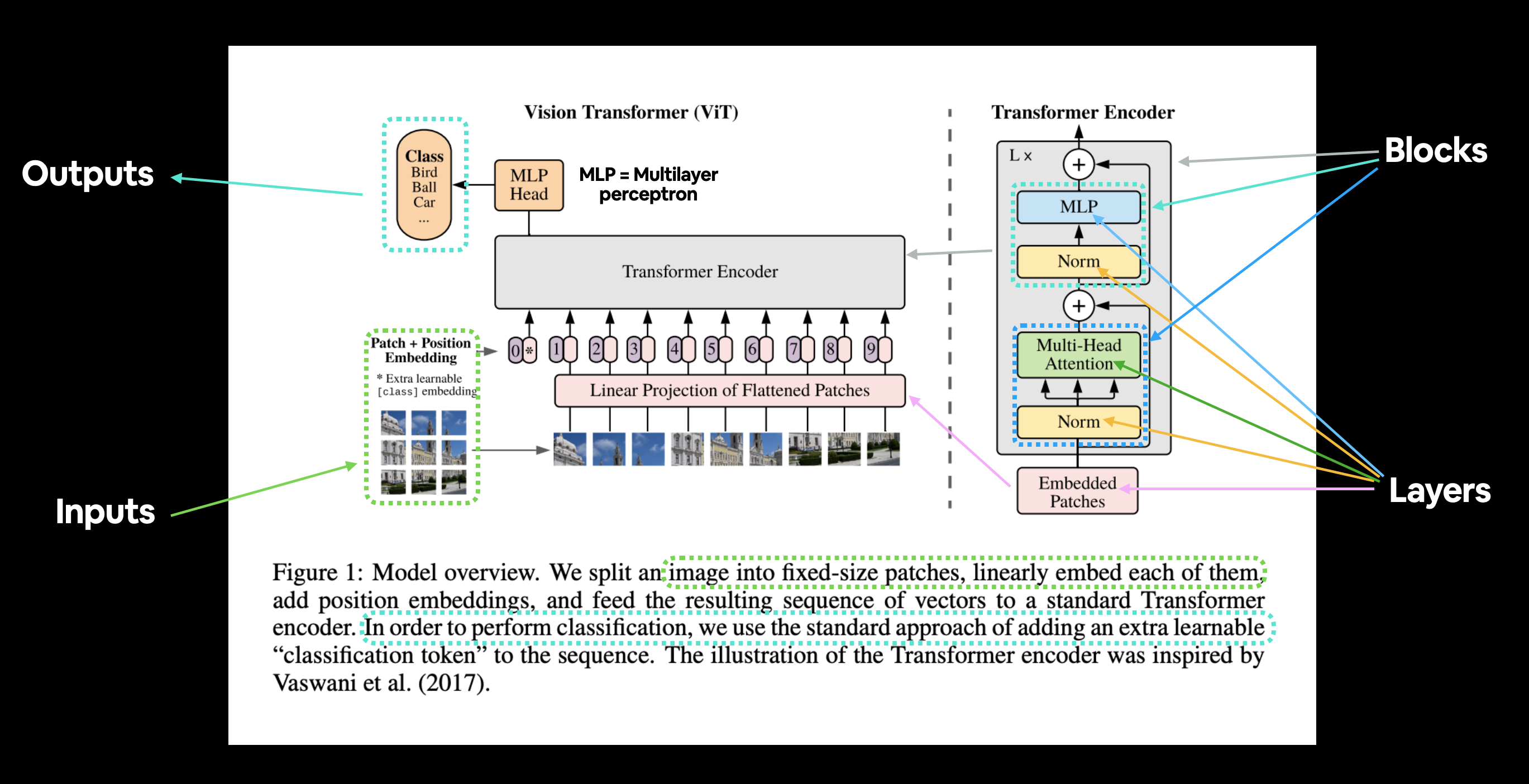
Figure 1 from the ViT Paper showcasing the different inputs, outputs, layers and blocks that create the architecture. Our goal will be to replicate each of these using PyTorch code.
The ViT architecture is comprised of several stages:
- Patch + Position Embedding (inputs) - Turns the input image into a sequence of image patches and add a position number what order the patch comes in.
- Linear projection of flattened patches (Embedded Patches) - The image patches get turned into an embedding, the benefit of using an embedding rather than just the image values is that an embedding is a learnable representation (typically in the form of a vector) of the image that can improve with training.
- Norm - This is short for "Layer Normalization" or "LayerNorm", a technique for regularizing (reducing overfitting) a neural network, you can use LayerNorm via the PyTorch layer
torch.nn.LayerNorm(). - Multi-Head Attention - This is a Multi-Headed Self-Attention layer or "MSA" for short. You can create an MSA layer via the PyTorch layer
torch.nn.MultiheadAttention(). - MLP (or Multilayer perceptron) - A MLP can often refer to any collection of feedforward layers (or in PyTorch's case, a collection of layers with a
forward()method). In the ViT Paper, the authors refer to the MLP as "MLP block" and it contains twotorch.nn.Linear()layers with atorch.nn.GELU()non-linearity activation in between them (section 3.1) and atorch.nn.Dropout()layer after each (Appendex B.1). - Transformer Encoder - The Transformer Encoder, is a collection of the layers listed above. There are two skip connections inside the Transformer encoder (the "+" symbols) meaning the layer's inputs are fed directly to immediate layers as well as subsequent layers. The overall ViT architecture is comprised of a number of Transformer encoders stacked on top of eachother.
- MLP Head - This is the output layer of the architecture, it converts the learned features of an input to a class output. Since we're working on image classification, you could also call this the "classifier head". The structure of the MLP Head is similar to the MLP block.
You might notice that many of the pieces of the ViT architecture can be created with existing PyTorch layers.
This is because of how PyTorch is designed, it's one of the main purposes of PyTorch to create reusable neural network layers for both researchers and machine learning practitioners.
Question: Why not code everything from scratch?
You could definitely do that by reproducing all of the math equations from the paper with custom PyTorch layers and that would certainly be an educative exercise, however, using pre-existing PyTorch layers is usually favoured as pre-existing layers have often been extensively tested and performance checked to make sure they run correctly and fast.
Note: We're going to focused on write PyTorch code to create these layers, for the background on what each of these layers does, I'd suggest reading the ViT Paper in full or reading the linked resources for each layer.
Let's take Figure 1 and adapt it to our FoodVision Mini problem of classifying images of food into pizza, steak or sushi.
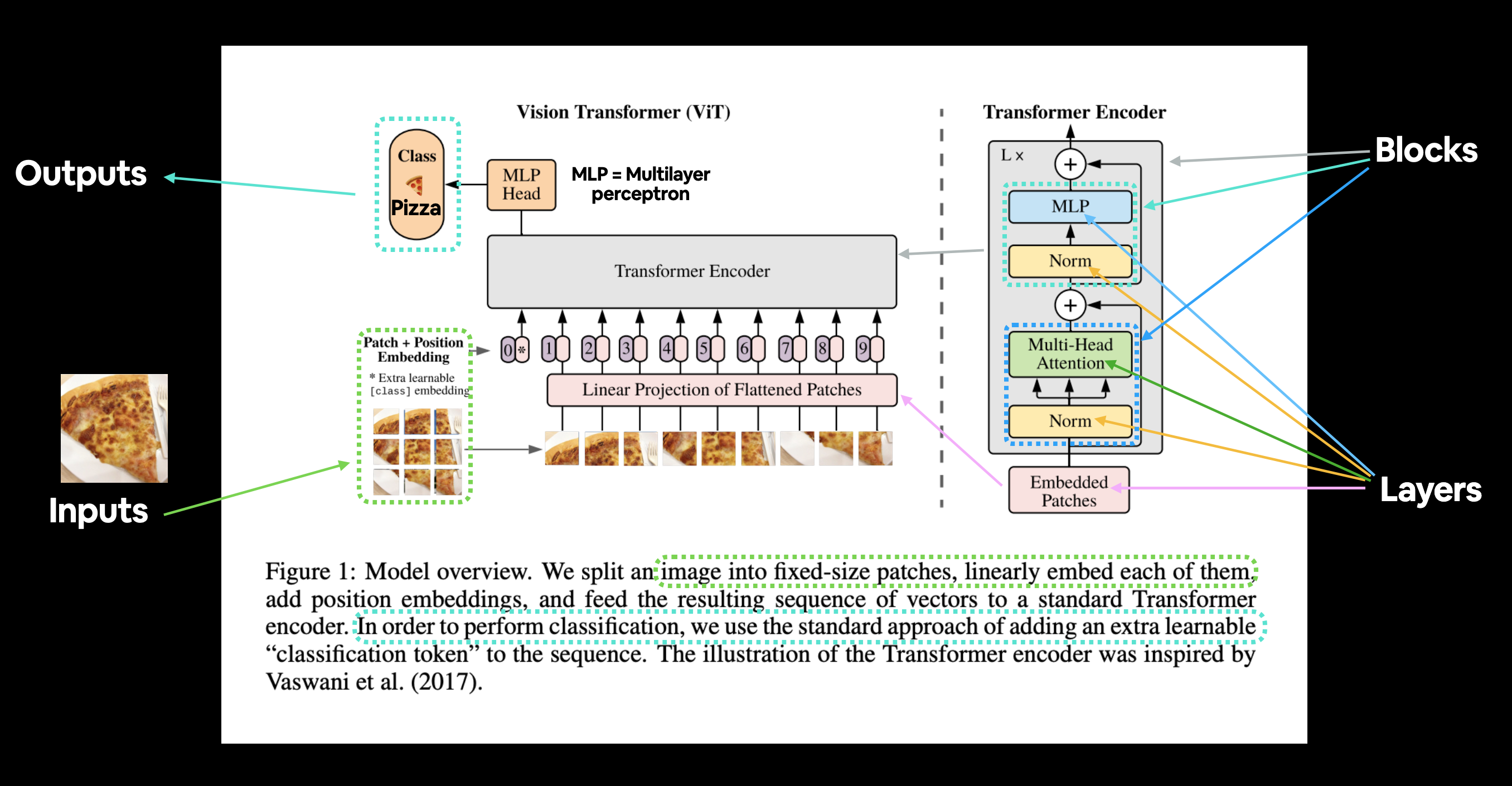
Figure 1 from the ViT Paper adapted for use with FoodVision Mini. An image of food goes in (pizza), the image gets turned into patches and then projected to an embedding. The embedding then travels through the various layers and blocks and (hopefully) the class "pizza" is returned.
3.2.2 Exploring the Four Equations
The next main part(s) of the ViT paper we're going to look at are the four equations in section 3.1.

These four equations represent the math behind the four major parts of the ViT architecture.
Section 3.1 describes each of these (some of the text has been omitted for brevity, bolded text is mine):
| Equation number | Description from ViT paper section 3.1 |
|---|---|
| 1 | ...The Transformer uses constant latent vector size D through all of its layers, so we flatten the patches and map to D dimensions with a trainable linear projection (Eq. 1). We refer to the output of this projection as the patch embeddings... Position embeddings are added to the patch embeddings to retain positional information. We use standard learnable 1D position embeddings... |
| 2 | The Transformer encoder (Vaswani et al., 2017) consists of alternating layers of multiheaded selfattention (MSA, see Appendix A) and MLP blocks (Eq. 2, 3). Layernorm (LN) is applied before every block, and residual connections after every block (Wang et al., 2019; Baevski & Auli, 2019). |
| 3 | Same as equation 2. |
| 4 | Similar to BERT's [ class ] token, we prepend a learnable embedding to the sequence of embedded patches \left(\mathbf{z}_{0}^{0}=\mathbf{x}_{\text {class }}\right), whose state at the output of the Transformer encoder \left(\mathbf{z}_{L}^{0}\right) serves as the image representation \mathbf{y} (Eq. 4)... |
Let's map these descriptions to the ViT architecture in Figure 1.
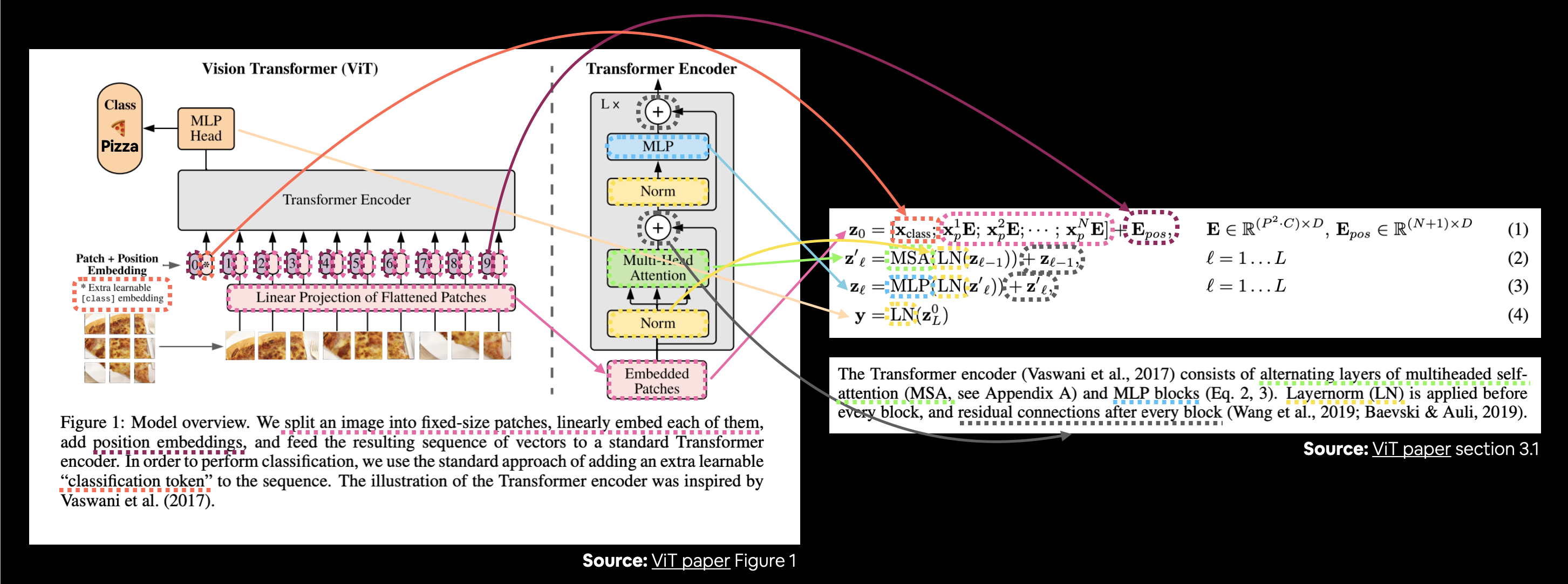
Connecting Figure 1 from the ViT paper to the four equations from section 3.1 describing the math behind each of the layers/blocks. Some details such as "residual connections after every block" are referred to in Figure 1 and in the text but not in the equations.
There's a lot happening in the image above but following the coloured lines and arrows reveals the main concepts of the ViT architecture.
How about we break down each equation further (it will be our goal to recreate these with code)?
In all equations (except equation 4), "$\mathbf{z}$" is the raw output of a particular layer:
\mathbf{z}_{0}is "z zero" (this is the output of the initial patch embedding layer).\mathbf{z}_{\ell}^{\prime}is "z of a particular layer prime" (or an intermediary value of z).\mathbf{z}_{\ell}is "z of a particular layer".
And \mathbf{y} is the overall output of the architecture.
3.3 My workflow for replicating papers
When I start working on replicating a paper, I go through the following steps:
- Read the whole paper end-to-end once (to get an idea of the main concepts).
- Go back through each section and see how they line up with each other and start thinking about how they might be turned into code (just like above).
- Repeat step 2 until I've got a fairly good outline.
- Use mathpix.com (a very handy tool) to turn any sections of the paper into markdown/LaTeX to put into notebooks.
- Replicate the simplest version of the model possible.
- If I get stuck, look up other examples.

Turning the four equations from the ViT paper into editable LaTeX/markdown using mathpix.com.
We've already gone through the first few steps above (and if you haven't read the full paper yet, I'd encourage you to give it a go) but what we'll be focusing on next is step 5: replicating the simplest version fo the model possible.
This is why we're starting with ViT-Base.
Replicating the smallest version of the architecture possible, get it working and then we can scale up if we wanted to.
Note: If you've never read a research paper before, many of the above steps can be intimidating. But don't worry, like anything, your skills at reading and replicating papers will improve with practice. Don't forget, a research paper is often months of work by many people compressed into a few pages. So trying to replicate it on your own is no small feat.
4. Equation 1: Split data into patches and creating the class, position and patch embedding
I remember one of my machine learning engineer friends used to say "it's all about the embedding."
As in, if you can represent your data in a good, learnable way (as embeddings are learnable representations), chances are, a learning algorithm will be able to perform well on them.
With that being said, let's start by creating the class, position and patch embeddings for the ViT architecture.
We'll start with the patch embedding.
This means we'll be turning our input images in a sequence of patches and then embedding those patches.
Recall that an embedding is a learnable representation of some form and is often a vector.
The term learnable is important because this means the numerical representation of an input image (that the model sees) can be improved over time.
We'll begin by following the opening paragraph of section 3.1 of the ViT paper (bold mine):
The standard Transformer receives as input a 1D sequence of token embeddings. To handle 2D images, we reshape the image
\mathbf{x} \in \mathbb{R}^{H \times W \times C}into a sequence of flattened 2D patches\mathbf{x}_{p} \in \mathbb{R}^{N \times\left(P^{2} \cdot C\right)}, where(H, W)is the resolution of the original image,Cis the number of channels,(P, P)is the resolution of each image patch, andN=H W / P^{2}is the resulting number of patches, which also serves as the effective input sequence length for the Transformer. The Transformer uses constant latent vector sizeDthrough all of its layers, so we flatten the patches and map toDdimensions with a trainable linear projection (Eq. 1). We refer to the output of this projection as the patch embeddings.
And size we're dealing with image shapes, let's keep in mind the line from Table 3 of the ViT paper:
Training resolution is 224.
Let's break down the text above.
Dis the size of the patch embeddings, different values forDfor various sized ViT models can be found in Table 1.- The image starts as 2D with size
{H \times W \times C}.(H, W)is the resolution of the original image (height, width).Cis the number of channels.
- The image gets converted to a sequence of flattened 2D patches with size
{N \times\left(P^{2} \cdot C\right)}.(P, P)is the resolution of each image patch (patch size).N=H W / P^{2}is the resulting number of patches, which also serves as the input sequence length for the Transformer.
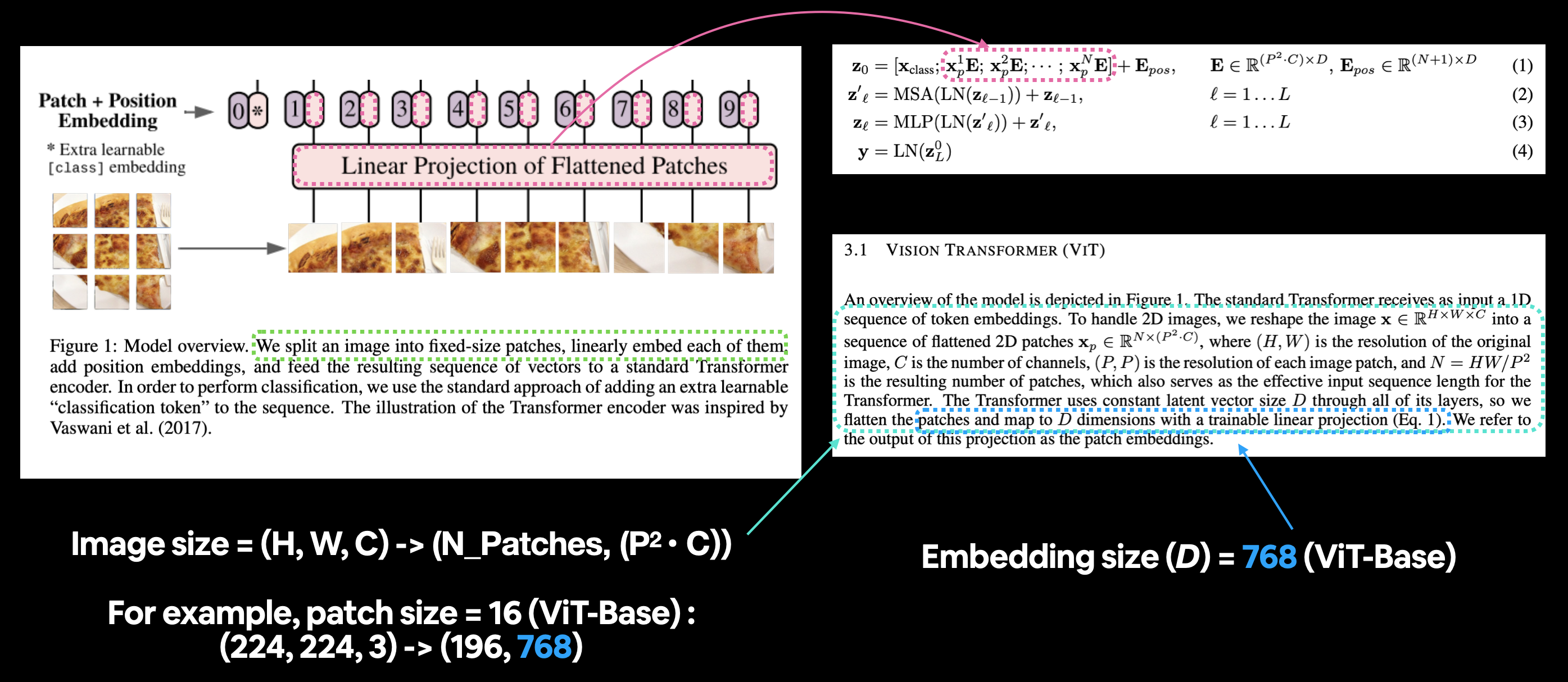
Mapping the patch and position embedding portion of the ViT architecture from Figure 1 to Equation 1. The opening paragraph of section 3.1 describes the different input and output shapes of the patch embedding layer.
# Create example values
height = 224 # H ("The training resolution is 224.")
width = 224 # W
color_channels = 3 # C
patch_size = 16 # P

# Calculate N (number of patches)
number_of_patches = int((height * width) / patch_size**2)
print(f"Number of patches (N) with image height (H={height}), width (W={width}) and patch size (P={patch_size}): {number_of_patches}")
Number of patches (N) with image height (H=224), width (W=224) and patch size (P=16): 196
# Input shape (this is the size of a single image)
embedding_layer_input_shape = (height, width, color_channels)

# Output shape
embedding_layer_output_shape = (number_of_patches, patch_size**2 * color_channels)

print(f"Input shape (single 2D image): {embedding_layer_input_shape}")
print(f"Output shape (single 2D image flattened into patches): {embedding_layer_output_shape}")
Input shape (single 2D image): (224, 224, 3) Output shape (single 2D image flattened into patches): (196, 768)
# View single image
plt.imshow(image.permute(1, 2, 0)) # adjust for matplotlib
plt.title(class_names[label])
plt.axis(False);# Change image shape to be compatible with matplotlib (color_channels, height, width) -> (height, width, color_channels)
image_permuted = image.permute(1, 2, 0)
# Index to plot the top row of patched pixels
patch_size = 16
plt.figure(figsize=(patch_size, patch_size))
plt.imshow(image_permuted[:patch_size, :, :]);
# Setup hyperparameters and make sure img_size and patch_size are compatible
img_size = 224
patch_size = 16
num_patches = img_size/patch_size
assert img_size % patch_size == 0, "Image size must be divisible by patch size"
print(f"Number of patches per row: {num_patches}\nPatch size: {patch_size} pixels x {patch_size} pixels")

# Create a series of subplots
fig, axs = plt.subplots(nrows=1,
                        ncols=img_size // patch_size, # one column for each patch
                        figsize=(num_patches, num_patches),
                        sharex=True,
                        sharey=True)

# Iterate through number of patches in the top row
for i, patch in enumerate(range(0, img_size, patch_size)):
    axs[i].imshow(image_permuted[:patch_size, patch:patch+patch_size, :]); # keep height index constant, alter the width index
    axs[i].set_xlabel(i+1) # set the label
    axs[i].set_xticks([])
    axs[i].set_yticks([])
Number of patches per row: 14.0 Patch size: 16 pixels x 16 pixels

# Setup hyperparameters and make sure img_size and patch_size are compatible
img_size = 224
patch_size = 16
num_patches = img_size/patch_size
assert img_size % patch_size == 0, "Image size must be divisible by patch size"
print(f"Number of patches per row: {num_patches}\
        \nNumber of patches per column: {num_patches}\
        \nTotal patches: {num_patches*num_patches}\
        \nPatch size: {patch_size} pixels x {patch_size} pixels")

# Create a series of subplots
fig, axs = plt.subplots(nrows=img_size // patch_size, # need int not float
                        ncols=img_size // patch_size,
                        figsize=(num_patches, num_patches),
                        sharex=True,
                        sharey=True)

# Loop through height and width of image
for i, patch_height in enumerate(range(0, img_size, patch_size)): # iterate through height
    for j, patch_width in enumerate(range(0, img_size, patch_size)): # iterate through width

        # Plot the permuted image patch (image_permuted -> (Height, Width, Color Channels))
        axs[i, j].imshow(image_permuted[patch_height:patch_height+patch_size, # iterate through height
                                        patch_width:patch_width+patch_size, # iterate through width
                                        :]) # get all color channels

        # Set up label information, remove the ticks for clarity and set labels to outside
        axs[i, j].set_ylabel(i+1,
                             rotation="horizontal",
                             horizontalalignment="right",
                             verticalalignment="center")
        axs[i, j].set_xlabel(j+1)
        axs[i, j].set_xticks([])
        axs[i, j].set_yticks([])
        axs[i, j].label_outer()

# Set a super title
fig.suptitle(f"{class_names[label]} -> Patchified", fontsize=16)
plt.show()
Number of patches per row: 14.0 Number of patches per column: 14.0 Total patches: 196.0 Patch size: 16 pixels x 16 pixels

4.3 Creating image patches with torch.nn.Conv2d()
We've seen what an image looks like when it gets turned into patches, now let's start moving towards replicating the patch embedding layers with PyTorch.
To visualize our single image we wrote code to loop through the different height and width dimensions of a single image and plot individual patches.
This operation is very similar to the convolutional operation we saw in 03. PyTorch Computer Vision section 7.1: Stepping through nn.Conv2d().
In fact, the authors of the ViT paper mention in section 3.1 that the patch embedding is achievable with a convolutional neural network (CNN):
Hybrid Architecture. As an alternative to raw image patches, the input sequence can be formed from feature maps of a CNN (LeCun et al., 1989). In this hybrid model, the patch embedding projection
\mathbf{E}(Eq. 1) is applied to patches extracted from a CNN feature map. As a special case, the patches can have spatial size1 \times 1, which means that the input sequence is obtained by simply flattening the spatial dimensions of the feature map and projecting to the Transformer dimension. The classification input embedding and position embeddings are added as described above.
The "feature map" they're refering to are the weights/activations produced by a convolutional layer passing over a given image.

By setting the kernel_size and stride parameters of a torch.nn.Conv2d() layer equal to the patch_size, we can effectively get a layer that splits our image into patches and creates a learnable embedding (referred to as a "Linear Projection" in the ViT paper) of each patch.
Remember our ideal input and output shapes for the patch embedding layer?
- Input: The image starts as 2D with size
{H \times W \times C}. - Output: The image gets converted to a 1D sequence of flattened 2D patches with size
{N \times\left(P^{2} \cdot C\right)}.
Or for an image size of 224 and patch size of 16:
- Input (2D image): (224, 224, 3) -> (height, width, color channels)
- Output (flattened 2D patches): (196, 768) -> (number of patches, embedding dimension)
We can recreate these with:
torch.nn.Conv2d()for turning our image into patches of CNN feature maps.torch.nn.Flatten()for flattening the spatial dimensions of the feature map.
Let's start with the torch.nn.Conv2d() layer.
We can replicate the creation of patches by setting the kernel_size and stride equal to patch_size.
This means each convolutional kernel will be of size (patch_size x patch_size) or if patch_size=16, (16 x 16) (the equivalent of one whole patch).
And each step or stride of the convolutional kernel will be patch_size pixels long or 16 pixels long (equivalent of stepping to the next patch).
We'll set in_channels=3 for the number of color channels in our image and we'll set out_channels=768, the same as the D value in Table 1 for ViT-Base (this is the embedding dimension, each image will be embedded into a learnable vector of size 768).
from torch import nn

# Set the patch size
patch_size=16

# Create the Conv2d layer with hyperparameters from the ViT paper
conv2d = nn.Conv2d(in_channels=3, # number of color channels
                   out_channels=768, # from Table 1: Hidden size D, this is the embedding size
                   kernel_size=patch_size, # could also use (patch_size, patch_size)
                   stride=patch_size,
padding=0)# View single image
plt.imshow(image.permute(1, 2, 0)) # adjust for matplotlib
plt.title(class_names[label])
plt.axis(False);# Pass the image through the convolutional layer
image_out_of_conv = conv2d(image.unsqueeze(0)) # add a single batch dimension (height, width, color_channels) -> (batch, height, width, color_channels)
print(image_out_of_conv.shape)torch.Size([1, 768, 14, 14])
# Plot random 5 convolutional feature maps
import random
random_indexes = random.sample(range(0, 758), k=5) # pick 5 numbers between 0 and the embedding size
print(f"Showing random convolutional feature maps from indexes: {random_indexes}")

# Create plot
fig, axs = plt.subplots(nrows=1, ncols=5, figsize=(12, 12))

# Plot random image feature maps
for i, idx in enumerate(random_indexes):
    image_conv_feature_map = image_out_of_conv[:, idx, :, :] # index on the output tensor of the convolutional layer
    axs[i].imshow(image_conv_feature_map.squeeze().detach().numpy())
    axs[i].set(xticklabels=[], yticklabels=[], xticks=[], yticks=[]);
Showing random convolutional feature maps from indexes: [110, 570, 290, 657, 74]

# Get a single feature map in tensor form
single_feature_map = image_out_of_conv[:, 0, :, :]
single_feature_map, single_feature_map.requires_grad(tensor([[[ 0.1592, 0.0173, -0.0210, 0.1359, 0.0335, 0.0427, -0.0092,
0.0083, -0.0529, 0.2340, 0.1053, 0.0538, 0.1022, 0.0943],
[ 0.1650, 0.0713, 0.1012, 0.1631, 0.1233, 0.1469, 0.1802,
0.0994, 0.0140, 0.0975, 0.0098, 0.2706, 0.0867, 0.0300],
[ 0.0861, 0.1311, 0.1592, 0.1088, 0.1676, 0.1351, 0.2301,
0.1804, 0.1935, 0.2321, 0.1229, 0.0969, 0.0613, 0.1579],
[ 0.1840, 0.0976, 0.1043, 0.1336, 0.2981, 0.1766, 0.1824,
0.1509, 0.1164, 0.1653, 0.0945, 0.1350, 0.0323, 0.1126],
[ 0.1878, 0.1396, 0.0955, 0.0850, 0.1755, 0.1842, 0.1722,
0.2535, 0.0632, 0.1401, 0.2233, 0.0554, 0.0651, 0.1742],
[ 0.1946, 0.2114, 0.1053, 0.1729, 0.1061, 0.2067, 0.1349,
0.1933, 0.2129, 0.2621, 0.2068, 0.2910, 0.2728, 0.2727],
[ 0.2102, 0.2228, 0.0791, 0.0404, 0.1149, 0.1454, 0.1279,
0.2430, 0.2646, 0.2478, 0.2455, 0.2428, 0.2591, 0.2731],
[ 0.2886, 0.1460, 0.1289, 0.1981, 0.0883, 0.1520, 0.1352,
0.2135, 0.1135, 0.0887, 0.2464, 0.2457, 0.2669, 0.2656],
[ 0.1537, 0.0040, 0.1985, 0.1634, 0.1830, 0.2196, 0.1801,
0.1691, 0.2792, 0.2388, 0.2578, 0.2679, 0.2547, 0.2744],
[ 0.0211, 0.0834, 0.2421, 0.1871, 0.1830, 0.1604, 0.1719,
0.2198, 0.1723, 0.2429, 0.2582, 0.2493, 0.2580, 0.3043],
[ 0.0212, -0.0494, -0.0142, 0.0832, 0.1803, 0.3022, 0.1754,
0.2053, 0.2544, 0.1510, 0.2842, 0.2865, 0.2975, 0.2866],
[ 0.0070, -0.1123, 0.0111, 0.0140, 0.0609, -0.0453, 0.0056,
0.0143, 0.0884, 0.1397, 0.2657, 0.2707, 0.2933, 0.3027],
[ 0.0304, 0.0762, 0.0609, 0.1714, 0.1407, 0.0765, 0.1267,
0.0830, 0.1181, 0.1721, 0.1880, 0.3077, 0.3097, 0.3332],
[-0.0300, -0.0174, -0.0106, 0.0640, 0.0560, 0.0425, 0.0555,
0.0723, 0.0499, 0.0694, 0.0383, 0.3284, 0.4014, 0.3623]]],
grad_fn=<SliceBackward0>),
True)# Current tensor shape
print(f"Current tensor shape: {image_out_of_conv.shape} -> [batch, embedding_dim, feature_map_height, feature_map_width]")Current tensor shape: torch.Size([1, 768, 14, 14]) -> [batch, embedding_dim, feature_map_height, feature_map_width]
# Create flatten layer
flatten = nn.Flatten(start_dim=2, # flatten feature_map_height (dimension 2)
end_dim=3) # flatten feature_map_width (dimension 3)# 1. View single image
plt.imshow(image.permute(1, 2, 0)) # adjust for matplotlib
plt.title(class_names[label])
plt.axis(False);
print(f"Original image shape: {image.shape}")
# 2. Turn image into feature maps
image_out_of_conv = conv2d(image.unsqueeze(0)) # add batch dimension to avoid shape errors
print(f"Image feature map shape: {image_out_of_conv.shape}")
# 3. Flatten the feature maps
image_out_of_conv_flattened = flatten(image_out_of_conv)
print(f"Flattened image feature map shape: {image_out_of_conv_flattened.shape}")Original image shape: torch.Size([3, 224, 224]) Image feature map shape: torch.Size([1, 768, 14, 14]) Flattened image feature map shape: torch.Size([1, 768, 196])
# Get flattened image patch embeddings in right shape
image_out_of_conv_flattened_reshaped = image_out_of_conv_flattened.permute(0, 2, 1) # [batch_size, P^2•C, N] -> [batch_size, N, P^2•C]
print(f"Patch embedding sequence shape: {image_out_of_conv_flattened_reshaped.shape} -> [batch_size, num_patches, embedding_size]")
Patch embedding sequence shape: torch.Size([1, 196, 768]) -> [batch_size, num_patches, embedding_size]
# Get a single flattened feature map
single_flattened_feature_map = image_out_of_conv_flattened_reshaped[:, :, 0] # index: (batch_size, number_of_patches, embedding_dimension)

# Plot the flattened feature map visually
plt.figure(figsize=(22, 22))
plt.imshow(single_flattened_feature_map.detach().numpy())
plt.title(f"Flattened feature map shape: {single_flattened_feature_map.shape}")
plt.axis(False);
# See the flattened feature map as a tensor
single_flattened_feature_map, single_flattened_feature_map.requires_grad, single_flattened_feature_map.shape(tensor([[ 0.1592, 0.0173, -0.0210, 0.1359, 0.0335, 0.0427, -0.0092, 0.0083,
-0.0529, 0.2340, 0.1053, 0.0538, 0.1022, 0.0943, 0.1650, 0.0713,
0.1012, 0.1631, 0.1233, 0.1469, 0.1802, 0.0994, 0.0140, 0.0975,
0.0098, 0.2706, 0.0867, 0.0300, 0.0861, 0.1311, 0.1592, 0.1088,
0.1676, 0.1351, 0.2301, 0.1804, 0.1935, 0.2321, 0.1229, 0.0969,
0.0613, 0.1579, 0.1840, 0.0976, 0.1043, 0.1336, 0.2981, 0.1766,
0.1824, 0.1509, 0.1164, 0.1653, 0.0945, 0.1350, 0.0323, 0.1126,
0.1878, 0.1396, 0.0955, 0.0850, 0.1755, 0.1842, 0.1722, 0.2535,
0.0632, 0.1401, 0.2233, 0.0554, 0.0651, 0.1742, 0.1946, 0.2114,
0.1053, 0.1729, 0.1061, 0.2067, 0.1349, 0.1933, 0.2129, 0.2621,
0.2068, 0.2910, 0.2728, 0.2727, 0.2102, 0.2228, 0.0791, 0.0404,
0.1149, 0.1454, 0.1279, 0.2430, 0.2646, 0.2478, 0.2455, 0.2428,
0.2591, 0.2731, 0.2886, 0.1460, 0.1289, 0.1981, 0.0883, 0.1520,
0.1352, 0.2135, 0.1135, 0.0887, 0.2464, 0.2457, 0.2669, 0.2656,
0.1537, 0.0040, 0.1985, 0.1634, 0.1830, 0.2196, 0.1801, 0.1691,
0.2792, 0.2388, 0.2578, 0.2679, 0.2547, 0.2744, 0.0211, 0.0834,
0.2421, 0.1871, 0.1830, 0.1604, 0.1719, 0.2198, 0.1723, 0.2429,
0.2582, 0.2493, 0.2580, 0.3043, 0.0212, -0.0494, -0.0142, 0.0832,
0.1803, 0.3022, 0.1754, 0.2053, 0.2544, 0.1510, 0.2842, 0.2865,
0.2975, 0.2866, 0.0070, -0.1123, 0.0111, 0.0140, 0.0609, -0.0453,
0.0056, 0.0143, 0.0884, 0.1397, 0.2657, 0.2707, 0.2933, 0.3027,
0.0304, 0.0762, 0.0609, 0.1714, 0.1407, 0.0765, 0.1267, 0.0830,
0.1181, 0.1721, 0.1880, 0.3077, 0.3097, 0.3332, -0.0300, -0.0174,
-0.0106, 0.0640, 0.0560, 0.0425, 0.0555, 0.0723, 0.0499, 0.0694,
0.0383, 0.3284, 0.4014, 0.3623]], grad_fn=<SelectBackward0>),
True,
torch.Size([1, 196]))# 1. Create a class which subclasses nn.Module
class PatchEmbedding(nn.Module):
"""Turns a 2D input image into a 1D sequence learnable embedding vector.
Args:
in_channels (int): Number of color channels for the input images. Defaults to 3.
patch_size (int): Size of patches to convert input image into. Defaults to 16.
embedding_dim (int): Size of embedding to turn image into. Defaults to 768.
"""
# 2. Initialize the class with appropriate variables
def __init__(self,
in_channels:int=3,
patch_size:int=16,
embedding_dim:int=768):
super().__init__()
# 3. Create a layer to turn an image into patches
self.patcher = nn.Conv2d(in_channels=in_channels,
out_channels=embedding_dim,
kernel_size=patch_size,
stride=patch_size,
padding=0)
# 4. Create a layer to flatten the patch feature maps into a single dimension
self.flatten = nn.Flatten(start_dim=2, # only flatten the feature map dimensions into a single vector
end_dim=3)
# 5. Define the forward method
def forward(self, x):
# Create assertion to check that inputs are the correct shape
image_resolution = x.shape[-1]
assert image_resolution % patch_size == 0, f"Input image size must be divisble by patch size, image shape: {image_resolution}, patch size: {patch_size}"
# Perform the forward pass
x_patched = self.patcher(x)
x_flattened = self.flatten(x_patched)
# 6. Make sure the output shape has the right order
return x_flattened.permute(0, 2, 1) # adjust so the embedding is on the final dimension [batch_size, P^2•C, N] -> [batch_size, N, P^2•C]set_seeds()
# Create an instance of patch embedding layer
patchify = PatchEmbedding(in_channels=3,
patch_size=16,
embedding_dim=768)
# Pass a single image through
print(f"Input image shape: {image.unsqueeze(0).shape}")
patch_embedded_image = patchify(image.unsqueeze(0)) # add an extra batch dimension on the 0th index, otherwise will error
print(f"Output patch embedding shape: {patch_embedded_image.shape}")Input image shape: torch.Size([1, 3, 224, 224]) Output patch embedding shape: torch.Size([1, 196, 768])
Beautiful!
The output shape matches the ideal input and output shapes we'd like to see from the patch embedding layer:
- Input: The image starts as 2D with size
{H \times W \times C}. - Output: The image gets converted to a 1D sequence of flattened 2D patches with size
{N \times\left(P^{2} \cdot C\right)}.
Where:
(H, W)is the resolution of the original image.Cis the number of channels.(P, P)is the resolution of each image patch (patch size).N=H W / P^{2}is the resulting number of patches, which also serves as the effective input sequence length for the Transformer.
We've now replicated the patch embedding for equation 1 but not the class token/position embedding.
We'll get to these later on.
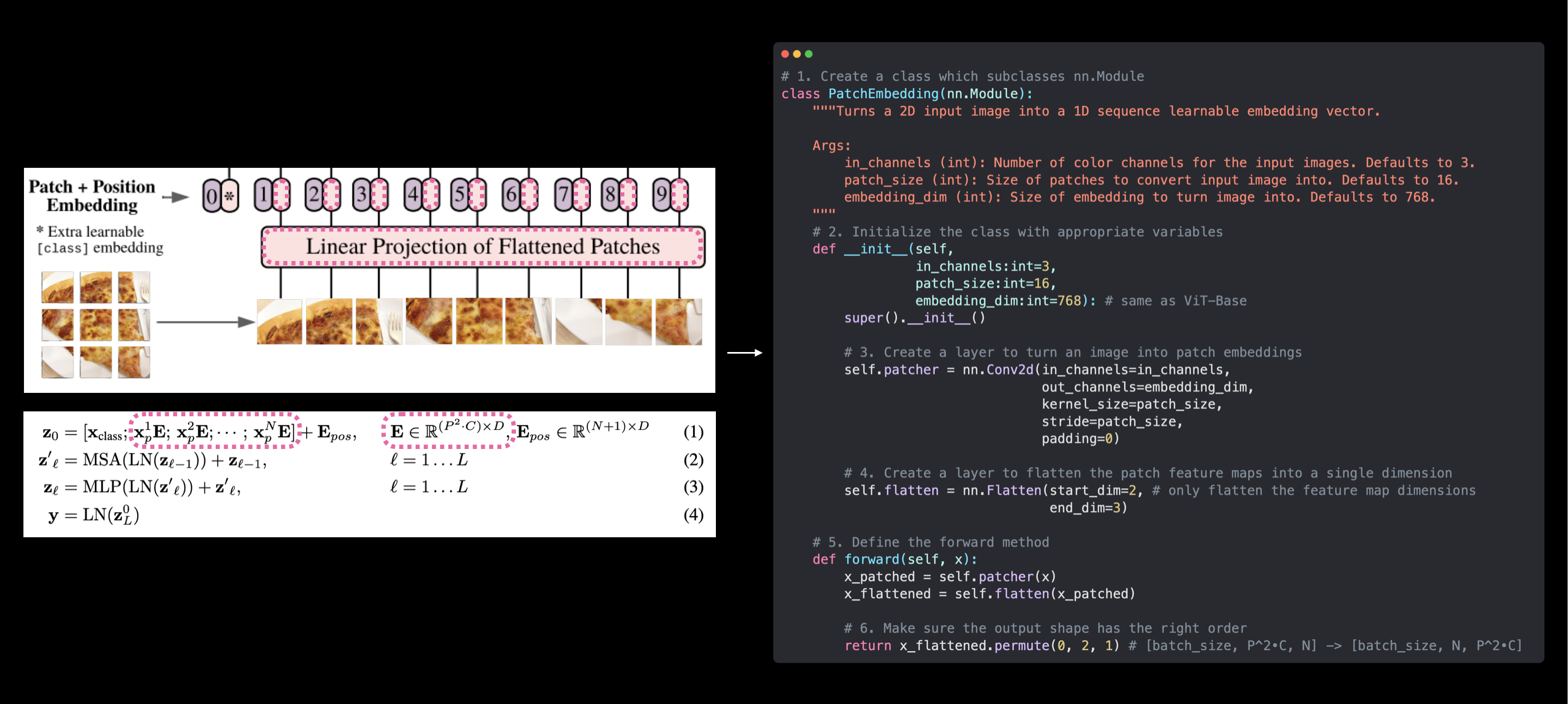
Our PatchEmbedding class (right) replicates the patch embedding of the ViT architecture from Figure 1 and Equation 1 from the ViT paper (left). However, the learnable class embedding and position embeddings haven't been created yet. These will come soon.
Let's now get a summary of our PatchEmbedding layer.
# Create random input sizes
random_input_image = (1, 3, 224, 224)
random_input_image_error = (1, 3, 250, 250) # will error because image size is incompatible with patch_size

# # Get a summary of the input and outputs of PatchEmbedding (uncomment for full output)
# summary(PatchEmbedding(),
#         input_size=random_input_image, # try swapping this for "random_input_image_error"
#         col_names=["input_size", "output_size", "num_params", "trainable"],
#         col_width=20,
#         row_settings=["var_names"])
4.6 Creating the class token embedding
Okay we've made the image patch embedding, time to get to work on the class token embedding.
Or \mathbf{x}_\text {class } from equation 1.
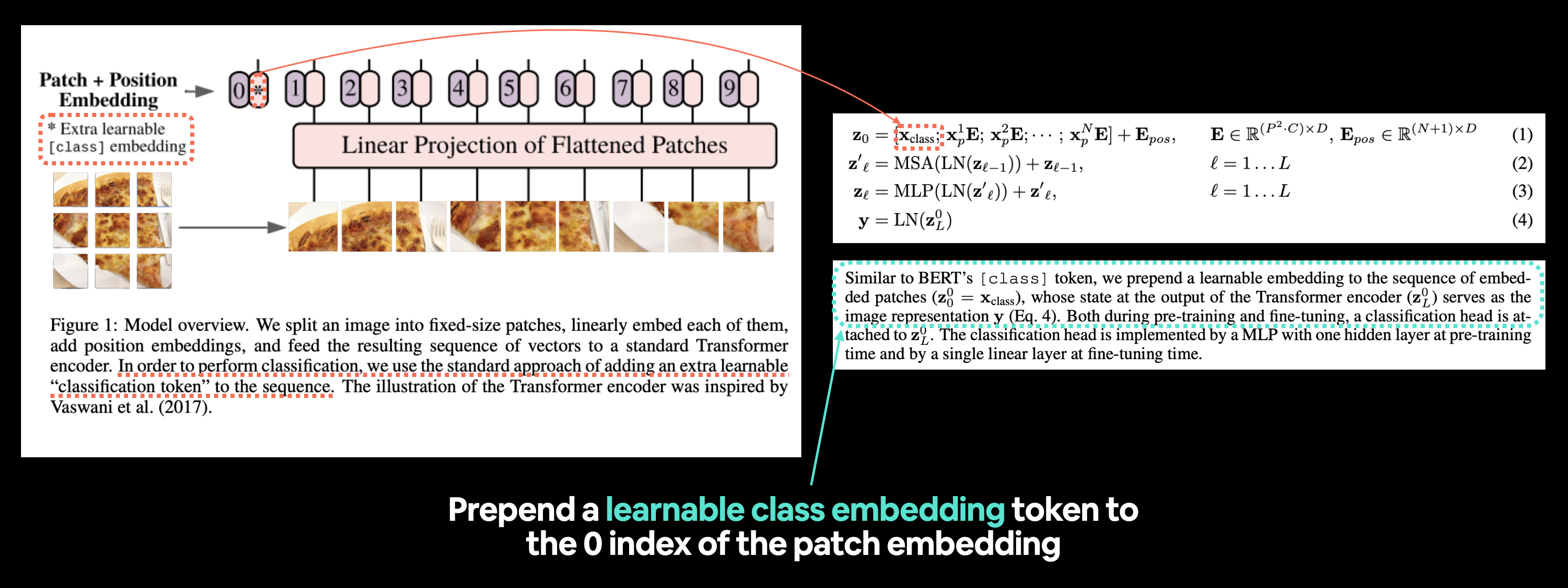
Left: Figure 1 from the ViT paper with the "classification token" or [class] embedding token we're going to recreate highlighted. Right: Equation 1 and section 3.1 of the ViT paper that relate to the learnable class embedding token.
Reading the second paragraph of section 3.1 from the ViT paper, we see the following description:
Similar to BERT's
[ class ]token, we prepend a learnable embedding to the sequence of embedded patches\left(\mathbf{z}_{0}^{0}=\mathbf{x}_{\text {class }}\right), whose state at the output of the Transformer encoder\left(\mathbf{z}_{L}^{0}\right)serves as the image representation\mathbf{y}(Eq. 4).
Note: BERT (Bidirectional Encoder Representations from Transformers) is one of the original machine learning research papers to use the Transformer architecture to achieve outstanding results on natural language processing (NLP) tasks and is where the idea of having a
[ class ]token at the start of a sequence originated, class being a description for the "classification" class the sequence belonged to.
So we need to "preprend a learnable embedding to the sequence of embedded patches".
Let's start by viewing our sequence of embedded patches tensor (created in section 4.5) and its shape.
# View the patch embedding and patch embedding shape
print(patch_embedded_image)
print(f"Patch embedding shape: {patch_embedded_image.shape} -> [batch_size, number_of_patches, embedding_dimension]")
tensor([[[-0.5916, 0.1065, -0.0335, ..., 0.1634, -0.1418, 0.2621],
[-0.6331, 0.2230, -0.0218, ..., 0.2753, -0.3510, 0.1206],
[-0.5227, 0.0228, -0.2376, ..., 0.4102, -0.2379, 0.1911],
...,
[-0.9917, 0.2912, -0.2652, ..., 0.7523, -0.4618, 0.3439],
[-0.8799, 0.2309, -0.1697, ..., 0.5668, -0.3730, 0.3251],
[-0.4552, 0.0929, -0.2891, ..., 0.5705, -0.3528, 0.2079]]],
grad_fn=<PermuteBackward0>)
Patch embedding shape: torch.Size([1, 196, 768]) -> [batch_size, number_of_patches, embedding_dimension]
# Get the batch size and embedding dimension
batch_size = patch_embedded_image.shape[0]
embedding_dimension = patch_embedded_image.shape[-1]

# Create the class token embedding as a learnable parameter that shares the same size as the embedding dimension (D)
class_token = nn.Parameter(torch.ones(batch_size, 1, embedding_dimension), # [batch_size, number_of_tokens, embedding_dimension]
                           requires_grad=True) # make sure the embedding is learnable

# Show the first 10 examples of the class_token
print(class_token[:, :, :10])

# Print the class_token shape
print(f"Class token shape: {class_token.shape} -> [batch_size, number_of_tokens, embedding_dimension]")
tensor([[[1., 1., 1., 1., 1., 1., 1., 1., 1., 1.]]], grad_fn=<SliceBackward0>) Class token shape: torch.Size([1, 1, 768]) -> [batch_size, number_of_tokens, embedding_dimension]
# Add the class token embedding to the front of the patch embedding
patch_embedded_image_with_class_embedding = torch.cat((class_token, patch_embedded_image),
                                                      dim=1) # concat on first dimension

# Print the sequence of patch embeddings with the prepended class token embedding
print(patch_embedded_image_with_class_embedding)
print(f"Sequence of patch embeddings with class token prepended shape: {patch_embedded_image_with_class_embedding.shape} -> [batch_size, number_of_patches, embedding_dimension]")
tensor([[[ 1.0000, 1.0000, 1.0000, ..., 1.0000, 1.0000, 1.0000],
[-0.5916, 0.1065, -0.0335, ..., 0.1634, -0.1418, 0.2621],
[-0.6331, 0.2230, -0.0218, ..., 0.2753, -0.3510, 0.1206],
...,
[-0.9917, 0.2912, -0.2652, ..., 0.7523, -0.4618, 0.3439],
[-0.8799, 0.2309, -0.1697, ..., 0.5668, -0.3730, 0.3251],
[-0.4552, 0.0929, -0.2891, ..., 0.5705, -0.3528, 0.2079]]],
grad_fn=<CatBackward0>)
Sequence of patch embeddings with class token prepended shape: torch.Size([1, 197, 768]) -> [batch_size, number_of_patches, embedding_dimension]
Nice! Learnable class token prepended!
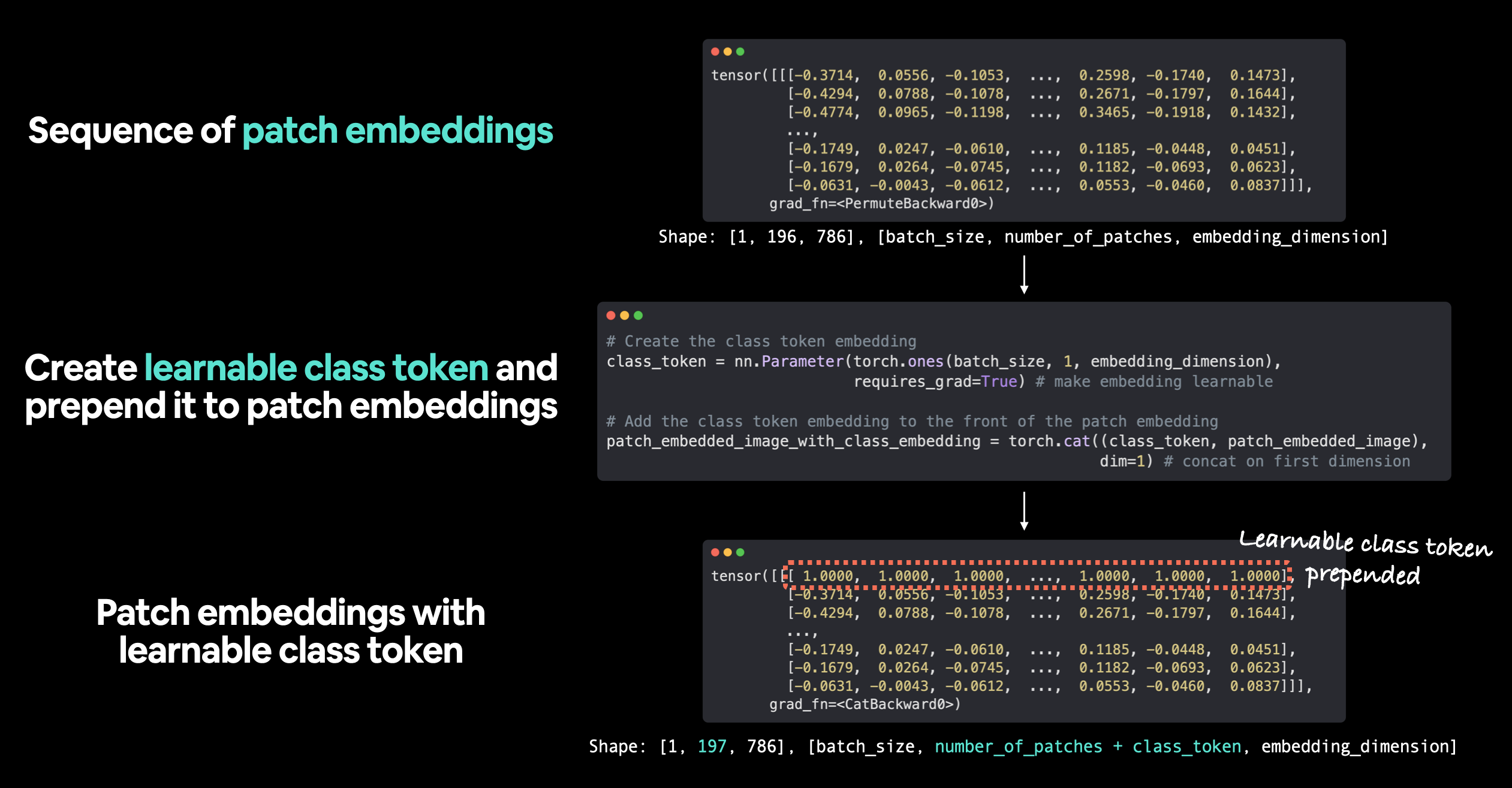
Reviewing what we've done to create the learnable class token, we start with a sequence of image patch embeddings created by PatchEmbedding() on single image, we then created a learnable class token with one value for each of the embedding dimensions and then prepended it to the original sequence of patch embeddings. Note: Using torch.ones() to create the learnable class token is mostly for demonstration purposes only, in practice, you'd like create it with torch.randn().
4.7 Creating the position embedding
Well, we've got the class token embedding and the patch embedding, now how might we create the position embedding?
Or \mathbf{E}_{\text {pos }} from equation 1 where E stands for "embedding".
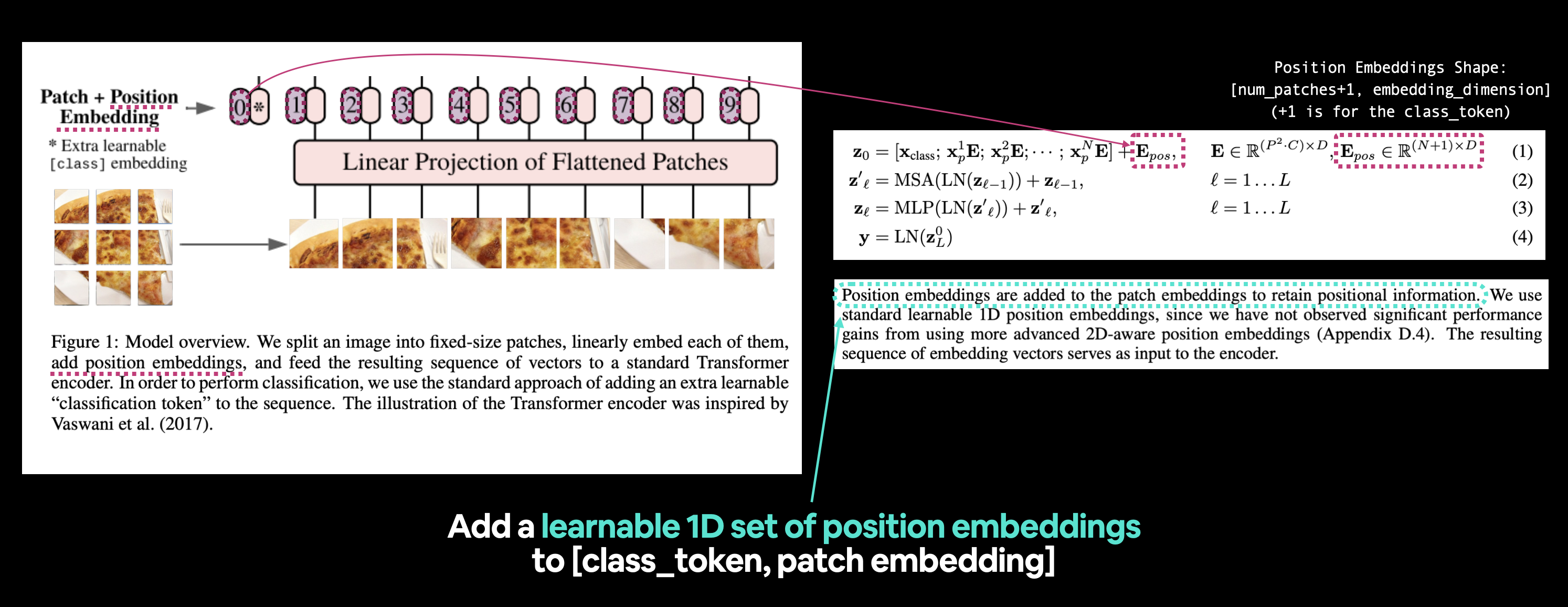
Left: Figure 1 from the ViT paper with the position embedding we're going to recreate highlighted. Right: Equation 1 and section 3.1 of the ViT paper that relate to the position embedding.
Let's find out more by reading section 3.1 of the ViT paper (bold mine):
Position embeddings are added to the patch embeddings to retain positional information. We use standard learnable 1D position embeddings, since we have not observed significant performance gains from using more advanced 2D-aware position embeddings (Appendix D.4). The resulting sequence of embedding vectors serves as input to the encoder.
By "retain positional information" the authors mean they want the architecture to know what "order" the patches come in. As in, patch two comes after patch one and patch three comes after patch two and on and on.
This positional information can be important when considering what's in an image (without positional information an a flattened sequence could be seen as having no order and thus no patch relates to any other patch).
To start creating the position embeddings, let's view our current embeddings.
# View the sequence of patch embeddings with the prepended class embedding
patch_embedded_image_with_class_embedding, patch_embedded_image_with_class_embedding.shape(tensor([[[ 1.0000, 1.0000, 1.0000, ..., 1.0000, 1.0000, 1.0000],
[-0.5916, 0.1065, -0.0335, ..., 0.1634, -0.1418, 0.2621],
[-0.6331, 0.2230, -0.0218, ..., 0.2753, -0.3510, 0.1206],
...,
[-0.9917, 0.2912, -0.2652, ..., 0.7523, -0.4618, 0.3439],
[-0.8799, 0.2309, -0.1697, ..., 0.5668, -0.3730, 0.3251],
[-0.4552, 0.0929, -0.2891, ..., 0.5705, -0.3528, 0.2079]]],
grad_fn=<CatBackward0>),
torch.Size([1, 197, 768]))# Calculate N (number of patches)
number_of_patches = int((height * width) / patch_size**2)
# Get embedding dimension
embedding_dimension = patch_embedded_image_with_class_embedding.shape[2]
# Create the learnable 1D position embedding
position_embedding = nn.Parameter(torch.ones(1,
number_of_patches+1,
embedding_dimension),
requires_grad=True) # make sure it's learnable
# Show the first 10 sequences and 10 position embedding values and check the shape of the position embedding
print(position_embedding[:, :10, :10])
print(f"Position embeddding shape: {position_embedding.shape} -> [batch_size, number_of_patches, embedding_dimension]")tensor([[[1., 1., 1., 1., 1., 1., 1., 1., 1., 1.],
[1., 1., 1., 1., 1., 1., 1., 1., 1., 1.],
[1., 1., 1., 1., 1., 1., 1., 1., 1., 1.],
[1., 1., 1., 1., 1., 1., 1., 1., 1., 1.],
[1., 1., 1., 1., 1., 1., 1., 1., 1., 1.],
[1., 1., 1., 1., 1., 1., 1., 1., 1., 1.],
[1., 1., 1., 1., 1., 1., 1., 1., 1., 1.],
[1., 1., 1., 1., 1., 1., 1., 1., 1., 1.],
[1., 1., 1., 1., 1., 1., 1., 1., 1., 1.],
[1., 1., 1., 1., 1., 1., 1., 1., 1., 1.]]], grad_fn=<SliceBackward0>)
Position embeddding shape: torch.Size([1, 197, 768]) -> [batch_size, number_of_patches, embedding_dimension]
# Add the position embedding to the patch and class token embedding
patch_and_position_embedding = patch_embedded_image_with_class_embedding + position_embedding
print(patch_and_position_embedding)
print(f"Patch embeddings, class token prepended and positional embeddings added shape: {patch_and_position_embedding.shape} -> [batch_size, number_of_patches, embedding_dimension]")
tensor([[[2.0000, 2.0000, 2.0000, ..., 2.0000, 2.0000, 2.0000],
[0.4084, 1.1065, 0.9665, ..., 1.1634, 0.8582, 1.2621],
[0.3669, 1.2230, 0.9782, ..., 1.2753, 0.6490, 1.1206],
...,
[0.0083, 1.2912, 0.7348, ..., 1.7523, 0.5382, 1.3439],
[0.1201, 1.2309, 0.8303, ..., 1.5668, 0.6270, 1.3251],
[0.5448, 1.0929, 0.7109, ..., 1.5705, 0.6472, 1.2079]]],
grad_fn=<AddBackward0>)
Patch embeddings, class token prepended and positional embeddings added shape: torch.Size([1, 197, 768]) -> [batch_size, number_of_patches, embedding_dimension]
Notice how the values of each of the elements in the embedding tensor increases by 1 (this is because of the position embeddings being created with torch.ones()).
Note: We could put both the class token embedding and position embedding into their own layer if we wanted to. But we'll see later on in section 8 how they can be incorporated into the overall ViT architecture's
forward()method.
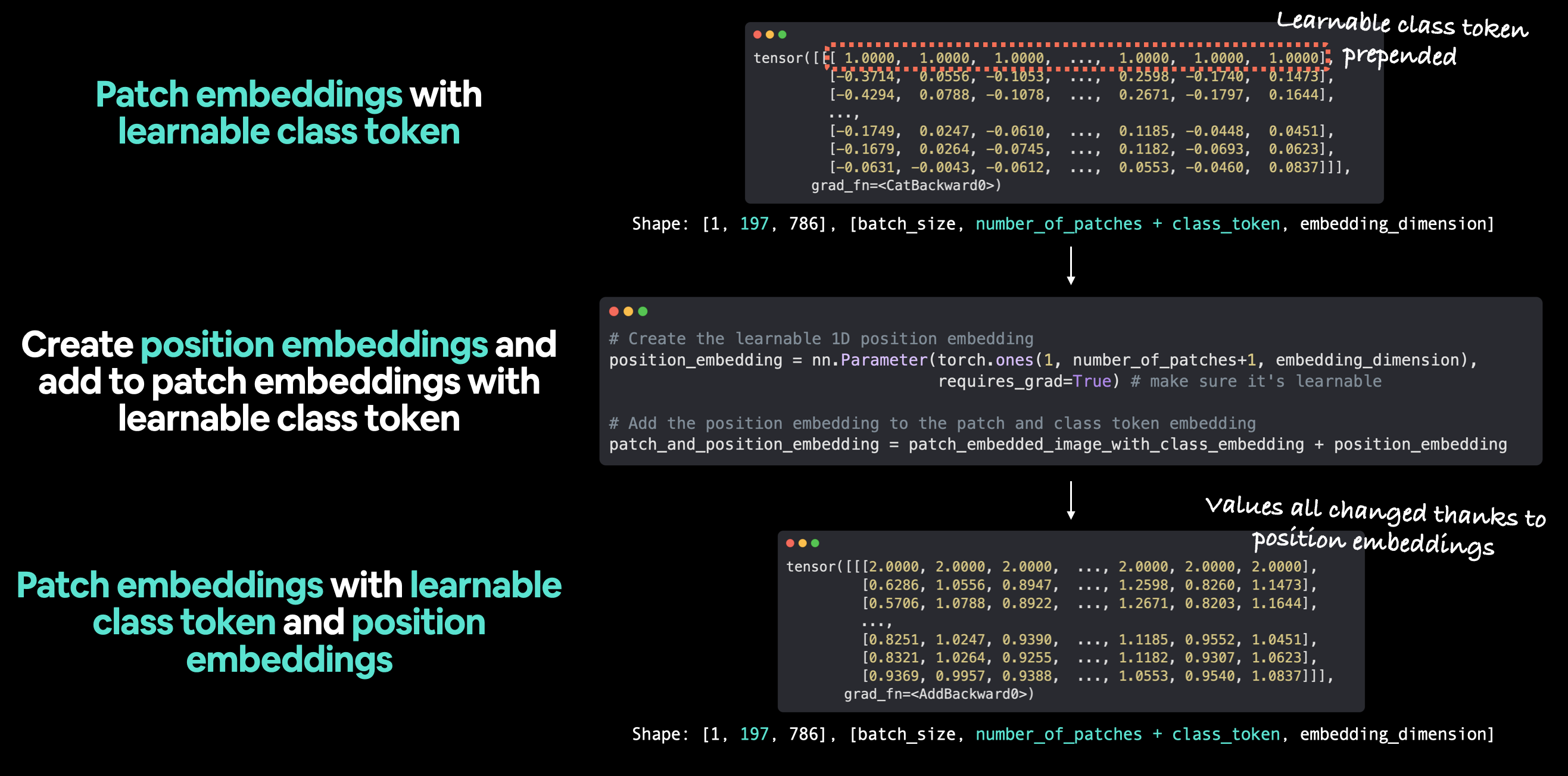
The workflow we've used for adding the position embeddings to the sequence of patch embeddings and class token. Note: torch.ones() only used to create embeddings for illustration purposes, in practice, you'd likely use torch.randn() to start with a random number.
set_seeds()

# 1. Set patch size
patch_size = 16

# 2. Print shape of original image tensor and get the image dimensions
print(f"Image tensor shape: {image.shape}")
height, width = image.shape[1], image.shape[2]

# 3. Get image tensor and add batch dimension
x = image.unsqueeze(0)
print(f"Input image with batch dimension shape: {x.shape}")

# 4. Create patch embedding layer
patch_embedding_layer = PatchEmbedding(in_channels=3,
                                       patch_size=patch_size,
                                       embedding_dim=768)

# 5. Pass image through patch embedding layer
patch_embedding = patch_embedding_layer(x)
print(f"Patching embedding shape: {patch_embedding.shape}")

# 6. Create class token embedding
batch_size = patch_embedding.shape[0]
embedding_dimension = patch_embedding.shape[-1]
class_token = nn.Parameter(torch.ones(batch_size, 1, embedding_dimension),
                           requires_grad=True) # make sure it's learnable
print(f"Class token embedding shape: {class_token.shape}")

# 7. Prepend class token embedding to patch embedding
patch_embedding_class_token = torch.cat((class_token, patch_embedding), dim=1)
print(f"Patch embedding with class token shape: {patch_embedding_class_token.shape}")

# 8. Create position embedding
number_of_patches = int((height * width) / patch_size**2)
position_embedding = nn.Parameter(torch.ones(1, number_of_patches+1, embedding_dimension),
                                  requires_grad=True) # make sure it's learnable

# 9. Add position embedding to patch embedding with class token
patch_and_position_embedding = patch_embedding_class_token + position_embedding
print(f"Patch and position embedding shape: {patch_and_position_embedding.shape}")
Image tensor shape: torch.Size([3, 224, 224]) Input image with batch dimension shape: torch.Size([1, 3, 224, 224]) Patching embedding shape: torch.Size([1, 196, 768]) Class token embedding shape: torch.Size([1, 1, 768]) Patch embedding with class token shape: torch.Size([1, 197, 768]) Patch and position embedding shape: torch.Size([1, 197, 768])