mirror of
https://github.com/mrdbourke/pytorch-deep-learning.git
synced 2026-11-27 06:07:09 +00:00

170 KiB
170 KiB

What we're going to cover
In this module we're going to cover a standard PyTorch workflow (it can be chopped and changed as necessary but it covers the main outline of steps).
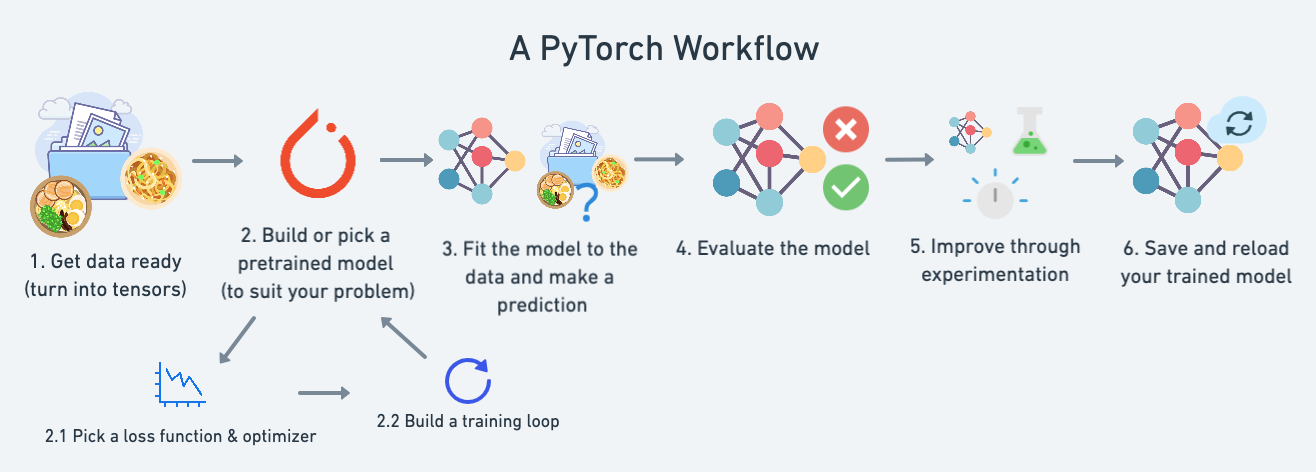
For now, we'll use this workflow to predict a simple straight line but the workflow steps can be repeated and changed depending on the problem you're working on.
Specifically, we're going to cover:
| Topic | Contents |
|---|---|
| 1. Getting data ready | Data can be almost anything but for to get started we're going to create a simple straight line |
| 2. Building a model | Here we'll create a model to learn patterns in the data, we'll also choose a loss function, optimizer and build a training loop. |
| 3. Fitting the model to data (training) | We've got data and a model, now let's let the model (try to) find patterns in the (training) data. |
| 4. Making predictions and evaluating a model (inference) | Our model's found patterns in the data, let's compare its findings to the actual (testing) data. |
| 5. Saving and loading a model | You may want to use your model elsewhere, or come back to it later, here we'll cover that. |
| 6. Putting it all together | Let's take all of the above and combine it. |
In [100]:
what_were_covering = {1: "data (prepare and load)",
    2: "build model",
    3: "fitting the model to data (training)",
    4: "making predictions and evaluating a model (inference)",
    5: "saving and loading a model",
    6: "putting it all together"
}In [101]:
import torch
from torch import nn # nn contains all of PyTorch's building blocks for neural networks
import matplotlib.pyplot as plt

# Check PyTorch version
torch.__version__
Out [101]:
'1.10.0+cu111'
In [102]:
# Create *known* parameters
weight = 0.7
bias = 0.3

# Create data
start = 0
end = 1
step = 0.02
X = torch.arange(start, end, step).unsqueeze(dim=1)
y = weight * X + bias

X[:10], y[:10]
Out [102]:
(tensor([[0.0000],
         [0.0200],
         [0.0400],
         [0.0600],
         [0.0800],
         [0.1000],
         [0.1200],
         [0.1400],
         [0.1600],
         [0.1800]]), tensor([[0.3000],
         [0.3140],
         [0.3280],
         [0.3420],
         [0.3560],
         [0.3700],
         [0.3840],
         [0.3980],
         [0.4120],
[0.4260]]))In [103]:
# Create train/test split
train_split = int(0.8 * len(X)) # 80% of data used for training set, 20% for testing
X_train, y_train = X[:train_split], y[:train_split]
X_test, y_test = X[train_split:], y[train_split:]

len(X_train), len(y_train), len(X_test), len(y_test)
Out [103]:
(40, 40, 10, 10)
In [104]:
def plot_predictions(train_data=X_train,
                     train_labels=y_train,
                     test_data=X_test,
                     test_labels=y_test,
                     predictions=None):
  """
  Plots training data, test data and compares predictions.
  """
  plt.figure(figsize=(10, 7))

  # Plot training data in blue
  plt.scatter(train_data, train_labels, c="b", s=4, label="Training data")

  # Plot test data in green
  plt.scatter(test_data, test_labels, c="g", s=4, label="Testing data")

  if predictions is not None:
    # Plot the predictions in red (predictions were made on the test data)
    plt.scatter(test_data, predictions, c="r", s=4, label="Predictions")

  # Show the legend
  plt.legend(prop={"size": 14});
In [105]:
plot_predictions();
In [106]:
# Create a Linear Regression model class
class LinearRegressionModel(nn.Module): # <- almost everything in PyTorch is a nn.Module (think of this as neural network lego blocks)
    def __init__(self):
        super().__init__()
        self.weights = nn.Parameter(torch.randn(1, # <- start with random weights (this will get adjusted as the model learns)
            requires_grad=True, # <- can we update this value with gradient descent?
            dtype=torch.float # <- PyTorch loves float32 by default
        ))

        self.bias = nn.Parameter(torch.randn(1, # <- start with random bias (this will get adjusted as the model learns)
            requires_grad=True, # <- can we update this value with gradient descent?
            dtype=torch.float # <- PyTorch loves float32 by default
        ))

    # Forward defines the computation in the model
    def forward(self, x): # <- "x" is the input data (e.g. training/testing features)
return self.weights * x + self.bias # <- this is the linear regression formulaIn [107]:
# Set manual seed since nn.Parameter are randomly initialzied
torch.manual_seed(42)

# Create an instance of the model (this is a subclass of nn.Module that contains nn.Parameter(s))
model_0 = LinearRegressionModel()

# Check the nn.Parameter(s) within the nn.Module subclass we created
list(model_0.parameters())
Out [107]:
[Parameter containing:
 tensor([0.3367], requires_grad=True), Parameter containing:
 tensor([0.1288], requires_grad=True)]
In [108]:
# List named parameters
model_0.state_dict()
Out [108]:
OrderedDict([('weights', tensor([0.3367])), ('bias', tensor([0.1288]))])In [109]:
# Make predictions with model
with torch.inference_mode():
    y_preds = model_0(X_test)

# Note: in older PyTorch code you might also see torch.no_grad()
# with torch.no_grad():
# y_preds = model_0(X_test)In [110]:
# Check the predictions
print(f"Number of testing samples: {len(X_test)}")
print(f"Number of predictions made: {len(y_preds)}")
print(f"Predicted values:\n{y_preds}")
Number of testing samples: 10
Number of predictions made: 10
Predicted values:
tensor([[0.3982],
[0.4049],
[0.4116],
[0.4184],
[0.4251],
[0.4318],
[0.4386],
[0.4453],
[0.4520],
[0.4588]])
In [111]:
plot_predictions(predictions=y_preds)
In [112]:
# Create the loss function
loss_fn = nn.L1Loss() # MAE loss is same as L1Loss

# Create the optimizer
optimizer = torch.optim.SGD(params=model_0.parameters(), # parameters of target model to optimize
lr=0.01) # learning rate (how much the optimizer should change parameters at each step, higher=more (less stable), lower=less (might take a long time))In [116]:
torch.manual_seed(42)

# Set the number of epochs (how many times the model will pass over the training data)
epochs = 100

# Create empty loss lists to track values
train_loss_values = []
test_loss_values = []
epoch_count = []

for epoch in range(epochs):
    ### Training

    # Put model in training mode (this is the default state of a model)
    model_0.train()

    # 1. Forward pass on train data using the forward() method inside
    y_pred = model_0(X_train)
    # print(y_pred)

    # 2. Calculate the loss (how different)
    loss = loss_fn(y_pred, y_train)

    # 3. Zero grad of the optimizer
    optimizer.zero_grad()

    # 4. Loss backwards
    loss.backward()

    # 5. Progress the optimizer
    optimizer.step()

    ### Testing

    # Put the model in evaluation mode
    model_0.eval()

    with torch.inference_mode():
      # 1. Forward pass on test data
      test_pred = model_0(X_test)

    # 2. Caculate loss on test data
    test_loss = loss_fn(test_pred, y_test.type(torch.float)) # predictions come in torch.float datatype, so comparisons need to be done with tensors of the same type

    # Print out what's happening
    if epoch % 10 == 0:
        epoch_count.append(epoch)
        train_loss_values.append(loss)
        test_loss_values.append(test_loss)
        print(f"Epoch: {epoch} | MAE Train Loss: {loss} | MAE Test Loss: {test_loss} ")
Epoch: 0 | MAE Train Loss: 0.024458957836031914 | MAE Test Loss: 0.05646304413676262 Epoch: 10 | MAE Train Loss: 0.021020207554101944 | MAE Test Loss: 0.04819049686193466 Epoch: 20 | MAE Train Loss: 0.01758546568453312 | MAE Test Loss: 0.04060482233762741 Epoch: 30 | MAE Train Loss: 0.014155393466353416 | MAE Test Loss: 0.03233227878808975 Epoch: 40 | MAE Train Loss: 0.010716589167714119 | MAE Test Loss: 0.024059748277068138 Epoch: 50 | MAE Train Loss: 0.0072835334576666355 | MAE Test Loss: 0.016474086791276932 Epoch: 60 | MAE Train Loss: 0.0038517764769494534 | MAE Test Loss: 0.008201557211577892 Epoch: 70 | MAE Train Loss: 0.008932482451200485 | MAE Test Loss: 0.005023092031478882 Epoch: 80 | MAE Train Loss: 0.008932482451200485 | MAE Test Loss: 0.005023092031478882 Epoch: 90 | MAE Train Loss: 0.008932482451200485 | MAE Test Loss: 0.005023092031478882
In [117]:
# Plot the loss curves
plt.plot(epoch_count, train_loss_values, label="Train loss")
plt.plot(epoch_count, test_loss_values, label="Test loss")
plt.title("Training and test loss curves")
plt.ylabel("Loss")
plt.xlabel("Epochs")
plt.legend();
In [118]:
# Find our model's learned parameters
print("The model learned the following values for weights and bias:")
print(model_0.state_dict())
print("\nAnd the original values for weights and bias are:")
print(f"weights: {weight}, bias: {bias}")
The model learned the following values for weights and bias:
OrderedDict([('weights', tensor([0.6990])), ('bias', tensor([0.3093]))])
And the original values for weights and bias are:
weights: 0.7, bias: 0.3
In [124]:
# 1. Set the model in evaluation mode
model_0.eval()

# 2. Setup the inference mode context manager
with torch.inference_mode():
  # 3. Make sure the calculations are done with the model and data on the same device
  # in our case, we haven't setup device-agnostic code yet so our data and model are
  # on the CPU by default.
  # model_0.to(device)
  # X_test = X_test.to(device)
  y_preds = model_0(X_test)
y_preds
Out [124]:
tensor([[0.8685],
        [0.8825],
        [0.8965],
        [0.9105],
        [0.9245],
        [0.9384],
        [0.9524],
        [0.9664],
        [0.9804],
[0.9944]])In [125]:
plot_predictions(predictions=y_preds)
In [137]:
from pathlib import Path

# 1. Create models directory
MODEL_PATH = Path("models")
MODEL_PATH.mkdir(parents=True, exist_ok=True)

# 2. Create model save path
MODEL_NAME = "01_pytorch_workflow_model_0.pth"
MODEL_SAVE_PATH = MODEL_PATH / MODEL_NAME

# 3. Save the model state dict
print(f"Saving model to: {MODEL_SAVE_PATH}")
torch.save(obj=model_0.state_dict(), # only saving the state_dict() only saves the models learned parameters
           f=MODEL_SAVE_PATH)
Saving model to: models/01_pytorch_workflow_model_0.pth
In [138]:
# Check the saved file path
!ls -l models/01_pytorch_workflow_model_0.pth
-rw-r--r-- 1 root root 1063 Jan 26 02:27 models/01_pytorch_workflow_model_0.pth
In [139]:
# Instantiate a new instance of our model (this will be instantiated with random weights)
loaded_model_0 = LinearRegressionModel()

# Load the state_dict of our saved model (this will update the new instance of our model with trained weights)
loaded_model_0.load_state_dict(torch.load(f=MODEL_SAVE_PATH))
Out [139]:
<All keys matched successfully>
In [140]:
# 1. Put the loaded model into evaluation mode
loaded_model_0.eval()

# 2. Use the inference mode context manager to make predictions
with torch.inference_mode():
loaded_model_preds = loaded_model_0(X_test) # perform a forward pass on the test data with the loaded modelIn [141]:
# Compare previous model predictions with loaded model predictions (these should be the same)
y_preds == loaded_model_preds
Out [141]:
tensor([[True],
        [True],
        [True],
        [True],
        [True],
        [True],
        [True],
        [True],
        [True],
[True]])In [ ]:
# Setup device agnostic code
device = "cuda" if torch.cuda.is_available() else "cpu"
device
'cuda'
In [ ]:
# Check which device model is on
next(model_0.parameters()).device
device(type='cpu')
In [ ]:
weight = 0.7
bias = 0.3
start = 0
end = 1
step = 0.02

X = torch.arange(start, end, step).unsqueeze(dim=1) # without unsqueeze, errors will happen later on (shapes within linear layers)
y = weight * X + bias
X[:10], y[:10]
(tensor([[0.0000],
[0.0200],
[0.0400],
[0.0600],
[0.0800],
[0.1000],
[0.1200],
[0.1400],
[0.1600],
[0.1800]]),
tensor([[0.3000],
[0.3140],
[0.3280],
[0.3420],
[0.3560],
[0.3700],
[0.3840],
[0.3980],
[0.4120],
[0.4260]]))In [ ]:
# Split data
train_split = int(0.8 * len(X))
X_train, y_train = X[:train_split], y[:train_split]
X_test, y_test = X[train_split:], y[train_split:]

len(X_train), len(y_train), len(X_test), len(y_test)
(40, 40, 10, 10)
In [ ]:
plot_predictions(X_train, y_train, X_test, y_test)
In [ ]:
class LinearRegressionModelV2(nn.Module):
    def __init__(self):
        super().__init__()
        self.linear_layer = nn.Linear(in_features=1,
                                      out_features=1)

    def forward(self, x):
        return self.linear_layer(x)

torch.manual_seed(42)
model_1 = LinearRegressionModelV2()
model_1, model_1.state_dict()
(LinearRegressionModelV2(
(linear_layer): Linear(in_features=1, out_features=1, bias=True)
),
OrderedDict([('linear_layer.weight', tensor([[0.7645]])),
('linear_layer.bias', tensor([0.8300]))]))In [ ]:
# Check model device
next(model_1.parameters()).device
device(type='cpu')
In [ ]:
device = "cuda" if torch.cuda.is_available() else "cpu"
model_1.to(device)
next(model_1.parameters()).device
device(type='cuda', index=0)
In [ ]:
loss_fn = nn.L1Loss()
optimizer = torch.optim.SGD(params=model_1.parameters(), lr=0.01)
In [ ]:
torch.manual_seed(42)
epochs = 1000
for epoch in range(epochs):
    # Without this, error will happen (not all model/data on device)
    X_train = X_train.to(device)
    X_test = X_test.to(device)
    y_train = y_train.to(device)
    y_test = y_test.to(device)

    # Training
    model_1.train() # train mode is on by default after construction
    # 1. Forward pass
    y_pred = model_1(X_train)

    # 2. Calculate loss
    loss = loss_fn(y_pred, y_train)

    # 3. Zero grad optimizer
    optimizer.zero_grad()

    # 4. Loss backward
    loss.backward()

    # 5. Step the optimizer
    optimizer.step()

    # Testing
    model_1.eval()
    # 1. Forward pass
    with torch.inference_mode():
        test_pred = model_1(X_test)

        # 2. Calculate the loss
        test_loss = loss_fn(test_pred, y_test)

    if epoch % 100 == 0:
        print(f"Epoch: {epoch} | Train loss: {loss} | Test loss: {test_loss}")
Epoch: 0 | Train loss: 0.5551779866218567 | Test loss: 0.5739762187004089 Epoch: 100 | Train loss: 0.006215683650225401 | Test loss: 0.014086711220443249 Epoch: 200 | Train loss: 0.0012645035749301314 | Test loss: 0.013801801018416882 Epoch: 300 | Train loss: 0.0012645035749301314 | Test loss: 0.013801801018416882 Epoch: 400 | Train loss: 0.0012645035749301314 | Test loss: 0.013801801018416882 Epoch: 500 | Train loss: 0.0012645035749301314 | Test loss: 0.013801801018416882 Epoch: 600 | Train loss: 0.0012645035749301314 | Test loss: 0.013801801018416882 Epoch: 700 | Train loss: 0.0012645035749301314 | Test loss: 0.013801801018416882 Epoch: 800 | Train loss: 0.0012645035749301314 | Test loss: 0.013801801018416882 Epoch: 900 | Train loss: 0.0012645035749301314 | Test loss: 0.013801801018416882
In [ ]:
model_1.state_dict()OrderedDict([('linear_layer.weight', tensor([[0.6968]], device='cuda:0')),
('linear_layer.bias', tensor([0.3025], device='cuda:0'))])In [ ]:
weight, bias(0.7, 0.3)
In [ ]:
model_1.eval()
with torch.inference_mode():
    y_preds = model_1(X_test)
y_preds
tensor([[0.8600],
[0.8739],
[0.8878],
[0.9018],
[0.9157],
[0.9296],
[0.9436],
[0.9575],
[0.9714],
[0.9854]], device='cuda:0')In [ ]:
# plot_predictions(predictions=y_preds) # -> won't work... data not on CPU
plot_predictions(predictions=y_preds.cpu())
In [ ]:
# Save model
os.makedirs("models", exist_ok=True)
save_path = "models/01_pytorch_workflow_model_1.pth"
torch.save(model_1.state_dict(), save_path)
In [ ]:
# Load model (if your data is on GPU, model will have to be on GPU to make predictions)
loaded_model_1 = LinearRegressionModelV2()
loaded_model_1.load_state_dict(torch.load(save_path))
loaded_model_1.to(device)
loaded_model_1, next(loaded_model_1.parameters()).device
(LinearRegressionModelV2( (linear_layer): Linear(in_features=1, out_features=1, bias=True) ), device(type='cuda', index=0))
In [ ]:
# Evaluate loaded model
loaded_model_1.eval()
with torch.inference_mode():
    loaded_model_1_preds = loaded_model_1(X_test)
y_preds == loaded_model_1_preds
tensor([[True],
[True],
[True],
[True],
[True],
[True],
[True],
[True],
[True],
[True]], device='cuda:0')