
692 KiB

TK - What is experiment tracking?
Machine learning and deep learning are very experimental.
You have to put your artist's beret/chef's hat on to cook up lots of different models.
And you have to put on your scientist's coat to track the results of various combinations of data, model architectures and training regimes.
That's where experiment tracking comes in.
If you're running lots of different experiments, experiment tracking helps you figure out what works and what doesn't.
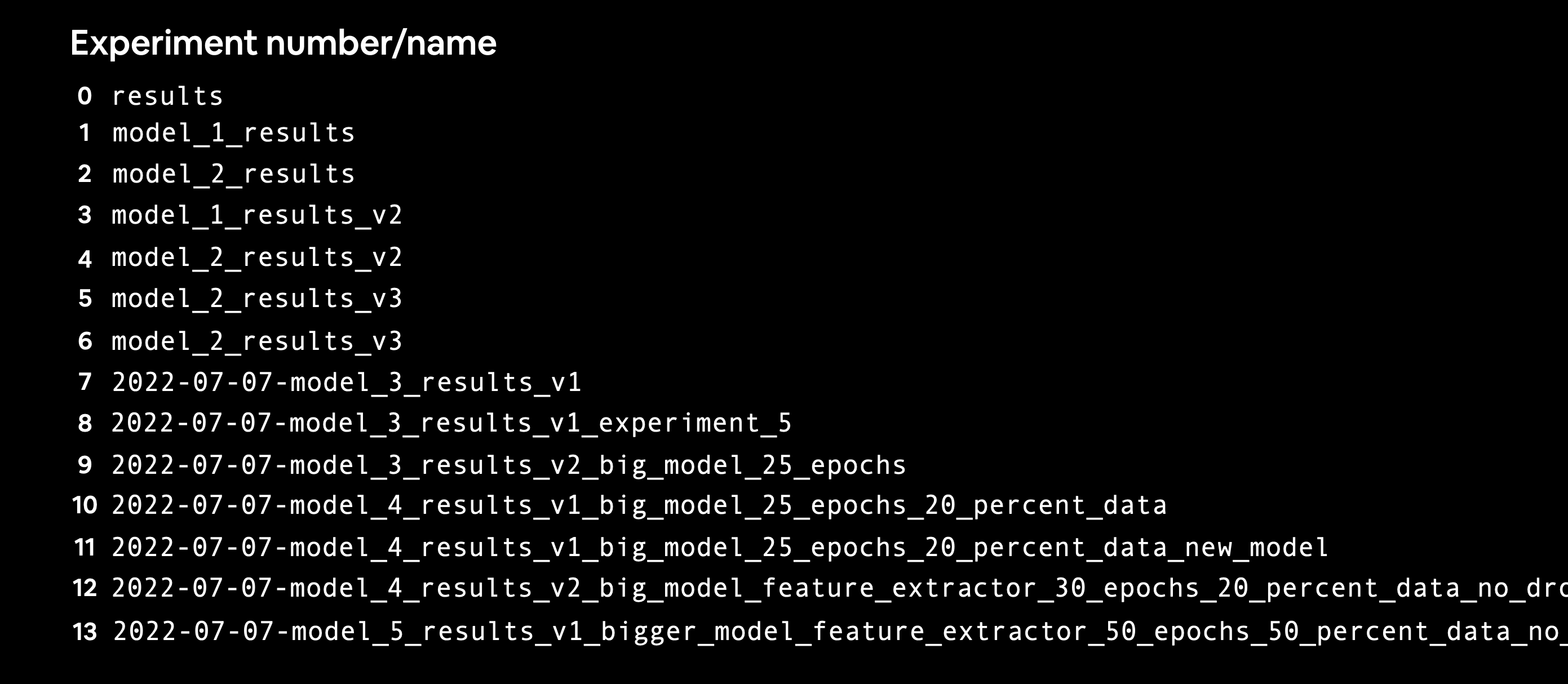
After building a few models and tracking their results, you'll start to notice how quickly it can get out of hand.
TK - Different ways to track machine learning experiments
There are as many different ways to track machine learning experiments as there is experiments to run.
This table covers a few.
| Method | Setup | Pros | Cons | Cost |
|---|---|---|---|---|
| Python dictionaries, CSV files, print outs | None | Easy to setup, runs in pure Python | Hard to keep track of large numbers of experiments | Free |
| TensorBoard | Minimal, install tensorboard |
Extensions built into PyTorch, widely recognized and used, easily scales. | User-experience not as nice as other options. | Free |
| Weights & Biases Experiment Tracking | Minimal, install wandb, make an account. |
Incredible user experience, make experiments public, tracks almost anything | Requires external resource outside of PyTorch. | Free for personal use |
| MLFlow | Minimal, install mlflow and starting tracking |
Fully open-source MLOps lifecycle management, many integrations. | Little bit harder to setup a remote tracking server than other services. | Free |
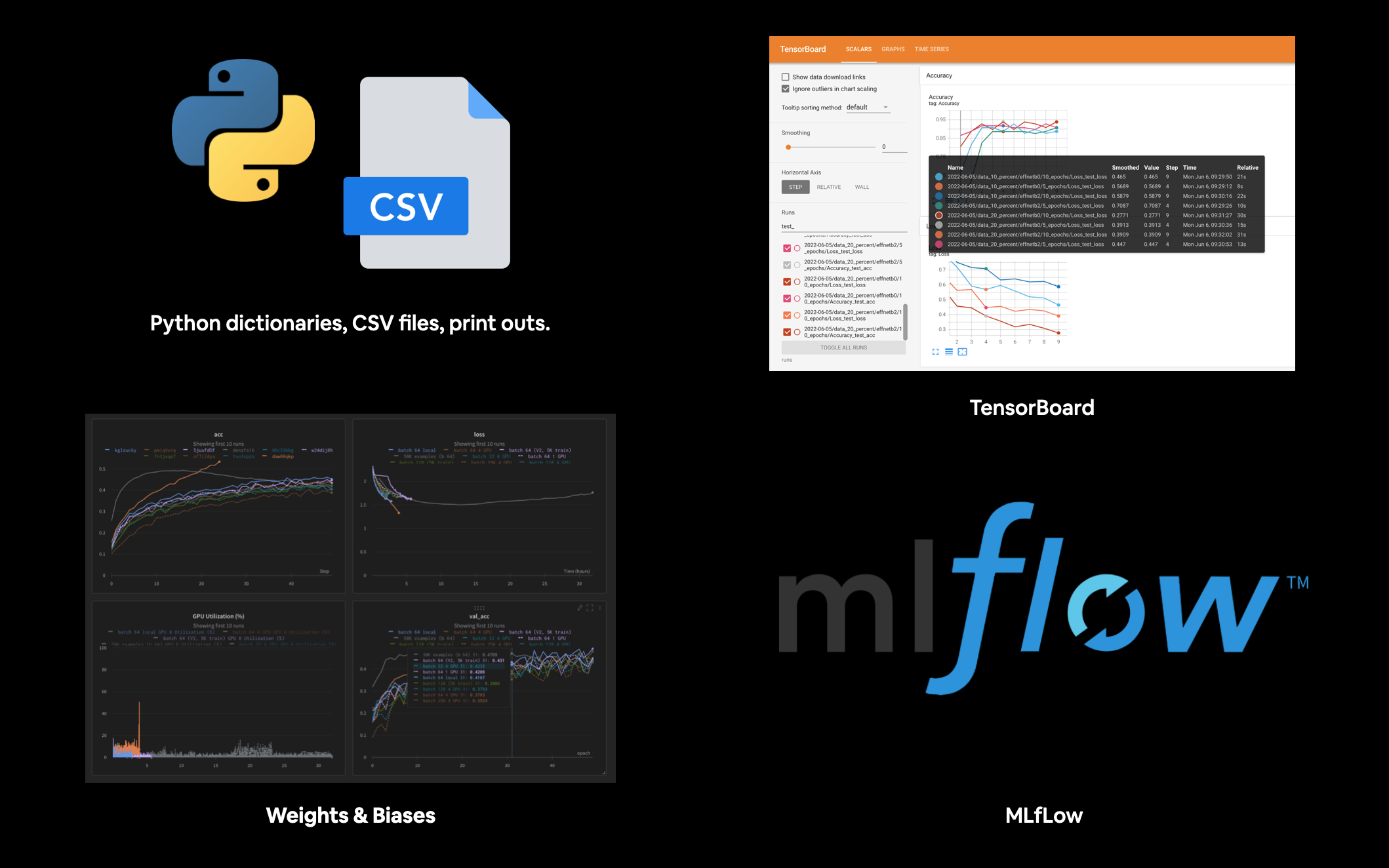
Various places and techniques you can use to track your machine learning experiments. Note: There are various other options similar to Weights & Biases and open-source options similar to MLflow but I've left them out for brevity. You can find more by searching "machine learning experiment tracking".
# For this notebook to run with updated APIs, we need torch 1.12+ and torchvision 0.13+
try:
    import torch
    import torchvision
    assert int(torch.__version__.split(".")[1]) >= 12, "torch version should be 1.12+"
    assert int(torchvision.__version__.split(".")[1]) >= 13, "torchvision version should be 0.13+"
    print(f"torch version: {torch.__version__}")
    print(f"torchvision version: {torchvision.__version__}")
except:
    print(f"[INFO] torch/torchvision versions not as required, installing nightly versions.")
    !pip3 install -U --pre torch torchvision torchaudio --extra-index-url https://download.pytorch.org/whl/nightly/cu113
    import torch
    import torchvision
    print(f"torch version: {torch.__version__}")
    print(f"torchvision version: {torchvision.__version__}")
torch version: 1.13.0.dev20220620+cu113 torchvision version: 0.14.0.dev20220620+cu113
# Continue with regular imports
import matplotlib.pyplot as plt
import torch
import torchvision

from torch import nn
from torchvision import transforms

# Try to get torchinfo, install it if it doesn't work
try:
    from torchinfo import summary
except:
    print("[INFO] Couldn't find torchinfo... installing it.")
    !pip install -q torchinfo
    from torchinfo import summary

# Try to import the going_modular directory, download it from GitHub if it doesn't work
try:
    from going_modular.going_modular import data_setup, engine
except:
    # Get the going_modular scripts
    print("[INFO] Couldn't find going_modular scripts... downloading them from GitHub.")
    !git clone https://github.com/mrdbourke/pytorch-deep-learning
    !mv pytorch-deep-learning/going_modular .
    !rm -rf pytorch-deep-learning
from going_modular.going_modular import data_setup, enginedevice = "cuda" if torch.cuda.is_available() else "cpu"
device'cuda'
# Set seeds
def set_seeds(seed: int=42):
    """Sets random sets for torch operations.

    Args:
        seed (int, optional): Random seed to set. Defaults to 42.
    """
    # Set the seed for general torch operations
    torch.manual_seed(seed)
    # Set the seed for CUDA torch operations (ones that happen on the GPU)
torch.cuda.manual_seed(seed)import os
import zipfile
from pathlib import Path
import requests
def download_data(source: str,
destination: str,
remove_source: bool = True) -> Path:
"""Downloads a zipped dataset from source and unzips to destination.
Args:
source (str): A link to a zipped file containing data.
destination (str): A target directory to unzip data to.
remove_source (bool): Whether to remove the source after downloading and extracting.
Returns:
pathlib.Path to downloaded data.
Example usage:
download_data(source="https://github.com/mrdbourke/pytorch-deep-learning/raw/main/data/pizza_steak_sushi.zip",
destination="pizza_steak_sushi")
"""
# Setup path to data folder
data_path = Path("data/")
image_path = data_path / destination
# If the image folder doesn't exist, download it and prepare it...
if image_path.is_dir():
print(f"[INFO] {image_path} directory exists, skipping download.")
else:
print(f"[INFO] Did not find {image_path} directory, creating one...")
image_path.mkdir(parents=True, exist_ok=True)
# Download pizza, steak, sushi data
target_file = Path(source).name
with open(data_path / target_file, "wb") as f:
request = requests.get(source)
print(f"[INFO] Downloading {target_file} from {source}...")
f.write(request.content)
# Unzip pizza, steak, sushi data
with zipfile.ZipFile(data_path / target_file, "r") as zip_ref:
print(f"[INFO] Unzipping {target_file} data...")
zip_ref.extractall(image_path)
# Remove .zip file
if remove_source:
os.remove(data_path / target_file)
return image_path
image_path = download_data(source="https://github.com/mrdbourke/pytorch-deep-learning/raw/main/data/pizza_steak_sushi.zip",
destination="pizza_steak_sushi")
image_path[INFO] data/pizza_steak_sushi directory exists, skipping download.
PosixPath('data/pizza_steak_sushi')# Setup dirs
train_dir = image_path / "train"
test_dir = image_path / "test"
# Setup ImageNet normalization levels (turns all images into similar distribution as ImageNet)
normalize = transforms.Normalize(mean=[0.485, 0.456, 0.406],
                                 std=[0.229, 0.224, 0.225])
# Create transform pipeline manually
manual_transforms = transforms.Compose([
transforms.Resize((224, 224)),
transforms.ToTensor(),
normalize
])
print(f"Manually created transforms: {manual_transforms}")
# Create data loaders
train_dataloader, test_dataloader, class_names = data_setup.create_dataloaders(
train_dir=train_dir,
test_dir=test_dir,
transform=manual_transforms, # use manually created transforms
batch_size=32
)
train_dataloader, test_dataloader, class_namesManually created transforms: Compose(
Resize(size=(224, 224), interpolation=bilinear, max_size=None, antialias=None)
ToTensor()
Normalize(mean=[0.485, 0.456, 0.406], std=[0.229, 0.224, 0.225])
)
(<torch.utils.data.dataloader.DataLoader at 0x7fcbcd63ca90>,
 <torch.utils.data.dataloader.DataLoader at 0x7fcbcd5ce8b0>,
 ['pizza', 'steak', 'sushi'])
# Setup dirs
train_dir = image_path / "train"
test_dir = image_path / "test"

# Setup pretrained weights (plenty of these available in torchvision.models)
weights = torchvision.models.EfficientNet_B0_Weights.DEFAULT

# Get transforms from weights (these are the transforms that were used to obtain the weights)
automatic_transforms = weights.transforms()
print(f"Automatically created transforms: {automatic_transforms}")

# Create data loaders
train_dataloader, test_dataloader, class_names = data_setup.create_dataloaders(
    train_dir=train_dir,
    test_dir=test_dir,
    transform=automatic_transforms, # use automatic created transforms
    batch_size=32
)

train_dataloader, test_dataloader, class_namesAutomatically created transforms: ImageClassification(
crop_size=[224]
resize_size=[256]
mean=[0.485, 0.456, 0.406]
std=[0.229, 0.224, 0.225]
interpolation=InterpolationMode.BICUBIC
)
(<torch.utils.data.dataloader.DataLoader at 0x7fcbcd5cec40>,
 <torch.utils.data.dataloader.DataLoader at 0x7fcbcd5ce580>,
 ['pizza', 'steak', 'sushi'])
# Note: This is how a pretrained model would be created in torchvision > 0.13, it will be deprecated in future versions.
# model = torchvision.models.efficientnet_b0(pretrained=True).to(device) # OLD

# Download the pretrained weights for EfficientNet_B0
weights = torchvision.models.EfficientNet_B0_Weights.DEFAULT # NEW in torchvision 0.13, "DEFAULT" means "best weights available"

# Setup the model with the pretrained weights and send it to the target device
model = torchvision.models.efficientnet_b0(weights=weights).to(device)

# View the output of the model
# model# Freeze all base layers by setting requires_grad attribute to False
for param in model.features.parameters():
param.requires_grad = False
# Since we're creating a new layer with random weights (torch.nn.Linear),
# let's set the seeds
set_seeds()
# Update the classifier head to suit our problem
model.classifier = torch.nn.Sequential(
nn.Dropout(p=0.2, inplace=True),
nn.Linear(in_features=1280,
out_features=len(class_names),
bias=True).to(device))from torchinfo import summary
# # Get a summary of the model (uncomment for full output)
# summary(model,
# input_size=(32, 3, 224, 224), # make sure this is "input_size", not "input_shape" (batch_size, color_channels, height, width)
# verbose=0,
# col_names=["input_size", "output_size", "num_params", "trainable"],
# col_width=20,
# row_settings=["var_names"]
# )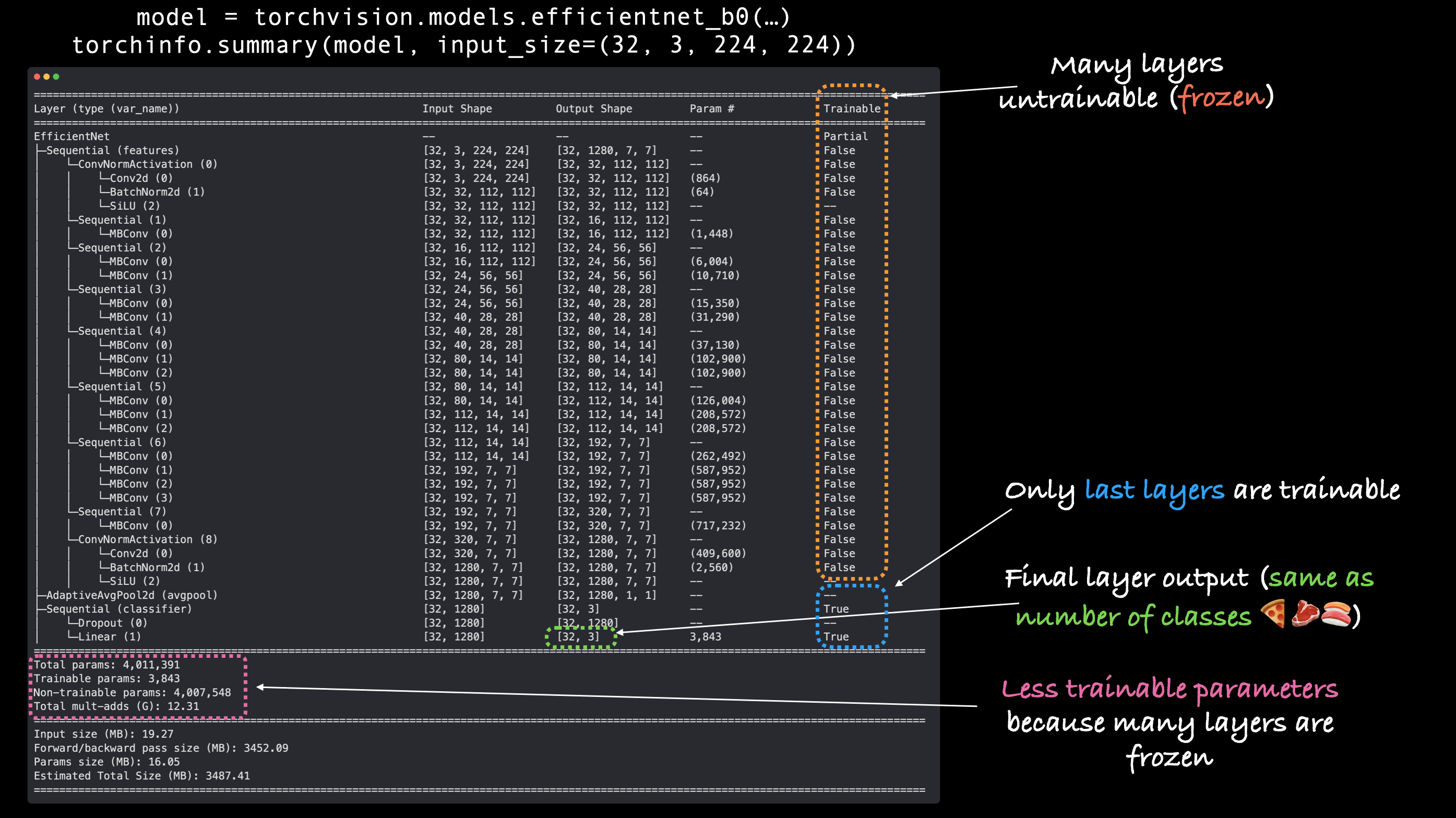
Output of torchinfo.summary() with our feature extractor EffNetB0 model, notice how the base layers are frozen (not trainable) and the output layers are customized to our own problem.
# Define loss and optimizer
loss_fn = nn.CrossEntropyLoss()
optimizer = torch.optim.Adam(model.parameters(), lr=0.001)from torch.utils.tensorboard import SummaryWriter
# Create a writer with all default settings
writer = SummaryWriter()from typing import Dict, List
from tqdm.auto import tqdm
from going_modular.going_modular.engine import train_step, test_step
# Import train() function from:
# https://github.com/mrdbourke/pytorch-deep-learning/blob/main/going_modular/going_modular/engine.py
def train(model: torch.nn.Module,
train_dataloader: torch.utils.data.DataLoader,
test_dataloader: torch.utils.data.DataLoader,
optimizer: torch.optim.Optimizer,
loss_fn: torch.nn.Module,
epochs: int,
device: torch.device) -> Dict[str, List]:
"""Trains and tests a PyTorch model.
Passes a target PyTorch models through train_step() and test_step()
functions for a number of epochs, training and testing the model
in the same epoch loop.
Calculates, prints and stores evaluation metrics throughout.
Args:
model: A PyTorch model to be trained and tested.
train_dataloader: A DataLoader instance for the model to be trained on.
test_dataloader: A DataLoader instance for the model to be tested on.
optimizer: A PyTorch optimizer to help minimize the loss function.
loss_fn: A PyTorch loss function to calculate loss on both datasets.
epochs: An integer indicating how many epochs to train for.
device: A target device to compute on (e.g. "cuda" or "cpu").
Returns:
A dictionary of training and testing loss as well as training and
testing accuracy metrics. Each metric has a value in a list for
each epoch.
In the form: {train_loss: [...],
train_acc: [...],
test_loss: [...],
test_acc: [...]}
For example if training for epochs=2:
{train_loss: [2.0616, 1.0537],
train_acc: [0.3945, 0.3945],
test_loss: [1.2641, 1.5706],
test_acc: [0.3400, 0.2973]}
"""
# Create empty results dictionary
results = {"train_loss": [],
"train_acc": [],
"test_loss": [],
"test_acc": []
}
# Loop through training and testing steps for a number of epochs
for epoch in tqdm(range(epochs)):
train_loss, train_acc = train_step(model=model,
dataloader=train_dataloader,
loss_fn=loss_fn,
optimizer=optimizer,
device=device)
test_loss, test_acc = test_step(model=model,
dataloader=test_dataloader,
loss_fn=loss_fn,
device=device)
# Print out what's happening
print(
f"Epoch: {epoch+1} | "
f"train_loss: {train_loss:.4f} | "
f"train_acc: {train_acc:.4f} | "
f"test_loss: {test_loss:.4f} | "
f"test_acc: {test_acc:.4f}"
)
# Update results dictionary
results["train_loss"].append(train_loss)
results["train_acc"].append(train_acc)
results["test_loss"].append(test_loss)
results["test_acc"].append(test_acc)
### New ###
# Add loss results to SummaryWriter
writer.add_scalars(main_tag="Loss",
tag_scalar_dict={"train_loss": train_loss,
"test_loss": test_loss},
global_step=epoch)
# Add accuracy results to SummaryWriter
writer.add_scalars(main_tag="Accuracy",
tag_scalar_dict={"train_acc": train_acc,
"test_acc": test_acc},
global_step=epoch)
# Track the PyTorch model architecture
writer.add_graph(model=model,
# Pass in an example input
input_to_model=torch.randn(32, 3, 224, 224).to(device))
# Close the writer
writer.close()
# Return the filled results at the end of the epochs
return results# Train model
# Note: Not using engine.train() since the original script isn't updated to use writer
set_seeds()
results = train(model=model,
train_dataloader=train_dataloader,
test_dataloader=test_dataloader,
optimizer=optimizer,
loss_fn=loss_fn,
epochs=5,
device=device)0%| | 0/5 [00:00<?, ?it/s]
Epoch: 1 | train_loss: 1.0924 | train_acc: 0.3984 | test_loss: 0.9133 | test_acc: 0.5398
Epoch: 2 | train_loss: 0.8975 | train_acc: 0.6562 | test_loss: 0.7838 | test_acc: 0.8561
Epoch: 3 | train_loss: 0.8037 | train_acc: 0.7461 | test_loss: 0.6723 | test_acc: 0.8864
Epoch: 4 | train_loss: 0.6769 | train_acc: 0.8516 | test_loss: 0.6698 | test_acc: 0.8049
Epoch: 5 | train_loss: 0.7065 | train_acc: 0.7188 | test_loss: 0.6746 | test_acc: 0.7737
# Check out the model results
results{'train_loss': [1.0923754647374153,
0.8974628075957298,
0.803724929690361,
0.6769256368279457,
0.7064960040152073],
'train_acc': [0.3984375, 0.65625, 0.74609375, 0.8515625, 0.71875],
'test_loss': [0.9132757981618246,
0.7837507526079813,
0.6722926497459412,
0.6698453426361084,
0.6746167540550232],
'test_acc': [0.5397727272727273,
0.8560606060606061,
0.8863636363636364,
0.8049242424242425,
0.7736742424242425]}# Example code to run in Jupyter or Google Colab Notebook (uncomment to try it out)
# %load_ext tensorboard
# %tensorboard --logdir runsIf all went correctly, you should see something like the following:
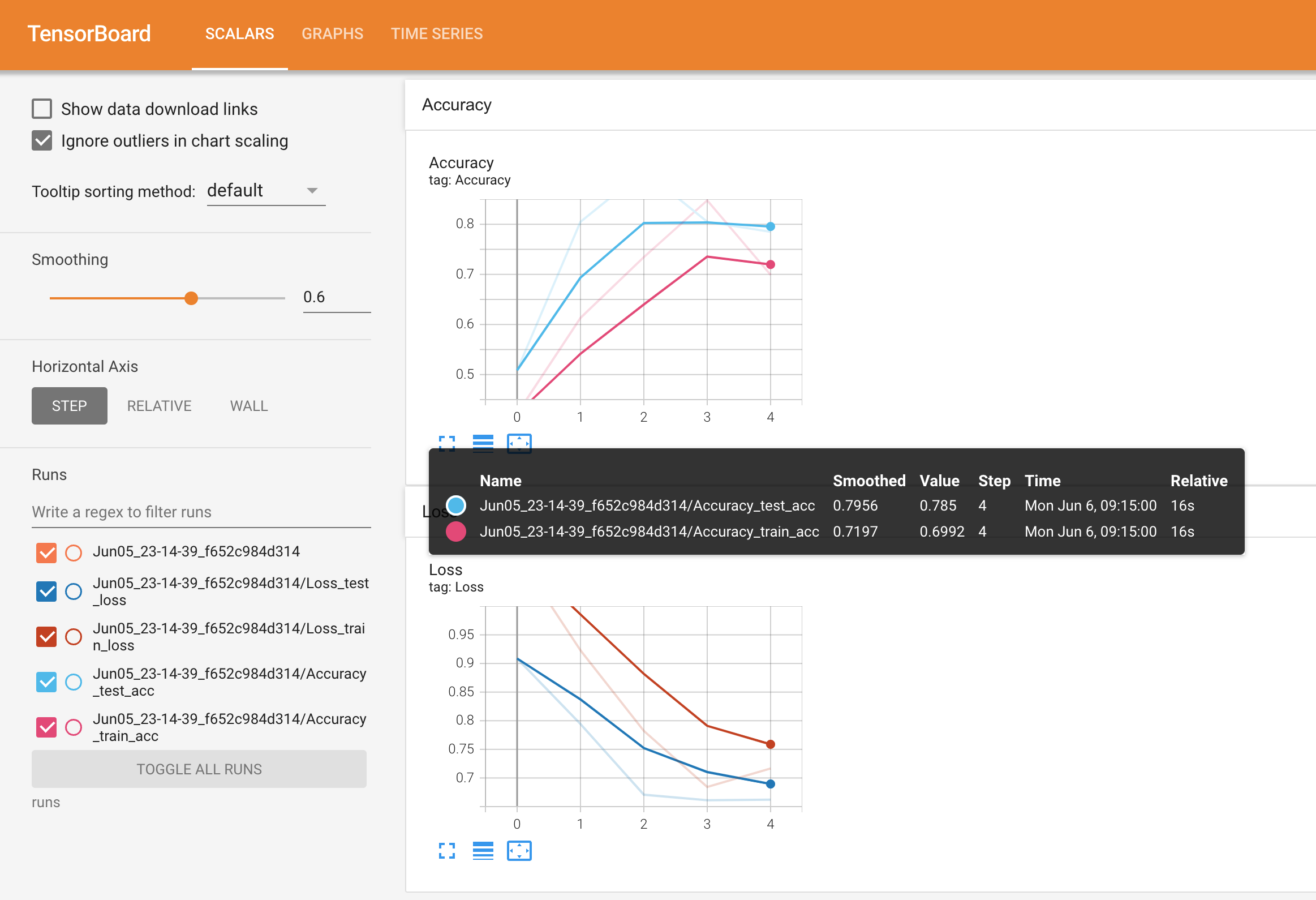
Viewing a single modelling experiment's results for accuracy and loss in TensorBoard.
Note: For more information on running TensorBoard in notebooks or in other locations, see the following:
- Using TensorBoard in Notebooks guide by TensorFlow
- Get started with TensorBoard.dev (helpful for uploading your TensorBoard logs to a shareable link)
def create_writer(experiment_name: str,
                  model_name: str,
                  extra: str=None) -> torch.utils.tensorboard.writer.SummaryWriter():
    """Creates a torch.utils.tensorboard.writer.SummaryWriter() instance saving to a specific log_dir.

    log_dir is combination of runs/timestamp_experiment_name_model_name_extra.

    Where timestamp is the current date in YYYY-MM-DD format.

    Args:
        experiment_name (str): Name of experiment.
        model_name (str): Name of model.
        extra (str, optional): Anything extra to add to the directory. Defaults to None.

    Returns:
        torch.utils.tensorboard.writer.SummaryWriter(): Instance of a writer saving to log_dir.

    Example usage:
        writer = create_writer(experiment_name="data_10_percent",
                               model_name="effnetb2",
                               extra="5_epochs")
        This is the same as:
        writer = SummaryWriter(log_dir="runs/2022-06-04/data_10_percent/effnetb2/5_epochs/")
    """
    from datetime import datetime
    import os

    # Get timestamp of current date (all experiments on certain day live in same folder)
    timestamp = datetime.now().strftime("%Y-%m-%d") # returns current date in YYYY-MM-DD format

    if extra:
        # Create log directory path
        log_dir = os.path.join("runs", timestamp, experiment_name, model_name, extra)
    else:
        log_dir = os.path.join("runs", timestamp, experiment_name, model_name)

    print(f"[INFO] Created SummaryWriter, saving to: {log_dir}...")
return SummaryWriter(log_dir=log_dir)# Create an example writer
example_writer = create_writer(experiment_name="data_10_percent",
model_name="effnetb0",
extra="5_epochs")[INFO] Created SummaryWriter, saving to: runs/2022-06-21/data_10_percent/effnetb0/5_epochs...
from typing import Dict, List
from tqdm.auto import tqdm

# Add writer parameter to train()
def train(model: torch.nn.Module,
          train_dataloader: torch.utils.data.DataLoader,
          test_dataloader: torch.utils.data.DataLoader,
          optimizer: torch.optim.Optimizer,
          loss_fn: torch.nn.Module,
          epochs: int,
          device: torch.device,
          writer: torch.utils.tensorboard.writer.SummaryWriter # new parameter to take in a writer
          ) -> Dict[str, List]:
    """Trains and tests a PyTorch model.

    Passes a target PyTorch models through train_step() and test_step()
    functions for a number of epochs, training and testing the model
    in the same epoch loop.

    Calculates, prints and stores evaluation metrics throughout.

    Stores metrics to specified writer log_dir if present.

    Args:
      model: A PyTorch model to be trained and tested.
      train_dataloader: A DataLoader instance for the model to be trained on.
      test_dataloader: A DataLoader instance for the model to be tested on.
      optimizer: A PyTorch optimizer to help minimize the loss function.
      loss_fn: A PyTorch loss function to calculate loss on both datasets.
      epochs: An integer indicating how many epochs to train for.
      device: A target device to compute on (e.g. "cuda" or "cpu").
      writer: A SummaryWriter() instance to log model results to.

    Returns:
      A dictionary of training and testing loss as well as training and
      testing accuracy metrics. Each metric has a value in a list for
      each epoch.
      In the form: {train_loss: [...],
                train_acc: [...],
                test_loss: [...],
                test_acc: [...]}
      For example if training for epochs=2:
              {train_loss: [2.0616, 1.0537],
                train_acc: [0.3945, 0.3945],
                test_loss: [1.2641, 1.5706],
                test_acc: [0.3400, 0.2973]}
    """
    # Create empty results dictionary
    results = {"train_loss": [],
               "train_acc": [],
               "test_loss": [],
               "test_acc": []
    }

    # Loop through training and testing steps for a number of epochs
    for epoch in tqdm(range(epochs)):
        train_loss, train_acc = train_step(model=model,
                                          dataloader=train_dataloader,
                                          loss_fn=loss_fn,
                                          optimizer=optimizer,
                                          device=device)
        test_loss, test_acc = test_step(model=model,
          dataloader=test_dataloader,
          loss_fn=loss_fn,
          device=device)

        # Print out what's happening
        print(
          f"Epoch: {epoch+1} | "
          f"train_loss: {train_loss:.4f} | "
          f"train_acc: {train_acc:.4f} | "
          f"test_loss: {test_loss:.4f} | "
          f"test_acc: {test_acc:.4f}"
        )

        # Update results dictionary
        results["train_loss"].append(train_loss)
        results["train_acc"].append(train_acc)
        results["test_loss"].append(test_loss)
        results["test_acc"].append(test_acc)


        ### New ###
        # See if there's a writer, if so, log to it
        if writer:
            # Add results to SummaryWriter
            writer.add_scalars(main_tag="Loss",
                               tag_scalar_dict={"train_loss": train_loss,
                                                "test_loss": test_loss},
                               global_step=epoch)
            writer.add_scalars(main_tag="Accuracy",
                               tag_scalar_dict={"train_acc": train_acc,
                                                "test_acc": test_acc},
                               global_step=epoch)

            # Close the writer
            writer.close()
        else:
            pass

    # Close the writer
    writer.close()

    # Return the filled results at the end of the epochs
return results# Download 10 percent and 20 percent training data (if necessary)
data_10_percent_path = download_data(source="https://github.com/mrdbourke/pytorch-deep-learning/raw/main/data/pizza_steak_sushi.zip",
destination="pizza_steak_sushi")
data_20_percent_path = download_data(source="https://github.com/mrdbourke/pytorch-deep-learning/raw/main/data/pizza_steak_sushi_20_percent.zip",
destination="pizza_steak_sushi_20_percent")[INFO] data/pizza_steak_sushi directory exists, skipping download. [INFO] data/pizza_steak_sushi_20_percent directory exists, skipping download.
# Setup training directory paths
train_dir_10_percent = data_10_percent_path / "train"
train_dir_20_percent = data_20_percent_path / "train"

# Setup testing directory paths (note: use the same test dataset for both to compare the results)
test_dir = data_10_percent_path / "test"

# Check the directories
print(f"Training directory 10%: {train_dir_10_percent}")
print(f"Training directory 20%: {train_dir_20_percent}")
print(f"Testing directory: {test_dir}")
Training directory 10%: data/pizza_steak_sushi/train Training directory 20%: data/pizza_steak_sushi_20_percent/train Testing directory: data/pizza_steak_sushi/test
from torchvision import transforms

# Create a transform to normalize data distribution to be inline with ImageNet
normalize = transforms.Normalize(mean=[0.485, 0.456, 0.406], # values per colour channel [red, green, blue]
                                 std=[0.229, 0.224, 0.225]) # values per colour channel [red, green, blue]

# Compose transforms into a pipeline
simple_transform = transforms.Compose([
    transforms.Resize((224, 224)),
    transforms.ToTensor(),
    normalize
])BATCH_SIZE = 32
# Create 10% training and test DataLoaders
train_dataloader_10_percent, test_dataloader, class_names = data_setup.create_dataloaders(train_dir=train_dir_10_percent,
test_dir=test_dir,
transform=simple_transform,
batch_size=BATCH_SIZE
)
# Create 20% training and test data DataLoders
train_dataloader_20_percent, test_dataloader, class_names = data_setup.create_dataloaders(train_dir=train_dir_20_percent,
test_dir=test_dir,
transform=simple_transform,
batch_size=BATCH_SIZE
)
# Find the number of samples/batches per dataloader (using the same test_dataloader for both experiments)
print(f"Number of batches of size {BATCH_SIZE} in 10 percent training data: {len(train_dataloader_10_percent)}")
print(f"Number of batches of size {BATCH_SIZE} in 20 percent training data: {len(train_dataloader_20_percent)}")
print(f"Number of batches of size {BATCH_SIZE} in testing data: {len(train_dataloader_10_percent)} (all experiments will use the same test set)")
print(f"Number of classes: {len(class_names)}, class names: {class_names}")Number of batches of size 32 in 10 percent training data: 8 Number of batches of size 32 in 20 percent training data: 15 Number of batches of size 32 in testing data: 8 (all experiments will use the same test set) Number of classes: 3, class names: ['pizza', 'steak', 'sushi']
import torchvision
from torchinfo import summary

# 1. Create an instance of EffNetB2 with pretrained weights
effnetb2_weights = torchvision.models.EfficientNet_B2_Weights.DEFAULT # "DEFAULT" means best available weights
effnetb2 = torchvision.models.efficientnet_b2(weights=effnetb2_weights)

# # 2. Get a summary of standard EffNetB2 from torchvision.models (uncomment for full output)
# summary(model=effnetb2,
#         input_size=(32, 3, 224, 224), # make sure this is "input_size", not "input_shape"
#         # col_names=["input_size"], # uncomment for smaller output
#         col_names=["input_size", "output_size", "num_params", "trainable"],
#         col_width=20,
#         row_settings=["var_names"]
# )

# 3. Get the number of in_features of the EfficientNetB2 classifier layer
print(f"Number of in_features to final layer of EfficientNetB2: {len(effnetb2.classifier.state_dict()['1.weight'][0])}")============================================================================================================================================ Layer (type (var_name)) Input Shape Output Shape Param # Trainable ============================================================================================================================================ EfficientNet (EfficientNet) [32, 3, 224, 224] [32, 1000] -- True ├─Sequential (features) [32, 3, 224, 224] [32, 1408, 7, 7] -- True │ └─Conv2dNormActivation (0) [32, 3, 224, 224] [32, 32, 112, 112] -- True │ │ └─Conv2d (0) [32, 3, 224, 224] [32, 32, 112, 112] 864 True │ │ └─BatchNorm2d (1) [32, 32, 112, 112] [32, 32, 112, 112] 64 True │ │ └─SiLU (2) [32, 32, 112, 112] [32, 32, 112, 112] -- -- │ └─Sequential (1) [32, 32, 112, 112] [32, 16, 112, 112] -- True │ │ └─MBConv (0) [32, 32, 112, 112] [32, 16, 112, 112] 1,448 True │ │ └─MBConv (1) [32, 16, 112, 112] [32, 16, 112, 112] 612 True │ └─Sequential (2) [32, 16, 112, 112] [32, 24, 56, 56] -- True │ │ └─MBConv (0) [32, 16, 112, 112] [32, 24, 56, 56] 6,004 True │ │ └─MBConv (1) [32, 24, 56, 56] [32, 24, 56, 56] 10,710 True │ │ └─MBConv (2) [32, 24, 56, 56] [32, 24, 56, 56] 10,710 True │ └─Sequential (3) [32, 24, 56, 56] [32, 48, 28, 28] -- True │ │ └─MBConv (0) [32, 24, 56, 56] [32, 48, 28, 28] 16,518 True │ │ └─MBConv (1) [32, 48, 28, 28] [32, 48, 28, 28] 43,308 True │ │ └─MBConv (2) [32, 48, 28, 28] [32, 48, 28, 28] 43,308 True │ └─Sequential (4) [32, 48, 28, 28] [32, 88, 14, 14] -- True │ │ └─MBConv (0) [32, 48, 28, 28] [32, 88, 14, 14] 50,300 True │ │ └─MBConv (1) [32, 88, 14, 14] [32, 88, 14, 14] 123,750 True │ │ └─MBConv (2) [32, 88, 14, 14] [32, 88, 14, 14] 123,750 True │ │ └─MBConv (3) [32, 88, 14, 14] [32, 88, 14, 14] 123,750 True │ └─Sequential (5) [32, 88, 14, 14] [32, 120, 14, 14] -- True │ │ └─MBConv (0) [32, 88, 14, 14] [32, 120, 14, 14] 149,158 True │ │ └─MBConv (1) [32, 120, 14, 14] [32, 120, 14, 14] 237,870 True │ │ └─MBConv (2) [32, 120, 14, 14] [32, 120, 14, 14] 237,870 True │ │ └─MBConv (3) [32, 120, 14, 14] [32, 120, 14, 14] 237,870 True │ └─Sequential (6) [32, 120, 14, 14] [32, 208, 7, 7] -- True │ │ └─MBConv (0) [32, 120, 14, 14] [32, 208, 7, 7] 301,406 True │ │ └─MBConv (1) [32, 208, 7, 7] [32, 208, 7, 7] 686,868 True │ │ └─MBConv (2) [32, 208, 7, 7] [32, 208, 7, 7] 686,868 True │ │ └─MBConv (3) [32, 208, 7, 7] [32, 208, 7, 7] 686,868 True │ │ └─MBConv (4) [32, 208, 7, 7] [32, 208, 7, 7] 686,868 True │ └─Sequential (7) [32, 208, 7, 7] [32, 352, 7, 7] -- True │ │ └─MBConv (0) [32, 208, 7, 7] [32, 352, 7, 7] 846,900 True │ │ └─MBConv (1) [32, 352, 7, 7] [32, 352, 7, 7] 1,888,920 True │ └─Conv2dNormActivation (8) [32, 352, 7, 7] [32, 1408, 7, 7] -- True │ │ └─Conv2d (0) [32, 352, 7, 7] [32, 1408, 7, 7] 495,616 True │ │ └─BatchNorm2d (1) [32, 1408, 7, 7] [32, 1408, 7, 7] 2,816 True │ │ └─SiLU (2) [32, 1408, 7, 7] [32, 1408, 7, 7] -- -- ├─AdaptiveAvgPool2d (avgpool) [32, 1408, 7, 7] [32, 1408, 1, 1] -- -- ├─Sequential (classifier) [32, 1408] [32, 1000] -- True │ └─Dropout (0) [32, 1408] [32, 1408] -- -- │ └─Linear (1) [32, 1408] [32, 1000] 1,409,000 True ============================================================================================================================================ Total params: 9,109,994 Trainable params: 9,109,994 Non-trainable params: 0 Total mult-adds (G): 21.09 ============================================================================================================================================ Input size (MB): 19.27 Forward/backward pass size (MB): 5017.79 Params size (MB): 36.44 Estimated Total Size (MB): 5073.49 ============================================================================================================================================
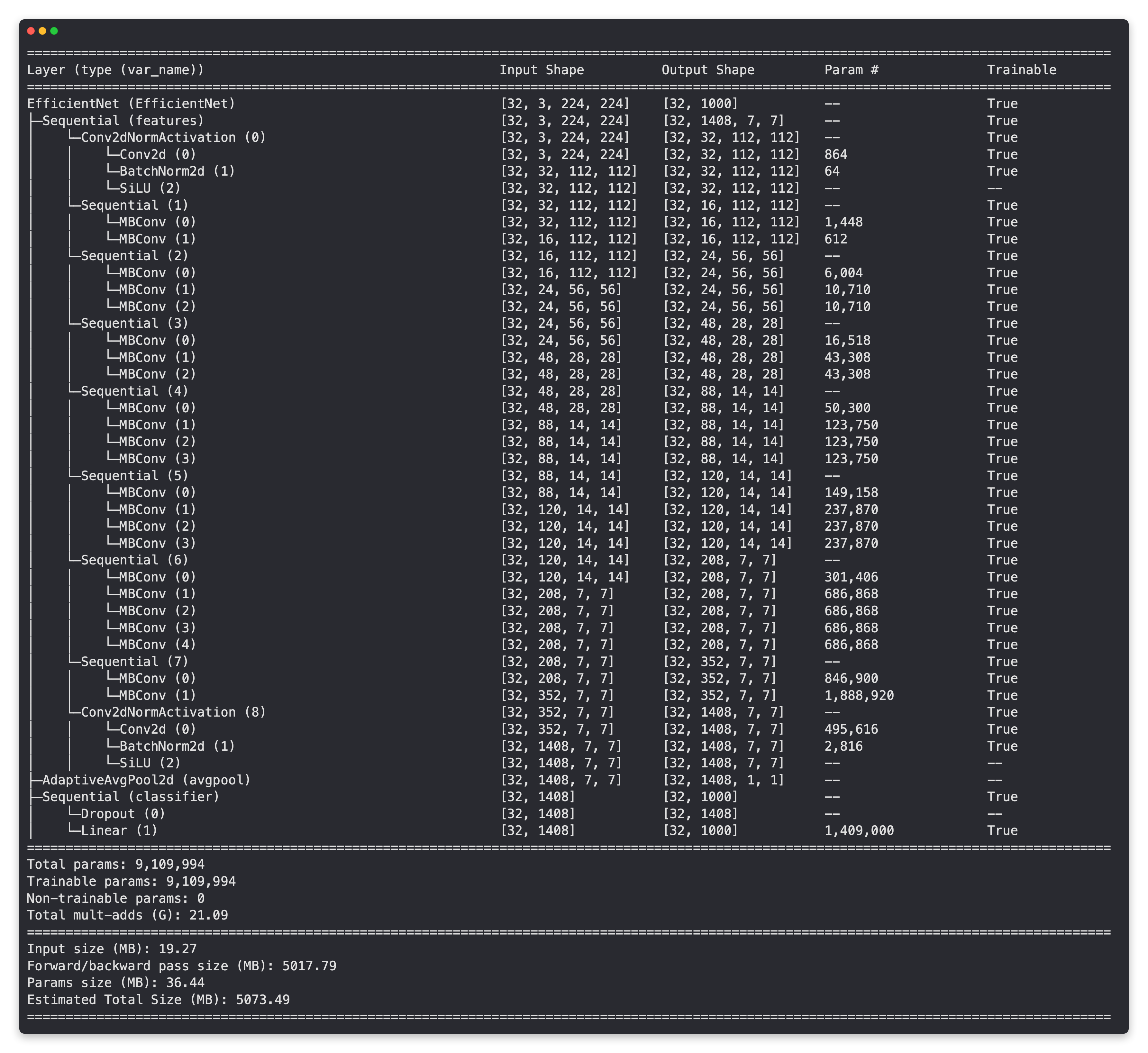
Model summary of EffNetB2 feature extractor model with all layers unfrozen (trainable) and default classifier head from ImageNet pretraining.
Now we know the required number of in_features for the EffNetB2 model, let's create a couple of helper functions to setup our EffNetB0 and EffNetB2 feature extractor models.
We want these functions to:
- Get the base model from
torchvision.models - Freeze the base layers in the model (set
requires_grad=False) - Set the random seeds (we don't need to do this but since we're running a series of experiments and initalizing a new layer with random weights, we want the randomness to be similar for each experiment)
- Change the classifier head (to suit our problem)
- Give the model a name (e.g. "effnetb0" for EffNetB0)
Let's do it.
import torchvision
from torch import nn

# Get num out features (one for each class pizza, steak, sushi)
OUT_FEATURES = len(class_names)

# Create an EffNetB0 feature extractor
def create_effnetb0():
    # 1. Get the base mdoel with pretrained weights and send to target device
    weights = torchvision.models.EfficientNet_B0_Weights.DEFAULT
    model = torchvision.models.efficientnet_b0(weights=weights).to(device)

    # 2. Freeze the base model layers
    for param in model.features.parameters():
        param.requires_grad = False

    # 3. Set the seeds
    set_seeds()

    # 4. Change the classifier head
    model.classifier = nn.Sequential(
        nn.Dropout(p=0.2),
        nn.Linear(in_features=1280, out_features=OUT_FEATURES)
    ).to(device)

    # 5. Give the model a name
    model.name = "effnetb0"
    print(f"[INFO] Created new {model.name} model.")
    return model

# Create an EffNetB2 feature extractor
def create_effnetb2():
    # 1. Get the base model with pretrained weights and send to target device
    weights = torchvision.models.EfficientNet_B2_Weights.DEFAULT
    model = torchvision.models.efficientnet_b2(weights=weights).to(device)

    # 2. Freeze the base model layers
    for param in model.features.parameters():
        param.requires_grad = False

    # 3. Set the seeds
    set_seeds()

    # 4. Change the classifier head
    model.classifier = nn.Sequential(
        nn.Dropout(p=0.3),
        nn.Linear(in_features=1408, out_features=OUT_FEATURES)
    ).to(device)

    # 5. Give the model a name
    model.name = "effnetb2"
    print(f"[INFO] Created new {model.name} model.")
return modeleffnetb0 = create_effnetb0()
# Get an output summary of the layers in our EffNetB0 feature extractor model (uncomment to view full output)
# summary(model=effnetb0,
# input_size=(32, 3, 224, 224), # make sure this is "input_size", not "input_shape"
# # col_names=["input_size"], # uncomment for smaller output
# col_names=["input_size", "output_size", "num_params", "trainable"],
# col_width=20,
# row_settings=["var_names"]
# ) [INFO] Created new effnetb0 model.
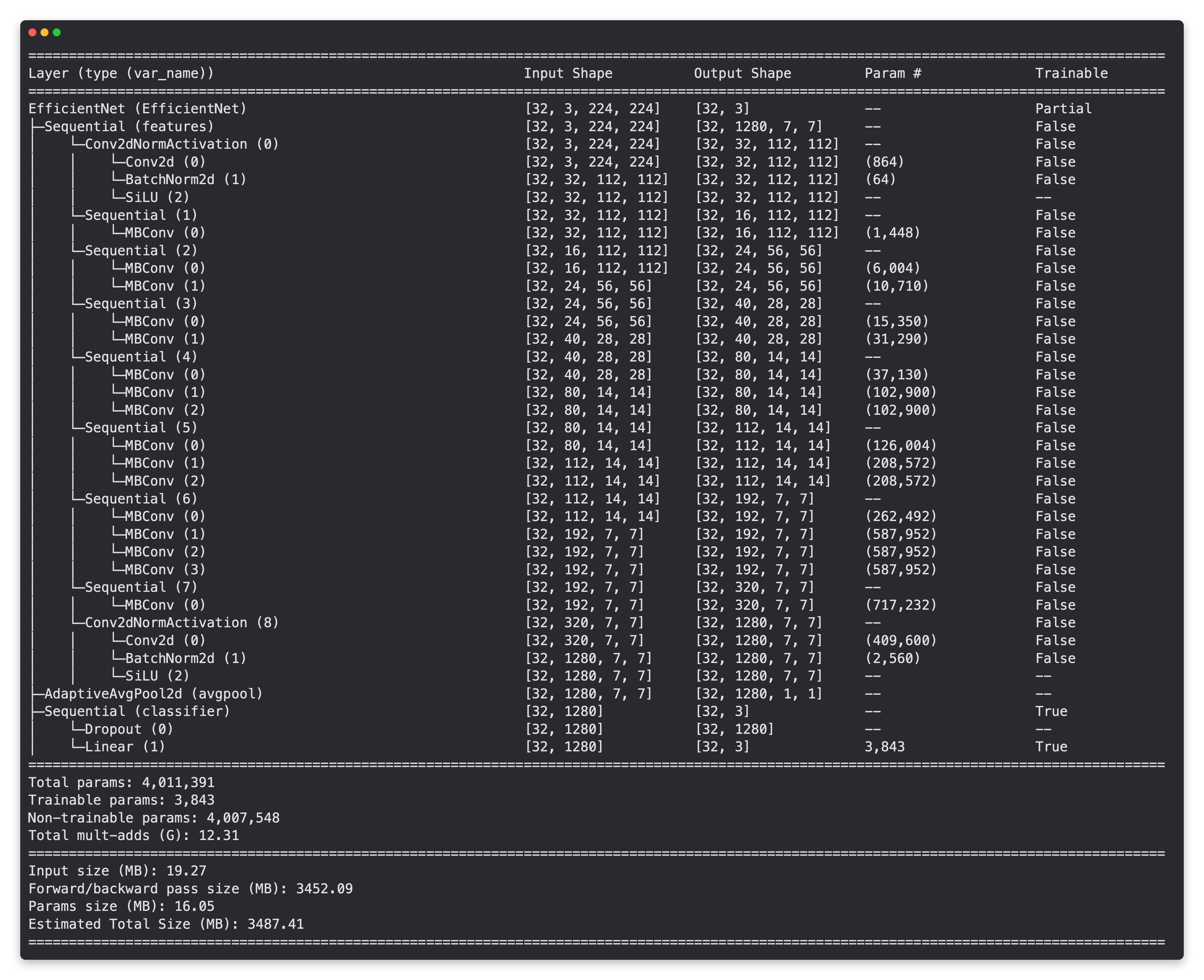
Model summary of EffNetB0 model with base layers frozen (untrainable) and updated classifier head (suited for pizza, steak, sushi image classification).
effnetb2 = create_effnetb2()

# Get an output summary of the layers in our EffNetB2 feature extractor model (uncomment to view full output)
# summary(model=effnetb2,
#         input_size=(32, 3, 224, 224), # make sure this is "input_size", not "input_shape"
#         # col_names=["input_size"], # uncomment for smaller output
#         col_names=["input_size", "output_size", "num_params", "trainable"],
#         col_width=20,
#         row_settings=["var_names"]
# )
[INFO] Created new effnetb2 model.
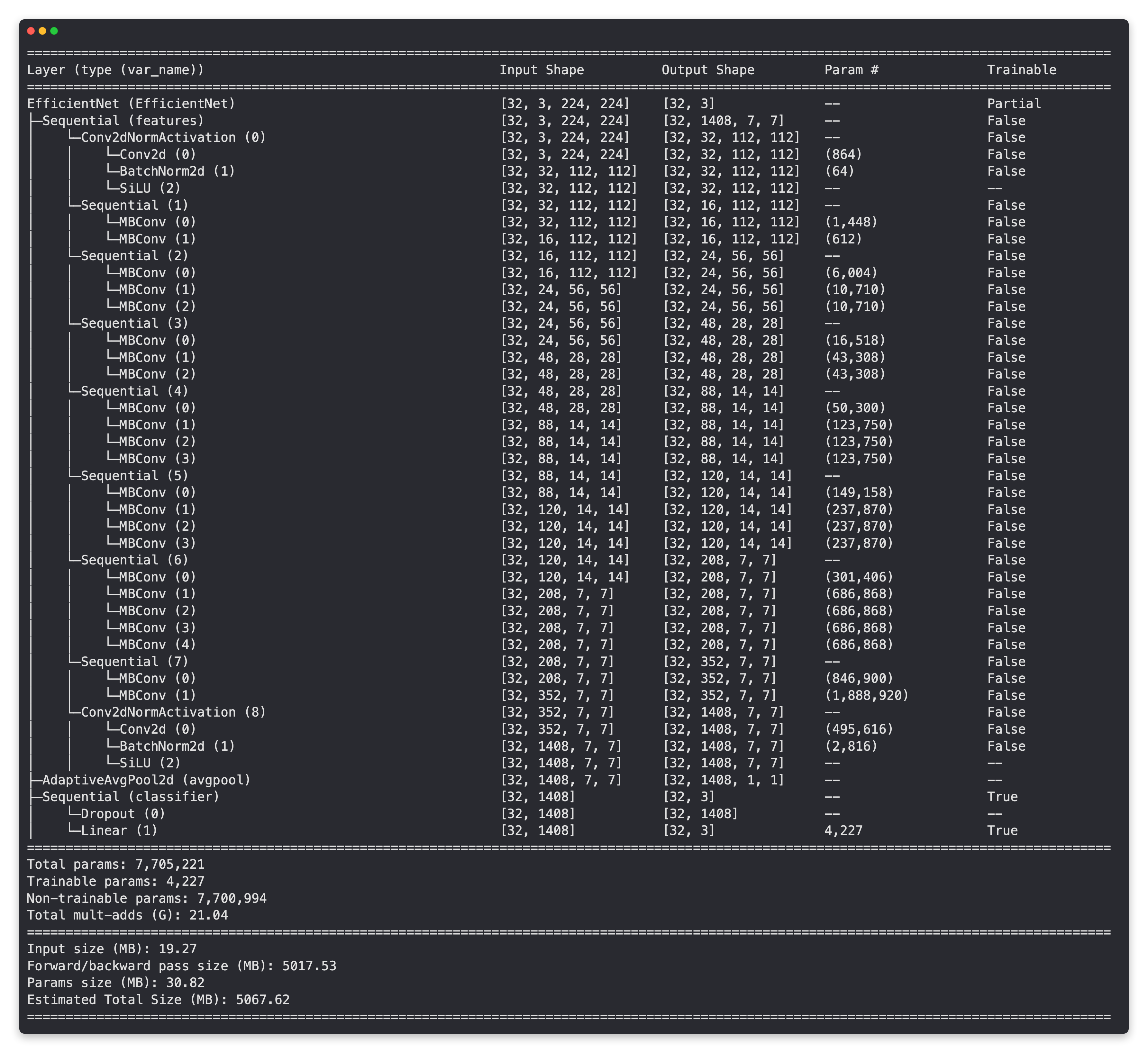
Model summary of EffNetB2 model with base layers frozen (untrainable) and updated classifier head (suited for pizza, steak, sushi image classification).
# 1. Create epochs list
num_epochs = [5, 10]

# 2. Create models list (need to create a new model for each experiment)
models = ["effnetb0", "effnetb2"]

# 3. Create dataloaders dictionary for various dataloaders
train_dataloaders = {"data_10_percent": train_dataloader_10_percent,
"data_20_percent": train_dataloader_20_percent}%%time
from going_modular.going_modular.utils import save_model
# 1. Set the random seeds
set_seeds(seed=42)
# 2. Keep track of experiment numbers
experiment_number = 0
# 3. Loop through each DataLoader
for dataloader_name, train_dataloader in train_dataloaders.items():
# 4. Loop through each number of epochs
for epochs in num_epochs:
# 5. Loop through each model name and create a new model based on the name
for model_name in models:
# 6. Create information print outs
experiment_number += 1
print(f"[INFO] Experiment number: {experiment_number}")
print(f"[INFO] Model: {model_name}")
print(f"[INFO] DataLoader: {dataloader_name}")
print(f"[INFO] Number of epochs: {epochs}")
# 7. Select the model
if model_name == "effnetb0":
model = create_effnetb0() # creates a new model each time (important because we want each experiment to start from scratch)
else:
model = create_effnetb2() # creates a new model each time (important because we want each experiment to start from scratch)
# 8. Create a new loss and optimizer for every model
loss_fn = nn.CrossEntropyLoss()
optimizer = torch.optim.Adam(params=model.parameters(), lr=0.001)
# 9. Train target model with target dataloaders and track experiments
train(model=model,
train_dataloader=train_dataloader,
test_dataloader=test_dataloader,
optimizer=optimizer,
loss_fn=loss_fn,
epochs=epochs,
device=device,
writer=create_writer(experiment_name=dataloader_name,
model_name=model_name,
extra=f"{epochs}_epochs"))
# 10. Save the model to file so we can get back the best model
save_filepath = f"07_{model_name}_{dataloader_name}_{epochs}_epochs.pth"
save_model(model=model,
target_dir="models",
model_name=save_filepath)
print("-"*50 + "\n")[INFO] Experiment number: 1 [INFO] Model: effnetb0 [INFO] DataLoader: data_10_percent [INFO] Number of epochs: 5 [INFO] Created new effnetb0 model. [INFO] Created SummaryWriter, saving to: runs/2022-06-21/data_10_percent/effnetb0/5_epochs...
0%| | 0/5 [00:00<?, ?it/s]
Epoch: 1 | train_loss: 1.0528 | train_acc: 0.4961 | test_loss: 0.9217 | test_acc: 0.4678
Epoch: 2 | train_loss: 0.8747 | train_acc: 0.6992 | test_loss: 0.8138 | test_acc: 0.6203
Epoch: 3 | train_loss: 0.8099 | train_acc: 0.6445 | test_loss: 0.7175 | test_acc: 0.8258
Epoch: 4 | train_loss: 0.7097 | train_acc: 0.7578 | test_loss: 0.5897 | test_acc: 0.8864
Epoch: 5 | train_loss: 0.5980 | train_acc: 0.9141 | test_loss: 0.5676 | test_acc: 0.8864
[INFO] Saving model to: models/07_effnetb0_data_10_percent_5_epochs.pth
--------------------------------------------------

[INFO] Experiment number: 2
[INFO] Model: effnetb2
[INFO] DataLoader: data_10_percent
[INFO] Number of epochs: 5
[INFO] Created new effnetb2 model.
[INFO] Created SummaryWriter, saving to: runs/2022-06-21/data_10_percent/effnetb2/5_epochs...
0%| | 0/5 [00:00<?, ?it/s]
Epoch: 1 | train_loss: 1.0928 | train_acc: 0.3711 | test_loss: 0.9557 | test_acc: 0.6610
Epoch: 2 | train_loss: 0.9247 | train_acc: 0.6445 | test_loss: 0.8711 | test_acc: 0.8144
Epoch: 3 | train_loss: 0.8086 | train_acc: 0.7656 | test_loss: 0.7511 | test_acc: 0.9176
Epoch: 4 | train_loss: 0.7191 | train_acc: 0.8867 | test_loss: 0.7150 | test_acc: 0.9081
Epoch: 5 | train_loss: 0.6851 | train_acc: 0.7695 | test_loss: 0.7076 | test_acc: 0.8873
[INFO] Saving model to: models/07_effnetb2_data_10_percent_5_epochs.pth
--------------------------------------------------

[INFO] Experiment number: 3
[INFO] Model: effnetb0
[INFO] DataLoader: data_10_percent
[INFO] Number of epochs: 10
[INFO] Created new effnetb0 model.
[INFO] Created SummaryWriter, saving to: runs/2022-06-21/data_10_percent/effnetb0/10_epochs...
0%| | 0/10 [00:00<?, ?it/s]
Epoch: 1 | train_loss: 1.0528 | train_acc: 0.4961 | test_loss: 0.9217 | test_acc: 0.4678
Epoch: 2 | train_loss: 0.8747 | train_acc: 0.6992 | test_loss: 0.8138 | test_acc: 0.6203
Epoch: 3 | train_loss: 0.8099 | train_acc: 0.6445 | test_loss: 0.7175 | test_acc: 0.8258
Epoch: 4 | train_loss: 0.7097 | train_acc: 0.7578 | test_loss: 0.5897 | test_acc: 0.8864
Epoch: 5 | train_loss: 0.5980 | train_acc: 0.9141 | test_loss: 0.5676 | test_acc: 0.8864
Epoch: 6 | train_loss: 0.5611 | train_acc: 0.8984 | test_loss: 0.5949 | test_acc: 0.8864
Epoch: 7 | train_loss: 0.5573 | train_acc: 0.7930 | test_loss: 0.5566 | test_acc: 0.8864
Epoch: 8 | train_loss: 0.4702 | train_acc: 0.9492 | test_loss: 0.5176 | test_acc: 0.8759
Epoch: 9 | train_loss: 0.5728 | train_acc: 0.7773 | test_loss: 0.5095 | test_acc: 0.8873
Epoch: 10 | train_loss: 0.4794 | train_acc: 0.8242 | test_loss: 0.4640 | test_acc: 0.9072
[INFO] Saving model to: models/07_effnetb0_data_10_percent_10_epochs.pth
--------------------------------------------------

[INFO] Experiment number: 4
[INFO] Model: effnetb2
[INFO] DataLoader: data_10_percent
[INFO] Number of epochs: 10
[INFO] Created new effnetb2 model.
[INFO] Created SummaryWriter, saving to: runs/2022-06-21/data_10_percent/effnetb2/10_epochs...
0%| | 0/10 [00:00<?, ?it/s]
Epoch: 1 | train_loss: 1.0928 | train_acc: 0.3711 | test_loss: 0.9557 | test_acc: 0.6610
Epoch: 2 | train_loss: 0.9247 | train_acc: 0.6445 | test_loss: 0.8711 | test_acc: 0.8144
Epoch: 3 | train_loss: 0.8086 | train_acc: 0.7656 | test_loss: 0.7511 | test_acc: 0.9176
Epoch: 4 | train_loss: 0.7191 | train_acc: 0.8867 | test_loss: 0.7150 | test_acc: 0.9081
Epoch: 5 | train_loss: 0.6851 | train_acc: 0.7695 | test_loss: 0.7076 | test_acc: 0.8873
Epoch: 6 | train_loss: 0.6111 | train_acc: 0.7812 | test_loss: 0.6325 | test_acc: 0.9280
Epoch: 7 | train_loss: 0.6127 | train_acc: 0.8008 | test_loss: 0.6404 | test_acc: 0.8769
Epoch: 8 | train_loss: 0.5202 | train_acc: 0.9336 | test_loss: 0.6200 | test_acc: 0.8977
Epoch: 9 | train_loss: 0.5425 | train_acc: 0.8008 | test_loss: 0.6227 | test_acc: 0.8466
Epoch: 10 | train_loss: 0.4908 | train_acc: 0.8125 | test_loss: 0.5870 | test_acc: 0.8873
[INFO] Saving model to: models/07_effnetb2_data_10_percent_10_epochs.pth
--------------------------------------------------

[INFO] Experiment number: 5
[INFO] Model: effnetb0
[INFO] DataLoader: data_20_percent
[INFO] Number of epochs: 5
[INFO] Created new effnetb0 model.
[INFO] Created SummaryWriter, saving to: runs/2022-06-21/data_20_percent/effnetb0/5_epochs...
0%| | 0/5 [00:00<?, ?it/s]
Epoch: 1 | train_loss: 0.9577 | train_acc: 0.6167 | test_loss: 0.6545 | test_acc: 0.8655
Epoch: 2 | train_loss: 0.6881 | train_acc: 0.8438 | test_loss: 0.5798 | test_acc: 0.9176
Epoch: 3 | train_loss: 0.5798 | train_acc: 0.8604 | test_loss: 0.4575 | test_acc: 0.9176
Epoch: 4 | train_loss: 0.4930 | train_acc: 0.8646 | test_loss: 0.4458 | test_acc: 0.9176
Epoch: 5 | train_loss: 0.4886 | train_acc: 0.8500 | test_loss: 0.3909 | test_acc: 0.9176
[INFO] Saving model to: models/07_effnetb0_data_20_percent_5_epochs.pth
--------------------------------------------------

[INFO] Experiment number: 6
[INFO] Model: effnetb2
[INFO] DataLoader: data_20_percent
[INFO] Number of epochs: 5
[INFO] Created new effnetb2 model.
[INFO] Created SummaryWriter, saving to: runs/2022-06-21/data_20_percent/effnetb2/5_epochs...
0%| | 0/5 [00:00<?, ?it/s]
Epoch: 1 | train_loss: 0.9830 | train_acc: 0.5521 | test_loss: 0.7767 | test_acc: 0.8153
Epoch: 2 | train_loss: 0.7298 | train_acc: 0.7604 | test_loss: 0.6673 | test_acc: 0.8873
Epoch: 3 | train_loss: 0.6022 | train_acc: 0.8458 | test_loss: 0.5622 | test_acc: 0.9280
Epoch: 4 | train_loss: 0.5435 | train_acc: 0.8354 | test_loss: 0.5679 | test_acc: 0.9186
Epoch: 5 | train_loss: 0.4404 | train_acc: 0.9042 | test_loss: 0.4462 | test_acc: 0.9489
[INFO] Saving model to: models/07_effnetb2_data_20_percent_5_epochs.pth
--------------------------------------------------

[INFO] Experiment number: 7
[INFO] Model: effnetb0
[INFO] DataLoader: data_20_percent
[INFO] Number of epochs: 10
[INFO] Created new effnetb0 model.
[INFO] Created SummaryWriter, saving to: runs/2022-06-21/data_20_percent/effnetb0/10_epochs...
0%| | 0/10 [00:00<?, ?it/s]
Epoch: 1 | train_loss: 0.9577 | train_acc: 0.6167 | test_loss: 0.6545 | test_acc: 0.8655
Epoch: 2 | train_loss: 0.6881 | train_acc: 0.8438 | test_loss: 0.5798 | test_acc: 0.9176
Epoch: 3 | train_loss: 0.5798 | train_acc: 0.8604 | test_loss: 0.4575 | test_acc: 0.9176
Epoch: 4 | train_loss: 0.4930 | train_acc: 0.8646 | test_loss: 0.4458 | test_acc: 0.9176
Epoch: 5 | train_loss: 0.4886 | train_acc: 0.8500 | test_loss: 0.3909 | test_acc: 0.9176
Epoch: 6 | train_loss: 0.3705 | train_acc: 0.8854 | test_loss: 0.3568 | test_acc: 0.9072
Epoch: 7 | train_loss: 0.3551 | train_acc: 0.9250 | test_loss: 0.3187 | test_acc: 0.9072
Epoch: 8 | train_loss: 0.3745 | train_acc: 0.8938 | test_loss: 0.3349 | test_acc: 0.8873
Epoch: 9 | train_loss: 0.2972 | train_acc: 0.9396 | test_loss: 0.3092 | test_acc: 0.9280
Epoch: 10 | train_loss: 0.3620 | train_acc: 0.8479 | test_loss: 0.2780 | test_acc: 0.9072
[INFO] Saving model to: models/07_effnetb0_data_20_percent_10_epochs.pth
--------------------------------------------------

[INFO] Experiment number: 8
[INFO] Model: effnetb2
[INFO] DataLoader: data_20_percent
[INFO] Number of epochs: 10
[INFO] Created new effnetb2 model.
[INFO] Created SummaryWriter, saving to: runs/2022-06-21/data_20_percent/effnetb2/10_epochs...
0%| | 0/10 [00:00<?, ?it/s]
Epoch: 1 | train_loss: 0.9830 | train_acc: 0.5521 | test_loss: 0.7767 | test_acc: 0.8153
Epoch: 2 | train_loss: 0.7298 | train_acc: 0.7604 | test_loss: 0.6673 | test_acc: 0.8873
Epoch: 3 | train_loss: 0.6022 | train_acc: 0.8458 | test_loss: 0.5622 | test_acc: 0.9280
Epoch: 4 | train_loss: 0.5435 | train_acc: 0.8354 | test_loss: 0.5679 | test_acc: 0.9186
Epoch: 5 | train_loss: 0.4404 | train_acc: 0.9042 | test_loss: 0.4462 | test_acc: 0.9489
Epoch: 6 | train_loss: 0.3889 | train_acc: 0.9104 | test_loss: 0.4555 | test_acc: 0.8977
Epoch: 7 | train_loss: 0.3483 | train_acc: 0.9271 | test_loss: 0.4227 | test_acc: 0.9384
Epoch: 8 | train_loss: 0.3862 | train_acc: 0.8771 | test_loss: 0.4344 | test_acc: 0.9280
Epoch: 9 | train_loss: 0.3308 | train_acc: 0.8979 | test_loss: 0.4242 | test_acc: 0.9384
Epoch: 10 | train_loss: 0.3383 | train_acc: 0.8896 | test_loss: 0.3906 | test_acc: 0.9384
[INFO] Saving model to: models/07_effnetb2_data_20_percent_10_epochs.pth
--------------------------------------------------

CPU times: user 27.4 s, sys: 1min 14s, total: 1min 41s
Wall time: 2min 17s
# Viewing TensorBoard in Jupyter and Google Colab Notebooks (uncomment to view full TensorBoard instance)
# %load_ext tensorboard
# %tensorboard --logdir runs
Running the cell above we should get an output similar to the following.
Note: Depending on the random seeds you used/hardware you used there's a chance your numbers aren't exactly the same as what's here. This is okay. It's due to the inheret randomness of deep learning. What matters most is the trend. Where your numbers are heading. If they're off by a large amount, perhaps there's something wrong and best to go back and check the code. But if they're off by a small amount (say a couple of decimal places or so), that's okay.
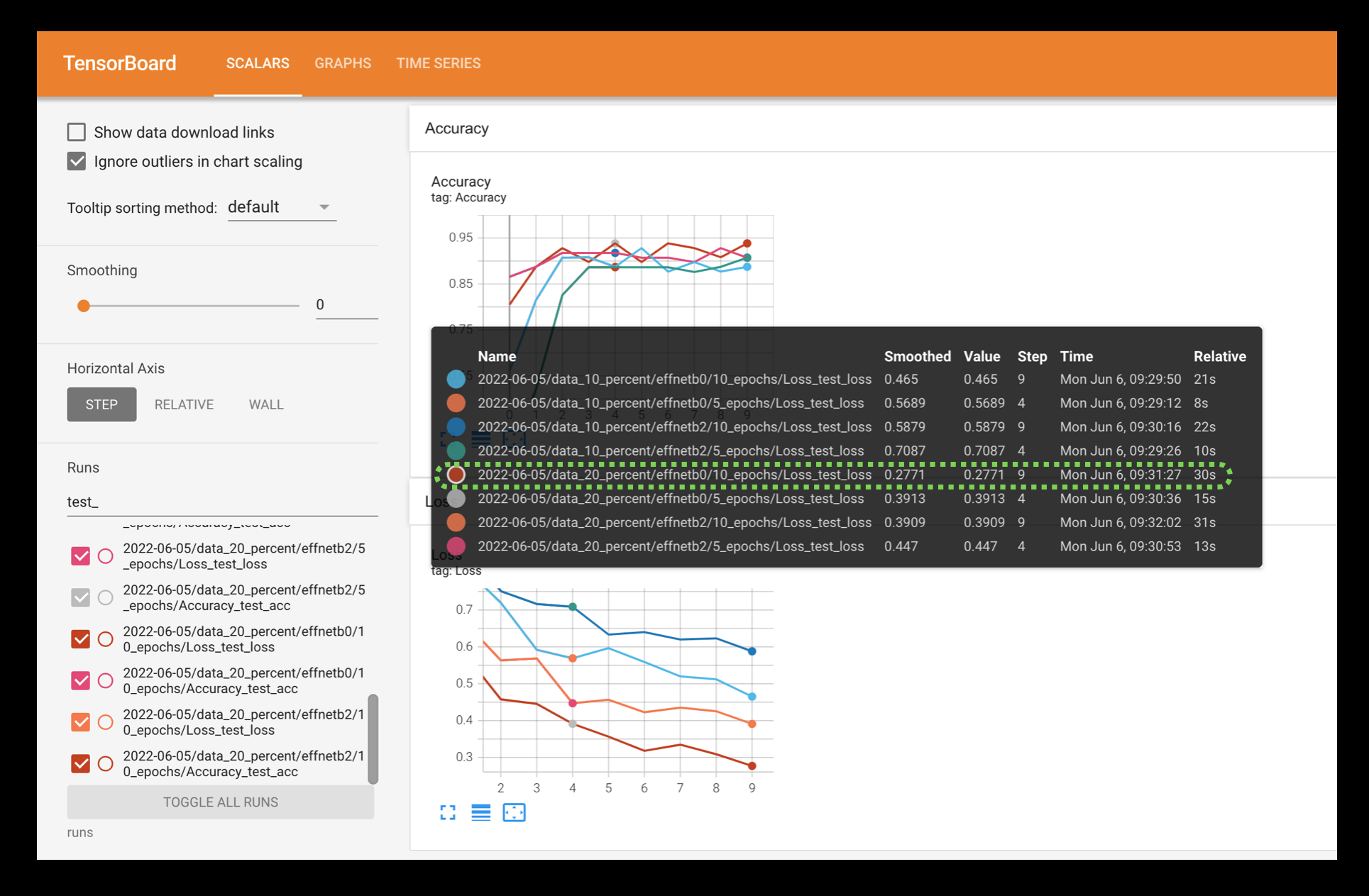
Visualizing the test loss values for the different modelling experiments in TensorBoard, you can see that the EffNetB2 model trained for 10 epochs and with 20% of the data achieves the lowest loss. This sticks with the overall trend of the experiments that: more data, larger model and longer training time is generally better.
You can also upload your TensorBoard experiment results to tensorboard.dev to host them publically for free.
For example, running code similiar to the following:
# # Upload the results to TensorBoard.dev (uncomment to try it out)
# !tensorboard dev upload --logdir runs \
#     --name "07. PyTorch Experiment Tracking: FoodVision Mini model results" \
# --description "Comparing results of different model size, training data amount and training time."# Setup the best model filepath
best_model_path = "models/07_effnetb2_data_20_percent_10_epochs.pth"
# Instantiate a new instance of EffNetB2 (to load the saved state_dict() to)
best_model = create_effnetb2()
# Load the saved best model state_dict()
best_model.load_state_dict(torch.load(best_model_path))[INFO] Created new effnetb2 model.
<All keys matched successfully>
# Check the model file size
from pathlib import Path

# Get the model size in bytes then convert to megabytes
effnetb2_model_size = Path(best_model_path).stat().st_size // (1024*1024)
print(f"EfficientNetB2 feature extractor model size: {effnetb2_model_size} MB")
EfficientNetB2 feature extractor model size: 29 MB
# Import function to make predictions on images and plot them
# See the function previously created in section: https://www.learnpytorch.io/06_pytorch_transfer_learning/#6-make-predictions-on-images-from-the-test-set
from going_modular.going_modular.predictions import pred_and_plot_image

# Get a random list of 3 images from 20% test set
import random
num_images_to_plot = 3
test_image_path_list = list(Path(data_20_percent_path / "test").glob("*/*.jpg")) # get all test image paths from 20% dataset
test_image_path_sample = random.sample(population=test_image_path_list,
                                       k=num_images_to_plot) # randomly select k number of images

# Iterate through random test image paths, make predictions on them and plot them
for image_path in test_image_path_sample:
    pred_and_plot_image(model=best_model,
                        image_path=image_path,
                        class_names=class_names,
                        image_size=(224, 224))


# Download custom image
import requests

# Setup custom image path
custom_image_path = Path("data/04-pizza-dad.jpeg")

# Download the image if it doesn't already exist
if not custom_image_path.is_file():
    with open(custom_image_path, "wb") as f:
        # When downloading from GitHub, need to use the "raw" file link
        request = requests.get("https://raw.githubusercontent.com/mrdbourke/pytorch-deep-learning/main/images/04-pizza-dad.jpeg")
        print(f"Downloading {custom_image_path}...")
        f.write(request.content)
else:
    print(f"{custom_image_path} already exists, skipping download.")

# Predict on custom image
pred_and_plot_image(model=model,
                    image_path=custom_image_path,
                    class_names=class_names)
data/04-pizza-dad.jpeg already exists, skipping download.
