
1.2 MiB

TK - Why replicate a machine learning research paper?
A machine learning research paper is often a presentation of months of work and experiments done by some of the best machine learning teams in the world condensed into a few pages of text.
And if these experiments lead to better results in an area related to the problem you're working on, it'd be nice to them out.
Also, replicating the work of others is a fantastic way to practice your skills.
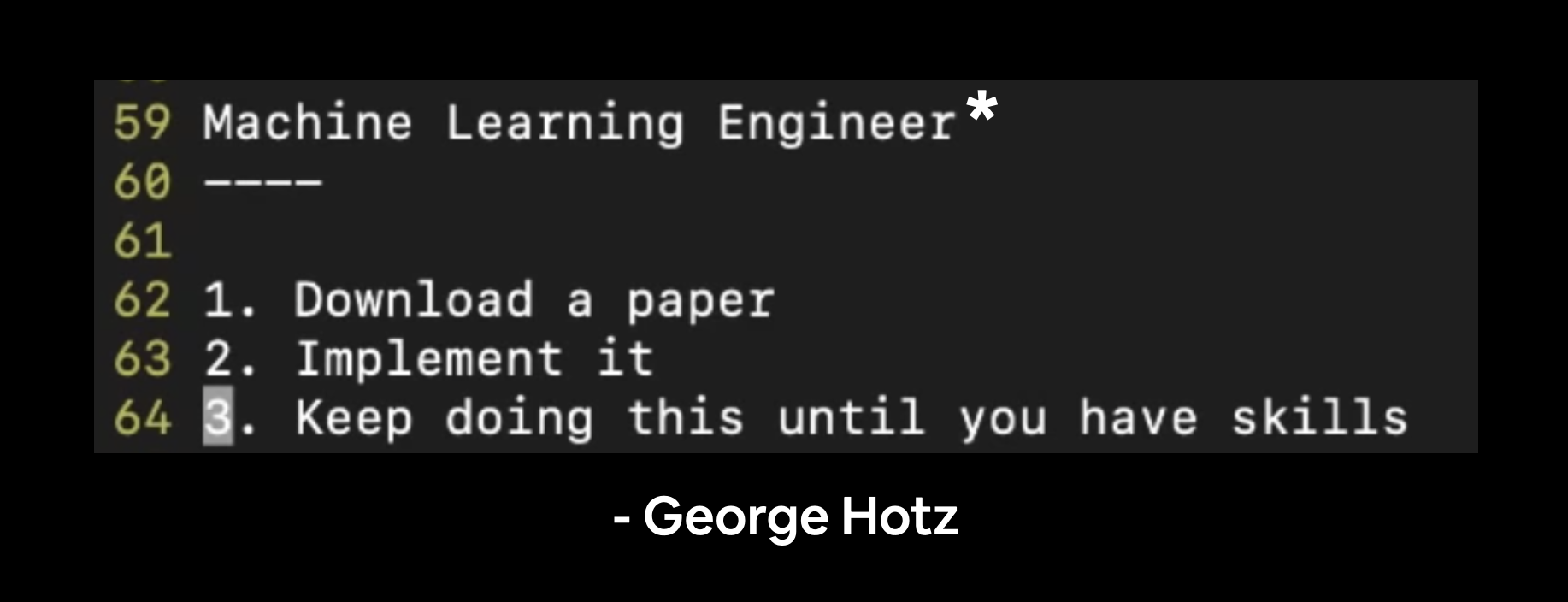
George Hotz is founder of comma.ai, a self-driving car company and livestreams machine learning coding on Twitch and those videos get posted in full to YouTube. I pulled this quote from one of his livestreams. The "٭" is to note that machine learning engineering often involves the extra step(s) of preprocessing data and making your models available for others to use (deployment).
When you first start trying to replicate research papers, you'll likely be overwhelmed.
That's normal.
Research teams spend weeks, months and sometimes years creating these works so it makes sense if it takes you sometime to even read let alone reproduce the works.
Replicating research is such a tough problem, phenomenal machine learning libraries and tools such as, HuggingFace, PyTorch Image Models (timm library) and fast.ai have been born out of making machine learning research more accessible.
# For this notebook to run with updated APIs, we need torch 1.12+ and torchvision 0.13+
try:
    import torch
    import torchvision
    assert int(torch.__version__.split(".")[1]) >= 12, "torch version should be 1.12+"
    assert int(torchvision.__version__.split(".")[1]) >= 13, "torchvision version should be 0.13+"
    print(f"torch version: {torch.__version__}")
    print(f"torchvision version: {torchvision.__version__}")
except:
    print(f"[INFO] torch/torchvision versions not as required, installing nightly versions.")
    !pip3 install -U --pre torch torchvision torchaudio --extra-index-url https://download.pytorch.org/whl/nightly/cu113
    import torch
    import torchvision
    print(f"torch version: {torch.__version__}")
    print(f"torchvision version: {torchvision.__version__}")
torch version: 1.12.0+cu102 torchvision version: 0.13.0+cu102
# Continue with regular imports
import matplotlib.pyplot as plt
import torch
import torchvision

from torch import nn
from torchvision import transforms

# Try to get torchinfo, install it if it doesn't work
try:
    from torchinfo import summary
except:
    print("[INFO] Couldn't find torchinfo... installing it.")
    !pip install -q torchinfo
    from torchinfo import summary

# Try to import the going_modular directory, download it from GitHub if it doesn't work
try:
    from going_modular.going_modular import data_setup, engine
    from helper_functions import download_data, set_seeds, plot_loss_curves
except:
    # Get the going_modular scripts
    print("[INFO] Couldn't find going_modular or helper_functions scripts... downloading them from GitHub.")
    !git clone https://github.com/mrdbourke/pytorch-deep-learning
    !mv pytorch-deep-learning/going_modular .
    !mv pytorch-deep-learning/helper_functions.py . # get the helper_functions.py script
    !rm -rf pytorch-deep-learning
    from going_modular.going_modular import data_setup, engine
from helper_functions import download_data, set_seeds, plot_loss_curvesdevice = "cuda" if torch.cuda.is_available() else "cpu"
device'cuda'
# Download pizza, steak, sushi images from GitHub
image_path = download_data(source="https://github.com/mrdbourke/pytorch-deep-learning/raw/main/data/pizza_steak_sushi.zip",
destination="pizza_steak_sushi")
image_path[INFO] data/pizza_steak_sushi directory exists, skipping download.
PosixPath('data/pizza_steak_sushi')# Setup directory paths to train and test images
train_dir = image_path / "train"
test_dir = image_path / "test"TK 2. Create Datasets and DataLoaders
Since we've got some data, let's now turn it into DataLoader's.
To do so we can use the create_dataloaders() function in data_setup.py.
First, we'll create a transform to prepare our images.
This where one of the first references to the ViT paper will come in.
In Table 3, the training resolution is mentioned as being 224 (height=224, width=224).
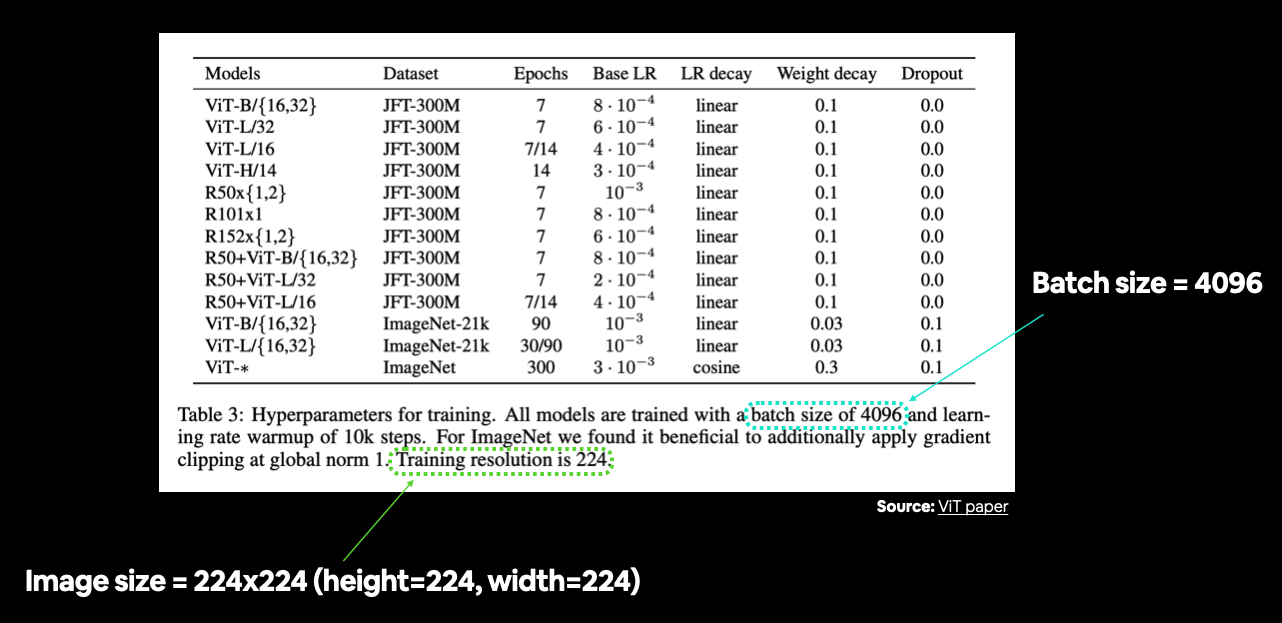
You can often find various hyperparameter settings listed in a table. In this case we're still preparing our data, so we're mainly concerned with things like image size and batch size. Source: Table 3 in ViT paper.
So we'll make sure our transform resizes our images appropriately.
And since we'll be training our model from scratch (no transfer learning to begin with), we won't provide a normalize transform like we did in 06. PyTorch Transfer Learning section 2.1.
2.1 Prepare transforms for images
# Create image size (from Table 3 in the ViT paper)
IMG_SIZE = 224
# Create transform pipeline manually
manual_transforms = transforms.Compose([
transforms.Resize((IMG_SIZE, IMG_SIZE)),
transforms.ToTensor(),
])
print(f"Manually created transforms: {manual_transforms}")Manually created transforms: Compose(
Resize(size=(224, 224), interpolation=bilinear, max_size=None, antialias=None)
ToTensor()
)
# Set the batch size
BATCH_SIZE = 32 # this is lower than the ViT paper but it's because we're starting small
# Create data loaders
train_dataloader, test_dataloader, class_names = data_setup.create_dataloaders(
train_dir=train_dir,
test_dir=test_dir,
transform=manual_transforms, # use manually created transforms
batch_size=BATCH_SIZE
)
train_dataloader, test_dataloader, class_names(<torch.utils.data.dataloader.DataLoader at 0x7fafe426c460>, <torch.utils.data.dataloader.DataLoader at 0x7fafe41c7190>, ['pizza', 'steak', 'sushi'])
# Get a batch of images
image_batch, label_batch = next(iter(train_dataloader))
# Get a single image from the batch
image, label = image_batch[0], label_batch[0]
# View the batch shapes
image.shape, label(torch.Size([3, 224, 224]), tensor(0))
# Plot image with matplotlib
plt.imshow(image.permute(1, 2, 0)) # rearrange image dimensions to suit matplotlib [color_channels, height, width] -> [height, width, color_channels]
plt.title(class_names[label])
plt.axis(False);
TK 3.2.1 Exploring Figure 1
Let's start by going through Figure 1 of the ViT Paper.
The main things we'll be paying attention to are:
- Layers - takes an input, performs an operation or function, produces an output.
- Blocks - a collection of layers, which in turn also takes an input and produces an output.
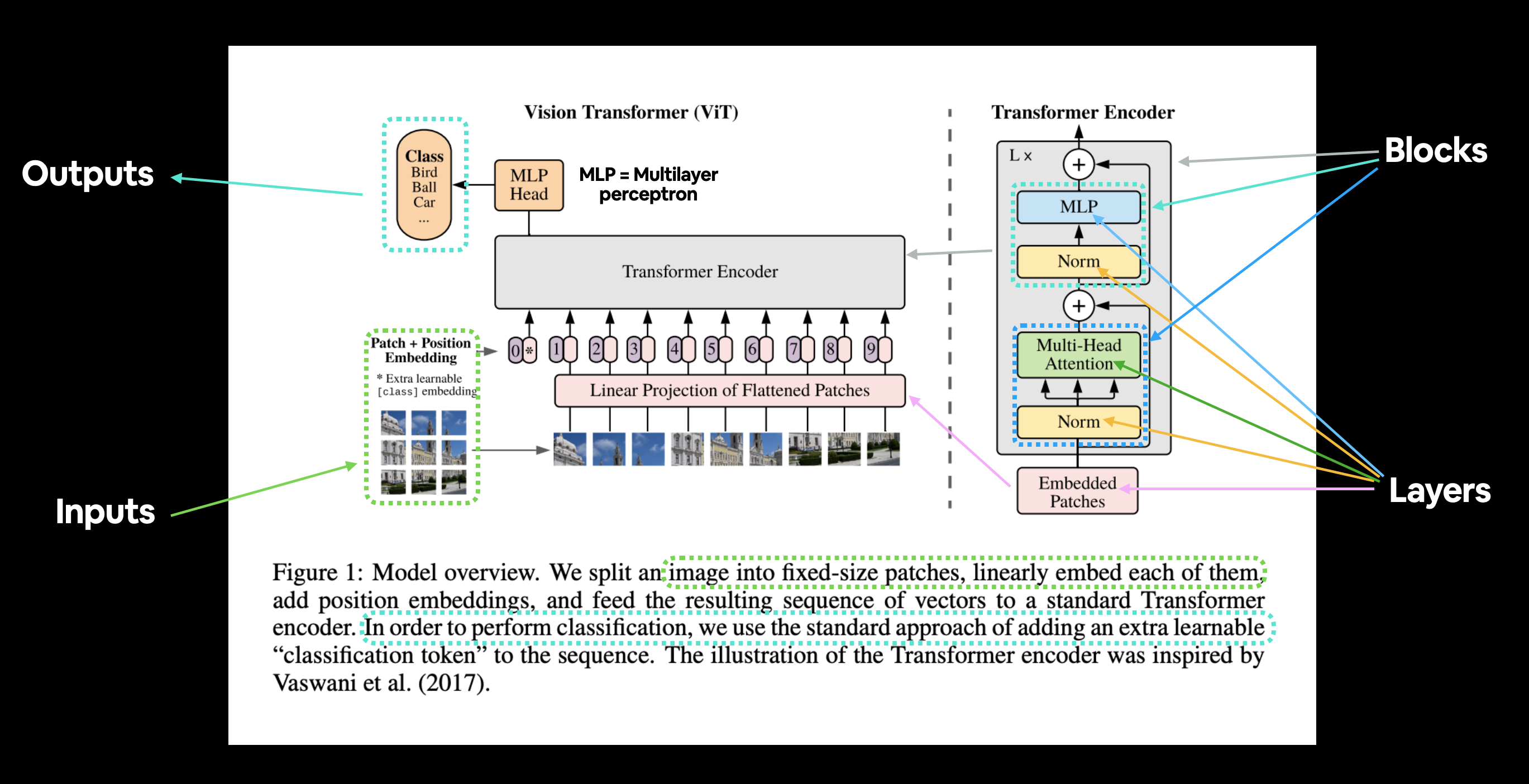
Figure 1 from the ViT Paper showcasing the different inputs, outputs, layers and blocks that create the architecture. Our goal will be to replicate each of these using PyTorch code.
The ViT architecture is comprised of several stages:
- Patch + Position Embedding (inputs) - Turns the input image into a sequence of image patches and add a position number what order the patch comes in.
- Linear projection of flattened patches (Embedded Patches) - The image patches get turned into an embedding, the benefit of using an embedding rather than just the image values is that an embedding is a learnable representation (typically in the form of a vector) of the image that can improve with training.
- Norm - This is short for "Layer Normalization" or "LayerNorm", a technique for regularizing (reducing overfitting) a neural network, you can use LayerNorm via the PyTorch layer
torch.nn.LayerNorm(). - Multi-Head Attention - This is a Multi-Headed Self-Attention layer or "MSA" for short. You can create an MSA layer via the PyTorch layer
torch.nn.MultiheadAttention(). - MLP (or Multilayer perceptron) - A MLP can often refer to any collection of feedforward layers (or in PyTorch's case, a collection of layers with a
forward()method). In the ViT Paper, the authors refer to the MLP as "MLP block" and it contains twotorch.nn.Linear()layers with atorch.nn.GELU()non-linearity activation in between them (section 3.1) and atorch.nn.Dropout()layer after each (Appendex B.1). - Transformer Encoder - The Transformer Encoder, is a collection of the layers listed above. There are two skip connections inside the Transformer encoder (the "+" symbols) meaning the layer's inputs are fed directly to immediate layers as well as subsequent layers. The overall ViT architecture is comprised of a number of Transformer encoders stacked on top of eachother.
- MLP Head - This is the output layer of the architecture, it converts the learned features of an input to a class output. Since we're working on image classification, you could also call this the "classifier head". The structure of the MLP Head is similar to the MLP block.
You might notice that many of the pieces of the ViT architecture can be created with existing PyTorch layers.
This is because of how PyTorch is designed, it's one of the main purposes of PyTorch to create reusable neural network layers for both researchers and machine learning practitioners.
Question: Why not code everything from scratch?
You could definitely do that by reproducing all of the math equations from the paper with custom PyTorch layers and that would certainly be an educative exercise, however, using pre-existing PyTorch layers is usually favoured as pre-existing layers have often been extensively tested and performance checked to make sure they run correctly and fast.
Note: We're going to focused on write PyTorch code to create these layers, for the background on what each of these layers does, I'd suggest reading the ViT Paper in full or reading the linked resources for each layer.
Let's take Figure 1 and adapt it to our FoodVision Mini problem of classifying images of food into pizza, steak or sushi.
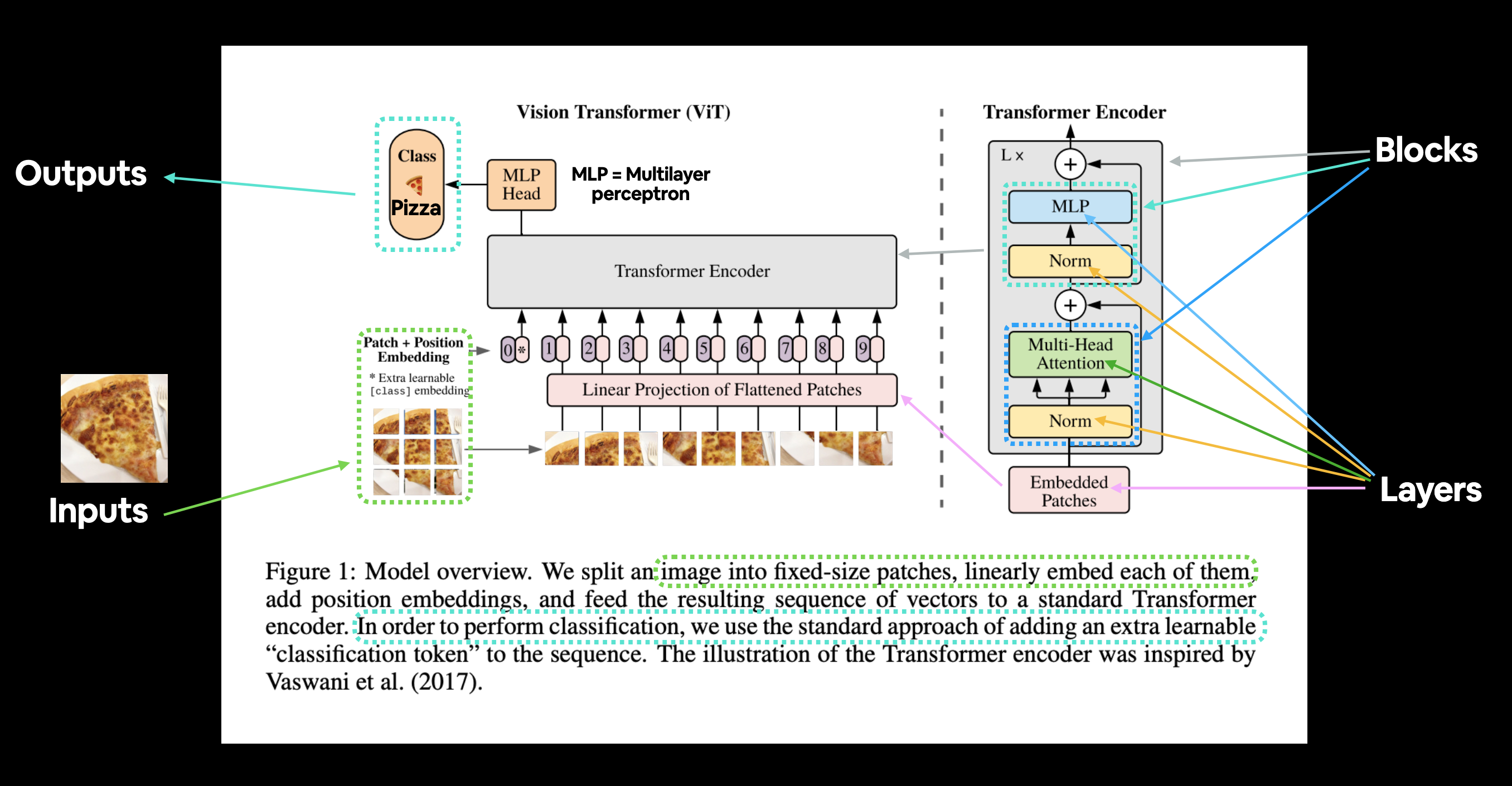
Figure 1 from the ViT Paper adapted for use with FoodVision Mini. An image of food goes in (pizza), the image gets turned into patches and then projected to an embedding. The embedding then travels through the various layers and blocks and (hopefully) the class "pizza" is returned.
TK - 3.2.2 Exploring the Four Equations
The next main part(s) of the ViT paper we're going to look at are the four equations in section 3.1.

These four equations represent the math behind the four major parts of the ViT architecture.
Section 3.1 describes each of these (some of the text has been omitted for brevity, bolded text is mine):
- ...The Transformer uses constant latent vector size
Dthrough all of its layers, so we flatten the patches and map toDdimensions with a trainable linear projection (Eq. 1). We refer to the output of this projection as the patch embeddings. - The Transformer encoder (Vaswani et al., 2017) consists of alternating layers of multiheaded selfattention (MSA, see Appendix A) and MLP blocks (Eq. 2, 3). Layernorm (LN) is applied before every block, and residual connections after every block (Wang et al., 2019; Baevski & Auli, 2019).
- See above.
- Similar to BERT's [ class ] token, we prepend a learnable embedding to the sequence of embedded patches
\left(\mathbf{z}_{0}^{0}=\mathbf{x}_{\text {class }}\right), whose state at the output of the Transformer encoder\left(\mathbf{z}_{L}^{0}\right)serves as the image representation\mathbf{y}(Eq. 4)...
Let's map these descriptions to the ViT architecture in Figure 1.
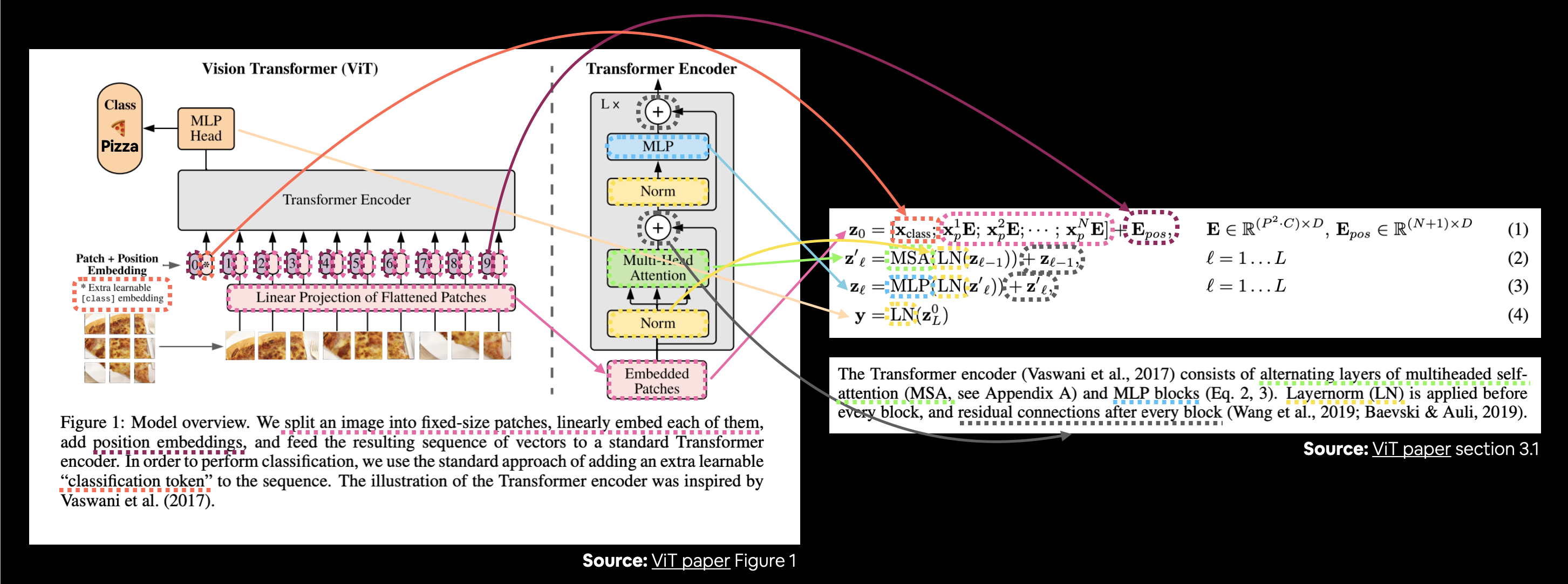
Connecting Figure 1 from the ViT paper to the four equations from section 3.1 describing the math behind each of the layers/blocks. Some details such as "residual connections after every block" are referred to in Figure 1 and in the text but not in the equations.
There's a lot happening in the image above but following the coloured lines and arrows reveals the main concepts of the ViT architecture.
Equation 1
\begin{aligned}
\mathbf{z}_{0} &=\left[\mathbf{x}_{\text {class }} ; \mathbf{x}_{p}^{1} \mathbf{E} ; \mathbf{x}_{p}^{2} \mathbf{E} ; \cdots ; \mathbf{x}_{p}^{N} \mathbf{E}\right]+\mathbf{E}_{\text {pos }}, & & \mathbf{E} \in \mathbb{R}^{\left(P^{2} \cdot C\right) \times D}, \mathbf{E}_{\text {pos }} \in \mathbb{R}^{(N+1) \times D}
\end{aligned}
This equation deals with the patch embedding and position embedding of the input image.
In vector form, the embedding might look something like:
TK - update the vector form to reflect a real exmaple
[class_token, image_patch_1, image_patch_2, image_patch_3...] + [0, image_patch_1_position, image_patch_2_position, image_patch_3_position...]
Where each of the elements in the vector is learnable (their requires_grad=True).
Equation 2
\begin{aligned}
\mathbf{z}_{\ell}^{\prime} &=\operatorname{MSA}\left(\operatorname{LN}\left(\mathbf{z}_{\ell-1}\right)\right)+\mathbf{z}_{\ell-1}, & & \ell=1 \ldots L
\end{aligned}
This says that for every layer from 1 through to L (the total number of layers), there's a Multi-Head Attention layer (MSA) wrapping a LayerNorm layer (LN).
The addition on the end is the equivalent of adding the input to the output and forming a skip/residual connection.
We'll call this layer the "MSA block".
In pseudocode, this might look like:
# MSA block
x_output_MSA_block = MSA_layer(LN_layer(x_input)) + x_input
Equation 3
\begin{aligned}
\mathbf{z}_{\ell} &=\operatorname{MLP}\left(\operatorname{LN}\left(\mathbf{z}_{\ell}^{\prime}\right)\right)+\mathbf{z}_{\ell}^{\prime}, & & \ell=1 \ldots L \\
\end{aligned}
This says that for every layer from 1 through to L (the total number of layers), there's also a Multilayer Perceptron layer (MLP) wrapping a LayerNorm layer (LN).
The addition on the end is showing the presence of a skip/residual connection.
We'll call this layer the "MLP block".
In pseudocode, this might look like:
# MLP block
# Notice how the layer(s) take the output of the MSA block (above) as input and use it as the skip connection on the end
x_output_MLP_block = MLP_layer(LN_layer(x_output_MSA_block)) + x_output_MSA_block
Equation 4
\begin{aligned}
\mathbf{y} &=\operatorname{LN}\left(\mathbf{z}_{L}^{0}\right) & &
\end{aligned}
This says for the last layer L, the output y is the 0 index token of z wrapped in a LayerNorm layer (LN).
Or in our case, the 0 index of x_output_MLP_block:
# MLP Head
y = LN_layer(Linear_layer(x_output_MLP_block[0]))
Of course there are some simplifications above but we'll take care of those when we start to write PyTorch code for each section.
Note: The above section covers alot of information. But don't forget if something doesn't make sense, you can always research it further. By asking questions like "what is a residual connection?".
TK 4. Equation 1: Split data into patches and creating the patch embedding
Let's start by creating the patch embedding.
This means we'll be turning our input images in a sequence of patches and then embedding those patches.
Recall that an embedding is a learnable representation of some form and is often a vector. The term learnable is important because this means the representation of an input image can be improved and learned over time.
We'll begin by following the opening paragraph of section 3.1 of the ViT paper (bold mine):
The standard Transformer receives as input a 1D sequence of token embeddings. To handle 2D images, we reshape the image
\mathbf{x} \in \mathbb{R}^{H \times W \times C}into a sequence of flattened 2D patches\mathbf{x}_{p} \in \mathbb{R}^{N \times\left(P^{2} \cdot C\right)}, where(H, W)is the resolution of the original image,Cis the number of channels,(P, P)is the resolution of each image patch, andN=H W / P^{2}is the resulting number of patches, which also serves as the effective input sequence length for the Transformer. The Transformer uses constant latent vector sizeDthrough all of its layers, so we flatten the patches and map toDdimensions with a trainable linear projection (Eq. 1). We refer to the output of this projection as the patch embeddings.
And size we're dealing with image shapes, let's keep in mind the line from Table 3 of the ViT paper:
Training resolution is 224.
Let's break down the text above.
Dis the size of the patch embeddings, different values forDcan be found in Table 1.- The image starts as 2D with size
{H \times W \times C}. - The image gets converted to a sequence of flattened 2D patches with size
{N \times\left(P^{2} \cdot C\right)}.(H, W)is the resolution of the original image.Cis the number of channels.(P, P)is the resolution of each image patch (patch size).N=H W / P^{2}is the resulting number of patches, which also serves as the effective input sequence length for the Transformer.
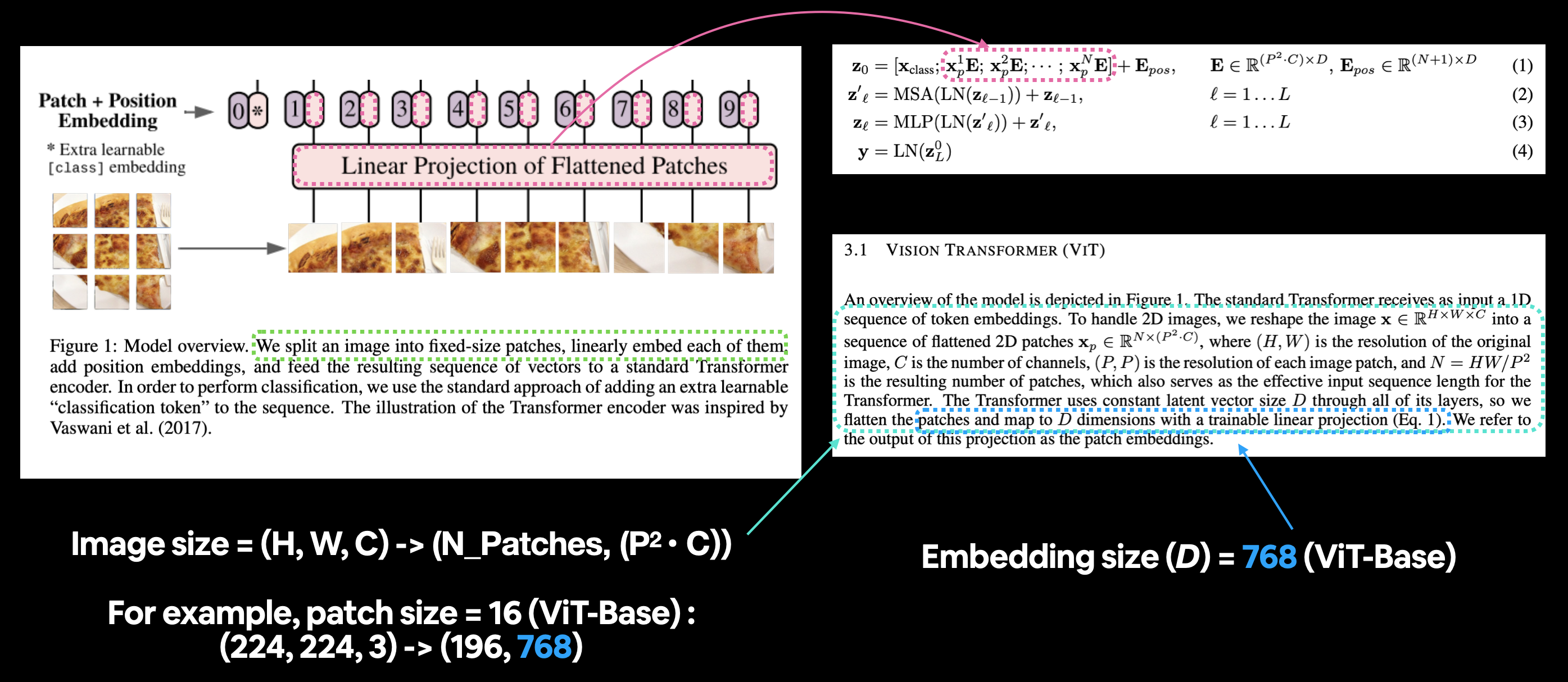
Mapping the patch and position embedding portion of the ViT architecture from Figure 1 to Equation 1. The opening paragraph of section 3.1 describes the different input and output shapes of the patch embedding layer.
# Create example values
height = 224 # H ("The training resolution is 224.")
width = 224 # W
color_channels = 3 # C
patch_size = 16 # P
# Calculate N (number of patches)
number_of_patches = int((height * width) / patch_size**2)
print(f"Number of patches (N) with image height (H={height}), width (W={width}) and patch size (P={patch_size}): {number_of_patches}")Number of patches (N) with image height (H=224), width (W=224) and patch size (P=16): 196
# Input shape
input_shape = (height, width, color_channels)
# Output shape
output_shape = (number_of_patches, patch_size**2 * color_channels)
print(f"Input shape (2D image): {input_shape}")
print(f"Output shape (flattened 2D patches): {output_shape}")Input shape (2D image): (224, 224, 3) Output shape (flattened 2D patches): (196, 768)
# View single image
plt.imshow(image.permute(1, 2, 0)) # adjust for matplotlib
plt.title(class_names[label])
plt.axis(False);# Change image shape to be compatible with matplotlib (color_channels, height, width) -> (height, width, color_channels)
image_permuted = image.permute(1, 2, 0)
# Index to plot the top row of patched pixels
patch_size = 16
plt.figure(figsize=(patch_size, patch_size))
plt.imshow(image_permuted[:patch_size, :, :]);
# Setup hyperparameters and make sure img_size and patch_size are compatible
img_size = 224
patch_size = 16
num_patches = img_size/patch_size
assert img_size % patch_size == 0, "Image size must be divisible by patch size"
print(f"Number of patches per row: {num_patches}")
# Create a series of subplots
fig, axs = plt.subplots(nrows=1,
ncols=img_size // patch_size, # one column for each patch
figsize=(num_patches, num_patches),
sharex=True,
sharey=True)
# Iterate through number of patches in the top row
for i, patch in enumerate(range(0, img_size, patch_size)):
axs[i].imshow(image_permuted[:patch_size, patch:patch+patch_size, :]); # keep height index constant, alter the width index
axs[i].set_xlabel(i+1) # set the label
axs[i].set_xticks([])
axs[i].set_yticks([])Number of patches per row: 14.0

# Setup hyperparameters and make sure img_size and patch_size are compatible
img_size = 224
patch_size = 16
num_patches = img_size/patch_size
assert img_size % patch_size == 0, "Image size must be divisible by patch size"
print(f"Number of patches per row: {num_patches}\nNumber of patches per column: {num_patches}\nTotal patches: {num_patches*num_patches}")
# Create a series of subplots
fig, axs = plt.subplots(nrows=img_size // patch_size, # need int not float
ncols=img_size // patch_size,
figsize=(num_patches, num_patches),
sharex=True,
sharey=True)
# Loop through height and width of image
for i, patch_height in enumerate(range(0, img_size, patch_size)): # iterate through height
for j, patch_width in enumerate(range(0, img_size, patch_size)): # iterate through width
# Plot the permuted image patch (image_permuted -> (Height, Width, Color Channels))
axs[i, j].imshow(image_permuted[patch_height:patch_h+patch_size, # iterate through height
patch_width:patch_w+patch_size, # iterate through width
:]) # get all color channels
# Set up label information, remove the ticks for clarity and set labels to outside
axs[i, j].set_ylabel(i+1,
rotation="horizontal",
horizontalalignment="right",
verticalalignment="center")
axs[i, j].set_xlabel(j+1)
axs[i, j].set_xticks([])
axs[i, j].set_yticks([])
axs[i, j].label_outer()
# Set a super title
fig.suptitle(f"{class_names[label]} -> Patchified", fontsize=16)
plt.show()Number of patches per row: 14.0 Number of patches per column: 14.0 Total patches: 196.0

from torch import nn
patch_size=16
# Create the embedding and the patch in one hit
conv2d = nn.Conv2d(in_channels=3,
out_channels=768, # from Table 1: Hidden size D
kernel_size=patch_size,
stride=patch_size,
padding=0)
flatten = nn.Flatten(start_dim=2,
end_dim=3) # https://pytorch.org/docs/stable/generated/torch.nn.Flatten.html # Now we have a patchified image of 256 tokens + an embedding for each patch
patch_image_out_of_conv = conv2d(image.unsqueeze(0))
print(patch_image_out_of_conv.shape)
patch_image = flatten(conv2d(image.unsqueeze(0)))
patch_image.shapetorch.Size([1, 768, 14, 14])
torch.Size([1, 768, 196])
# Plot random 10 conv patches
import random
random_start = random.randint(0, 758)
random_end = random_start + 10
print(f"Showing 10 random Conv2d patches from index {random_start} to {random_end}")
patches = patch_image_out_of_conv[:, random_start:random_start+10, :, :]
fig, axs = plt.subplots(ncols=10, squeeze=False, figsize=(16, 16))
for i in range(10):
axs[0, i].imshow(patches[:, i, :, :].squeeze().detach().numpy())
axs[0, i].set(xticklabels=[], yticklabels=[], xticks=[], yticks=[]);Showing 10 random Conv2d patches from index 89 to 99

# Get image in shape [batch_size, N, P^2*C]
patch_image.transpose(-2, -1).shapetorch.Size([1, 256, 768])
# Get image in shape [batch_size, N, P^2*C]
reshaped_patch_image = patch_image.permute(0, 2, 1)
reshaped_patch_image.shapetorch.Size([1, 256, 768])
class PatchEmbedding(nn.Module):
def __init__(self,
in_channels=3,
patch_size=16,
embedding_dim=768):
super().__init__()
self.patcher = nn.Conv2d(in_channels=in_channels,
out_channels=embedding_dim,
kernel_size=patch_size,
stride=patch_size,
padding=0)
self.flatten = nn.Flatten(start_dim=2, # only flatten the 2nd last and last dim
end_dim=3)
def forward(self, x):
# print(x.shape)
x_patched = self.patcher(x)
# print(x_patched.shape)
x_flattened = self.flatten(x_patched)
# print(x_flattened.shape)
return x_flattened.permute(0, 2, 1) # adjust so the embedding is on the final dimension [batch_size, P^2*C, N] -> [batch_size, N, P^2*C]patchify = PatchEmbedding()
patched_image = patchify(image.unsqueeze(0)) # add an extra batch dimension on the 0th index, otherwise will error
patched_image.shapetorch.Size([1, 196, 768])
summary(patchify, input_size=(1, 3, 224, 224),
col_names=["input_size", "output_size", "num_params", "trainable"],
col_width=20,
row_settings=["var_names"])======================================================================================================================== Layer (type (var_name)) Input Shape Output Shape Param # Trainable ======================================================================================================================== PatchEmbedding (PatchEmbedding) [1, 3, 224, 224] [1, 196, 768] -- True ├─Conv2d (patcher) [1, 3, 224, 224] [1, 768, 14, 14] 590,592 True ├─Flatten (flatten) [1, 768, 14, 14] [1, 768, 196] -- -- ======================================================================================================================== Total params: 590,592 Trainable params: 590,592 Non-trainable params: 0 Total mult-adds (M): 115.76 ======================================================================================================================== Input size (MB): 0.60 Forward/backward pass size (MB): 1.20 Params size (MB): 2.36 Estimated Total Size (MB): 4.17 ========================================================================================================================
class MultiheadSelfAttentionBlock(nn.Module):
"""Creates a multi-head self-attention block ("MSABlock" for short).
Uses PyTorch's torch.nn.MultiheadAttention: https://pytorch.org/docs/stable/generated/torch.nn.MultiheadAttention.html
Source code for what's happening behind the scenes: https://github.com/pytorch/pytorch/blob/master/torch/nn/functional.py#L4909
"""
def __init__(self,
embedding_dim=768, # From Table 1
num_heads=12, # From Table 1
attn_dropout=0): # Doesn't look like the paper uses any dropout in MSABlocks
super().__init__()
self.multihead_attn = nn.MultiheadAttention(embed_dim=embedding_dim,
num_heads=num_heads,
dropout=attn_dropout,
batch_first=True)
def forward(self, x):
attn_output, _ = self.multihead_attn(query=x,
key=x,
value=x,
need_weights=False)
return attn_outputmultihead_self_attention_block = MultiheadSelfAttentionBlock(embedding_dim=768,
num_heads=12)
patched_image_through_msa_block = multihead_self_attention_block(patched_image)
patched_image_through_msa_block.shapetorch.Size([1, 196, 768])
# Could also call this "FeedForward"
class MLPBlock(nn.Module):
"""Creates an MLPBlock of the Vision Transformer architecture."""
def __init__(self,
embedding_dim, # embedding dimension (Hidden Size D in Table 1)
mlp_size, # MLP size in Table 1
dropout=0): # "Dropout... is applied to every dense layer... (Appendix B.1)"
super().__init__()
self.mlp = nn.Sequential(
nn.Linear(in_features=embedding_dim,
out_features=mlp_size),
nn.GELU(), # "The MLP contains two layers with a GELU non-linearity (section 3.1)."
nn.Dropout(p=dropout),
nn.Linear(in_features=mlp_size, # needs to take same in_features as out_features of layer above
out_features=embedding_dim) # take back to embedding_dim
nn.Dropout(p=dropout)
)
def forward(self, x):
return self.mlp(x)mlp_block = MLPBlock(embedding_dim=768, # Table 1
mlp_size=3072) # Table 1
patched_image_through_mlp_block = mlp_block(patched_image_through_msa_block)
patched_image_through_mlp_block.shapetorch.Size([1, 196, 768])
class TransformerEncoderBlock(nn.Module):
"""Creates a Transformer Encoder block."""
def __init__(self,
embedding_dim=768, # From Table 1
num_heads=12, # From Table 1
mlp_size=3072, # From Table 1
mlp_dropout=0.1,
attn_dropout=0):
super().__init__()
# Create MSA Block (for equation 2)
self.msa_block = nn.Sequential(
nn.LayerNorm(normalized_shape=embedding_dim),
MultiheadSelfAttentionBlock(embedding_dim=embedding_dim,
num_heads=num_heads,
attn_dropout=attn_dropout))
# Create MLP Block (for equation 3)
self.mlp_block = nn.Sequential(
nn.LayerNorm(normalized_shape=embedding_dim),
MLPBlock(embedding_dim=embedding_dim,
mlp_size=mlp_size,
dropout=mlp_dropout))
def forward(self, x):
x = self.msa_block(x) + x # Create skip connection
x = self.mlp_block(x) + x # Create skip connection
return xclass ViT(nn.Module):
"""Creates a Vision Transformer architecture."""
def __init__(self,
img_size=224, # From Table 3 in ViT paper
in_channels=3,
patch_size=16,
num_transformer_layers=12, # From Table 1 in ViT paper
embedding_dim=768,
mlp_size=3072,
num_heads=12,
attn_dropout=0,
mlp_dropout=0.1,
embedding_dropout=0.1,
num_classes=1000): # default for ImageNet
super().__init__() # don't for the super().__init__()!
# Get image size
self.img_height, self.img_width = img_size, img_size
# Calculate number of patches (height * width/patch^2)
self.num_patches = (self.img_height * self.img_width) // patch_size**2
# Create position embedding (from index 1 -> last of patch embedding size)
self.position_embedding = nn.Parameter(data=torch.randn(1, self.num_patches+1, embedding_dim),
requires_grad=True)
# Create class embedding (needs to go at front of sequence embedding)
self.class_embedding = nn.Parameter(data=torch.randn(1, 1, embedding_dim),
requires_grad=True)
# Create embedding dropout
self.embedding_dropout = nn.Dropout(p=embedding_dropout)
# Create patch embedding layer
self.patch_embedding = PatchEmbedding(in_channels=in_channels,
patch_size=patch_size,
embedding_dim=embedding_dim)
# Create transformer encoder blocks
self.transformer_enedoder = nn.Sequential(*[TransformerEncoderBlock(embedding_dim=embedding_dim,
num_heads=num_heads,
mlp_size=mlp_size,
mlp_dropout=mlp_dropout) for _ in range(num_transformer_layers)])
# Create classifier head (equation 4)
self.classifier = nn.Sequential(
nn.LayerNorm(normalized_shape=embedding_dim),
nn.Linear(in_features=embedding_dim,
out_features=num_classes)
)
def forward(self, x):
# Get batch size
batch_size = x.shape[0]
# Create class token embedding
class_token = self.class_embedding.expand(batch_size, -1, -1)
# Create patch embedding
x = self.patch_embedding(x)
# Concat class embedding and patch embedding (equation 1)
x = torch.cat((class_token, x), dim=1)
# Add position embedding to patch embedding (equation 1)
x = self.position_embedding + x
# Run embedding dropout
x = self.embedding_dropout(x)
# Pass patch, position and class embedding through transformer encoder layers (equations 2 & 3)
x = self.transformer_enedoder(x)
# Put 0 index logit through classifier (equation 4)
x = self.classifier(x[:, 0]) # run on each sample in a batch at 0 index
return x
batch_size = 32
class_tokens = nn.Parameter(data=torch.randn(1, 1, 768))
class_tokens.expand(batch_size, -1, -1).shapetorch.Size([32, 1, 768])
set_seeds()
device = "cuda" if torch.cuda.is_available() else "cpu"
rand_image = torch.randn(1, 3, 224, 224)
# vit = ViT(num_classes=len(class_names))
vit = ViT(num_classes=3)
vit(rand_image)tensor([[0.6055, 1.3140, 0.2506]], grad_fn=<AddmmBackward0>)
from torchinfo import summary
# TK - clean up the summary so it looks nice when it prints out
# Print a summary using torchinfo (uncomment for actual output)
summary(model=vit,
input_size=(128, 3, 224, 224), # make sure this is "input_size", not "input_shape"
# col_names=["input_size"], # uncomment for smaller output
col_names=["input_size", "output_size", "num_params", "trainable"],
col_width=20,
row_settings=["var_names"]
)=========================================================================================================================================================== Layer (type (var_name)) Input Shape Output Shape Param # Trainable =========================================================================================================================================================== ViT (ViT) [128, 3, 224, 224] [128, 3] 152,064 True ├─Dropout (embedding_dropout) [128, 197, 768] [128, 197, 768] -- -- ├─PatchEmbedding (patch_embedding) [128, 3, 224, 224] [128, 196, 768] -- True │ └─Conv2d (patcher) [128, 3, 224, 224] [128, 768, 14, 14] 590,592 True │ └─Flatten (flatten) [128, 768, 14, 14] [128, 768, 196] -- -- ├─Dropout (embedding_dropout) [128, 197, 768] [128, 197, 768] -- -- ├─Sequential (transformer_enedoder) [128, 197, 768] [128, 197, 768] -- True │ └─TransformerEncoderBlock (0) [128, 197, 768] [128, 197, 768] -- True │ │ └─Sequential (msa_block) [128, 197, 768] [128, 197, 768] 2,363,904 True │ │ └─Sequential (mlp_block) [128, 197, 768] [128, 197, 768] 4,723,968 True │ └─TransformerEncoderBlock (1) [128, 197, 768] [128, 197, 768] -- True │ │ └─Sequential (msa_block) [128, 197, 768] [128, 197, 768] 2,363,904 True │ │ └─Sequential (mlp_block) [128, 197, 768] [128, 197, 768] 4,723,968 True │ └─TransformerEncoderBlock (2) [128, 197, 768] [128, 197, 768] -- True │ │ └─Sequential (msa_block) [128, 197, 768] [128, 197, 768] 2,363,904 True │ │ └─Sequential (mlp_block) [128, 197, 768] [128, 197, 768] 4,723,968 True │ └─TransformerEncoderBlock (3) [128, 197, 768] [128, 197, 768] -- True │ │ └─Sequential (msa_block) [128, 197, 768] [128, 197, 768] 2,363,904 True │ │ └─Sequential (mlp_block) [128, 197, 768] [128, 197, 768] 4,723,968 True │ └─TransformerEncoderBlock (4) [128, 197, 768] [128, 197, 768] -- True │ │ └─Sequential (msa_block) [128, 197, 768] [128, 197, 768] 2,363,904 True │ │ └─Sequential (mlp_block) [128, 197, 768] [128, 197, 768] 4,723,968 True │ └─TransformerEncoderBlock (5) [128, 197, 768] [128, 197, 768] -- True │ │ └─Sequential (msa_block) [128, 197, 768] [128, 197, 768] 2,363,904 True │ │ └─Sequential (mlp_block) [128, 197, 768] [128, 197, 768] 4,723,968 True │ └─TransformerEncoderBlock (6) [128, 197, 768] [128, 197, 768] -- True │ │ └─Sequential (msa_block) [128, 197, 768] [128, 197, 768] 2,363,904 True │ │ └─Sequential (mlp_block) [128, 197, 768] [128, 197, 768] 4,723,968 True │ └─TransformerEncoderBlock (7) [128, 197, 768] [128, 197, 768] -- True │ │ └─Sequential (msa_block) [128, 197, 768] [128, 197, 768] 2,363,904 True │ │ └─Sequential (mlp_block) [128, 197, 768] [128, 197, 768] 4,723,968 True │ └─TransformerEncoderBlock (8) [128, 197, 768] [128, 197, 768] -- True │ │ └─Sequential (msa_block) [128, 197, 768] [128, 197, 768] 2,363,904 True │ │ └─Sequential (mlp_block) [128, 197, 768] [128, 197, 768] 4,723,968 True │ └─TransformerEncoderBlock (9) [128, 197, 768] [128, 197, 768] -- True │ │ └─Sequential (msa_block) [128, 197, 768] [128, 197, 768] 2,363,904 True │ │ └─Sequential (mlp_block) [128, 197, 768] [128, 197, 768] 4,723,968 True │ └─TransformerEncoderBlock (10) [128, 197, 768] [128, 197, 768] -- True │ │ └─Sequential (msa_block) [128, 197, 768] [128, 197, 768] 2,363,904 True │ │ └─Sequential (mlp_block) [128, 197, 768] [128, 197, 768] 4,723,968 True │ └─TransformerEncoderBlock (11) [128, 197, 768] [128, 197, 768] -- True │ │ └─Sequential (msa_block) [128, 197, 768] [128, 197, 768] 2,363,904 True │ │ └─Sequential (mlp_block) [128, 197, 768] [128, 197, 768] 4,723,968 True ├─Sequential (classifier) [128, 768] [128, 3] -- True │ └─LayerNorm (0) [128, 768] [128, 768] 1,536 True │ └─Linear (1) [128, 768] [128, 3] 2,307 True =========================================================================================================================================================== Total params: 85,800,963 Trainable params: 85,800,963 Non-trainable params: 0 Total mult-adds (G): 22.08 =========================================================================================================================================================== Input size (MB): 77.07 Forward/backward pass size (MB): 13168.81 Params size (MB): 257.55 Estimated Total Size (MB): 13503.43 ===========================================================================================================================================================
batch_size = 32
cls_embedding = nn.Parameter(torch.randn(1, 1, 768))
# See here: https://pytorch.org/docs/stable/generated/torch.Tensor.expand.html
cls_embedding.shape, cls_embedding.expand(batch_size, -1, -1).shape(torch.Size([1, 1, 768]), torch.Size([32, 1, 768]))
from going_modular.going_modular import engine
optimizer = torch.optim.Adam(params=vit.parameters(),
lr=1e-3,
betas=(0.9, 0.999), # default
weight_decay=0.1) # from the ViT paper section 4.1
loss_fn = torch.nn.CrossEntropyLoss()
set_seeds()
results = engine.train(model=vit,
train_dataloader=train_dataloader,
test_dataloader=test_dataloader,
optimizer=optimizer,
loss_fn=loss_fn,
epochs=10,
device=device)0%| | 0/10 [00:00<?, ?it/s]
Epoch: 1 | train_loss: 3.8765 | train_acc: 0.3516 | test_loss: 1.8075 | test_acc: 0.2604 Epoch: 2 | train_loss: 1.7652 | train_acc: 0.2500 | test_loss: 1.8281 | test_acc: 0.1979 Epoch: 3 | train_loss: 1.7685 | train_acc: 0.2930 | test_loss: 1.0586 | test_acc: 0.5417 Epoch: 4 | train_loss: 1.3442 | train_acc: 0.3906 | test_loss: 1.6053 | test_acc: 0.1979 Epoch: 5 | train_loss: 1.2500 | train_acc: 0.2969 | test_loss: 1.0597 | test_acc: 0.4811 Epoch: 6 | train_loss: 1.1027 | train_acc: 0.4258 | test_loss: 1.2707 | test_acc: 0.1979 Epoch: 7 | train_loss: 1.1864 | train_acc: 0.2578 | test_loss: 1.3656 | test_acc: 0.1979 Epoch: 8 | train_loss: 1.1701 | train_acc: 0.3047 | test_loss: 1.2117 | test_acc: 0.2604 Epoch: 9 | train_loss: 1.1279 | train_acc: 0.4219 | test_loss: 1.0078 | test_acc: 0.5417 Epoch: 10 | train_loss: 1.1814 | train_acc: 0.2344 | test_loss: 1.1760 | test_acc: 0.2604
from helper_functions import plot_loss_curves
plot_loss_curves(results)
# The following requires torch v0.12+ and torchvision v0.13+
import torch
import torchvision
print(torch.__version__)
print(torchvision.__version__)1.13.0.dev20220606 0.14.0.dev20220606
device = "cuda" if torch.cuda.is_available() else "cpu"
device'cuda'
# Set seeds
def set_seeds(seed=42):
    torch.manual_seed(seed)
torch.cuda.manual_seed(seed)# Requires torchvision >= 0.13
pretrained_vit_weights = torchvision.models.ViT_B_16_Weights.DEFAULT
pretrained_vit = torchvision.models.vit_b_16(weights=pretrained_vit_weights).to(device)
# Freeze the base parameters
for parameter in pretrained_vit.parameters():
parameter.requires_grad = False
# Change the classifier head
set_seeds()
pretrained_vit.heads = nn.Linear(in_features=768, out_features=len(class_names)).to(device)# Print a summary using torchinfo (uncomment for actual output)
summary(model=pretrained_vit,
input_size=(128, 3, 224, 224), # make sure this is "input_size", not "input_shape"
# col_names=["input_size"], # uncomment for smaller output
col_names=["input_size", "output_size", "num_params", "trainable"],
col_width=20,
row_settings=["var_names"]
)====================================================================================================================================================== Layer (type (var_name)) Input Shape Output Shape Param # Trainable ====================================================================================================================================================== VisionTransformer (VisionTransformer) [128, 3, 224, 224] [128, 3] 768 Partial ├─Conv2d (conv_proj) [128, 3, 224, 224] [128, 768, 14, 14] (590,592) False ├─Encoder (encoder) [128, 197, 768] [128, 197, 768] 151,296 False │ └─Dropout (dropout) [128, 197, 768] [128, 197, 768] -- -- │ └─Sequential (layers) [128, 197, 768] [128, 197, 768] -- False │ │ └─EncoderBlock (encoder_layer_0) [128, 197, 768] [128, 197, 768] (7,087,872) False │ │ └─EncoderBlock (encoder_layer_1) [128, 197, 768] [128, 197, 768] (7,087,872) False │ │ └─EncoderBlock (encoder_layer_2) [128, 197, 768] [128, 197, 768] (7,087,872) False │ │ └─EncoderBlock (encoder_layer_3) [128, 197, 768] [128, 197, 768] (7,087,872) False │ │ └─EncoderBlock (encoder_layer_4) [128, 197, 768] [128, 197, 768] (7,087,872) False │ │ └─EncoderBlock (encoder_layer_5) [128, 197, 768] [128, 197, 768] (7,087,872) False │ │ └─EncoderBlock (encoder_layer_6) [128, 197, 768] [128, 197, 768] (7,087,872) False │ │ └─EncoderBlock (encoder_layer_7) [128, 197, 768] [128, 197, 768] (7,087,872) False │ │ └─EncoderBlock (encoder_layer_8) [128, 197, 768] [128, 197, 768] (7,087,872) False │ │ └─EncoderBlock (encoder_layer_9) [128, 197, 768] [128, 197, 768] (7,087,872) False │ │ └─EncoderBlock (encoder_layer_10) [128, 197, 768] [128, 197, 768] (7,087,872) False │ │ └─EncoderBlock (encoder_layer_11) [128, 197, 768] [128, 197, 768] (7,087,872) False │ └─LayerNorm (ln) [128, 197, 768] [128, 197, 768] (1,536) False ├─Linear (heads) [128, 768] [128, 3] 2,307 True ====================================================================================================================================================== Total params: 85,800,963 Trainable params: 2,307 Non-trainable params: 85,798,656 Total mult-adds (G): 22.08 ====================================================================================================================================================== Input size (MB): 77.07 Forward/backward pass size (MB): 13322.95 Params size (MB): 257.55 Estimated Total Size (MB): 13657.57 ======================================================================================================================================================
# TK - the above output has the same number of parameters as our own created model# Download pizza, steak, sushi images from GitHub
image_path = download_data(source="https://github.com/mrdbourke/pytorch-deep-learning/raw/main/data/pizza_steak_sushi.zip",
destination="pizza_steak_sushi")
image_path[INFO] data/pizza_steak_sushi directory exists, skipping download.
PosixPath('data/pizza_steak_sushi')train_dir = image_path / "train"
test_dir = image_path / "test"
train_dir, test_dir(PosixPath('data/pizza_steak_sushi/train'),
PosixPath('data/pizza_steak_sushi/test'))# Create dataset for pretrained ViT
pretrained_vit_transforms = pretrained_vit_weights.transforms()
print(pretrained_vit_transforms)
train_dataloader_pretrained, test_dataloader_pretrained, class_names = data_setup.create_dataloaders(train_dir=train_dir,
test_dir=test_dir,
transform=pretrained_vit_transforms,
batch_size=1024) # From here: https://arxiv.org/abs/2205.01580 (there are other improvements there too...)
ImageClassification(
    crop_size=[224]
    resize_size=[256]
    mean=[0.485, 0.456, 0.406]
    std=[0.229, 0.224, 0.225]
    interpolation=InterpolationMode.BILINEAR
)
# Train pretrained feature extractor ViT for 5 epochs on Pizza, Steak, Sushi
# TK - can probably increase the batch_size here because we're using feature extraction and not
# training the whole model
from going_modular.going_modular import engine

optimizer = torch.optim.Adam(params=pretrained_vit.parameters(),
                             lr=1e-3)
loss_fn = torch.nn.CrossEntropyLoss()

set_seeds()
pretrained_vit_results = engine.train(model=pretrained_vit,
                                      train_dataloader=train_dataloader_pretrained,
                                      test_dataloader=test_dataloader_pretrained,
                                      optimizer=optimizer,
                                      loss_fn=loss_fn,
                                      epochs=10,
                                      device=device)
0%| | 0/10 [00:00<?, ?it/s]
Epoch: 1 | train_loss: 1.1490 | train_acc: 0.2356 | test_loss: 1.0584 | test_acc: 0.4667
Epoch: 2 | train_loss: 1.0017 | train_acc: 0.5289 | test_loss: 0.9194 | test_acc: 0.6400
Epoch: 3 | train_loss: 0.8716 | train_acc: 0.7244 | test_loss: 0.7983 | test_acc: 0.6667
Epoch: 4 | train_loss: 0.7583 | train_acc: 0.8089 | test_loss: 0.6942 | test_acc: 0.7733
Epoch: 5 | train_loss: 0.6608 | train_acc: 0.8622 | test_loss: 0.6060 | test_acc: 0.8800
Epoch: 6 | train_loss: 0.5777 | train_acc: 0.8889 | test_loss: 0.5318 | test_acc: 0.8933
Epoch: 7 | train_loss: 0.5076 | train_acc: 0.9156 | test_loss: 0.4700 | test_acc: 0.9067
Epoch: 8 | train_loss: 0.4487 | train_acc: 0.9244 | test_loss: 0.4188 | test_acc: 0.9333
Epoch: 9 | train_loss: 0.3993 | train_acc: 0.9378 | test_loss: 0.3765 | test_acc: 0.9333
Epoch: 10 | train_loss: 0.3580 | train_acc: 0.9378 | test_loss: 0.3417 | test_acc: 0.9467
# Plot the loss curves
from helper_functions import plot_loss_curves

plot_loss_curves(pretrained_vit_results) 
# Save the model
from going_modular.going_modular import utils

utils.save_model(model=pretrained_vit,
                 target_dir="models",
                 model_name="08_pretrained_vit_feature_extractor_pizza_steak_sushi.pth")
[INFO] Saving model to: models/08_pretrained_vit_feature_extractor_pizza_steak_sushi.pth
from pathlib import Path

# Get the model size in bytes then convert to megabytes
pretrained_vit_model_size = Path("models/08_pretrained_vit_feature_extractor_pizza_steak_sushi.pth").stat().st_size // (1024*1024)
print(f"Pretrained ViT feature extractor model size: {pretrained_vit_model_size} MB")
Pretrained ViT feature extractor model size: 327 MB