
1.8 MiB

# For this notebook to run with updated APIs, we need torch 1.12+ and torchvision 0.13+
try:
    import torch
    import torchvision
    assert int(torch.__version__.split(".")[1]) >= 12, "torch version should be 1.12+"
    assert int(torchvision.__version__.split(".")[1]) >= 13, "torchvision version should be 0.13+"
    print(f"torch version: {torch.__version__}")
    print(f"torchvision version: {torchvision.__version__}")
except:
    print(f"[INFO] torch/torchvision versions not as required, installing nightly versions.")
    !pip3 install -U --pre torch torchvision torchaudio --extra-index-url https://download.pytorch.org/whl/nightly/cu113
    import torch
    import torchvision
    print(f"torch version: {torch.__version__}")
    print(f"torchvision version: {torchvision.__version__}")
torch version: 1.12.0+cu113 torchvision version: 0.13.0+cu113
# Continue with regular imports
import matplotlib.pyplot as plt
import torch
import torchvision

from torch import nn
from torchvision import transforms

# Try to get torchinfo, install it if it doesn't work
try:
    from torchinfo import summary
except:
    print("[INFO] Couldn't find torchinfo... installing it.")
    !pip install -q torchinfo
    from torchinfo import summary

# Try to import the going_modular directory, download it from GitHub if it doesn't work
try:
    from going_modular.going_modular import data_setup, engine
    from helper_functions import download_data, set_seeds, plot_loss_curves
except:
    # Get the going_modular scripts
    print("[INFO] Couldn't find going_modular or helper_functions scripts... downloading them from GitHub.")
    !git clone https://github.com/mrdbourke/pytorch-deep-learning
    !mv pytorch-deep-learning/going_modular .
    !mv pytorch-deep-learning/helper_functions.py . # get the helper_functions.py script
    !rm -rf pytorch-deep-learning
    from going_modular.going_modular import data_setup, engine
from helper_functions import download_data, set_seeds, plot_loss_curves# Setup device agnostic code
device = "cuda" if torch.cuda.is_available() else "cpu"
device'cuda'
# Download pizza, steak, sushi images from GitHub
image_path = download_data(source="https://github.com/mrdbourke/pytorch-deep-learning/raw/main/data/pizza_steak_sushi.zip",
                           destination="pizza_steak_sushi")
image_path[INFO] data/pizza_steak_sushi directory exists, skipping download.
PosixPath('data/pizza_steak_sushi')# Setup directory paths to train and test images
train_dir = image_path / "train"
test_dir = image_path / "test"train_dir, test_dir(PosixPath('data/pizza_steak_sushi/train'),
PosixPath('data/pizza_steak_sushi/test'))from torchvision import transforms
from going_modular.going_modular import data_setup
# Create image size
IMG_SIZE = 224 # comes from Table 3 of the ViT paper
# Create transforms pipeline
manual_transforms = transforms.Compose([
transforms.Resize((IMG_SIZE, IMG_SIZE)),
transforms.ToTensor()
])
print(f"Manually created transforms: {manual_transforms}")Manually created transforms: Compose(
Resize(size=(224, 224), interpolation=bilinear, max_size=None, antialias=None)
ToTensor()
)
# Create a batch size of 32 (gthe paper uses 4096 but this may be too big for our smaller hardware... can always scale up later)
BATCH_SIZE = 32

# Create DataLoaders
train_dataloader, test_dataloader, class_names = data_setup.create_dataloaders(
    train_dir=train_dir,
    test_dir=test_dir,
    transform=manual_transforms,
    batch_size=BATCH_SIZE
)

len(train_dataloader), len(test_dataloader), class_names(8, 3, ['pizza', 'steak', 'sushi'])
# Get a batch of images
image_batch, label_batch = next(iter(train_dataloader))

# Get a single image and label from the batch
image, label = image_batch[0], label_batch[0]

# View the single image and label shapes
image.shape, label(torch.Size([3, 224, 224]), tensor(0))
# Plot the image with matplotlib
import matplotlib.pyplot as plt

plt.imshow(image.permute(1, 2, 0)) # (color_channels, height, width) -> (height, width, color_channels)
plt.title(class_names[label])
plt.axis(False);
Figure 1
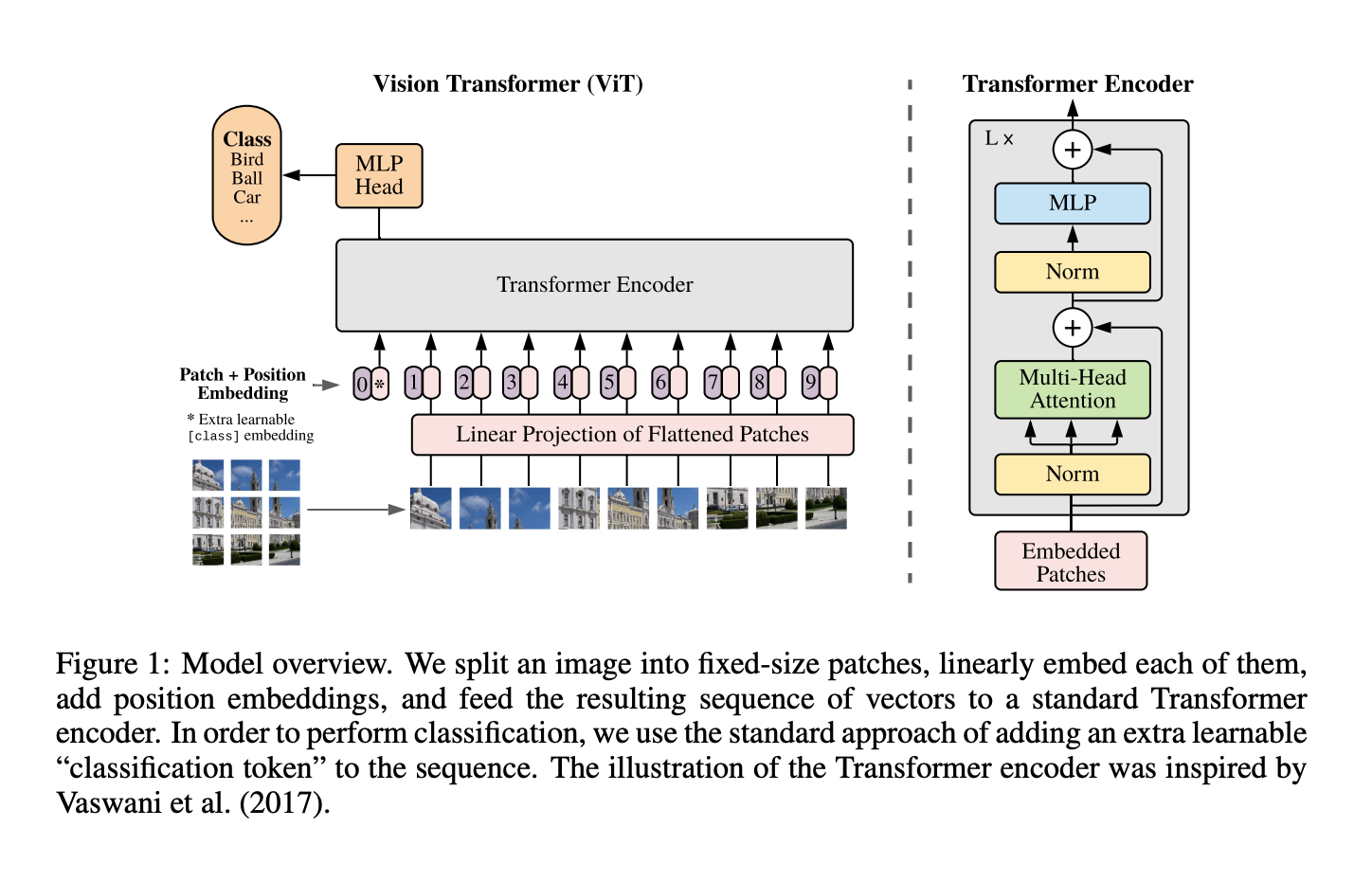
- Embedding = learnable representation (start with random numbers and improve over time)
Four equations

Section 3.1 describes the various equations:
Equation 1:
An overview of the model is depicted in Figure 1. The standard Transformer receives as input a 1D sequence of token embeddings. To handle 2 \mathrm{D} images, we reshape the image \mathbf{x} \in \mathbb{R}^{H \times W \times C} into a sequence of flattened 2 \mathrm{D} patches \mathbf{x}_{p} \in \mathbb{R}^{N \times\left(P^{2} \cdot C\right)}, where (H, W) is the resolution of the original image, C is the number of channels, (P, P) is the resolution of each image patch, and N=H W / P^{2} is the resulting number of patches, which also serves as the effective input sequence length for the Transformer. The Transformer uses constant latent vector size D through all of its layers, so we flatten the patches and map to D dimensions with a trainable linear projection (Eq. 1). We refer to the output of this projection as the patch embeddings.
Equation 1:
Position embeddings are added to the patch embeddings to retain positional information. We use standard learnable 1 \mathrm{D} position embeddings, since we have not observed significant performance gains from using more advanced 2D-aware position embeddings (Appendix D.4). The resulting sequence of embedding vectors serves as input to the encoder.
In pseudocode:
# Equation 1
x_input = [class_token, image_patch_1, image_patch_2, ... image_patch_N] + [class_token_pos, image_patch_1_pos, image_patch_2_pos, ... image_patch_N_pos]
Table 1
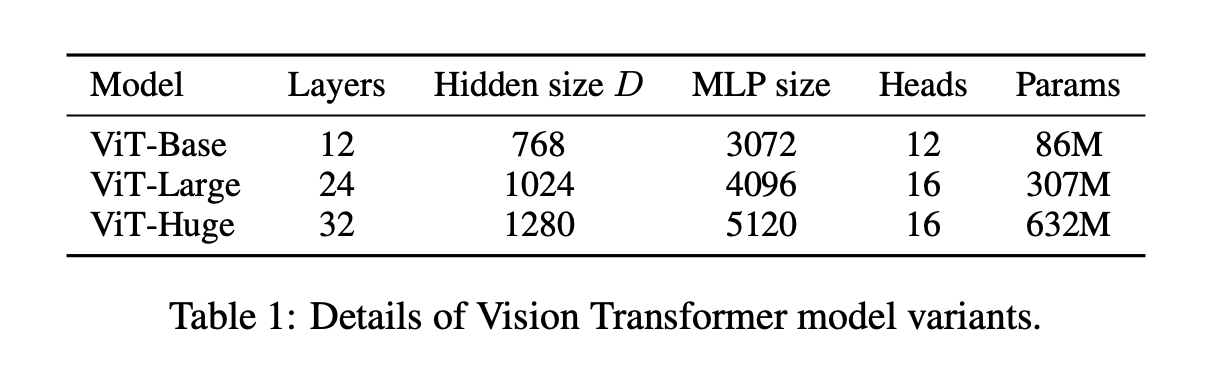
- ViT-Base, ViT-Large and ViT-Huge are all different sizes of the same model architecture
- ViT-B/16 = ViT-Base with image patch size 16x16
- Layers - the number of transformer encoder layers
- Hidden size
D- the embedding size throughout the architecture - MLP size - the number of hidden units/neurons in the MLP
- Heads - the number of multi-head self-attention
# Create example values
height = 224
width = 224
color_channels = 3
patch_size = 16

# Calculate the number of patches
number_of_patches = int((height * width) / patch_size**2)
number_of_patches196
# Input shape
embedding_layer_input_shape = (height, width, color_channels)

# Output shape
embedding_layer_output_shape = (number_of_patches, patch_size**2 * color_channels)

print(f"Input shape (single 2D image): {embedding_layer_input_shape}")
print(f"Output shape (single 1D sequence of patches): {embedding_layer_output_shape} -> (number_of_patches, embedding_dimension)")
Input shape (single 2D image): (224, 224, 3) Output shape (single 1D sequence of patches): (196, 768) -> (number_of_patches, embedding_dimension)
# View a single image
plt.imshow(image.permute(1, 2, 0))
plt.title(class_names[label])
plt.axis(False);image.shapetorch.Size([3, 224, 224])
# Get the top row of the image
image_permuted = image.permute(1, 2, 0) # convert image to color channels last (H, W, C)

# Index to plot the top row of pixels
patch_size = 16
plt.figure(figsize=(patch_size, patch_size))
plt.imshow(image_permuted[:patch_size, :, :])<matplotlib.image.AxesImage at 0x7fc62c2838d0>

# Setup code to plot top row as patches
img_size = 224
patch_size = 16
num_patches = img_size/patch_size
assert img_size % patch_size == 0, "Image size must be divisible by patch size"
print(f"Number of patches per row: {num_patches}\nPatch size: {patch_size} pixels x {patch_size} pixels")

# Create a series of subplots
fig, axs = plt.subplots(nrows=1,
                        ncols=img_size // patch_size, # one column for each patch
                        sharex=True,
                        sharey=True,
                        figsize=(patch_size, patch_size))

# Iterate through number of patches in the top row
for i, patch in enumerate(range(0, img_size, patch_size)):
  axs[i].imshow(image_permuted[:patch_size, patch:patch+patch_size, :]);
  axs[i].set_xlabel(i+1) # set the patch label
  axs[i].set_xticks([])
  axs[i].set_yticks([])
Number of patches per row: 14.0 Patch size: 16 pixels x 16 pixels

# Setup code to plot whole image as patches
img_size = 224
patch_size = 16
num_patches = img_size/patch_size
assert img_size % patch_size == 0, "Image size must be divisible by patch size"
print(f"Number of patches per row: {num_patches}\
  \nNumber of patches per column: {num_patches}\
  \nTotal patches: {num_patches*num_patches}\
  \nPatch size: {patch_size} pixels x {patch_size} pixels")

# Create a series of subplots
fig, axs = plt.subplots(nrows=img_size // patch_size,
                        ncols=img_size // patch_size,
                        figsize=(num_patches, num_patches),
                        sharex=True,
                        sharey=True)

# Loop through height and width of image
for i, patch_height in enumerate(range(0, img_size, patch_size)): # iterate through height
  for j, patch_width in enumerate(range(0, img_size, patch_size)):
    # Plot the permuted image on the different axes
    axs[i, j].imshow(image_permuted[patch_height:patch_height+patch_size, # iterate through height
                                    patch_width:patch_width+patch_size, # iterate through width
                                    :]) # get all color channels
    # Set up label information for each subplot (patch)
    axs[i, j].set_ylabel(i+1,
                         rotation="horizontal",
                         horizontalalignment="right",
                         verticalalignment="center")
    axs[i, j].set_xlabel(j+1)
    axs[i, j].set_xticks([])
    axs[i, j].set_yticks([])
    axs[i, j].label_outer()

# Set up a title for the plot
fig.suptitle(f"{class_names[label]} -> Patchified", fontsize=14)
plt.show()
Number of patches per row: 14.0 Number of patches per column: 14.0 Total patches: 196.0 Patch size: 16 pixels x 16 pixels

# Create conv2d layer to turn image into patches of learnable feature maps (embeddings)
from torch import nn

# Set the patch size
patch_size = 16

# Create a conv2d lyaer with hyperparameters from the ViT paper
conv2d = nn.Conv2d(in_channels=3, # for color images
                   out_channels=768, # D size from Table 1 for ViT-Base
                   kernel_size=patch_size,
                   stride=patch_size,
                   padding=0)
conv2dConv2d(3, 768, kernel_size=(16, 16), stride=(16, 16))
# View single image
plt.imshow(image.permute(1, 2, 0))
plt.title(class_names[label])
plt.axis(False);# Pass the image through the convolutional layer
image_out_of_conv = conv2d(image.unsqueeze(0)) # add batch dimension -> (batch_size, color_channels, height, width)
print(image_out_of_conv.shape) torch.Size([1, 768, 14, 14])
image_out_of_conv.requires_gradTrue
# plot random convolutional feature maps (embeddings)
import random
random_indexes = random.sample(range(0, 758), k=5)
print(f"Showing random convolutional feature maps from indexes: {random_indexes}")

# Create plot
fig, axs = plt.subplots(nrows=1, ncols=5, figsize=(12, 12))

# Plot random image feature maps
for i, idx in enumerate(random_indexes):
  image_conv_feature_map = image_out_of_conv[:, idx, :, :] # index on the output tensor of the conv2d layer
  axs[i].imshow(image_conv_feature_map.squeeze().detach().numpy()) # remove batch dimension, and remove from grad tracking/switch to numpy for matplotlib
  axs[i].set(xticklabels=[], yticklabels=[], xticks=[], yticks=[])
Showing random convolutional feature maps from indexes: [507, 71, 166, 241, 272]

# Get a single feature map in tensor form
single_feature_map = image_out_of_conv[:, 0, :, :]
single_feature_map, single_feature_map.requires_grad(tensor([[[ 0.1407, 0.1090, 0.1021, 0.1104, 0.0994, -0.0023, 0.0833,
0.0281, 0.0831, 0.0941, 0.0986, 0.0203, 0.0206, -0.0152],
[ 0.0804, 0.1664, 0.1979, -0.0078, -0.3030, -0.0536, -0.2039,
-0.0388, -0.0347, -0.1243, -0.1810, -0.0476, 0.1051, 0.0399],
[-0.0716, 0.0355, -0.0671, -0.0396, -0.2541, -0.1525, -0.1335,
-0.1575, 0.0895, -0.0103, -0.1282, -0.0114, -0.0942, -0.0481],
[-0.1791, -0.1164, -0.1725, -0.0481, -0.0625, -0.0877, -0.1679,
-0.0722, -0.1618, -0.0711, -0.0335, 0.1048, 0.1567, 0.1100],
[ 0.0778, -0.2123, -0.0797, -0.1068, -0.0471, -0.0960, 0.0561,
-0.0643, -0.0510, -0.0651, -0.0275, -0.0313, -0.1188, -0.0143],
[-0.1055, -0.0940, 0.0829, -0.0087, -0.0778, -0.1851, -0.1613,
0.1131, 0.0694, -0.1660, -0.2467, 0.0015, 0.1099, 0.1271],
[-0.0018, 0.0883, -0.0462, -0.0074, 0.0591, -0.1006, -0.0257,
-0.2168, -0.1621, 0.1588, 0.0712, 0.0631, -0.1775, -0.1007],
[ 0.0357, -0.0580, -0.1732, -0.2045, -0.0843, -0.1670, -0.0618,
0.0191, 0.0565, -0.1508, 0.0103, 0.0300, 0.1253, 0.0356],
[-0.0979, -0.1481, -0.1128, 0.1911, 0.1118, 0.1514, -0.1875,
-0.2145, 0.0742, 0.0809, 0.2035, 0.0928, 0.1184, 0.1298],
[-0.0954, -0.1065, -0.1638, -0.0156, 0.0218, -0.1327, -0.1192,
-0.1086, -0.1809, -0.0102, -0.1456, 0.0052, -0.0445, 0.0401],
[-0.0196, 0.0171, 0.0129, -0.1425, -0.0151, -0.0344, -0.0826,
-0.0653, -0.1250, 0.0047, -0.0196, -0.0445, 0.0677, 0.0581],
[-0.0221, -0.0131, -0.0670, -0.1478, -0.0123, 0.0458, 0.0050,
-0.0714, -0.0824, -0.0079, -0.0218, 0.0119, -0.1344, -0.0957],
[-0.1727, -0.0127, -0.0364, -0.0090, -0.0312, -0.0084, 0.0170,
-0.0113, -0.1140, -0.1092, -0.1072, -0.0010, 0.0080, -0.1315],
[-0.1228, -0.1214, -0.1354, -0.0643, -0.1033, -0.1008, -0.1099,
-0.0781, -0.0485, -0.1678, -0.1026, -0.0602, -0.0902, 0.0780]]],
grad_fn=<SliceBackward0>), True)print(f"{image_out_of_conv.shape} -> (batch_size, embedding_dim, feature_map_height, feature_map_width)")torch.Size([1, 768, 14, 14]) -> (batch_size, embedding_dim, feature_map_height, feature_map_width)
from torch import nn
flatten_layer = nn.Flatten(start_dim=2,
                           end_dim=3)

flatten_layer(image_out_of_conv).shapetorch.Size([1, 768, 196])
# Put everything together
plt.imshow(image.permute(1, 2, 0))
plt.title(class_names[label])
plt.axis(False)
print(f"Original image shape: {image.shape}")

# Turn image into feature maps
image_out_of_conv = conv2d(image.unsqueeze(0)) # add batch dimension
print(f"Image feature map (patches) shape: {image_out_of_conv.shape}")

# Flatten the feature maps
image_out_of_conv_flattened = flatten_layer(image_out_of_conv)
print(f"Flattened image feature map shape: {image_out_of_conv_flattened.shape}")
Original image shape: torch.Size([3, 224, 224]) Image feature map (patches) shape: torch.Size([1, 768, 14, 14]) Flattened image feature map shape: torch.Size([1, 768, 196])
# Rearrange output of flattened layer
image_out_of_conv_flattened_permuted = image_out_of_conv_flattened.permute(0, 2, 1)
print(f"{image_out_of_conv_flattened_permuted.shape} -> (batch_size, number_of_patches, embedding_dimension)")
torch.Size([1, 196, 768]) -> (batch_size, number_of_patches, embedding_dimension)
# Get a single flattened feature map
single_flattened_feature_map = image_out_of_conv_flattened_permuted[:, :, 0]

# Plot the flattened feature map visually
plt.figure(figsize=(22, 22))
plt.imshow(single_flattened_feature_map.detach().numpy())
plt.title(f"Flattened feature map shape: {single_flattened_feature_map.shape}")
plt.axis(False); 
# 1. Create a class called PatchEmbedding
class PatchEmbedding(nn.Module):
  # 2. Initilaize the layer with appropriate hyperparameters
  def __init__(self,
               in_channels:int=3,
               patch_size:int=16,
               embedding_dim:int=768): # from Table 1 for ViT-Base
    super().__init__()

    self.patch_size = patch_size

    # 3. Create a layer to turn an image into embedded patches
    self.patcher = nn.Conv2d(in_channels=in_channels,
                             out_channels=embedding_dim,
                             kernel_size=patch_size,
                             stride=patch_size,
                             padding=0)

    # 4. Create a layer to flatten feature map outputs of Conv2d
    self.flatten = nn.Flatten(start_dim=2,
                              end_dim=3)

  # 5. Define a forward method to define the forward computation steps
  def forward(self, x):
    # Create assertion to check that inputs are the correct shape
    image_resolution = x.shape[-1]
    assert image_resolution % patch_size == 0, f"Input image size must be divisible by patch size, image shape: {image_resolution}, patch size: {self.patch_size}"

    # Perform the forward pass
    x_patched = self.patcher(x)
    x_flattened = self.flatten(x_patched)
    # 6. Make the returned sequence embedding dimensions are in the right order (batch_size, number_of_patches, embedding_dimension)
    return x_flattened.permute(0, 2, 1)
set_seeds()

# Create an instance of patch embedding layer
patchify = PatchEmbedding(in_channels=3,
                          patch_size=16,
                          embedding_dim=768)

# Pass a single image through patch embedding layer
print(f"Input image size: {image.unsqueeze(0).shape}")
patch_embedded_image = patchify(image.unsqueeze(0)) # add an extra batch dimension
print(f"Output patch embedding sequence shape: {patch_embedded_image.shape}")
Input image size: torch.Size([1, 3, 224, 224]) Output patch embedding sequence shape: torch.Size([1, 196, 768])
rand_image_tensor = torch.randn(1, 3, 224, 224)
rand_image_tensor_bad = torch.randn(1, 3, 250, 250)

# patchify(rand_image_tensor_bad)patch_embedded_imagetensor([[[-0.7665, 0.1767, -0.2405, ..., 0.6293, -0.3423, 0.3247],
[-0.7299, 0.1911, -0.1953, ..., 0.5647, -0.3340, 0.2806],
[-0.7201, 0.1827, -0.1611, ..., 0.5443, -0.3373, 0.2574],
...,
[-0.5255, 0.0765, -0.0469, ..., 0.3121, -0.3001, 0.2329],
[-0.4847, 0.1029, -0.0593, ..., 0.2676, -0.2530, 0.0827],
[-0.2441, 0.1201, -0.3067, ..., 0.2972, -0.1575, 0.0815]]],
grad_fn=<PermuteBackward0>)# Get the batch size and embedding dimension
batch_size = patch_embedded_image.shape[0]
embedding_dimension = patch_embedded_image.shape[-1]
batch_size, embedding_dimension(1, 768)
# Create class token embedding as a learnable parameter that shares the same size as the embedding dimension (D)
class_token = nn.Parameter(torch.ones(batch_size, 1, embedding_dimension),
                           requires_grad=True)
class_token.shapetorch.Size([1, 1, 768])
patch_embedded_image.shapetorch.Size([1, 196, 768])
# Add the class token embedding to the front of the patch embedding
patch_embedded_image_with_class_embedding = torch.cat((class_token, patch_embedded_image),
                                                      dim=1) # number_of_patches dimension

print(patch_embedded_image_with_class_embedding)
print(f"Sequence of patch embeddings with class token prepended shape: {patch_embedded_image_with_class_embedding.shape} -> (batch_size, class_token + number_of_patches, embedding_dim)")
tensor([[[ 1.0000, 1.0000, 1.0000, ..., 1.0000, 1.0000, 1.0000],
[-0.7665, 0.1767, -0.2405, ..., 0.6293, -0.3423, 0.3247],
[-0.7299, 0.1911, -0.1953, ..., 0.5647, -0.3340, 0.2806],
...,
[-0.5255, 0.0765, -0.0469, ..., 0.3121, -0.3001, 0.2329],
[-0.4847, 0.1029, -0.0593, ..., 0.2676, -0.2530, 0.0827],
[-0.2441, 0.1201, -0.3067, ..., 0.2972, -0.1575, 0.0815]]],
grad_fn=<CatBackward0>)
Sequence of patch embeddings with class token prepended shape: torch.Size([1, 197, 768]) -> (batch_size, class_token + number_of_patches, embedding_dim)
# Calculate N (number_of_patches)
number_of_patches = int((height * width) / patch_size**2)

# Get the embedding dimension
embedding_dimension = patch_embedded_image_with_class_embedding.shape[-1]

# Create the learnable 1D position embedding
position_embedding = nn.Parameter(torch.ones(1,
                                             number_of_patches+1,
                                             embedding_dimension),
                                  requires_grad=True)

position_embedding, position_embedding.shape(Parameter containing:
tensor([[[1., 1., 1., ..., 1., 1., 1.],
[1., 1., 1., ..., 1., 1., 1.],
[1., 1., 1., ..., 1., 1., 1.],
...,
[1., 1., 1., ..., 1., 1., 1.],
[1., 1., 1., ..., 1., 1., 1.],
[1., 1., 1., ..., 1., 1., 1.]]], requires_grad=True),
torch.Size([1, 197, 768]))# View the sequence of patch embeddings with the prepended class embedding
patch_embedded_image_with_class_embedding, patch_embedded_image_with_class_embedding.shape(tensor([[[ 1.0000, 1.0000, 1.0000, ..., 1.0000, 1.0000, 1.0000],
[-0.7665, 0.1767, -0.2405, ..., 0.6293, -0.3423, 0.3247],
[-0.7299, 0.1911, -0.1953, ..., 0.5647, -0.3340, 0.2806],
...,
[-0.5255, 0.0765, -0.0469, ..., 0.3121, -0.3001, 0.2329],
[-0.4847, 0.1029, -0.0593, ..., 0.2676, -0.2530, 0.0827],
[-0.2441, 0.1201, -0.3067, ..., 0.2972, -0.1575, 0.0815]]],
grad_fn=<CatBackward0>), torch.Size([1, 197, 768]))# Add the position embedding to the patch and class token embedding
patch_and_position_embedding = patch_embedded_image_with_class_embedding + position_embedding
print(patch_and_position_embedding)
print(f"Patch and position embedding shape: {patch_and_position_embedding.shape}")tensor([[[2.0000, 2.0000, 2.0000, ..., 2.0000, 2.0000, 2.0000],
[0.2335, 1.1767, 0.7595, ..., 1.6293, 0.6577, 1.3247],
[0.2701, 1.1911, 0.8047, ..., 1.5647, 0.6660, 1.2806],
...,
[0.4745, 1.0765, 0.9531, ..., 1.3121, 0.6999, 1.2329],
[0.5153, 1.1029, 0.9408, ..., 1.2676, 0.7470, 1.0827],
[0.7559, 1.1201, 0.6933, ..., 1.2972, 0.8425, 1.0815]]],
grad_fn=<AddBackward0>)
Patch and position embedding shape: torch.Size([1, 197, 768])
# Set seeds
set_seeds()

# 1. Set the patch size
patch_size = 16

# 2. Print shapes of the original image tensor and get the image dimensions
print(f"Image tensor shape: {image.shape}")
height, width = image.shape[1], image.shape[2]

# 3. Get image tensor and add a batch dimension
x = image.unsqueeze(0)
print(f"Input image shape: {x.shape}")

# 4. Create patch embedding layer
patch_embedding_layer = PatchEmbedding(in_channels=3,
                                       patch_size=patch_size,
                                       embedding_dim=768)

# 5. Pass input image through PatchEmbedding
patch_embedding = patch_embedding_layer(x)
print(f"Patch embedding shape: {patch_embedding.shape}")

# 6. Create class token embedding
batch_size = patch_embedding.shape[0]
embedding_dimension = patch_embedding.shape[-1]
class_token = nn.Parameter(torch.ones(batch_size, 1, embedding_dimension),
                           requires_grad=True) # make sure it's learnable
print(f"Class token embedding shape: {class_token.shape}")

# 7. Prepend the class token embedding to patch embedding
patch_embedding_class_token = torch.cat((class_token, patch_embedding), dim=1)
print(f"Patch embedding with class token shape: {patch_embedding_class_token.shape}")

# 8. Create position embedding
number_of_patches = int((height*width) / patch_size**2)
position_embedding = nn.Parameter(torch.ones(1, number_of_patches+1, embedding_dimension),
                                  requires_grad=True)

# 9. Add the position embedding to patch embedding with class token
patch_and_position_embedding = patch_embedding_class_token + position_embedding
print(f"Patch and position embedding shape: {patch_and_position_embedding.shape} ")
Image tensor shape: torch.Size([3, 224, 224]) Input image shape: torch.Size([1, 3, 224, 224]) Patch embedding shape: torch.Size([1, 196, 768]) Class token embedding shape: torch.Size([1, 1, 768]) Patch embedding with class token shape: torch.Size([1, 197, 768]) Patch and position embedding shape: torch.Size([1, 197, 768])
class MultiHeadSelfAttentionBlock(nn.Module):
  """Creates a multi-head self-attention block ("MSA block" for short).
  """
  def __init__(self,
               embedding_dim:int=768, # Hidden size D (embedding dimension) from Table 1 for ViT-Base
               num_heads:int=12, # Heads from Table 1 for ViT-Base
               attn_dropout:int=0):
    super().__init__()

    # Create the norm layer (LN)
    self.layer_norm = nn.LayerNorm(normalized_shape=embedding_dim)

    # Create multihead attention (MSA) layer
    self.multihead_attn = nn.MultiheadAttention(embed_dim=embedding_dim,
                                                num_heads=num_heads,
                                                dropout=attn_dropout,
                                                batch_first=True) # is the batch first? (batch, seq, feature) -> (batch, number_of_patches, embedding_dimension)

  def forward(self, x):
    x = self.layer_norm(x)
    attn_output, _ = self.multihead_attn(query=x,
                                         key=x,
                                         value=x,
                                         need_weights=False)
return attn_output# Create an instance MSA block
multihead_self_attention_block = MultiHeadSelfAttentionBlock(embedding_dim=768,
num_heads=12,
attn_dropout=0)
# Pass the patch and position image embedding sequence through MSA block
patched_image_through_msa_block = multihead_self_attention_block(patch_and_position_embedding)
print(f"Input shape of MSA block: {patch_and_position_embedding.shape}")
print(f"Output shape of MSA block: {patched_image_through_msa_block.shape}")Input shape of MSA block: torch.Size([1, 197, 768]) Output shape of MSA block: torch.Size([1, 197, 768])
class MLPBlock(nn.Module):
  def __init__(self,
               embedding_dim:int=768,
               mlp_size:int=3072,
               dropout:int=0.1):
    super().__init__()

    # Create the norm layer (LN)
    self.layer_norm = nn.LayerNorm(normalized_shape=embedding_dim)

    # Create the MLP
    self.mlp = nn.Sequential(
        nn.Linear(in_features=embedding_dim,
                  out_features=mlp_size),
        nn.GELU(),
        nn.Dropout(p=dropout),
        nn.Linear(in_features=mlp_size,
                  out_features=embedding_dim),
        nn.Dropout(p=dropout)
    )

  def forward(self, x):
    x = self.layer_norm(x)
    x = self.mlp(x)
    return x
# return self.mlp(self.layer_norm(x)) # same as above # Create an instance of MLPBlock
mlp_block = MLPBlock(embedding_dim=768,
mlp_size=3072,
dropout=0.1)
# Pass output the MSABlock through MLPBlock
patched_image_through_mlp_block = mlp_block(patched_image_through_msa_block)
print(f"Input shape of MLP block: {patched_image_through_msa_block.shape}")
print(f"Output shape of MLP block: {patched_image_through_mlp_block.shape}")Input shape of MLP block: torch.Size([1, 197, 768]) Output shape of MLP block: torch.Size([1, 197, 768])
class TransformerEncoderBlock(nn.Module):
  def __init__(self,
               embedding_dim:int=768, # Hidden size D from table 1, 768 for ViT-Base
               num_heads:int=12, # from table 1
               mlp_size:int=3072, # from table 1
               mlp_dropout:int=0.1, # from table 3
               attn_dropout:int=0):
    super().__init__()

    # Create MSA block (equation 2)
    self.msa_block = MultiHeadSelfAttentionBlock(embedding_dim=embedding_dim,
                                                 num_heads=num_heads,
                                                 attn_dropout=attn_dropout)

    # Create MLP block (equation 3)
    self.mlp_block = MLPBlock(embedding_dim=embedding_dim,
                              mlp_size=mlp_size,
                              dropout=mlp_dropout)

  def forward(self, x):
    x = self.msa_block(x) + x # residual/skip connection for equation 2
    x = self.mlp_block(x) + x # residual/skip connection for equation 3
return x # Create an instance of TransformerEncoderBlock()
transformer_encoder_block = TransformerEncoderBlock()
# Get a summary using torchinfo.summary
summary(model=transformer_encoder_block,
input_size=(1, 197, 768), # (batch_size, number_of_patches, embedding_dimension)
col_names=["input_size", "output_size", "num_params", "trainable"],
col_width=20,
row_settings=["var_names"])============================================================================================================================================ Layer (type (var_name)) Input Shape Output Shape Param # Trainable ============================================================================================================================================ TransformerEncoderBlock (TransformerEncoderBlock) [1, 197, 768] [1, 197, 768] -- True ├─MultiHeadSelfAttentionBlock (msa_block) [1, 197, 768] [1, 197, 768] -- True │ └─LayerNorm (layer_norm) [1, 197, 768] [1, 197, 768] 1,536 True │ └─MultiheadAttention (multihead_attn) -- [1, 197, 768] 1,771,776 True │ │ └─NonDynamicallyQuantizableLinear (out_proj) -- -- 590,592 True ├─MLPBlock (mlp_block) [1, 197, 768] [1, 197, 768] -- True │ └─LayerNorm (layer_norm) [1, 197, 768] [1, 197, 768] 1,536 True │ └─Sequential (mlp) [1, 197, 768] [1, 197, 768] -- True │ │ └─Linear (0) [1, 197, 768] [1, 197, 3072] 2,362,368 True │ │ └─GELU (1) [1, 197, 3072] [1, 197, 3072] -- -- │ │ └─Dropout (2) [1, 197, 3072] [1, 197, 3072] -- -- │ │ └─Linear (3) [1, 197, 3072] [1, 197, 768] 2,360,064 True │ │ └─Dropout (4) [1, 197, 768] [1, 197, 768] -- -- ============================================================================================================================================ Total params: 7,087,872 Trainable params: 7,087,872 Non-trainable params: 0 Total mult-adds (M): 4.73 ============================================================================================================================================ Input size (MB): 0.61 Forward/backward pass size (MB): 8.47 Params size (MB): 21.26 Estimated Total Size (MB): 30.34 ============================================================================================================================================
# Create the same as above with torch.nn.TransformerEncoderLayer()
torch_transformer_encoder_layer = nn.TransformerEncoderLayer(d_model=768, # embedding size from table 1
                                                             nhead=12, # heads from table 1
                                                             dim_feedforward=3072, # MLP size from table
                                                             dropout=0.1,
                                                             activation="gelu",
                                                             batch_first=True,
                                                             norm_first=True)

torch_transformer_encoder_layerTransformerEncoderLayer(
(self_attn): MultiheadAttention(
(out_proj): NonDynamicallyQuantizableLinear(in_features=768, out_features=768, bias=True)
)
(linear1): Linear(in_features=768, out_features=3072, bias=True)
(dropout): Dropout(p=0.1, inplace=False)
(linear2): Linear(in_features=3072, out_features=768, bias=True)
(norm1): LayerNorm((768,), eps=1e-05, elementwise_affine=True)
(norm2): LayerNorm((768,), eps=1e-05, elementwise_affine=True)
(dropout1): Dropout(p=0.1, inplace=False)
(dropout2): Dropout(p=0.1, inplace=False)
)# Get a summary using torchinfo.summary
summary(model=torch_transformer_encoder_layer,
input_size=(1, 197, 768), # (batch_size, number_of_patches, embedding_dimension)
col_names=["input_size", "output_size", "num_params", "trainable"],
col_width=20,
row_settings=["var_names"])================================================================================================================================== Layer (type (var_name)) Input Shape Output Shape Param # Trainable ================================================================================================================================== TransformerEncoderLayer (TransformerEncoderLayer) [1, 197, 768] [1, 197, 768] 3,072 True ├─LayerNorm (norm1) [1, 197, 768] [1, 197, 768] (recursive) True ├─MultiheadAttention (self_attn) [1, 197, 768] [1, 197, 768] 2,362,368 True ├─Dropout (dropout1) [1, 197, 768] [1, 197, 768] -- -- ├─LayerNorm (norm2) [1, 197, 768] [1, 197, 768] (recursive) True ├─Linear (linear1) [1, 197, 768] [1, 197, 3072] 2,362,368 True ├─LayerNorm (norm1) [1, 197, 768] [1, 197, 768] (recursive) True ├─LayerNorm (norm2) [1, 197, 768] [1, 197, 768] (recursive) True ├─Dropout (dropout) [1, 197, 3072] [1, 197, 3072] -- -- ├─Dropout (dropout2) [1, 197, 768] [1, 197, 768] -- -- ├─Linear (linear2) [1, 197, 3072] [1, 197, 768] 2,360,064 True ├─Dropout (dropout2) [1, 197, 768] [1, 197, 768] -- -- ================================================================================================================================== Total params: 7,087,872 Trainable params: 7,087,872 Non-trainable params: 0 Total mult-adds (M): 4.73 ================================================================================================================================== Input size (MB): 0.61 Forward/backward pass size (MB): 6.05 Params size (MB): 18.89 Estimated Total Size (MB): 25.55 ==================================================================================================================================
# Create a ViT class
class ViT(nn.Module):
  def __init__(self,
               img_size:int=224, # Table 3 from the ViT paper
               in_channels:int=3,
               patch_size:int=16,
               num_transformer_layers:int=12, # Table 1 for "Layers" for ViT-Base
               embedding_dim:int=768, # Hidden size D from Table 1 for ViT-Base
               mlp_size:int=3072, # Table 1
               num_heads:int=12, # Table 1
               attn_dropout:int=0,
               mlp_dropout:int=0.1,
               embedding_dropout:int=0.1, # Dropout for patch and position embeddings
               num_classes:int=1000): # number of classes in our classification problem
    super().__init__()

    # Make an assertion that the image size is compatible with the patch size
    assert img_size % patch_size == 0,  f"Image size must be divisible by patch size, image: {img_size}, patch size: {patch_size}"

    # Calculate the number of patches (height * width/patch^2)
    self.num_patches = (img_size * img_size) // patch_size**2

    # Create learnable class embedding (needs to go at front of sequence of patch embeddings)
    self.class_embedding = nn.Parameter(data=torch.randn(1, 1, embedding_dim),
                                        requires_grad=True)

    # Create learnable position embedding
    self.position_embedding = nn.Parameter(data=torch.randn(1, self.num_patches+1, embedding_dim))

    # Create embedding dropout value
    self.embedding_dropout = nn.Dropout(p=embedding_dropout)

    # Create patch embedding layer
    self.patch_embedding = PatchEmbedding(in_channels=in_channels,
                                          patch_size=patch_size,
                                          embedding_dim=embedding_dim)

    # Create the Transformer Encoder block
    self.transformer_encoder = nn.Sequential(*[TransformerEncoderBlock(embedding_dim=embedding_dim,
                                                                       num_heads=num_heads,
                                                                       mlp_size=mlp_size,
                                                                       mlp_dropout=mlp_dropout) for _ in range(num_transformer_layers)])

    # Create classifier head
    self.classifier = nn.Sequential(
        nn.LayerNorm(normalized_shape=embedding_dim),
        nn.Linear(in_features=embedding_dim,
                  out_features=num_classes)
    )

  def forward(self, x):
    # Get the batch size
    batch_size = x.shape[0]

    # Create class token embedding and expand it to match the batch size (equation 1)
    class_token = self.class_embedding.expand(batch_size, -1, -1) # "-1" means to infer the dimensions

    # Create the patch embedding (equation 1)
    x = self.patch_embedding(x)

    # Concat class token embedding and patch embedding (equation 1)
    x = torch.cat((class_token, x), dim=1) # (batch_size, number_of_patches, embedding_dim)

    # Add position embedding to class token and patch embedding
    x = self.position_embedding + x

    # Apply dropout to patch embedding ("directly after adding positional- to patch embeddings")
    x = self.embedding_dropout(x)

    # Pass position and patch embedding to Transformer Encoder (equation 2 & 3)
    x = self.transformer_encoder(x)

    # Put 0th index logit through classifier (equation 4)
    x = self.classifier(x[:, 0])

return x batch_size=32
embedding_dim=768
class_embedding = nn.Parameter(data=torch.randn(1, 1, embedding_dim),
requires_grad=True)
class_embedding_expanded = class_embedding.expand(batch_size, -1, -1)
print(class_embedding.shape)
print(class_embedding_expanded.shape)torch.Size([1, 1, 768]) torch.Size([32, 1, 768])
set_seeds()

# Create a random image tensor with same shape as a single image
random_image_tensor = torch.randn(1, 3, 224, 224)

# Create an instance of ViT with the number of classes we're working with (pizza, steak and sushi)
vit = ViT(num_classes=len(class_names))

# Pass the random image tensor to our ViT instance
vit(random_image_tensor)tensor([[-0.2377, 0.7360, 1.2137]], grad_fn=<AddmmBackward0>)
from torchinfo import summary

summary(model=ViT(num_classes=len(class_names)),
        input_size=(1, 3, 224, 224), # (batch_size, color_channels, height, width)
        col_names=["input_size", "output_size", "num_params", "trainable"],
        col_width=20,
row_settings=["var_names"])====================================================================================================================================================== Layer (type (var_name)) Input Shape Output Shape Param # Trainable ====================================================================================================================================================== ViT (ViT) [1, 3, 224, 224] [1, 3] 152,064 True ├─Dropout (embedding_dropout) [1, 197, 768] [1, 197, 768] -- -- ├─PatchEmbedding (patch_embedding) [1, 3, 224, 224] [1, 196, 768] -- True │ └─Conv2d (patcher) [1, 3, 224, 224] [1, 768, 14, 14] 590,592 True │ └─Flatten (flatten) [1, 768, 14, 14] [1, 768, 196] -- -- ├─Dropout (embedding_dropout) [1, 197, 768] [1, 197, 768] -- -- ├─Sequential (transformer_encoder) [1, 197, 768] [1, 197, 768] -- True │ └─TransformerEncoderBlock (0) [1, 197, 768] [1, 197, 768] -- True │ │ └─MultiHeadSelfAttentionBlock (msa_block) [1, 197, 768] [1, 197, 768] 2,363,904 True │ │ └─MLPBlock (mlp_block) [1, 197, 768] [1, 197, 768] 4,723,968 True │ └─TransformerEncoderBlock (1) [1, 197, 768] [1, 197, 768] -- True │ │ └─MultiHeadSelfAttentionBlock (msa_block) [1, 197, 768] [1, 197, 768] 2,363,904 True │ │ └─MLPBlock (mlp_block) [1, 197, 768] [1, 197, 768] 4,723,968 True │ └─TransformerEncoderBlock (2) [1, 197, 768] [1, 197, 768] -- True │ │ └─MultiHeadSelfAttentionBlock (msa_block) [1, 197, 768] [1, 197, 768] 2,363,904 True │ │ └─MLPBlock (mlp_block) [1, 197, 768] [1, 197, 768] 4,723,968 True │ └─TransformerEncoderBlock (3) [1, 197, 768] [1, 197, 768] -- True │ │ └─MultiHeadSelfAttentionBlock (msa_block) [1, 197, 768] [1, 197, 768] 2,363,904 True │ │ └─MLPBlock (mlp_block) [1, 197, 768] [1, 197, 768] 4,723,968 True │ └─TransformerEncoderBlock (4) [1, 197, 768] [1, 197, 768] -- True │ │ └─MultiHeadSelfAttentionBlock (msa_block) [1, 197, 768] [1, 197, 768] 2,363,904 True │ │ └─MLPBlock (mlp_block) [1, 197, 768] [1, 197, 768] 4,723,968 True │ └─TransformerEncoderBlock (5) [1, 197, 768] [1, 197, 768] -- True │ │ └─MultiHeadSelfAttentionBlock (msa_block) [1, 197, 768] [1, 197, 768] 2,363,904 True │ │ └─MLPBlock (mlp_block) [1, 197, 768] [1, 197, 768] 4,723,968 True │ └─TransformerEncoderBlock (6) [1, 197, 768] [1, 197, 768] -- True │ │ └─MultiHeadSelfAttentionBlock (msa_block) [1, 197, 768] [1, 197, 768] 2,363,904 True │ │ └─MLPBlock (mlp_block) [1, 197, 768] [1, 197, 768] 4,723,968 True │ └─TransformerEncoderBlock (7) [1, 197, 768] [1, 197, 768] -- True │ │ └─MultiHeadSelfAttentionBlock (msa_block) [1, 197, 768] [1, 197, 768] 2,363,904 True │ │ └─MLPBlock (mlp_block) [1, 197, 768] [1, 197, 768] 4,723,968 True │ └─TransformerEncoderBlock (8) [1, 197, 768] [1, 197, 768] -- True │ │ └─MultiHeadSelfAttentionBlock (msa_block) [1, 197, 768] [1, 197, 768] 2,363,904 True │ │ └─MLPBlock (mlp_block) [1, 197, 768] [1, 197, 768] 4,723,968 True │ └─TransformerEncoderBlock (9) [1, 197, 768] [1, 197, 768] -- True │ │ └─MultiHeadSelfAttentionBlock (msa_block) [1, 197, 768] [1, 197, 768] 2,363,904 True │ │ └─MLPBlock (mlp_block) [1, 197, 768] [1, 197, 768] 4,723,968 True │ └─TransformerEncoderBlock (10) [1, 197, 768] [1, 197, 768] -- True │ │ └─MultiHeadSelfAttentionBlock (msa_block) [1, 197, 768] [1, 197, 768] 2,363,904 True │ │ └─MLPBlock (mlp_block) [1, 197, 768] [1, 197, 768] 4,723,968 True │ └─TransformerEncoderBlock (11) [1, 197, 768] [1, 197, 768] -- True │ │ └─MultiHeadSelfAttentionBlock (msa_block) [1, 197, 768] [1, 197, 768] 2,363,904 True │ │ └─MLPBlock (mlp_block) [1, 197, 768] [1, 197, 768] 4,723,968 True ├─Sequential (classifier) [1, 768] [1, 3] -- True │ └─LayerNorm (0) [1, 768] [1, 768] 1,536 True │ └─Linear (1) [1, 768] [1, 3] 2,307 True ====================================================================================================================================================== Total params: 85,800,963 Trainable params: 85,800,963 Non-trainable params: 0 Total mult-adds (M): 172.47 ====================================================================================================================================================== Input size (MB): 0.60 Forward/backward pass size (MB): 102.88 Params size (MB): 257.55 Estimated Total Size (MB): 361.03 ======================================================================================================================================================
 # Number of parameters in pretrained ViT
 num_params = 85,800,963
num_params(85, 800, 963)
# vitdevice'cuda'
from going_modular.going_modular import engine

set_seeds()

optimizer = torch.optim.Adam(vit.parameters(),
                             lr=1e-3,
                             betas=(0.9, 0.999),
                             weight_decay=0.1)

loss_fn = torch.nn.CrossEntropyLoss()

results = engine.train(model=vit,
                       train_dataloader=train_dataloader,
                       test_dataloader=test_dataloader,
                       epochs=10,
                       optimizer=optimizer,
                       loss_fn=loss_fn,
                       device=device)
0%| | 0/10 [00:00<?, ?it/s]
Epoch: 1 | train_loss: 4.9009 | train_acc: 0.2969 | test_loss: 1.0362 | test_acc: 0.5417
Epoch: 2 | train_loss: 1.5928 | train_acc: 0.2773 | test_loss: 1.5662 | test_acc: 0.1979
Epoch: 3 | train_loss: 1.4393 | train_acc: 0.2617 | test_loss: 1.2755 | test_acc: 0.1979
Epoch: 4 | train_loss: 1.2928 | train_acc: 0.2891 | test_loss: 1.6844 | test_acc: 0.1979
Epoch: 5 | train_loss: 1.2678 | train_acc: 0.2852 | test_loss: 1.7159 | test_acc: 0.2604
Epoch: 6 | train_loss: 1.1954 | train_acc: 0.4102 | test_loss: 1.9489 | test_acc: 0.1979
Epoch: 7 | train_loss: 1.1835 | train_acc: 0.4062 | test_loss: 3.0747 | test_acc: 0.1979
Epoch: 8 | train_loss: 1.3447 | train_acc: 0.4180 | test_loss: 1.9179 | test_acc: 0.2604
Epoch: 9 | train_loss: 1.5294 | train_acc: 0.2383 | test_loss: 1.4440 | test_acc: 0.5417
Epoch: 10 | train_loss: 1.4364 | train_acc: 0.3359 | test_loss: 1.2803 | test_acc: 0.2604
from helper_functions import plot_loss_curves

plot_loss_curves(results) 
# Cost of a TPUv3 for 30 days
cost = 30*24*8
print(f"Cost of renting a TPUv3 for 30 straight days: ${cost}USD")
Cost of renting a TPUv3 for 30 straight days: $5760USD
# The following requires torch v0.12+ and torchvision 0.13+
import torch
import torchvision
print(torch.__version__)
print(torchvision.__version__)
1.12.0+cu113 0.13.0+cu113
device = "cuda" if torch.cuda.is_available() else "cpu"
device'cuda'