diff --git a/05_pytorch_going_modular.md b/05_pytorch_going_modular.md
index 927b796..79b9d95 100644
--- a/05_pytorch_going_modular.md
+++ b/05_pytorch_going_modular.md
@@ -57,7 +57,7 @@ I usually start machine learning projects in Jupyter/Google Colab notebooks for
Then when I've got something working, I move the most useful pieces of code to Python scripts.
-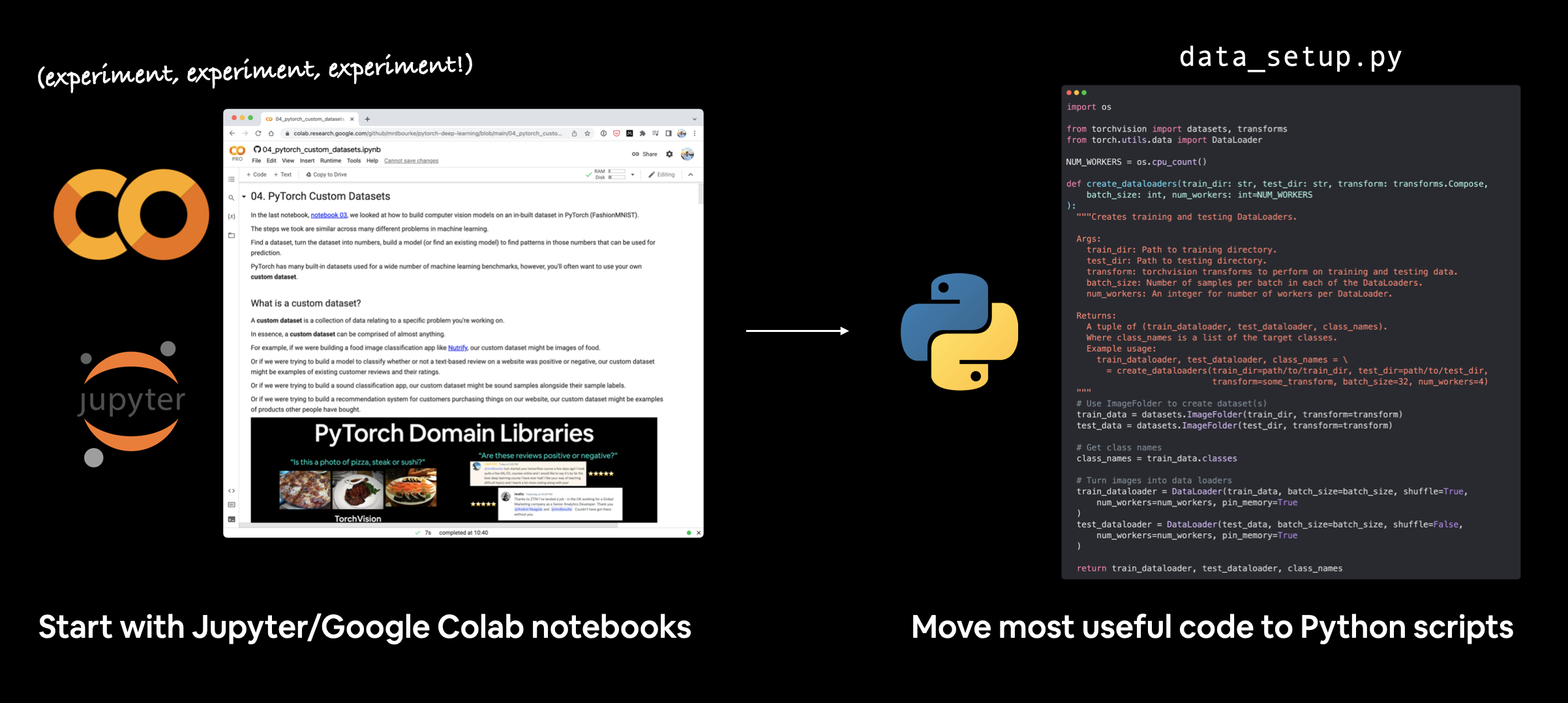 +
*There are many possible workflows for writing machine learning code. Some prefer to start with scripts, others (like me) prefer to start with notebooks and go to scripts later on.*
@@ -71,7 +71,7 @@ For example, you might be instructred to run code like the following in a termin
python train.py --model MODEL_NAME --batch_size BATCH_SIZE --lr LEARNING_RATE --num_epochs NUM_EPOCHS
```
-
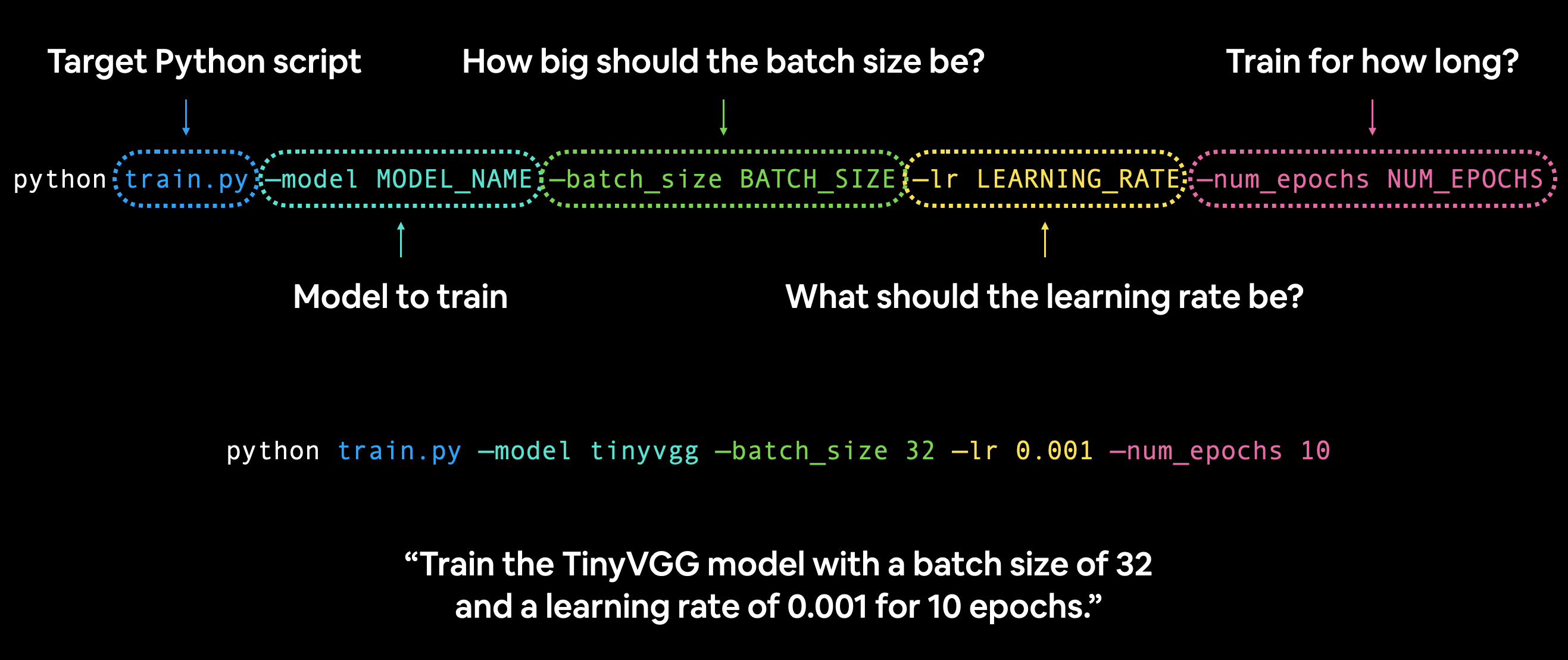 +
*Running a PyTorch `train.py` script on the command line with various hyperparameter settings.*
@@ -114,7 +114,7 @@ Because sometimes the best way to learn something is to see how it *differs* fro
If you run each notebook side-by-side you'll see how they differ and that's where the key learnings are.
-
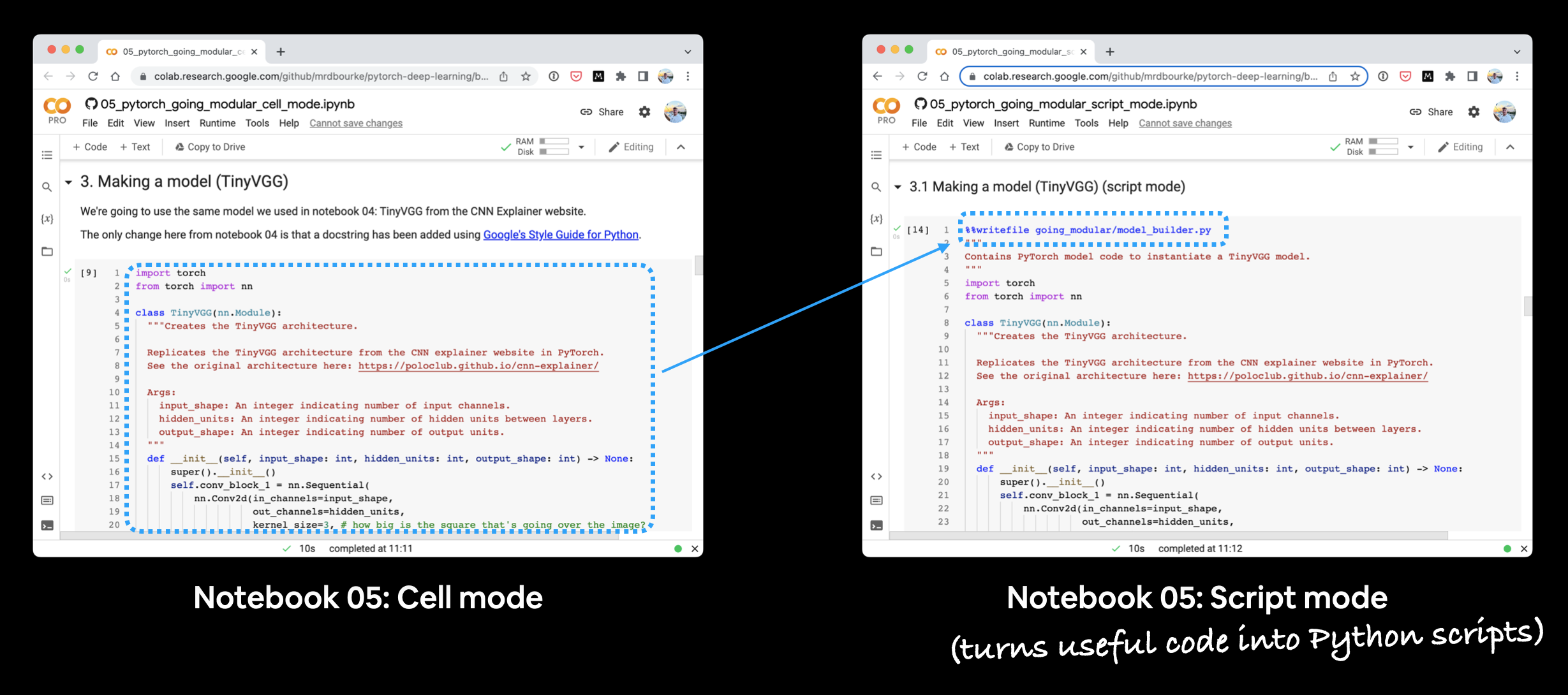 +
*Running the two notebooks for section 05 side-by-side. You'll notice that the **script mode notebook has extra code cells** to turn code from the cell mode notebook into Python scripts.*
diff --git a/going_modular/05_pytorch_going_modular_cell_mode.ipynb b/going_modular/05_pytorch_going_modular_cell_mode.ipynb
index f5ad936..ad03f9e 100644
--- a/going_modular/05_pytorch_going_modular_cell_mode.ipynb
+++ b/going_modular/05_pytorch_going_modular_cell_mode.ipynb
@@ -16,16 +16,64 @@
"id": "1M5tsObEa17-"
},
"source": [
- "# 05. Going Modular (cell mode)\n",
+ "# 05. Going Modular: Part 1 (cell mode)\n",
"\n",
- "* TK - this notebook condenses the code from 04 into a handful of cells.\n",
- "* TK - there will another version of this notebook \"script mode\" that turns these handful of cells into a handful of scripts\n",
+ "This notebook is part 1/2 of section [05. Going Modular](https://www.learnpytorch.io/05_pytorch_going_modular/).\n",
"\n",
- "Turn notebook -> python scripts\n",
+ "For reference, the two parts are: \n",
+ "1. [**05. Going Modular: Part 1 (cell mode)**](https://github.com/mrdbourke/pytorch-deep-learning/blob/main/going_modular/05_pytorch_going_modular_cell_mode.ipynb) - this notebook is run as a traditional Jupyter Notebook/Google Colab notebook and is a condensed version of [notebook 04](https://www.learnpytorch.io/04_pytorch_custom_datasets/).\n",
+ "2. [**05. Going Modular: Part 2 (script mode)**](https://github.com/mrdbourke/pytorch-deep-learning/blob/main/going_modular/05_pytorch_going_modular_script_mode.ipynb) - this notebook is the same as number 1 but with added functionality to turn each of the major sections into Python scripts, such as, `data_setup.py` and `train.py`. \n",
"\n",
- "Code in this notebook based off code in notebook 04 with minimal changes.\n",
+ "Why two parts?\n",
"\n",
- "TK - get GPU (for Google Colab)"
+ "Because sometimes the best way to learn something is to see how it *differs* from something else.\n",
+ "\n",
+ "If you run each notebook side-by-side you'll see how they differ and that's where the key learnings are."
+ ]
+ },
+ {
+ "cell_type": "markdown",
+ "metadata": {
+ "id": "1M5tsObEa17-"
+ },
+ "source": [
+ "## What is cell mode?\n",
+ "\n",
+ "A cell mode notebook is a regular notebook run exactly how we've been running them through the course.\n",
+ "\n",
+ "Some cells contain text and others contain code."
+ ]
+ },
+ {
+ "cell_type": "markdown",
+ "metadata": {
+ "id": "1M5tsObEa17-"
+ },
+ "source": [
+ "## What's the difference between this notebook (Part 1) and the script mode notebook (Part 2)?\n",
+ "\n",
+ "This notebook, 05. PyTorch Going Modular: Part 1 (cell mode), runs a cleaned up version of the most useful code from section [04. PyTorch Custom Datasets](https://www.learnpytorch.io/04_pytorch_custom_datasets/).\n",
+ "\n",
+ "Running this notebook end-to-end will result in recreating the image classification model we built in notebook 04 (TinyVGG) trained on images of pizza, steak and sushi.\n",
+ "\n",
+ "The main difference between this notebook (Part 1) and Part 2 is that each section in Part 2 (script mode) has an extra subsection (e.g. 2.1, 3.1, 4.1) for turning cell code into script code."
+ ]
+ },
+ {
+ "cell_type": "markdown",
+ "metadata": {
+ "id": "1M5tsObEa17-"
+ },
+ "source": [
+ "## Where can you get help?\n",
+ "\n",
+ "You can find the book version of this section [05. PyTorch Going Modular on learnpytorch.io](https://www.learnpytorch.io/05_pytorch_going_modular/).\n",
+ "\n",
+ "The rest of the materials for this course [are available on GitHub](https://github.com/mrdbourke/pytorch-deep-learning).\n",
+ "\n",
+ "If you run into trouble, you can ask a question on the course [GitHub Discussions page](https://github.com/mrdbourke/pytorch-deep-learning/discussions).\n",
+ "\n",
+ "And of course, there's the [PyTorch documentation](https://pytorch.org/docs/stable/index.html) and [PyTorch developer forums](https://discuss.pytorch.org/), a very helpful place for all things PyTorch. "
]
},
{
@@ -34,9 +82,13 @@
"id": "I_0BPjLcawE-"
},
"source": [
- "## TK - 0. Running a notebook in cell mode\n",
+ "## 0. Running a notebook in cell mode\n",
"\n",
- "TK - What is cell mode? ... running a notebook normally."
+ "As discussed, we're going to be running this notebook normally.\n",
+ "\n",
+ "One cell at a time.\n",
+ "\n",
+ "The code is from notebook 04, however, it has been condensed down to its core functionality."
]
},
{
@@ -45,7 +97,7 @@
"id": "1XgXFr97bCsI"
},
"source": [
- "## TK - 1. Get data\n",
+ "## 1. Get data\n",
"\n",
"We're going to start by downloading the same data we used in [notebook 04](https://www.learnpytorch.io/04_pytorch_custom_datasets/#1-get-data), the `pizza_steak_sushi` dataset with images of pizza, steak and sushi."
]
@@ -140,7 +192,7 @@
"id": "eYL6NynybU9Z"
},
"source": [
- "## TK - 2. Create Datasets and DataLoaders\n",
+ "## 2. Create Datasets and DataLoaders\n",
"\n",
"Now we'll turn the image dataset into PyTorch `Dataset`'s and `DataLoader`'s. "
]
@@ -298,8 +350,8 @@
{
"data": {
"text/plain": [
- "(,\n",
- " )"
+ "(,\n",
+ " )"
]
},
"execution_count": 7,
@@ -547,7 +599,7 @@
"id": "8OB4xIsXcHrp"
},
"source": [
- "## TK - 4. Creating `train_step()` and `test_step()` functions and `train()` to combine them \n",
+ "## 4. Creating `train_step()` and `test_step()` functions and `train()` to combine them \n",
"\n",
"Rather than writing them again, we can reuse the `train_step()` and `test_step()` functions from [notebook 04](https://www.learnpytorch.io/04_pytorch_custom_datasets/#75-create-train-test-loop-functions).\n",
"\n",
@@ -884,7 +936,7 @@
{
"data": {
"application/vnd.jupyter.widget-view+json": {
- "model_id": "54c42865cdff4fee8e2bb710e947e313",
+ "model_id": "803ff7aab243491e8451a74a5722b18d",
"version_major": 2,
"version_minor": 0
},
@@ -899,12 +951,12 @@
"name": "stdout",
"output_type": "stream",
"text": [
- "Epoch: 1 | train_loss: 1.0956 | train_acc: 0.3867 | test_loss: 1.0629 | test_acc: 0.4133\n",
- "Epoch: 2 | train_loss: 1.0114 | train_acc: 0.5067 | test_loss: 1.0214 | test_acc: 0.4533\n",
- "Epoch: 3 | train_loss: 0.9571 | train_acc: 0.5689 | test_loss: 0.9993 | test_acc: 0.4533\n",
- "Epoch: 4 | train_loss: 0.8963 | train_acc: 0.5733 | test_loss: 1.0074 | test_acc: 0.4667\n",
- "Epoch: 5 | train_loss: 0.8658 | train_acc: 0.6356 | test_loss: 1.0082 | test_acc: 0.5200\n",
- "[INFO] Total training time: 5.185 seconds\n",
+ "Epoch: 1 | train_loss: 1.0955 | train_acc: 0.3867 | test_loss: 1.0627 | test_acc: 0.4133\n",
+ "Epoch: 2 | train_loss: 1.0102 | train_acc: 0.5200 | test_loss: 1.0222 | test_acc: 0.4400\n",
+ "Epoch: 3 | train_loss: 0.9552 | train_acc: 0.5822 | test_loss: 1.0067 | test_acc: 0.4667\n",
+ "Epoch: 4 | train_loss: 0.8913 | train_acc: 0.5867 | test_loss: 1.0090 | test_acc: 0.4400\n",
+ "Epoch: 5 | train_loss: 0.8608 | train_acc: 0.6311 | test_loss: 1.0214 | test_acc: 0.4533\n",
+ "[INFO] Total training time: 5.859 seconds\n",
"[INFO] Saving model to: models/05_going_modular_cell_mode_tinyvgg_model.pth\n"
]
}
@@ -948,6 +1000,15 @@
" target_dir=\"models\",\n",
" model_name=\"05_going_modular_cell_mode_tinyvgg_model.pth\")"
]
+ },
+ {
+ "cell_type": "markdown",
+ "metadata": {},
+ "source": [
+ "We finish with a saved image classification model at `models/05_going_modular_cell_mode_tinyvgg_model.pth`.\n",
+ "\n",
+ "The code continues in [05. Going Modular: Part 2 (script mode)](https://github.com/mrdbourke/pytorch-deep-learning/blob/main/going_modular/05_pytorch_going_modular_script_mode.ipynb)."
+ ]
}
],
"metadata": {
diff --git a/going_modular/05_pytorch_going_modular_script_mode.ipynb b/going_modular/05_pytorch_going_modular_script_mode.ipynb
index 5b63260..c904053 100644
--- a/going_modular/05_pytorch_going_modular_script_mode.ipynb
+++ b/going_modular/05_pytorch_going_modular_script_mode.ipynb
@@ -17,11 +17,11 @@
"tags": []
},
"source": [
- "# 05. Going Modular (script mode)\n",
+ "# 05. Going Modular: Part 2 (script mode)\n",
"\n",
- "This notebook is part 2/2 of section 05. Going Modular.\n",
+ "This notebook is part 2/2 of section [05. Going Modular](https://www.learnpytorch.io/05_pytorch_going_modular/).\n",
"\n",
- "More specifically, the two parts are: \n",
+ "For reference, the two parts are: \n",
"1. [**05. Going Modular: Part 1 (cell mode)**](https://github.com/mrdbourke/pytorch-deep-learning/blob/main/going_modular/05_pytorch_going_modular_cell_mode.ipynb) - this notebook is run as a traditional Jupyter Notebook/Google Colab notebook and is a condensed version of [notebook 04](https://www.learnpytorch.io/04_pytorch_custom_datasets/).\n",
"2. [**05. Going Modular: Part 2 (script mode)**](https://github.com/mrdbourke/pytorch-deep-learning/blob/main/going_modular/05_pytorch_going_modular_script_mode.ipynb) - this notebook is the same as number 1 but with added functionality to turn each of the major sections into Python scripts, such as, `data_setup.py` and `train.py`. \n",
"\n",
@@ -29,9 +29,17 @@
"\n",
"Because sometimes the best way to learn something is to see how it *differs* from something else.\n",
"\n",
- "If you run each notebook side-by-side you'll see how they differ and that's where the key learnings are.\n",
- "\n",
- "## TK - What is script mode?\n",
+ "If you run each notebook side-by-side you'll see how they differ and that's where the key learnings are."
+ ]
+ },
+ {
+ "cell_type": "markdown",
+ "metadata": {
+ "id": "1M5tsObEa17-",
+ "tags": []
+ },
+ "source": [
+ "## What is script mode?\n",
"\n",
"**Script mode** uses [Jupyter Notebook cell magic](https://ipython.readthedocs.io/en/stable/interactive/magics.html) (special commands) to turn specific cells into Python scripts.\n",
"\n",
@@ -56,9 +64,17 @@
"\n",
"> **Question:** Do I have to create Python files like this? Can't I just start directly with a Python file and skip using a Google Colab notebook?\n",
">\n",
- "> **Answer:** Yes. This is only *one* way of creating Python scripts. If you know the kind of script you'd like to write, you could start writing it straight away. But since using Jupyter/Google Colab notebooks is a popular way of starting off data science and machine learning projects, knowing about the `%%writefile` magic command is a handy tip. \n",
- "\n",
- "## TK - What has script mode got to do with PyTorch?\n",
+ "> **Answer:** Yes. This is only *one* way of creating Python scripts. If you know the kind of script you'd like to write, you could start writing it straight away. But since using Jupyter/Google Colab notebooks is a popular way of starting off data science and machine learning projects, knowing about the `%%writefile` magic command is a handy tip. "
+ ]
+ },
+ {
+ "cell_type": "markdown",
+ "metadata": {
+ "id": "1M5tsObEa17-",
+ "tags": []
+ },
+ "source": [
+ "## What has script mode got to do with PyTorch?\n",
"\n",
"If you've written some useful code in a Jupyter Notebook or Google Colab notebook, chances are you'll want to use that code again.\n",
"\n",
@@ -66,9 +82,17 @@
"\n",
"This practice is not PyTorch specific.\n",
"\n",
- "But it's how you'll see many different online PyTorch repositories structured.\n",
- "\n",
- "### TK - PyTorch in the wild\n",
+ "But it's how you'll see many different online PyTorch repositories structured."
+ ]
+ },
+ {
+ "cell_type": "markdown",
+ "metadata": {
+ "id": "1M5tsObEa17-",
+ "tags": []
+ },
+ "source": [
+ "### PyTorch in the wild\n",
"\n",
"For example, if you find a PyTorch project on GitHub, it may be structured in the following way:\n",
"\n",
@@ -99,17 +123,33 @@
"\n",
"And the `models` and `data` directories could hold PyTorch models and data files respectively (though due to the size of models and data files, it's unlikely you'll find the *full* versions of these on GitHub, these directories are present above mainly for demonstration purposes).\n",
"\n",
- "> **Note:** There are many different ways to structure a Python project and subsequently a PyTorch project. This isn't a guide on *how* to structure your projects, only an example of how you *might* come across PyTorch projects in the wild. For more on structuring Python projects, see Real Python's [*Python Application Layouts: A Reference*](https://realpython.com/python-application-layouts/) guide.\n",
- "\n",
- "## TK - What's the difference between this notebook (Part 2) and the cell mode notebook (Part 1)?\n",
+ "> **Note:** There are many different ways to structure a Python project and subsequently a PyTorch project. This isn't a guide on *how* to structure your projects, only an example of how you *might* come across PyTorch projects in the wild. For more on structuring Python projects, see Real Python's [*Python Application Layouts: A Reference*](https://realpython.com/python-application-layouts/) guide."
+ ]
+ },
+ {
+ "cell_type": "markdown",
+ "metadata": {
+ "id": "1M5tsObEa17-",
+ "tags": []
+ },
+ "source": [
+ "## What's the difference between this notebook (Part 2) and the cell mode notebook (Part 1)?\n",
"\n",
"This notebook, 05 Going Modular: Part 2 (script mode), creates Python scripts out of the cells created in part 1.\n",
"\n",
"Running this notebook end-to-end will result in having a directory structure very similar to the `pytorch_project` structure above.\n",
"\n",
- "You'll notice each section in Part 2 (script mode) has an extra subsection (e.g. 2.1, 3.1, 4.1) for turning cell code into script code.\n",
- "\n",
- "## TK - What we're going to cover\n",
+ "You'll notice each section in Part 2 (script mode) has an extra subsection (e.g. 2.1, 3.1, 4.1) for turning cell code into script code."
+ ]
+ },
+ {
+ "cell_type": "markdown",
+ "metadata": {
+ "id": "1M5tsObEa17-",
+ "tags": []
+ },
+ "source": [
+ "## What we're going to cover\n",
"\n",
"By the end of this notebook you should finish with a directory structure of: \n",
"\n",
@@ -150,11 +190,21 @@
"python going_modular/train.py\n",
"```\n",
"\n",
- "In essence, we will have turned our helpful notebook code into **reusable modular code**.\n",
+ "In essence, we will have turned our helpful notebook code into **reusable modular code**."
+ ]
+ },
+ {
+ "cell_type": "markdown",
+ "metadata": {
+ "id": "1M5tsObEa17-",
+ "tags": []
+ },
+ "source": [
+ "## Where can you get help?\n",
"\n",
- "## TK - Where can you get help?\n",
+ "You can find the book version of this section [05. PyTorch Going Modular on learnpytorch.io](https://www.learnpytorch.io/05_pytorch_going_modular/).\n",
"\n",
- "All of the materials for this course [are available on GitHub](https://github.com/mrdbourke/pytorch-deep-learning).\n",
+ "The rest of the materials for this course [are available on GitHub](https://github.com/mrdbourke/pytorch-deep-learning).\n",
"\n",
"If you run into trouble, you can ask a question on the course [GitHub Discussions page](https://github.com/mrdbourke/pytorch-deep-learning/discussions).\n",
"\n",
@@ -167,9 +217,11 @@
"id": "OW_3D_fOap2I"
},
"source": [
- "## TK - 0. Creating a folder for storing Python scripts\n",
+ "## 0. Creating a folder for storing Python scripts\n",
"\n",
- "TK - What is script mode? ... writing code cells but storing them in Python Scripts (you could run these cells as normal but we'll be creating scripts with them)."
+ "Since we're going to be creating Python scripts out of our most useful code cells, let's create a folder for storing those scripts.\n",
+ "\n",
+ "We'll call the folder `going_modular` and create it using Python's [`os.makedirs()`](https://docs.python.org/3/library/os.html) method."
]
},
{
@@ -190,7 +242,7 @@
"id": "1XgXFr97bCsI"
},
"source": [
- "## TK - 1. Get data\n",
+ "## 1. Get data\n",
"\n",
"We're going to start by downloading the same data we used in [notebook 04](https://www.learnpytorch.io/04_pytorch_custom_datasets/#1-get-data), the `pizza_steak_sushi` dataset with images of pizza, steak and sushi."
]
@@ -210,7 +262,7 @@
"name": "stdout",
"output_type": "stream",
"text": [
- "Did not find data/pizza_steak_sushi directory, creating one...\n",
+ "data/pizza_steak_sushi directory exists.\n",
"Downloading pizza, steak, sushi data...\n",
"Unzipping pizza, steak, sushi data...\n"
]
@@ -285,7 +337,9 @@
"id": "eYL6NynybU9Z"
},
"source": [
- "## TK - 2. Create Datasets and DataLoaders"
+ "## 2. Create Datasets and DataLoaders\n",
+ "\n",
+ "Let's turn our data into PyTorch `Dataset`'s and `DataLoader`'s and find out a few useful attributes from them such as `classes` and their lengths. "
]
},
{
@@ -441,8 +495,8 @@
{
"data": {
"text/plain": [
- "(,\n",
- " )"
+ "(,\n",
+ " )"
]
},
"execution_count": 8,
@@ -501,10 +555,11 @@
"id": "RjINjcyGdwL9"
},
"source": [
- "### TK - 2.1 Create Datasets and DataLoaders (script mode)\n",
+ "### 2.1 Create Datasets and DataLoaders (script mode)\n",
"\n",
- "* TK - Turn the above into a function.\n",
- "* TK - write docstring"
+ "Rather than rewriting all of the code above everytime we wanted to load data, we can turn it into a script called `data_setup.py`.\n",
+ "\n",
+ "Let's capture all of the above functionality into a function called `create_dataloaders()`."
]
},
{
@@ -522,7 +577,7 @@
"name": "stdout",
"output_type": "stream",
"text": [
- "Writing going_modular/data_setup.py\n"
+ "Overwriting going_modular/data_setup.py\n"
]
}
],
@@ -601,9 +656,11 @@
"id": "gAQLp1dCbrY0"
},
"source": [
- "## 3. TK - Making a model (TinyVGG) \n",
+ "## 3. Making a model (TinyVGG) \n",
"\n",
- "TK - clean up this model code"
+ "We're going to use the same model we used in notebook 04: TinyVGG from the CNN Explainer website.\n",
+ "\n",
+ "The only change here from notebook 04 is that a docstring has been added using [Google's Style Guide for Python](https://google.github.io/styleguide/pyguide.html#384-classes). "
]
},
{
@@ -618,19 +675,19 @@
"from torch import nn \n",
"\n",
"class TinyVGG(nn.Module):\n",
- " \"\"\"Creates the TinyVGG architecture.\n",
+ " \"\"\"Creates the TinyVGG architecture.\n",
"\n",
- " Replicates the TinyVGG architecture from the CNN explainer website in PyTorch.\n",
- " See the original architecture here: https://poloclub.github.io/cnn-explainer/\n",
- " \n",
- " Args:\n",
+ " Replicates the TinyVGG architecture from the CNN explainer website in PyTorch.\n",
+ " See the original architecture here: https://poloclub.github.io/cnn-explainer/\n",
+ "\n",
+ " Args:\n",
" input_shape: An integer indicating number of input channels.\n",
" hidden_units: An integer indicating number of hidden units between layers.\n",
" output_shape: An integer indicating number of output units.\n",
- " \"\"\"\n",
- " def __init__(self, input_shape: int, hidden_units: int, output_shape: int) -> None:\n",
- " super().__init__()\n",
- " self.conv_block_1 = nn.Sequential(\n",
+ " \"\"\"\n",
+ " def __init__(self, input_shape: int, hidden_units: int, output_shape: int) -> None:\n",
+ " super().__init__()\n",
+ " self.conv_block_1 = nn.Sequential(\n",
" nn.Conv2d(in_channels=input_shape, \n",
" out_channels=hidden_units, \n",
" kernel_size=3, \n",
@@ -645,28 +702,28 @@
" nn.ReLU(),\n",
" nn.MaxPool2d(kernel_size=2,\n",
" stride=2)\n",
- " )\n",
- " self.conv_block_2 = nn.Sequential(\n",
+ " )\n",
+ " self.conv_block_2 = nn.Sequential(\n",
" nn.Conv2d(hidden_units, hidden_units, kernel_size=3, padding=0),\n",
" nn.ReLU(),\n",
" nn.Conv2d(hidden_units, hidden_units, kernel_size=3, padding=0),\n",
" nn.ReLU(),\n",
" nn.MaxPool2d(2)\n",
- " )\n",
- " self.classifier = nn.Sequential(\n",
+ " )\n",
+ " self.classifier = nn.Sequential(\n",
" nn.Flatten(),\n",
" # Where did this in_features shape come from? \n",
" # It's because each layer of our network compresses and changes the shape of our inputs data.\n",
" nn.Linear(in_features=hidden_units*13*13,\n",
" out_features=output_shape)\n",
- " )\n",
+ " )\n",
" \n",
- " def forward(self, x: torch.Tensor):\n",
- " x = self.conv_block_1(x)\n",
- " x = self.conv_block_2(x)\n",
- " x = self.classifier(x)\n",
- " return x\n",
- " # return self.classifier(self.block_2(self.block_1(x))) # <- leverage the benefits of operator fusion"
+ " def forward(self, x: torch.Tensor):\n",
+ " x = self.conv_block_1(x)\n",
+ " x = self.conv_block_2(x)\n",
+ " x = self.classifier(x)\n",
+ " return x\n",
+ " # return self.classifier(self.block_2(self.block_1(x))) # <- leverage the benefits of operator fusion"
]
},
{
@@ -739,7 +796,7 @@
"id": "C1CwvPiMcEfZ"
},
"source": [
- "Do a dummy forward pass."
+ "Let's check out our model by doing a dummy forward pass."
]
},
{
@@ -799,9 +856,13 @@
"id": "wSaDm_W7bc3y"
},
"source": [
- "### TK - 3.1 Making a model (TinyVGG) (script mode)\n",
+ "### 3.1 Making a model (TinyVGG) (script mode)\n",
"\n",
- "TK - turn the above modelling code into a script... (and then import it and do a dummy forward pass) "
+ "Over the past few notebooks (notebook 03 and notebook 04), we've built the TinyVGG model a few times.\n",
+ "\n",
+ "So it makes sense to put the model into its file so we can reuse it again and again.\n",
+ "\n",
+ "Let's put our `TinyVGG()` model class into a script called `model_builder.py` with the line `%%writefile going_modular/model_builder.py`. "
]
},
{
@@ -819,7 +880,7 @@
"name": "stdout",
"output_type": "stream",
"text": [
- "Writing going_modular/model_builder.py\n"
+ "Overwriting going_modular/model_builder.py\n"
]
}
],
@@ -832,19 +893,19 @@
"from torch import nn \n",
"\n",
"class TinyVGG(nn.Module):\n",
- " \"\"\"Creates the TinyVGG architecture.\n",
+ " \"\"\"Creates the TinyVGG architecture.\n",
"\n",
- " Replicates the TinyVGG architecture from the CNN explainer website in PyTorch.\n",
- " See the original architecture here: https://poloclub.github.io/cnn-explainer/\n",
- " \n",
- " Args:\n",
+ " Replicates the TinyVGG architecture from the CNN explainer website in PyTorch.\n",
+ " See the original architecture here: https://poloclub.github.io/cnn-explainer/\n",
+ "\n",
+ " Args:\n",
" input_shape: An integer indicating number of input channels.\n",
" hidden_units: An integer indicating number of hidden units between layers.\n",
" output_shape: An integer indicating number of output units.\n",
- " \"\"\"\n",
- " def __init__(self, input_shape: int, hidden_units: int, output_shape: int) -> None:\n",
- " super().__init__()\n",
- " self.conv_block_1 = nn.Sequential(\n",
+ " \"\"\"\n",
+ " def __init__(self, input_shape: int, hidden_units: int, output_shape: int) -> None:\n",
+ " super().__init__()\n",
+ " self.conv_block_1 = nn.Sequential(\n",
" nn.Conv2d(in_channels=input_shape, \n",
" out_channels=hidden_units, \n",
" kernel_size=3, \n",
@@ -859,28 +920,28 @@
" nn.ReLU(),\n",
" nn.MaxPool2d(kernel_size=2,\n",
" stride=2)\n",
- " )\n",
- " self.conv_block_2 = nn.Sequential(\n",
+ " )\n",
+ " self.conv_block_2 = nn.Sequential(\n",
" nn.Conv2d(hidden_units, hidden_units, kernel_size=3, padding=0),\n",
" nn.ReLU(),\n",
" nn.Conv2d(hidden_units, hidden_units, kernel_size=3, padding=0),\n",
" nn.ReLU(),\n",
" nn.MaxPool2d(2)\n",
- " )\n",
- " self.classifier = nn.Sequential(\n",
+ " )\n",
+ " self.classifier = nn.Sequential(\n",
" nn.Flatten(),\n",
" # Where did this in_features shape come from? \n",
" # It's because each layer of our network compresses and changes the shape of our inputs data.\n",
" nn.Linear(in_features=hidden_units*13*13,\n",
" out_features=output_shape)\n",
- " )\n",
+ " )\n",
" \n",
- " def forward(self, x: torch.Tensor):\n",
- " x = self.conv_block_1(x)\n",
- " x = self.conv_block_2(x)\n",
- " x = self.classifier(x)\n",
- " return x\n",
- " # return self.classifier(self.block_2(self.block_1(x))) # <- leverage the benefits of operator fusion"
+ " def forward(self, x: torch.Tensor):\n",
+ " x = self.conv_block_1(x)\n",
+ " x = self.conv_block_2(x)\n",
+ " x = self.classifier(x)\n",
+ " return x\n",
+ " # return self.classifier(self.block_2(self.block_1(x))) # <- leverage the benefits of operator fusion"
]
},
{
@@ -1012,7 +1073,7 @@
"id": "8OB4xIsXcHrp"
},
"source": [
- "## TK - 4. Creating `train_step()` and `test_step()` functions and `train()` to combine them \n",
+ "## 4. Creating `train_step()` and `test_step()` functions and `train()` to combine them \n",
"\n",
"Rather than writing them again, we can reuse the `train_step()` and `test_step()` functions from [notebook 04](https://www.learnpytorch.io/04_pytorch_custom_datasets/#75-create-train-test-loop-functions).\n",
"\n",
@@ -1038,60 +1099,60 @@
" loss_fn: torch.nn.Module, \n",
" optimizer: torch.optim.Optimizer,\n",
" device: torch.device) -> Tuple[float, float]:\n",
- " \"\"\"Trains a PyTorch model for a single epoch.\n",
+ " \"\"\"Trains a PyTorch model for a single epoch.\n",
"\n",
- " Turns a target PyTorch model to training mode and then\n",
- " runs through all of the required training steps (forward\n",
- " pass, loss calculation, optimizer step).\n",
+ " Turns a target PyTorch model to training mode and then\n",
+ " runs through all of the required training steps (forward\n",
+ " pass, loss calculation, optimizer step).\n",
"\n",
- " Args:\n",
+ " Args:\n",
" model: A PyTorch model to be trained.\n",
" dataloader: A DataLoader instance for the model to be trained on.\n",
" loss_fn: A PyTorch loss function to minimize.\n",
" optimizer: A PyTorch optimizer to help minimize the loss function.\n",
" device: A target device to compute on (e.g. \"cuda\" or \"cpu\").\n",
"\n",
- " Returns:\n",
+ " Returns:\n",
" A tuple of training loss and training accuracy metrics.\n",
" In the form (train_loss, train_accuracy). For example:\n",
- " \n",
+ "\n",
" (0.1112, 0.8743)\n",
- " \"\"\"\n",
- " # Put model in train mode\n",
- " model.train()\n",
- " \n",
- " # Setup train loss and train accuracy values\n",
- " train_loss, train_acc = 0, 0\n",
- " \n",
- " # Loop through data loader data batches\n",
- " for batch, (X, y) in enumerate(dataloader):\n",
- " # Send data to target device\n",
- " X, y = X.to(device), y.to(device)\n",
+ " \"\"\"\n",
+ " # Put model in train mode\n",
+ " model.train()\n",
"\n",
- " # 1. Forward pass\n",
- " y_pred = model(X)\n",
+ " # Setup train loss and train accuracy values\n",
+ " train_loss, train_acc = 0, 0\n",
"\n",
- " # 2. Calculate and accumulate loss\n",
- " loss = loss_fn(y_pred, y)\n",
- " train_loss += loss.item() \n",
+ " # Loop through data loader data batches\n",
+ " for batch, (X, y) in enumerate(dataloader):\n",
+ " # Send data to target device\n",
+ " X, y = X.to(device), y.to(device)\n",
"\n",
- " # 3. Optimizer zero grad\n",
- " optimizer.zero_grad()\n",
+ " # 1. Forward pass\n",
+ " y_pred = model(X)\n",
"\n",
- " # 4. Loss backward\n",
- " loss.backward()\n",
+ " # 2. Calculate and accumulate loss\n",
+ " loss = loss_fn(y_pred, y)\n",
+ " train_loss += loss.item() \n",
"\n",
- " # 5. Optimizer step\n",
- " optimizer.step()\n",
+ " # 3. Optimizer zero grad\n",
+ " optimizer.zero_grad()\n",
"\n",
- " # Calculate and accumulate accuracy metric across all batches\n",
- " y_pred_class = torch.argmax(torch.softmax(y_pred, dim=1), dim=1)\n",
- " train_acc += (y_pred_class == y).sum().item()/len(y_pred)\n",
+ " # 4. Loss backward\n",
+ " loss.backward()\n",
"\n",
- " # Adjust metrics to get average loss and accuracy per batch \n",
- " train_loss = train_loss / len(dataloader)\n",
- " train_acc = train_acc / len(dataloader)\n",
- " return train_loss, train_acc"
+ " # 5. Optimizer step\n",
+ " optimizer.step()\n",
+ "\n",
+ " # Calculate and accumulate accuracy metric across all batches\n",
+ " y_pred_class = torch.argmax(torch.softmax(y_pred, dim=1), dim=1)\n",
+ " train_acc += (y_pred_class == y).sum().item()/len(y_pred)\n",
+ "\n",
+ " # Adjust metrics to get average loss and accuracy per batch \n",
+ " train_loss = train_loss / len(dataloader)\n",
+ " train_acc = train_acc / len(dataloader)\n",
+ " return train_loss, train_acc"
]
},
{
@@ -1115,51 +1176,51 @@
" dataloader: torch.utils.data.DataLoader, \n",
" loss_fn: torch.nn.Module,\n",
" device: torch.device) -> Tuple[float, float]:\n",
- " \"\"\"Tests a PyTorch model for a single epoch.\n",
+ " \"\"\"Tests a PyTorch model for a single epoch.\n",
"\n",
- " Turns a target PyTorch model to \"eval\" mode and then performs\n",
- " a forward pass on a testing dataset.\n",
+ " Turns a target PyTorch model to \"eval\" mode and then performs\n",
+ " a forward pass on a testing dataset.\n",
"\n",
- " Args:\n",
+ " Args:\n",
" model: A PyTorch model to be tested.\n",
" dataloader: A DataLoader instance for the model to be tested on.\n",
" loss_fn: A PyTorch loss function to calculate loss on the test data.\n",
" device: A target device to compute on (e.g. \"cuda\" or \"cpu\").\n",
"\n",
- " Returns:\n",
+ " Returns:\n",
" A tuple of testing loss and testing accuracy metrics.\n",
" In the form (test_loss, test_accuracy). For example:\n",
- " \n",
- " (0.0223, 0.8985)\n",
- " \"\"\"\n",
- " # Put model in eval mode\n",
- " model.eval() \n",
- " \n",
- " # Setup test loss and test accuracy values\n",
- " test_loss, test_acc = 0, 0\n",
- " \n",
- " # Turn on inference context manager\n",
- " with torch.inference_mode():\n",
- " # Loop through DataLoader batches\n",
- " for batch, (X, y) in enumerate(dataloader):\n",
- " # Send data to target device\n",
- " X, y = X.to(device), y.to(device)\n",
- " \n",
- " # 1. Forward pass\n",
- " test_pred_logits = model(X)\n",
"\n",
- " # 2. Calculate and accumulate loss\n",
- " loss = loss_fn(test_pred_logits, y)\n",
- " test_loss += loss.item()\n",
- " \n",
- " # Calculate and accumulate accuracy\n",
- " test_pred_labels = test_pred_logits.argmax(dim=1)\n",
- " test_acc += ((test_pred_labels == y).sum().item()/len(test_pred_labels))\n",
- " \n",
- " # Adjust metrics to get average loss and accuracy per batch \n",
- " test_loss = test_loss / len(dataloader)\n",
- " test_acc = test_acc / len(dataloader)\n",
- " return test_loss, test_acc"
+ " (0.0223, 0.8985)\n",
+ " \"\"\"\n",
+ " # Put model in eval mode\n",
+ " model.eval() \n",
+ "\n",
+ " # Setup test loss and test accuracy values\n",
+ " test_loss, test_acc = 0, 0\n",
+ "\n",
+ " # Turn on inference context manager\n",
+ " with torch.inference_mode():\n",
+ " # Loop through DataLoader batches\n",
+ " for batch, (X, y) in enumerate(dataloader):\n",
+ " # Send data to target device\n",
+ " X, y = X.to(device), y.to(device)\n",
+ "\n",
+ " # 1. Forward pass\n",
+ " test_pred_logits = model(X)\n",
+ "\n",
+ " # 2. Calculate and accumulate loss\n",
+ " loss = loss_fn(test_pred_logits, y)\n",
+ " test_loss += loss.item()\n",
+ "\n",
+ " # Calculate and accumulate accuracy\n",
+ " test_pred_labels = test_pred_logits.argmax(dim=1)\n",
+ " test_acc += ((test_pred_labels == y).sum().item()/len(test_pred_labels))\n",
+ "\n",
+ " # Adjust metrics to get average loss and accuracy per batch \n",
+ " test_loss = test_loss / len(dataloader)\n",
+ " test_acc = test_acc / len(dataloader)\n",
+ " return test_loss, test_acc"
]
},
{
@@ -1189,15 +1250,15 @@
" loss_fn: torch.nn.Module,\n",
" epochs: int,\n",
" device: torch.device) -> Dict[str, List]:\n",
- " \"\"\"Trains and tests a PyTorch model.\n",
+ " \"\"\"Trains and tests a PyTorch model.\n",
"\n",
- " Passes a target PyTorch models through train_step() and test_step()\n",
- " functions for a number of epochs, training and testing the model\n",
- " in the same epoch loop.\n",
+ " Passes a target PyTorch models through train_step() and test_step()\n",
+ " functions for a number of epochs, training and testing the model\n",
+ " in the same epoch loop.\n",
"\n",
- " Calculates, prints and stores evaluation metrics throughout.\n",
+ " Calculates, prints and stores evaluation metrics throughout.\n",
"\n",
- " Args:\n",
+ " Args:\n",
" model: A PyTorch model to be trained and tested.\n",
" train_dataloader: A DataLoader instance for the model to be trained on.\n",
" test_dataloader: A DataLoader instance for the model to be tested on.\n",
@@ -1206,7 +1267,7 @@
" epochs: An integer indicating how many epochs to train for.\n",
" device: A target device to compute on (e.g. \"cuda\" or \"cpu\").\n",
"\n",
- " Returns:\n",
+ " Returns:\n",
" A dictionary of training and testing loss as well as training and\n",
" testing accuracy metrics. Each metric has a value in a list for \n",
" each epoch.\n",
@@ -1219,43 +1280,43 @@
" train_acc: [0.3945, 0.3945],\n",
" test_loss: [1.2641, 1.5706],\n",
" test_acc: [0.3400, 0.2973]} \n",
- " \"\"\"\n",
- " # Create empty results dictionary\n",
- " results = {\"train_loss\": [],\n",
+ " \"\"\"\n",
+ " # Create empty results dictionary\n",
+ " results = {\"train_loss\": [],\n",
" \"train_acc\": [],\n",
" \"test_loss\": [],\n",
" \"test_acc\": []\n",
- " }\n",
- " \n",
- " # Loop through training and testing steps for a number of epochs\n",
- " for epoch in tqdm(range(epochs)):\n",
- " train_loss, train_acc = train_step(model=model,\n",
+ " }\n",
+ "\n",
+ " # Loop through training and testing steps for a number of epochs\n",
+ " for epoch in tqdm(range(epochs)):\n",
+ " train_loss, train_acc = train_step(model=model,\n",
" dataloader=train_dataloader,\n",
" loss_fn=loss_fn,\n",
" optimizer=optimizer,\n",
" device=device)\n",
- " test_loss, test_acc = test_step(model=model,\n",
+ " test_loss, test_acc = test_step(model=model,\n",
" dataloader=test_dataloader,\n",
" loss_fn=loss_fn,\n",
" device=device)\n",
- " \n",
- " # Print out what's happening\n",
- " print(\n",
+ "\n",
+ " # Print out what's happening\n",
+ " print(\n",
" f\"Epoch: {epoch+1} | \"\n",
" f\"train_loss: {train_loss:.4f} | \"\n",
" f\"train_acc: {train_acc:.4f} | \"\n",
" f\"test_loss: {test_loss:.4f} | \"\n",
" f\"test_acc: {test_acc:.4f}\"\n",
- " )\n",
+ " )\n",
"\n",
- " # Update results dictionary\n",
- " results[\"train_loss\"].append(train_loss)\n",
- " results[\"train_acc\"].append(train_acc)\n",
- " results[\"test_loss\"].append(test_loss)\n",
- " results[\"test_acc\"].append(test_acc)\n",
+ " # Update results dictionary\n",
+ " results[\"train_loss\"].append(train_loss)\n",
+ " results[\"train_acc\"].append(train_acc)\n",
+ " results[\"test_loss\"].append(test_loss)\n",
+ " results[\"test_acc\"].append(test_acc)\n",
"\n",
- " # Return the filled results at the end of the epochs\n",
- " return results"
+ " # Return the filled results at the end of the epochs\n",
+ " return results"
]
},
{
@@ -1264,7 +1325,7 @@
"id": "tw_nYa4kfQeI"
},
"source": [
- "### TK - 4.1 Creating `train_step()` and `test_step()` functions and `train()` to combine them (script mode) \n",
+ "### 4.1 Creating `train_step()` and `test_step()` functions and `train()` to combine them (script mode) \n",
"\n",
"To create a script for `train_step()`, `test_step()` and `train()`, we'll combine their code all into a single cell.\n",
"\n",
@@ -1290,7 +1351,7 @@
"name": "stdout",
"output_type": "stream",
"text": [
- "Writing going_modular/engine.py\n"
+ "Overwriting going_modular/engine.py\n"
]
}
],
@@ -1309,110 +1370,110 @@
" loss_fn: torch.nn.Module, \n",
" optimizer: torch.optim.Optimizer,\n",
" device: torch.device) -> Tuple[float, float]:\n",
- " \"\"\"Trains a PyTorch model for a single epoch.\n",
+ " \"\"\"Trains a PyTorch model for a single epoch.\n",
"\n",
- " Turns a target PyTorch model to training mode and then\n",
- " runs through all of the required training steps (forward\n",
- " pass, loss calculation, optimizer step).\n",
+ " Turns a target PyTorch model to training mode and then\n",
+ " runs through all of the required training steps (forward\n",
+ " pass, loss calculation, optimizer step).\n",
"\n",
- " Args:\n",
+ " Args:\n",
" model: A PyTorch model to be trained.\n",
" dataloader: A DataLoader instance for the model to be trained on.\n",
" loss_fn: A PyTorch loss function to minimize.\n",
" optimizer: A PyTorch optimizer to help minimize the loss function.\n",
" device: A target device to compute on (e.g. \"cuda\" or \"cpu\").\n",
"\n",
- " Returns:\n",
+ " Returns:\n",
" A tuple of training loss and training accuracy metrics.\n",
" In the form (train_loss, train_accuracy). For example:\n",
- " \n",
+ "\n",
" (0.1112, 0.8743)\n",
- " \"\"\"\n",
- " # Put model in train mode\n",
- " model.train()\n",
- " \n",
- " # Setup train loss and train accuracy values\n",
- " train_loss, train_acc = 0, 0\n",
- " \n",
- " # Loop through data loader data batches\n",
- " for batch, (X, y) in enumerate(dataloader):\n",
- " # Send data to target device\n",
- " X, y = X.to(device), y.to(device)\n",
+ " \"\"\"\n",
+ " # Put model in train mode\n",
+ " model.train()\n",
"\n",
- " # 1. Forward pass\n",
- " y_pred = model(X)\n",
+ " # Setup train loss and train accuracy values\n",
+ " train_loss, train_acc = 0, 0\n",
"\n",
- " # 2. Calculate and accumulate loss\n",
- " loss = loss_fn(y_pred, y)\n",
- " train_loss += loss.item() \n",
+ " # Loop through data loader data batches\n",
+ " for batch, (X, y) in enumerate(dataloader):\n",
+ " # Send data to target device\n",
+ " X, y = X.to(device), y.to(device)\n",
"\n",
- " # 3. Optimizer zero grad\n",
- " optimizer.zero_grad()\n",
+ " # 1. Forward pass\n",
+ " y_pred = model(X)\n",
"\n",
- " # 4. Loss backward\n",
- " loss.backward()\n",
+ " # 2. Calculate and accumulate loss\n",
+ " loss = loss_fn(y_pred, y)\n",
+ " train_loss += loss.item() \n",
"\n",
- " # 5. Optimizer step\n",
- " optimizer.step()\n",
+ " # 3. Optimizer zero grad\n",
+ " optimizer.zero_grad()\n",
"\n",
- " # Calculate and accumulate accuracy metric across all batches\n",
- " y_pred_class = torch.argmax(torch.softmax(y_pred, dim=1), dim=1)\n",
- " train_acc += (y_pred_class == y).sum().item()/len(y_pred)\n",
+ " # 4. Loss backward\n",
+ " loss.backward()\n",
"\n",
- " # Adjust metrics to get average loss and accuracy per batch \n",
- " train_loss = train_loss / len(dataloader)\n",
- " train_acc = train_acc / len(dataloader)\n",
- " return train_loss, train_acc\n",
+ " # 5. Optimizer step\n",
+ " optimizer.step()\n",
+ "\n",
+ " # Calculate and accumulate accuracy metric across all batches\n",
+ " y_pred_class = torch.argmax(torch.softmax(y_pred, dim=1), dim=1)\n",
+ " train_acc += (y_pred_class == y).sum().item()/len(y_pred)\n",
+ "\n",
+ " # Adjust metrics to get average loss and accuracy per batch \n",
+ " train_loss = train_loss / len(dataloader)\n",
+ " train_acc = train_acc / len(dataloader)\n",
+ " return train_loss, train_acc\n",
"\n",
"def test_step(model: torch.nn.Module, \n",
" dataloader: torch.utils.data.DataLoader, \n",
" loss_fn: torch.nn.Module,\n",
" device: torch.device) -> Tuple[float, float]:\n",
- " \"\"\"Tests a PyTorch model for a single epoch.\n",
+ " \"\"\"Tests a PyTorch model for a single epoch.\n",
"\n",
- " Turns a target PyTorch model to \"eval\" mode and then performs\n",
- " a forward pass on a testing dataset.\n",
+ " Turns a target PyTorch model to \"eval\" mode and then performs\n",
+ " a forward pass on a testing dataset.\n",
"\n",
- " Args:\n",
+ " Args:\n",
" model: A PyTorch model to be tested.\n",
" dataloader: A DataLoader instance for the model to be tested on.\n",
" loss_fn: A PyTorch loss function to calculate loss on the test data.\n",
" device: A target device to compute on (e.g. \"cuda\" or \"cpu\").\n",
"\n",
- " Returns:\n",
+ " Returns:\n",
" A tuple of testing loss and testing accuracy metrics.\n",
" In the form (test_loss, test_accuracy). For example:\n",
- " \n",
- " (0.0223, 0.8985)\n",
- " \"\"\"\n",
- " # Put model in eval mode\n",
- " model.eval() \n",
- " \n",
- " # Setup test loss and test accuracy values\n",
- " test_loss, test_acc = 0, 0\n",
- " \n",
- " # Turn on inference context manager\n",
- " with torch.inference_mode():\n",
- " # Loop through DataLoader batches\n",
- " for batch, (X, y) in enumerate(dataloader):\n",
- " # Send data to target device\n",
- " X, y = X.to(device), y.to(device)\n",
- " \n",
- " # 1. Forward pass\n",
- " test_pred_logits = model(X)\n",
"\n",
- " # 2. Calculate and accumulate loss\n",
- " loss = loss_fn(test_pred_logits, y)\n",
- " test_loss += loss.item()\n",
- " \n",
- " # Calculate and accumulate accuracy\n",
- " test_pred_labels = test_pred_logits.argmax(dim=1)\n",
- " test_acc += ((test_pred_labels == y).sum().item()/len(test_pred_labels))\n",
- " \n",
- " # Adjust metrics to get average loss and accuracy per batch \n",
- " test_loss = test_loss / len(dataloader)\n",
- " test_acc = test_acc / len(dataloader)\n",
- " return test_loss, test_acc\n",
+ " (0.0223, 0.8985)\n",
+ " \"\"\"\n",
+ " # Put model in eval mode\n",
+ " model.eval() \n",
+ "\n",
+ " # Setup test loss and test accuracy values\n",
+ " test_loss, test_acc = 0, 0\n",
+ "\n",
+ " # Turn on inference context manager\n",
+ " with torch.inference_mode():\n",
+ " # Loop through DataLoader batches\n",
+ " for batch, (X, y) in enumerate(dataloader):\n",
+ " # Send data to target device\n",
+ " X, y = X.to(device), y.to(device)\n",
+ "\n",
+ " # 1. Forward pass\n",
+ " test_pred_logits = model(X)\n",
+ "\n",
+ " # 2. Calculate and accumulate loss\n",
+ " loss = loss_fn(test_pred_logits, y)\n",
+ " test_loss += loss.item()\n",
+ "\n",
+ " # Calculate and accumulate accuracy\n",
+ " test_pred_labels = test_pred_logits.argmax(dim=1)\n",
+ " test_acc += ((test_pred_labels == y).sum().item()/len(test_pred_labels))\n",
+ "\n",
+ " # Adjust metrics to get average loss and accuracy per batch \n",
+ " test_loss = test_loss / len(dataloader)\n",
+ " test_acc = test_acc / len(dataloader)\n",
+ " return test_loss, test_acc\n",
"\n",
"def train(model: torch.nn.Module, \n",
" train_dataloader: torch.utils.data.DataLoader, \n",
@@ -1421,15 +1482,15 @@
" loss_fn: torch.nn.Module,\n",
" epochs: int,\n",
" device: torch.device) -> Dict[str, List]:\n",
- " \"\"\"Trains and tests a PyTorch model.\n",
+ " \"\"\"Trains and tests a PyTorch model.\n",
"\n",
- " Passes a target PyTorch models through train_step() and test_step()\n",
- " functions for a number of epochs, training and testing the model\n",
- " in the same epoch loop.\n",
+ " Passes a target PyTorch models through train_step() and test_step()\n",
+ " functions for a number of epochs, training and testing the model\n",
+ " in the same epoch loop.\n",
"\n",
- " Calculates, prints and stores evaluation metrics throughout.\n",
+ " Calculates, prints and stores evaluation metrics throughout.\n",
"\n",
- " Args:\n",
+ " Args:\n",
" model: A PyTorch model to be trained and tested.\n",
" train_dataloader: A DataLoader instance for the model to be trained on.\n",
" test_dataloader: A DataLoader instance for the model to be tested on.\n",
@@ -1438,56 +1499,56 @@
" epochs: An integer indicating how many epochs to train for.\n",
" device: A target device to compute on (e.g. \"cuda\" or \"cpu\").\n",
"\n",
- " Returns:\n",
+ " Returns:\n",
" A dictionary of training and testing loss as well as training and\n",
" testing accuracy metrics. Each metric has a value in a list for \n",
" each epoch.\n",
" In the form: {train_loss: [...],\n",
- " train_acc: [...],\n",
- " test_loss: [...],\n",
- " test_acc: [...]} \n",
+ " train_acc: [...],\n",
+ " test_loss: [...],\n",
+ " test_acc: [...]} \n",
" For example if training for epochs=2: \n",
- " {train_loss: [2.0616, 1.0537],\n",
- " train_acc: [0.3945, 0.3945],\n",
- " test_loss: [1.2641, 1.5706],\n",
- " test_acc: [0.3400, 0.2973]} \n",
- " \"\"\"\n",
- " # Create empty results dictionary\n",
- " results = {\"train_loss\": [],\n",
- " \"train_acc\": [],\n",
- " \"test_loss\": [],\n",
- " \"test_acc\": []\n",
- " }\n",
- " \n",
- " # Loop through training and testing steps for a number of epochs\n",
- " for epoch in tqdm(range(epochs)):\n",
- " train_loss, train_acc = train_step(model=model,\n",
+ " {train_loss: [2.0616, 1.0537],\n",
+ " train_acc: [0.3945, 0.3945],\n",
+ " test_loss: [1.2641, 1.5706],\n",
+ " test_acc: [0.3400, 0.2973]} \n",
+ " \"\"\"\n",
+ " # Create empty results dictionary\n",
+ " results = {\"train_loss\": [],\n",
+ " \"train_acc\": [],\n",
+ " \"test_loss\": [],\n",
+ " \"test_acc\": []\n",
+ " }\n",
+ "\n",
+ " # Loop through training and testing steps for a number of epochs\n",
+ " for epoch in tqdm(range(epochs)):\n",
+ " train_loss, train_acc = train_step(model=model,\n",
" dataloader=train_dataloader,\n",
" loss_fn=loss_fn,\n",
" optimizer=optimizer,\n",
" device=device)\n",
- " test_loss, test_acc = test_step(model=model,\n",
+ " test_loss, test_acc = test_step(model=model,\n",
" dataloader=test_dataloader,\n",
" loss_fn=loss_fn,\n",
" device=device)\n",
- " \n",
- " # Print out what's happening\n",
- " print(\n",
+ "\n",
+ " # Print out what's happening\n",
+ " print(\n",
" f\"Epoch: {epoch+1} | \"\n",
" f\"train_loss: {train_loss:.4f} | \"\n",
" f\"train_acc: {train_acc:.4f} | \"\n",
" f\"test_loss: {test_loss:.4f} | \"\n",
" f\"test_acc: {test_acc:.4f}\"\n",
- " )\n",
+ " )\n",
"\n",
- " # Update results dictionary\n",
- " results[\"train_loss\"].append(train_loss)\n",
- " results[\"train_acc\"].append(train_acc)\n",
- " results[\"test_loss\"].append(test_loss)\n",
- " results[\"test_acc\"].append(test_acc)\n",
+ " # Update results dictionary\n",
+ " results[\"train_loss\"].append(train_loss)\n",
+ " results[\"train_acc\"].append(train_acc)\n",
+ " results[\"test_loss\"].append(test_loss)\n",
+ " results[\"test_acc\"].append(test_acc)\n",
"\n",
- " # Return the filled results at the end of the epochs\n",
- " return results"
+ " # Return the filled results at the end of the epochs\n",
+ " return results"
]
},
{
@@ -1496,7 +1557,7 @@
"id": "A2nXumITc9DL"
},
"source": [
- "## TK - 5. Creating a function to save the model\n",
+ "## 5. Creating a function to save the model\n",
"\n",
"Let's setup a function to save our model to a directory."
]
@@ -1514,31 +1575,31 @@
"def save_model(model: torch.nn.Module,\n",
" target_dir: str,\n",
" model_name: str):\n",
- " \"\"\"Saves a PyTorch model to a target directory.\n",
+ " \"\"\"Saves a PyTorch model to a target directory.\n",
"\n",
- " Args:\n",
+ " Args:\n",
" model: A target PyTorch model to save.\n",
" target_dir: A directory for saving the model to.\n",
" model_name: A filename for the saved model. Should include\n",
" either \".pth\" or \".pt\" as the file extension.\n",
- " \n",
- " Example usage:\n",
+ "\n",
+ " Example usage:\n",
" save_model(model=model_0,\n",
" target_dir=\"models\",\n",
" model_name=\"05_going_modular_tingvgg_model.pth\")\n",
- " \"\"\"\n",
- " # Create target directory\n",
- " target_dir_path = Path(target_dir)\n",
- " target_dir_path.mkdir(parents=True,\n",
+ " \"\"\"\n",
+ " # Create target directory\n",
+ " target_dir_path = Path(target_dir)\n",
+ " target_dir_path.mkdir(parents=True,\n",
" exist_ok=True)\n",
- " \n",
- " # Create model save path\n",
- " assert model_name.endswith(\".pth\") or model_name.endswith(\".pt\"), \"model_name should end with '.pt' or '.pth'\"\n",
- " model_save_path = target_dir_path / model_name\n",
"\n",
- " # Save the model state_dict()\n",
- " print(f\"[INFO] Saving model to: {model_save_path}\")\n",
- " torch.save(obj=model.state_dict(),\n",
+ " # Create model save path\n",
+ " assert model_name.endswith(\".pth\") or model_name.endswith(\".pt\"), \"model_name should end with '.pt' or '.pth'\"\n",
+ " model_save_path = target_dir_path / model_name\n",
+ "\n",
+ " # Save the model state_dict()\n",
+ " print(f\"[INFO] Saving model to: {model_save_path}\")\n",
+ " torch.save(obj=model.state_dict(),\n",
" f=model_save_path)"
]
},
@@ -1548,7 +1609,7 @@
"id": "F7SnPGOfc_Wc"
},
"source": [
- "### TK - 5.1 Creating a function to save the model (script mode)\n",
+ "### 5.1 Creating a function to save the model (script mode)\n",
"\n",
"How about we add our `save_model()` function to a script called `utils.py` which is short for \"utilities\".\n",
"\n",
@@ -1570,7 +1631,7 @@
"name": "stdout",
"output_type": "stream",
"text": [
- "Writing going_modular/utils.py\n"
+ "Overwriting going_modular/utils.py\n"
]
}
],
@@ -1585,31 +1646,31 @@
"def save_model(model: torch.nn.Module,\n",
" target_dir: str,\n",
" model_name: str):\n",
- " \"\"\"Saves a PyTorch model to a target directory.\n",
+ " \"\"\"Saves a PyTorch model to a target directory.\n",
"\n",
- " Args:\n",
+ " Args:\n",
" model: A target PyTorch model to save.\n",
" target_dir: A directory for saving the model to.\n",
" model_name: A filename for the saved model. Should include\n",
" either \".pth\" or \".pt\" as the file extension.\n",
- " \n",
- " Example usage:\n",
+ "\n",
+ " Example usage:\n",
" save_model(model=model_0,\n",
" target_dir=\"models\",\n",
" model_name=\"05_going_modular_tingvgg_model.pth\")\n",
- " \"\"\"\n",
- " # Create target directory\n",
- " target_dir_path = Path(target_dir)\n",
- " target_dir_path.mkdir(parents=True,\n",
+ " \"\"\"\n",
+ " # Create target directory\n",
+ " target_dir_path = Path(target_dir)\n",
+ " target_dir_path.mkdir(parents=True,\n",
" exist_ok=True)\n",
- " \n",
- " # Create model save path\n",
- " assert model_name.endswith(\".pth\") or model_name.endswith(\".pt\"), \"model_name should end with '.pt' or '.pth'\"\n",
- " model_save_path = target_dir_path / model_name\n",
"\n",
- " # Save the model state_dict()\n",
- " print(f\"[INFO] Saving model to: {model_save_path}\")\n",
- " torch.save(obj=model.state_dict(),\n",
+ " # Create model save path\n",
+ " assert model_name.endswith(\".pth\") or model_name.endswith(\".pt\"), \"model_name should end with '.pt' or '.pth'\"\n",
+ " model_save_path = target_dir_path / model_name\n",
+ "\n",
+ " # Save the model state_dict()\n",
+ " print(f\"[INFO] Saving model to: {model_save_path}\")\n",
+ " torch.save(obj=model.state_dict(),\n",
" f=model_save_path)"
]
},
@@ -1652,7 +1713,7 @@
{
"data": {
"application/vnd.jupyter.widget-view+json": {
- "model_id": "c9be7bc9d56b4880b4329f814f6690ed",
+ "model_id": "205f478a42ca42f2ab32113d597dc388",
"version_major": 2,
"version_minor": 0
},
@@ -1667,12 +1728,12 @@
"name": "stdout",
"output_type": "stream",
"text": [
- "Epoch: 1 | train_loss: 1.0956 | train_acc: 0.3867 | test_loss: 1.0629 | test_acc: 0.4133\n",
- "Epoch: 2 | train_loss: 1.0114 | train_acc: 0.5067 | test_loss: 1.0199 | test_acc: 0.4400\n",
- "Epoch: 3 | train_loss: 0.9563 | train_acc: 0.5644 | test_loss: 0.9977 | test_acc: 0.4400\n",
- "Epoch: 4 | train_loss: 0.8970 | train_acc: 0.5689 | test_loss: 1.0071 | test_acc: 0.4667\n",
- "Epoch: 5 | train_loss: 0.8618 | train_acc: 0.6178 | test_loss: 1.0213 | test_acc: 0.4800\n",
- "[INFO] Total training time: 5.192 seconds\n",
+ "Epoch: 1 | train_loss: 1.0956 | train_acc: 0.3867 | test_loss: 1.0630 | test_acc: 0.4133\n",
+ "Epoch: 2 | train_loss: 1.0141 | train_acc: 0.5111 | test_loss: 1.0210 | test_acc: 0.4533\n",
+ "Epoch: 3 | train_loss: 0.9591 | train_acc: 0.5644 | test_loss: 0.9961 | test_acc: 0.4400\n",
+ "Epoch: 4 | train_loss: 0.8994 | train_acc: 0.5778 | test_loss: 0.9986 | test_acc: 0.4533\n",
+ "Epoch: 5 | train_loss: 0.8652 | train_acc: 0.6267 | test_loss: 1.0010 | test_acc: 0.5467\n",
+ "[INFO] Total training time: 5.461 seconds\n",
"[INFO] Saving model to: models/05_going_modular_cell_mode_tinyvgg_model.pth\n"
]
}
@@ -1764,7 +1825,7 @@
"name": "stdout",
"output_type": "stream",
"text": [
- "Writing going_modular/train.py\n"
+ "Overwriting going_modular/train.py\n"
]
}
],
@@ -1892,12 +1953,12 @@
"name": "stdout",
"output_type": "stream",
"text": [
- " 0%| | 0/5 [00:00