diff --git a/02_pytorch_classification.ipynb b/02_pytorch_classification.ipynb
index 65b4a07..3c77ef3 100644
--- a/02_pytorch_classification.ipynb
+++ b/02_pytorch_classification.ipynb
@@ -3,8 +3,8 @@
{
"cell_type": "markdown",
"metadata": {
- "colab_type": "text",
- "id": "view-in-github"
+ "id": "view-in-github",
+ "colab_type": "text"
},
"source": [
" "
@@ -18,9 +18,7 @@
"source": [
"# 02. Neural Network Classification with PyTorch\n",
"\n",
- "## What is classification?\n",
- "\n",
- "TK - image for classification\n",
+ "## What is a classification problem?\n",
"\n",
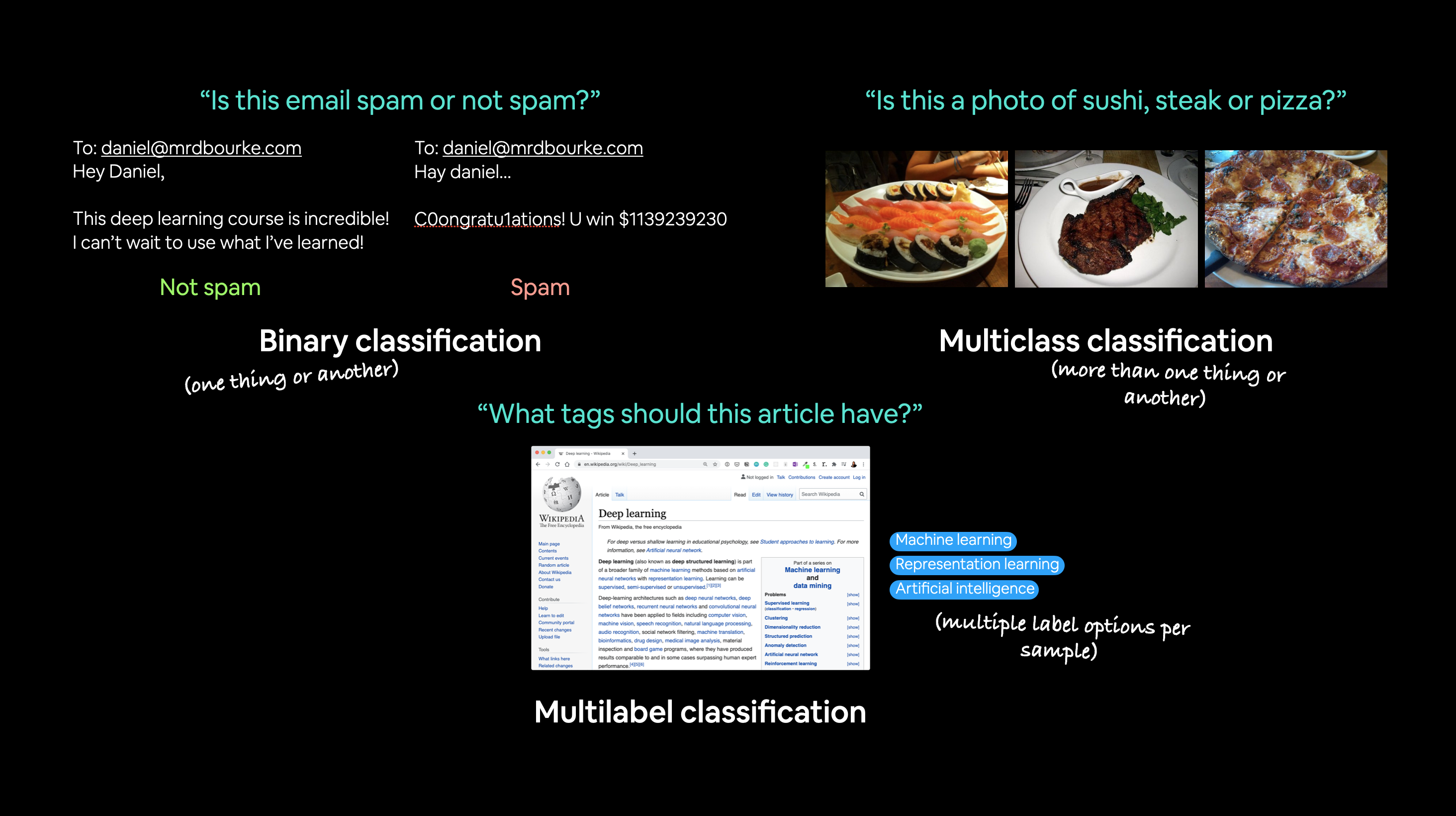
"A [classification problem](https://en.wikipedia.org/wiki/Statistical_classification) involves predicting whether something is one thing or another.\n",
"\n",
@@ -32,6 +30,8 @@
"| **Multi-class classification** | Target can be one of more than two options | Decide whether a photo of is of food, a person or a dog. |\n",
"| **Multi-label classification** | Target can be assigned more than one option | Predict what categories should be assigned to a Wikipedia article (e.g. mathematics, science & philosohpy). |\n",
"\n",
+ "\n",
+ "\n",
"Classification, along with regression (predicting a number, covered in [notebook 01](https://www.learnpytorch.io/01_pytorch_workflow/)) is one of the most common types of machine learning problems.\n",
"\n",
"In this notebook, we're going to work through a couple of different classification problems with PyTorch. \n",
@@ -47,7 +47,7 @@
"id": "9wTlTaDKH7Oj"
},
"source": [
- "## TK - What we're going to cover\n",
+ "## What we're going to cover\n",
"\n",
"In this notebook we're going to reiterate over the PyTorch workflow we coverd in notebook 01.\n",
"\n",
@@ -92,7 +92,7 @@
"id": "MSLHJiQxH4jU"
},
"source": [
- "## TK - 0. Architecture of a classification neural network\n",
+ "## 0. Architecture of a classification neural network\n",
"\n",
"Before we get into writing code, let's look at the general architecture of a classification neural network.\n",
"\n",
@@ -111,9 +111,7 @@
"\n",
"But it's more than enough to get started.\n",
"\n",
- "We're going to gets hands-on with this setup throughout this notebook.\n",
- "\n",
- "TK - image: architecture of a classification network"
+ "We're going to gets hands-on with this setup throughout this notebook."
]
},
{
@@ -122,7 +120,7 @@
"id": "VwvxFEjKHC71"
},
"source": [
- "## TK - 1. Make classification data and get it ready\n",
+ "## 1. Make classification data and get it ready\n",
"\n",
"Let's begin by making some data.\n",
"\n",
@@ -165,12 +163,12 @@
"base_uri": "https://localhost:8080/"
},
"id": "oAb8vcIhWEO8",
- "outputId": "2b70adac-1429-4f2b-b1e6-a5974e276375"
+ "outputId": "9801a9d4-204b-4096-e040-4ed5ddafde03"
},
"outputs": [
{
- "name": "stdout",
"output_type": "stream",
+ "name": "stdout",
"text": [
"First 5 X features:\n",
"[[ 0.75424625 0.23148074]\n",
@@ -209,14 +207,15 @@
"height": 363
},
"id": "XAAqx_8sHC73",
- "outputId": "37a286bc-d5ef-4d0f-a829-1921e6257fb6"
+ "outputId": "db1f7230-8f27-4f42-83a5-d287086c19e5"
},
"outputs": [
{
+ "output_type": "execute_result",
"data": {
"text/html": [
"\n",
- "